The Almost Eight Hundred and Fifty Trillion Dollar Market Most Traders Never Understand

The Almost Eight Hundred and Fifty Trillion Dollar Market Most Traders Never Understand
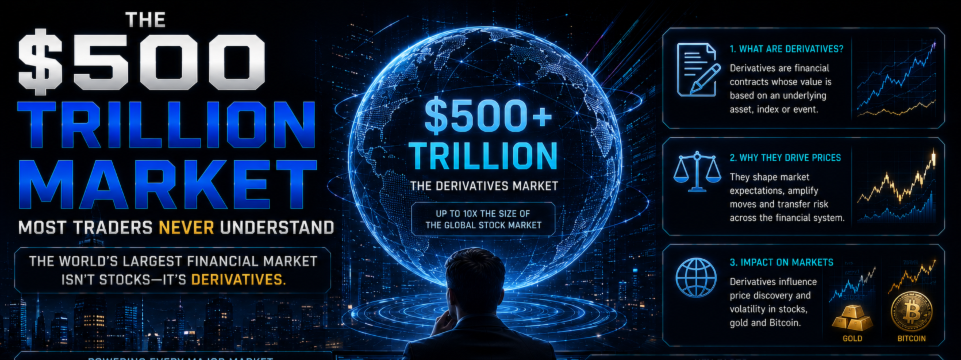
The world's largest financial market is not stocks, it is derivatives, and the honest headline number attached to that market is genuinely staggering, recent official data places the notional value of outstanding over the counter derivatives alone at roughly eight hundred and forty six trillion dollars. Before that number does any more work in this article, it deserves the single most important clarification most coverage of derivatives skips entirely, that headline figure dramatically overstates the actual money genuinely at risk, and understanding precisely why is the real education this article delivers.
Part One: What Derivatives Actually Are, and Why the Headline Number Misleads
A derivative is a financial contract whose value is derived from an underlying asset, a stock, a currency, a commodity, an interest rate, a bond, rather than representing direct ownership of that asset itself. The major categories, forwards, futures, swaps and options, each define a specific structure for how two parties agree to exchange value based on the future behavior of that underlying reference, without either party necessarily ever owning the asset directly at all.
Here is the crucial distinction almost never explained clearly. The notional value of a derivative is simply the reference size written into the contract, not money that actually changes hands or is genuinely at risk. Consider a foreign exchange forward where two parties agree to exchange fifty units of currency at a fixed rate in three months. The notional amount is fifty, because every calculation in the contract references that figure, but no money changes hands when the contract begins, and at maturity only the difference between the agreed rate and the actual market rate determines any real gain or loss. If that difference amounts to a fraction of a unit, the genuine economic exposure was never remotely close to the full notional figure quoted.
Applied across the entire global market, this distinction becomes enormous. Against that roughly eight hundred and forty six trillion dollar notional figure, the gross market value of the same outstanding derivatives, the sum of actual replacement cost across all contracts at current prices, a vastly more economically meaningful number, sits at approximately twenty one point eight trillion dollars, a small fraction of the notional headline. Go a step further and account for legally enforceable netting agreements between counterparties, and gross credit exposure, the figure that most accurately reflects genuine counterparty risk, falls to roughly three trillion dollars, less than half a percent of the original notional number that generates the dramatic headlines. The market is genuinely enormous by any of these measures. It is not, however, nearly as enormous as the biggest number alone implies.
The Four Main Categories, Explained Concretely
Forwards are private, customized agreements between two parties to exchange an asset at a fixed price on a future date, the FX forward example above being a classic case. They carry counterparty risk since there is no central exchange guaranteeing the trade.
Futures are standardized versions of the same basic idea, traded on a regulated exchange with a central clearinghouse guaranteeing performance, dramatically reducing counterparty risk compared to a private forward while sacrificing some customization.
Swaps involve two parties exchanging cash flows over time based on a reference rate or price, an interest rate swap exchanging a fixed rate for a floating one being the most common example, and interest rate derivatives specifically make up the largest single share of the entire global notional figure discussed above.
Options grant the right, but not the obligation, to buy or sell an asset at a fixed price before a set date, in exchange for an upfront premium. Consider a call option granting the right to buy a stock at a fixed strike price. If the market price never rises above that strike, the option simply expires worthless, and the buyer's entire loss is limited to the premium paid, a small fraction of the notional value the contract references. If the price rises well above the strike, the option's value can increase dramatically relative to that same small premium, illustrating directly how the actual money at risk on either side of an option contract can differ enormously from its notional size, precisely the distinction this article opened with.
Part Two: Why Derivatives Genuinely Influence Price Formation in Underlying Markets
Despite the notional versus real exposure distinction, derivatives markets do exert a real, well documented influence on how the underlying assets they reference are priced, through several distinct mechanisms.
- Dealer hedging flows. Financial institutions that sell options and other derivatives typically hedge their own resulting risk by buying or selling the underlying asset directly, adjusting that hedge continuously as the price moves. When a large volume of options is concentrated around specific price levels, the resulting dealer hedging activity can itself meaningfully amplify or dampen price movement in the underlying market, a genuine, mechanical transmission channel from derivatives activity into spot price action.
- Price discovery. Futures and options prices aggregate market wide expectations about future volatility and future price levels, information that feeds directly back into how the underlying spot market is priced, since informed participants often express new views first in derivatives markets before that information is fully reflected in spot prices.
- Embedded leverage. Derivatives allow market participants to gain exposure far larger than the capital they would need to own the underlying asset directly, meaning derivative driven flows can represent an outsized influence on price relative to the actual capital genuinely deployed, amplifying the practical market impact of a given amount of underlying conviction.
Worth understanding concretely rather than abstractly, when a dealer sells a large volume of call options at a specific strike price, standard hedging practice requires buying a proportional amount of the underlying asset, an amount that itself changes as price moves closer to or further from that strike. As price approaches a heavily concentrated strike level, dealer hedging activity can accelerate in a way that either reinforces the move toward that level or dampens further movement past it, depending on the specific positioning involved. This is precisely why certain price levels tied to large outstanding options positions can behave with unusual gravity or resistance around specific expiration dates, a genuine market structure effect rather than coincidence.
Part Three: Concrete Effects on Stocks, Gold and Bitcoin
Equities experience well documented derivative driven dynamics, particularly around major options expiration dates, when concentrated dealer hedging activity tied to large outstanding options positions can meaningfully influence price behavior in the underlying stock or index independent of any new fundamental information arriving that day.
Gold offers a genuinely current, concrete illustration of derivatives activity scaling directly with real price dynamics. Recent official data shows the gross market value of gold derivatives roughly doubling alongside a substantial rally in the underlying gold price, a direct, measurable demonstration of how derivatives activity in a specific commodity expands and contracts in step with genuine price movement in that same market, rather than existing in some separate, disconnected sphere.
Bitcoin presents a genuinely distinct dynamic worth understanding on its own terms. Crypto derivatives, particularly perpetual swaps, a structure with no direct traditional finance equivalent, frequently represent a very large share, often the majority, of total crypto trading volume relative to spot activity alone. This matters enormously for volatility, because leveraged derivative positions can trigger cascading, forced liquidations when price moves against a large concentration of leveraged bets, a mechanical, self reinforcing process capable of amplifying a price move well beyond what genuine spot buying or selling pressure alone would have produced, entirely independent of any new fundamental information arriving at that moment.
Understanding the specific mechanism behind perpetual swaps clarifies why this matters so much. A perpetual swap has no expiration date, unlike a traditional futures contract, and instead uses a periodic funding rate payment exchanged directly between long and short position holders to keep its price anchored close to the actual spot price. When perpetual prices trade meaningfully above spot, long position holders pay short holders, discouraging excess leveraged long exposure, and the reverse applies when perpetual prices trade below spot. When funding rates become extreme in either direction, it signals genuinely lopsided leveraged positioning, a market condition that historically precedes exactly the kind of sharp, mechanically driven liquidation cascade covered above, since a large concentration of leveraged positions on one side of the market represents a large pool of forced sellers or buyers waiting to be triggered by a comparatively modest initial price move.
Part Four: What This Means for How You Should Read Any Sudden Price Move
A sudden, sharp price move can reflect genuinely new information entering the market, or it can reflect purely mechanical derivative driven flows, dealer hedging activity or a leveraged liquidation cascade, occurring without any new fundamental information at all. Learning to hold both possibilities in mind, rather than assuming every sharp move must reflect some genuine new development, is a real, practical form of market literacy this entire discussion points toward. This is particularly relevant in Bitcoin specifically, where the scale of leveraged derivative activity relative to spot volume makes purely mechanical, derivative driven volatility spikes a genuine, recurring feature of the market's actual behavior rather than a rare exception.
Part Five: Why Volatility Adaptive Risk Architecture Matters Regardless of the Cause
Whether a volatility spike originates from genuine new information, a scheduled economic release, or a purely mechanical derivative driven liquidation cascade, the appropriate risk response is structurally the same, exposure that scales honestly with real, current conditions rather than assuming a fixed, unchanging environment. The ATR based dynamic stop and position sizing calculation inside ICONIC BTC AI+ responds to real time volatility regardless of its underlying cause, providing a defensible response to exactly the kind of derivative amplified volatility spikes covered above without requiring the system to first correctly diagnose the specific mechanical cause behind any given move. ICONIC GOLD AI+ applies the same volatility adaptive philosophy to a market where, as the current gold derivatives data above demonstrates directly, derivatives activity and genuine price dynamics move closely together.
How to Actually Use Derivatives Data as a Trader
Beyond simply understanding the mechanics, several genuinely practical habits follow directly from everything covered above. Watching options positioning concentrated around round, heavily traded strike prices ahead of a major expiration can offer real insight into where dealer hedging flows may create unusual price behavior in the days leading up to that date. In crypto specifically, monitoring perpetual funding rates provides a genuinely useful, freely available signal of how lopsided leveraged positioning has become, extreme funding in either direction is worth treating as a warning about elevated liquidation cascade risk in that direction, not a signal to blindly fade or follow. And whenever a sudden, sharp move occurs without any obvious accompanying news, it is worth genuinely asking whether a mechanical derivative driven cause, rather than a fundamental one, offers the more likely explanation, a habit of mind most trading education never explicitly teaches despite how frequently it applies in practice.
Frequently Asked Questions
How large is the derivatives market really? The notional value of outstanding over the counter derivatives alone recently stood at roughly eight hundred and forty six trillion dollars, but the gross market value, a far more economically meaningful measure of actual exposure, was approximately twenty one point eight trillion dollars, and gross credit exposure after netting was closer to three trillion dollars.
Why is notional value a misleading measure of real risk? Notional value is simply the reference size written into a contract, not money that changes hands or is genuinely at risk. Actual economic exposure is determined by the difference between contracted terms and actual market prices, which is typically a small fraction of the full notional figure.
Do derivatives genuinely affect the price of the underlying asset? Yes, through dealer hedging flows that require buying or selling the underlying asset as prices move, through price discovery where derivatives markets often reflect new information first, and through embedded leverage that amplifies the practical market impact of a given amount of capital.
Why is Bitcoin particularly exposed to derivative driven volatility? Crypto derivatives, especially perpetual swaps, frequently represent a majority of total trading volume relative to spot activity, and leveraged positions can trigger cascading forced liquidations that amplify price moves independent of any genuine new fundamental information.
Understanding the Real Number Beneath the Headline
The derivatives market is genuinely the largest financial market in the world by any reasonable measure, but the number that generates headlines is not the number that reflects genuine risk. Understanding the difference between notional scale and real economic exposure, and recognizing when a sudden price move reflects mechanical derivative driven flows rather than genuine new information, is real, practical market literacy that most trading education never properly explains.
Explore systems built to respond honestly to volatility regardless of its underlying source, including ICONIC BTC AI+ and ICONIC GOLD AI+, at iconicfx.tech.
Risk Disclaimer. Trading foreign exchange, cryptocurrencies, commodities and other leveraged financial instruments carries a high level of risk and may not be suitable for all investors. The high degree of leverage can work against you as well as for you. Past performance is not indicative of future results. Automated trading systems, indicators and Expert Advisors do not guarantee profits and can produce losses. ICONIC.FX provides software tools only and does not provide investment advice, portfolio management or financial recommendations. You are solely responsible for your own trading decisions. Seek advice from an independent licensed financial advisor if you have any doubts.