The Algorithmic Transformation of Financial Markets: How Modern Traders Generate Real Alpha Through Statistical Confluen

The Algorithmic Transformation of Financial Markets: How Modern Traders Generate Real Alpha Through Statistical Confluence and Adaptive Logic
The Fundamental Crisis of Classic Retail Trading
Online trading in global financial markets has undergone a dramatic evolution. The days when private traders could achieve long term profits using simple static chart patterns or indicator crossings are officially over. The modern market is dominated by high frequency algorithms, institutional systems, and quantitative models that exploit tiny inefficiencies within milliseconds and generate targeted liquidity sweeps. Anyone attempting to trade purely discretionarily today, relying on gut feeling and emotional impulsivity, is working directly against a wall.
The central problem boils down to market noise, incomplete confluence, and toxic money management. A setup that wins in a clean trend fails miserably when the market transitions into a volatile sideways range. Many traders view indicators in isolation, buying blindly without considering the overriding trend structure or the volatility environment. Furthermore, an inability to accept losses drives traders toward destructive grid or martingale strategies, where doubling down against a powerful market thrust mathematically leads to swift account liquidation. To survive, a paradigm shift is necessary: a flawless synthesis of advanced algorithmic confluence, strict risk based execution, and adaptive, real time live learning.
The Foundation of Market Structure and the Concept of True Statistical Confluence
Every profitable trading system requires a structural backbone to determine where institutional capital is flowing. Markets move fractally and dynamically, meaning a simple moving average crossover is no longer enough.
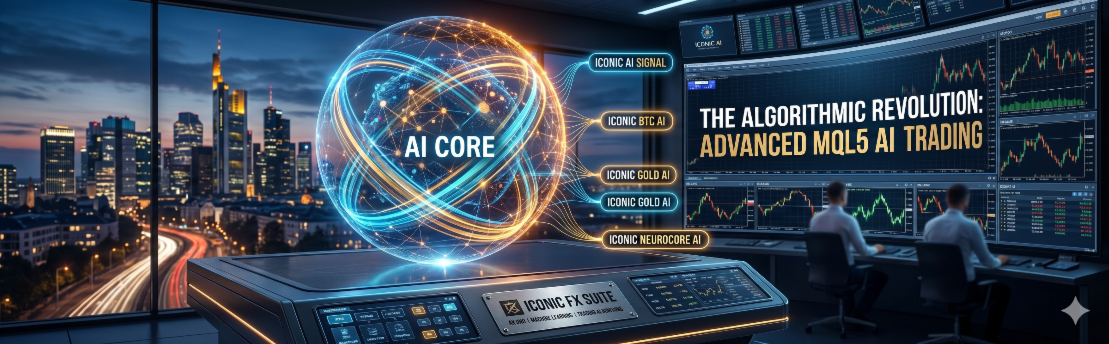
An excellent approach is tracking price extremes in combination with the Average True Range. Instead of smoothing closing prices, a robust algorithm calculates a dynamic channel landscape based on high and low prices. A trend change is strictly rule based: a bullish trend only flips to bearish when the closing price breaks below a dynamically trailed safety line. As long as this line holds, it tracks the market upward to let profits run while filtering out false consolidation signals. This structural backbone is exactly what defines systems like ICONIC AI SIGNAL, keeping you completely aligned with the overriding flow.
A single indicator is worthless. True edge requires a multidimensional confluence model where independent market variables align at the exact same moment. A professional signal generator evaluates the market through a strict point system, verifying trigger momentum (candle body strength), a healthy RSI momentum corridor, ADX trend strength, and real time volatility expansion. Only setups achieving a high score are admitted for execution, wiping out the vast majority of standard market noise.
Algorithmic Entry Pathways and Filtering by Market Regimes
Relying on a single entry logic is a capital mistake. A sophisticated algorithm utilizes multiple, clearly separated entry pathways activated by shifting market structures.
In an established trend, prices move in waves of impulse and correction. The pullback engine monitors the asset relative to a dynamic trigger center, arming the setup as the price dips into a defined ATR zone and executing only when a subsequent candle proves the correction is officially over. For explosive asset classes where corrections rarely occur, a breakout engine scans a fixed look back period for absolute highs or lows, hooking into the immediate momentum thrust as a level breaks. A third pathway captures the fresh structural shift in power, entering at the absolute base of a newly flipped trend line.
The critical multiplier is partitioning the market into distinct volatility regimes. Sideways ranges are heavily compressed, meaning signals are blocked by default since no trend continuation can be expected. When a valid trend is present, the pullback engine runs at full speed, whereas highly explosive, vertical impulses automatically prioritize breakout execution.
The Reality of Professional Risk Management
Long term success requires an absolute rejection of grid or martingale components. Opening additional positions against a losing trade or doubling the position size works temporarily in sideways brackets, but completely collapses when an institutional trend drives the price across thousands of points without a correction. Professional systems manage risk strictly: every trade must have a clearly defined entry, a structural stop loss, and a predefined target.
The market dictates risk through its immediate structure. In a bullish trade, the stop loss belongs structurally below the lowest swing low or the current trend line, cushioned by an ATR buffer to eliminate short term spread noise. To reduce risk to zero as quickly as possible, professional models use a staggered profit taking architecture. Once the price travels a distance equal to the initial risk, the first partial profit is realized and the stop loss is instantly trailed to break even. The remaining position runs as a risk free runner, exploiting large macro movements via an adaptive trailing step.
Artificial Intelligence in Trading and Adaptive Learning Processes
Financial time series exhibit a remarkably poor signal to noise ratio. Opaque, deep neural networks easily fall into the trap of overfitting, memorizing historical data perfectly while failing completely in live out of sample environments.
The technological solution relies on lean, highly efficient, and purely causal online learning methods executed directly on the trading platform. Instead of static rules, an advanced system utilizes a statistical model calculating the exact probability that a confluence setup will hit its first target before the stop loss. The system trains live on every single resolved outcome. To prevent overfitting, an L2 regularization process is built into the update loop, mathematically penalizing bloated weights and ensuring the brain retains only robust, sustainable market patterns.
Before a signal is plotted or executed, it faces a strict quality control soft gate. If the model calculates a win probability below the system threshold after its initial warmup phase, the signal is blocked. Signals passing the gate are classified into clear quality tiers, granting the operator precise statistical filtering capabilities.
Specialization on Asset Classes and Multi Symbol Portfolio Coordination
The true masterclass of algorithmic trading reveals itself when specialized systems for individual asset classes are harmonized by an overriding control instance . Bitcoin and gold are the two most important alternative stores of value in the modern financial world, yet they exhibit completely different statistical behaviors .
Bitcoin is characterized by its asymmetric volatility, where phases of extreme compression are often replaced by explosive breakouts that run relentlessly over thousands of points . An entry architecture specialized for this, such as the one we have anchored in ICONIC BTC AI, utilizes highly precise, structured breakout levels at absolute highs and lows as well as institutional zones . The system works with an intelligent logic where open orders are automatically deleted and adjusted to new structural realities down to the second if market variables no longer meet the highest criteria .
Gold, on the other hand, is the liquid center of global commodity trading. It reacts extremely sensitively to macroeconomic data but, unlike Bitcoin, is prone to massive false breakouts . Institutions often use chart structures specifically to fish for liquidity before the price reverses in the opposite direction . A system like ICONIC GOLD AI therefore requires a significantly more complex feature network in its AI brain to capture the interactions between trend strength and specific trading hours . In addition, an integrated protection function prevents the placement of orders when a breakout is immediately and heavily rejected, preventing the trader from being pulled into expensive losing trades .
When both asset classes are traded simultaneously on a single trading account, a new risk arises from correlation and system stress . Combining both systems into a single infrastructure is what we call ICONIC NEUROCORE AI . Here, a central coordinator acts as an overarching nervous system that monitors the total risk of the trading account through a three tiered safety architecture .
At the first loss thresholds, the coordinator switches the systems into a defensive mode where position sizes are reduced and targets are tightened to primarily stabilize the account . If stress continues to rise, a trading freeze triggers for new setups, while reaching a hard daily loss limit initiates a complete emergency exit that liquidates all open risks, keeping the account absolutely protected .
The Unfair Advantage of Professional Filter Frameworks
A system can have excellent entry patterns, but if it attempts to execute them in the midst of highly manipulative news events, it becomes a plaything for institutional algorithms . Professional systems therefore feature a direct, automated interface to the economic calendar . The system downloads all highly relevant economic data for the affected markets in the background . Before and after each of these events, a block window is generated within which the opening of new trades or the maintenance of schwebende pending orders is prohibited, protecting capital from extreme execution delays and uncontrollable spreads .
Similarly, volatility is directly coupled with the working hours of major global banks . A well thought out trading algorithm therefore focuses trading exactly on the highly liquid phases of the relevant global exchanges and defensively excludes the critical weekend to completely eliminate the risk of unpredictable opening gaps .
Conclusion and the Technological Leap Forward
The transition from tedious, emotional trading to permanently profitable operations in financial markets is inherently a technological leap. Anyone who continues to rely on flawed human chart analysis will fail in the modern algorithmic trading environment. However, the advantage that professional systems possess can be harnessed. Success in trading is the product of multidimensional confluence filtering, the uncompromising rejection of destructive methods like grids, and the deployment of adaptive structures .
If you are ready to elevate your trading activities to the level of true algorithmic systems, the ICONIC.FX Suite offers tailored solutions . For the manual and semi automatic trader, ICONIC AI SIGNAL delivers a precise confluence engine with visual levels plotted directly on your chart . If you are looking for fully automated trading in specialized markets, ICONIC BTC AI and ICONIC GOLD AI provide customized algorithms geared toward the respective unique traits of these assets . The absolute spearhead is the ICONIC NEUROCORE AI architecture, which functions as a multi symbol control center to guide and protect your trading account via harmonized risk management and an intelligent daily profit target .
Explore these pioneering technologies on our official developer platform and transform your trading from an emotional gamble into a data driven execution engine.