
What Is the Current Market Price (CMP) Zone and Why Do Professional Traders Use It?

A practical guide to understanding the Current Market Price zone strategy—how it forms, what makes a valid breakout, and why the retest entry is one of the cleanest setups in Forex and Gold trading.
What Is the Current Market Price (CMP) Zone and Why Do Professional Traders Use It?
If you spend any time in professional Forex and Gold trading communities, you will eventually hear the term CMP zone. It gets mentioned alongside concepts like supply and demand, order blocks, and key levels — but unlike some of those more complex frameworks, the CMP zone is refreshingly straightforward once you understand the core idea behind it.
This article explains what the CMP zone is, how it forms, what a valid breakout looks like, and why the retest entry is considered one of the cleanest and most reliable setups available to retail traders today.
WHAT DOES CMP STAND FOR?
CMP stands for Current Market Price. In the context of zone-based trading, a CMP zone refers to a price range that has been actively consolidated by the market in the most recent session or candle sequence. It is not a historical level drawn from months ago — it is a live, dynamic zone built from what price has been doing right now.
This is what separates CMP zone trading from traditional support and resistance. Rather than looking back at swing highs and lows from weeks or months in the past, CMP zone traders focus on the most recent price behaviour and ask a simple question:
Where has price been spending its time most recently, and what happens when it breaks out of that area?
HOW DOES A CMP ZONE FORM?
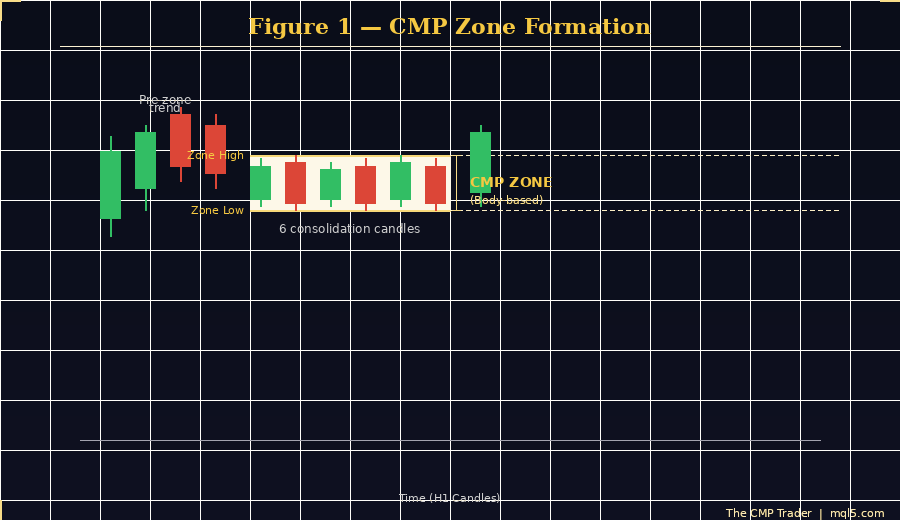
A CMP zone is defined by a series of recent closed candles that have consolidated within a relatively tight price range. The upper boundary of the zone is set by the highest point of that candle sequence, and the lower boundary is set by the lowest point.
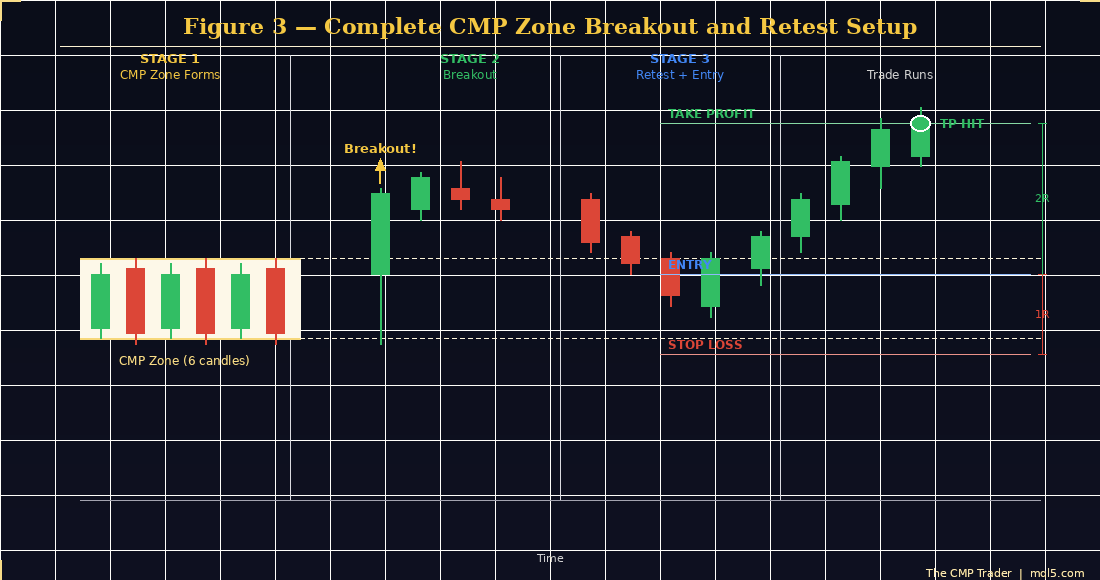
Depending on your preferred approach, you can define the zone boundaries using:
Candle bodies only — using the open and close prices of each candle. This produces a tighter, more conservative zone that reflects where price actually committed, rather than where it momentarily spiked.
Candle wicks — using the full high and low range of each candle. This produces a wider zone that accounts for all price activity including temporary extremes.
Neither approach is wrong. Body-based zones tend to produce cleaner breakouts with less noise. Wick-based zones tend to offer earlier entry signals but with slightly more false breaks. Most experienced CMP traders start with body-based zones and adjust from there. A typical CMP zone setup on the H1 timeframe might use between 3 and 12 consecutive candles to define the zone. More candles generally means a wider zone but also a more significant breakout when it eventually occurs.
WHAT MAKES A VALID BREAKOUT?
Not every candle that closes beyond the zone boundary counts as a valid breakout. This is where CMP trading requires discipline and clear rules — without them, you end up chasing every minor push beyond the zone and taking low-quality entries.
A high-quality CMP breakout typically has the following characteristics:
The closing price is clearly beyond the zone boundary — not just the wick, but the actual close. A candle that wicks through the zone and closes back inside has not broken out. It has tested the boundary and been rejected.
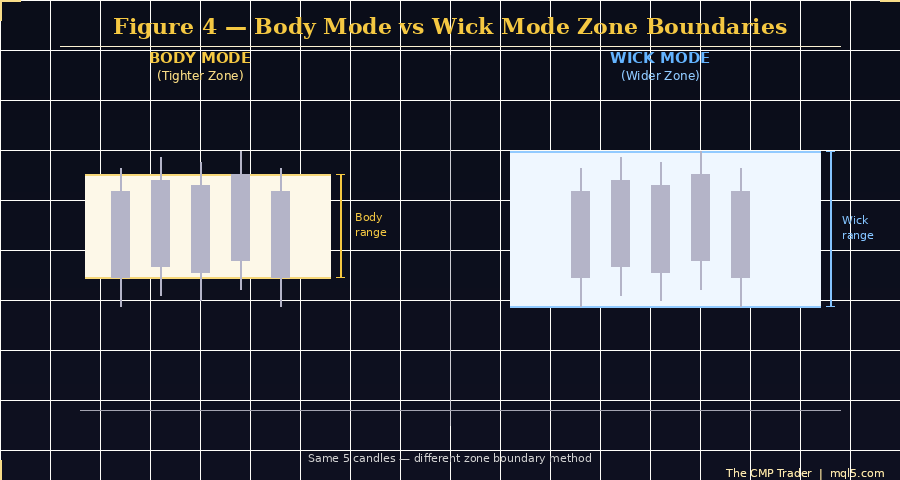
There is a meaningful distance between the zone boundary and the candle close. A close that is only one or two pips beyond the zone is not a convincing breakout. Most experienced traders require at least a defined pip distance before considering the breakout confirmed.
The breakout candle shows momentum. A strong, decisive candle with a clear directional body tells a different story to a small, indecisive candle that barely crosses the line. Looking at the body-to-range ratio of the breakout candle is a useful way to filter out weak breaks.
The close is positioned well within the breakout direction. For a bullish breakout, a candle that closes in the upper portion of its range is more convincing than one that closes in the middle. For a bearish breakout, the opposite applies.
When you apply these filters consistently, the number of signals reduces — but the quality of each signal increases significantly.
WHY THE RETEST IS THE REAL ENTRY
Here is where CMP zone trading becomes truly powerful and where most new traders initially struggle to be patient.
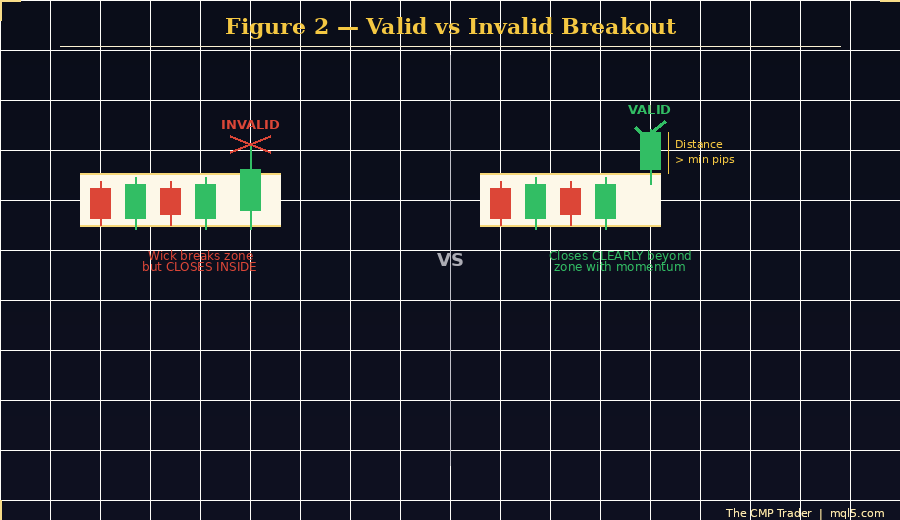
After a confirmed breakout, the natural instinct is to chase the move immediately. Price has broken out — it must keep going, right? Sometimes it does. But the traders who consistently extract value from CMP zone setups know that the real entry comes later, when price returns to retest the zone it just broke out of.
This retest is not a sign of weakness. It is the market doing exactly what it is supposed to do — returning to the breakout zone to confirm the level has changed character. What was previously resistance becomes support after a bullish breakout. What was previously support becomes resistance after a bearish breakout.
When price retests that zone and holds, you have one of the cleanest confluence setups available in Forex and Gold trading:
- A clearly defined zone with measurable boundaries
- A confirmed directional breakout from that zone
- A return to the zone that offers a precise, low-risk entry point
- A clear stop loss level just beyond the zone boundary
- A natural take profit target based on the next significant level or a defined risk-to-reward ratio
This is why professional traders talk about the CMP retest entry as their preferred method. The risk is defined. The entry is precise. The logic is clear. There is no guessing and no ambiguity.
THE PATIENCE PROBLEM — AND HOW AUTOMATION HELPS
The single biggest challenge with CMP zone trading is not identifying the zone or even knowing what to look for in a breakout. The hardest part is waiting.
Zones can form, sit intact for hours, break out while you are asleep or away from your screen, and retest within a single candle — all before you even open your charts in the morning. If you are manually monitoring three, five, or ten currency pairs plus Gold across multiple timeframes, missing setups is not a question of skill. It is simply a question of time and attention.
This is why many experienced CMP traders eventually move toward automating their strategy rather than abandoning it. The logic itself is sound. The execution is just physically demanding when done manually around a full day of other commitments.
Automation does not change the strategy. It simply removes the requirement for you to be watching the screen at the exact moment the setup occurs.
APPLYING CMP ZONE TRADING TO GOLD (XAUUSD)
Gold is one of the most popular instruments for CMP zone trading for several reasons. It trends strongly once it breaks out of consolidation. It retests key levels with notable consistency. And its volatility, while higher than most Forex pairs, tends to produce well-defined CMP zones on the H1 and H4 timeframes that respect technical boundaries clearly.
The main adjustment required for Gold compared to standard Forex pairs is the zone size parameters. A CMP zone on EURUSD might span 20 to 50 pips in a typical H1 setup. On XAUUSD, the equivalent zone might be 100 to 500 pips given the difference in price scale and volatility. Adjusting your zone size filters accordingly is essential for clean Gold CMP setups.
ATR-based stop loss and take profit calculations are also particularly valuable on Gold, where fixed pip distances can be either too tight during volatile sessions or too wide during quiet periods.
SUMMARY — THE THREE THINGS THAT MAKE CMP ZONE TRADING WORK
If you take one thing from this article, let it be this framework:
1. The zone must be well-defined. Tight, clean consolidation across multiple candles with clear boundaries is the foundation. A messy or overlapping zone produces messy signals.
2. The breakout must be convincing. Distance, momentum, and close position all matter. Weak breaks lead to false signals and losing trades. Be patient and wait for quality.
3. The retest must be respected. Do not chase the initial breakout. Wait for price to return to the zone, confirm the level has changed character, and enter with a clear stop and target. This is where the real edge lives.
CMP zone trading is not a shortcut or a secret. It is a disciplined, structured approach to reading what the market is doing right now — and responding to it with precision rather than emotion.
If you are interested in automating your CMP zone strategy, The CMP Trader Expert Advisor is available in the MQL5 Market