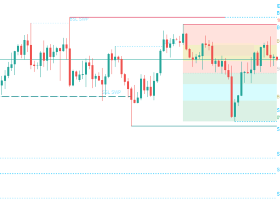
Lyra TF-Space Engine – Understanding Market Structure and Expansion Phase

Introduction
Most trading tools try to answer a simple question:
“Should I buy or sell?”
And most of them respond with signals, arrows, or probabilities.
But in real trading, many losses do not come from choosing the wrong direction.
Instead, they come from entering the market at the wrong condition.
The Lyra TF-Space Engine was built to address that exact problem.
It does not aim to predict the market.
It helps traders understand whether the market is ready to move.
Core Idea: Market = Structure + Space
This indicator is based on a simple but powerful concept:
Market movement depends on structure AND available space.
Most traders only look at structure:
-
Trend direction
-
Support and resistance
-
Moving averages
But structure alone is not enough.
A market can be perfectly aligned and still fail to move.
Why?
Because it has no space.
What This Indicator Does
Lyra TF-Space Engine analyzes multiple timeframes:
-
M1, M5, M15, M30, H1
For each timeframe, it calculates:
-
Median price (robust center)
-
Deviation using MAD (E = 1.4826 × MAD)
-
Candle body distribution (Quartile-based)
From this, it builds two key layers:
1. Structure Layer (P-STACK)
Defines whether the market is:
-
FULL UP
-
FULL DOWN
-
MIX
This shows directional alignment across timeframes.
2. Space Layer (TF-Space Engine)
Each timeframe is evaluated as:
-
COMPRESSION → Market is tight, limited movement
-
NORMAL → Neutral condition
-
DECOMPRESSION → Market has room to move
Global Market Mode
Instead of relying on a single signal, the indicator aggregates all timeframes into a Global Space Mode:
🔴 Global Compression
-
Most timeframes are tight
-
Market is noisy
-
High risk of false signals
🟡 Transition
-
Mixed conditions
-
Market is re-aligning
-
Direction is not yet stable
🟢 Global Decompression
-
Market has space
-
Movement is more likely to continue
-
Best condition for trend-following
Why This Matters
A common situation in trading:
-
Structure says: SELL
-
Trader enters
-
Price moves sideways or even goes up
This is not always a wrong direction.
It is often a wrong condition.
The market simply had no space to move.
Example Insight
Case 1:
-
FULL DOWN
-
Global Compression
Result:
-
Market stalls
-
High chance of reversal or noise
Case 2:
-
FULL DOWN
-
Global Decompression
Result:
-
Clean continuation
-
Higher probability move
Case 3 (Advanced):
-
Low TF Compression (M1, M5)
-
High TF Decompression (M30, H1)
This is a special condition:
Build-up before expansion
Price may pause temporarily before making a stronger move.
Understanding Market Phases
This indicator introduces a clearer view of market phases:
COMPRESSION → TRANSITION → DECOMPRESSION
-
Compression = no room
-
Transition = searching direction
-
Decompression = ready to move
Most indicators ignore this phase behavior.
Important Note
This tool is not a signal generator.
It does not tell you:
-
“Buy now”
-
“Sell now”
Instead, it helps answer a more important question:
“Is the market condition suitable for entry?”
Practical Use
Use this indicator to:
-
Avoid trading during compression
-
Wait during transition
-
Focus during decompression
Combine it with:
-
your strategy
-
your risk management
-
your execution rules
Final Thought
This indicator does not predict the market.
It reveals the condition of the market.
Understanding condition is often the difference between:
-
forcing trades
and -
trading with the market
Disclaimer
This tool is designed to assist decision-making, not to replace it.
Always apply proper risk management and personal judgment when trading.
Concept & Ethical Direction: Satrio Tri Santoso
Assisted by: Lyra