
Stop Loss Methods in Trading: A Clear Comparison and Why ATR Stands Out
A stop loss is one of the most important tools in trading. It automatically closes your position when the price moves against you by a certain amount, helping limit losses and protect your account. The big question for most traders is: where exactly should you place it?
There are several popular ways to decide. Here are the main ones, explained simply, with their strengths and weaknesses. Then we'll look at why many experienced traders, including Van Tharp, author of books like "Trade Your Way to Financial Freedom" consider the ATR method the strongest choice for most situations.
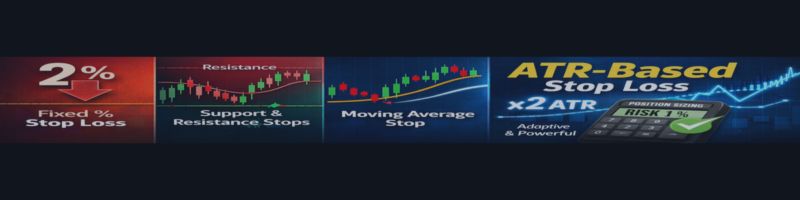
1. Fixed Percentage Stop Loss
This is the simplest approach. You pick a set percentage below your entry price (for long trades) or above (for shorts). Common choices are 1%, 2%, or 5%.
Example:
You buy a stock at $100 and set a 2% stop loss. Your stop goes at $98. If the price drops to $98, you exit.
Advantages:
- Extremely easy to calculate and apply.
- Keeps risk consistent in terms of account percentage (especially when combined with position sizing).
Drawbacks:
Markets are not the same every day. A volatile stock or currency pair can swing 3-5% easily in normal conditions, so a 2% stop gets hit too soon, even when the overall trend is still good. On calm days, the same stop might be too wide and expose you to bigger losses than necessary. The fixed number doesn't adjust to reality.
2. Chart-Based Stop Loss (Support and Resistance)
You look at the price chart and place the stop just beyond obvious levels where the price has bounced before.
- For a buy: stop just below a recent support level (a "floor" where buyers stepped in).
- For a sell: stop just above a recent resistance level (a "ceiling" where sellers pushed back).
Example:
The stock has bounced several times around $95. You buy at $102 and place the stop at $94 (just below support).
Advantages:
- Feels logical — you're using the market's own structure.
- Many traders watch the same levels, so they can work well in trending markets.
Drawbacks:
- These levels are obvious, so big players sometimes push the price just past them to trigger stops (called "stop hunting").
- Support can break unexpectedly, or the price can fake out (dip below then reverse).
- It's somewhat subjective — different people see different levels.
3. Indicator-Based Stop Loss (e.g., Moving Averages)
You use a technical indicator like a moving average as your guide. A common one is placing the stop below a 20-day or 50-day moving average.
Example:
You buy when price crosses above the 50-day MA, and set the stop below that line.
Advantages:
- More objective than pure chart levels.
- The line moves with price, so it can act as a trailing stop.
Drawbacks:
- Moving averages lag (they react slowly to new price action).
- In choppy markets, price crosses the line many times, causing frequent early exits.
Why ATR-Based Stop Loss Is Usually Superior
The Average True Range (ATR) measures how much an asset normally moves in a day (or any period you choose, most people use 14 periods but i reccommend 20 or even more). It's a volatility indicator created by J. Welles Wilder, and Van Tharp strongly recommended it in his books for setting realistic stops.
How it works:
You place the stop at a multiple of the ATR away from your entry. Common multiples are 2×, 3×, or even more depending on your style and timeframe.
Example:
- Stock price: $100
- 14-day ATR: $3 (meaning the asset typically moves about $3 per day)
- You use 2× ATR for your stop
- Stop loss = $100 – (2 × $3) = $94
If the market gets more volatile (ATR rises to $5), your next stop would automatically be wider. In calm markets (ATR drops), it tightens.
Why many pros prefer this approach:
1. It adapts to real volatility, unlike a fixed percentage, ATR gives each asset the breathing room it actually needs. A volatile crypto or small-cap stock gets a wider stop; a stable blue chip gets a tighter one. You avoid getting shaken out by normal wiggles.
2. Reduces premature exits — fixed or chart based stops often get hit during regular noise. ATR places the stop beyond typical daily ranges, so you stay in good trades longer while still protecting capital.
3. Works perfectly with position sizing — Van Tharp's core idea is "R-multiples" (measuring every trade as a multiple of your initial risk). When you use ATR to set the stop distance, your risk (1R) becomes consistent and logical. You then size your position so you only risk 1% (or whatever you choose) of your account per trade, no guesswork.
4. Statistical basis, not emotion — stops based on chart patterns or arbitrary percentages can be emotional or subjective. ATR is a cold, hard number calculated from actual price movement.
Of course, no method is perfect. In very strong trends you might want wider stops (some use 5-10× ATR for long term positions), and you should always backtest what multiple works best for your strategy. But for most traders, especially those serious about surviving long term, ATR gives the best balance of protection and staying power.
Once you start using it, you'll notice far fewer frustrating early stops. Your losses become smaller and more controlled, while winners have room to run. That's exactly what Van Tharp taught: trade in a way that gives probability and good risk management the edge over time.
Give ATR a try on your next trades. Start with 2-3× on a demo account. You might be surprised how much calmer and more consistent your results become.
The ATR based stop loss and position sizing calculation can be automated and you can find a solid solution here.