eToro in 2026: The Real Answers Traders Keep Asking (FREE BONUS = AI Assistant)

If you’re using a well-regulated broker (and you should), you’ll notice something: onboarding isn’t just “sign up and trade.” You’ll often face appropriateness / suitability questionnaires, risk disclosures, account classification choices, and product restrictions by country.
That’s not a bug — it’s a feature of proper regulation.
The AI system we built (our #1 recommendation before you trade)
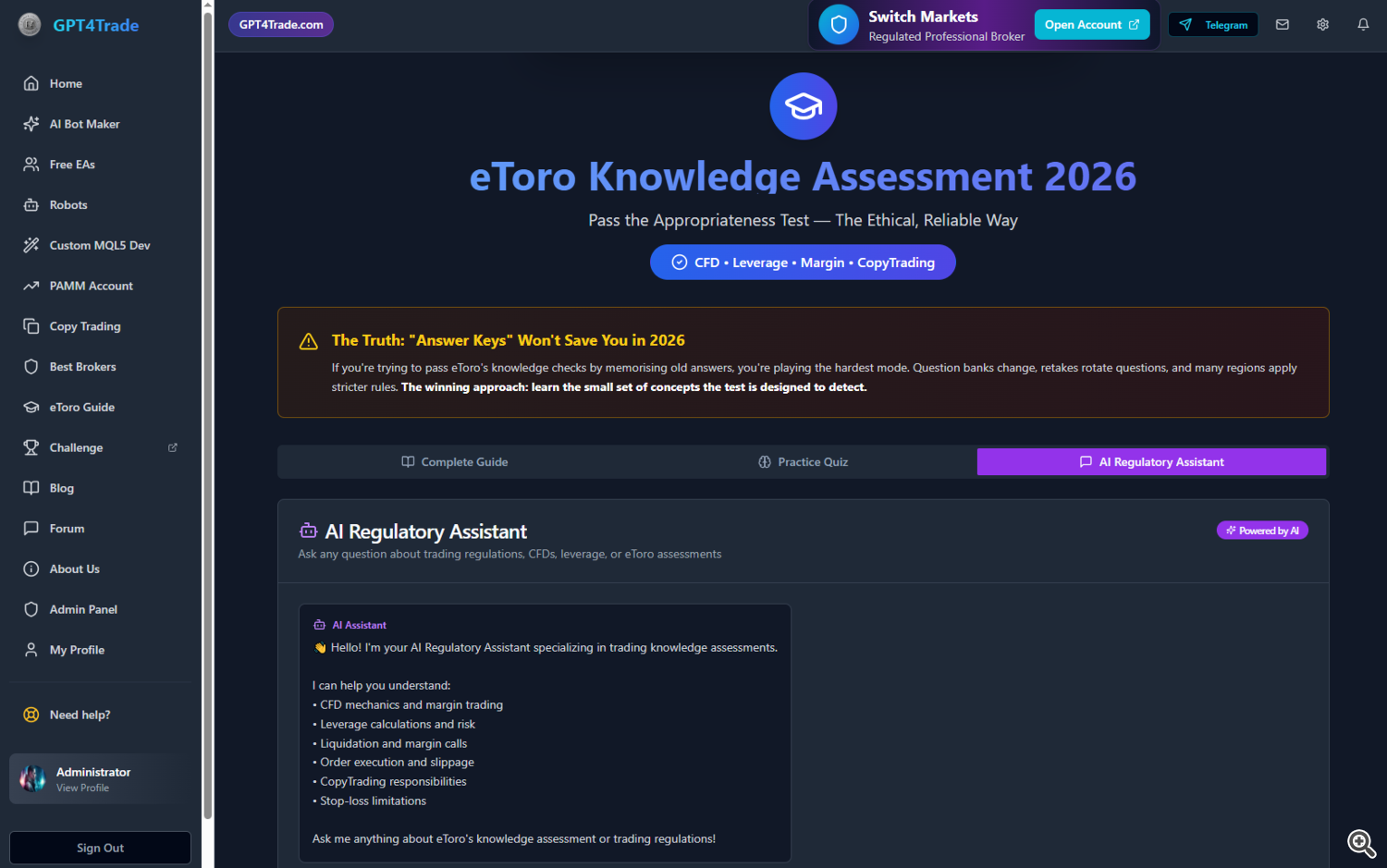
We built a dedicated AI Assistant for regulated brokers to help traders prepare for:
-
broker knowledge tests (appropriateness / suitability),
-
regulation-style exams,
-
product risk understanding (CFDs, leverage, margin, copy trading),
-
and common onboarding questions (fees, protections, restrictions).
It does not rely on leaked question banks and it does not teach you to “game” the system. Instead, it drills the exact concepts regulators expect you to understand — with explanations, examples, and practice scenarios — so you can pass confidently and trade responsibly.
How to access it:
-
eToro is not MT4/MT5. It’s its own platform.
-
Many features (CFDs, leverage, CopyTrader) can trigger assessments and restrictions depending on your country and profile.
-
If you want automation (EAs/bots), that’s typically an MT5 world, not an eToro world.
FAQ: the questions eToro clients ask every single day
1) “Is eToro regulated — and does it matter which ‘eToro’ I’m under?”
Yes, it matters a lot. eToro operates through different regulated entities depending on your country. Your protections, leverage, compensation scheme, and available products can change based on the entity and regulator.
What to do: inside your account (or in the broker’s legal pages), confirm which entity holds your account, then verify the regulator and license.
2) “Why am I forced to do a Knowledge / Appropriateness test?”
Because leveraged products like CFDs are considered complex and high risk. Regulated brokers are required to check whether you understand:
-
leverage magnifies losses,
-
margin can trigger forced closures,
-
execution isn’t guaranteed at your displayed price,
-
costs can accumulate (overnight/financing).
Passing is easiest when you genuinely understand the mechanics (we’ll give you a study map below).
3) “Why am I blocked from CopyTrader / copying other investors?”
Copy trading is often treated as a suitability question, not just knowledge. Brokers may need to assess whether copy trading fits your:
-
objectives,
-
risk tolerance,
-
financial situation,
-
experience with managed or semi-managed tools.
If your profile suggests it’s not suitable (or you didn’t provide enough info), the platform may restrict copying.
4) “Am I buying a real stock or a CFD?”
This is one of the biggest points of confusion.
General rule on many brokers:
-
Real asset investing means you own the underlying (where offered).
-
CFD trading means you do not own the underlying — you’re trading a derivative contract.
How to spot it in practice: your trade line and instrument details usually indicate if a position is a CFD. If you ever see the word CFD attached to the position/instrument, assume derivative mechanics and fees apply.
5) “What fees should I expect on eToro?”
Typical fee buckets traders overlook:
-
Spread (the buy vs sell difference),
-
overnight/financing fees on CFDs held overnight,
-
possible FX conversion effects because many accounts operate in USD,
-
and other product/account fees that vary by region.
Practical tip: before you click “Open Trade,” look at the execution window — regulated brokers normally show the costs right there.
6) “Can I lose more than I deposit?”
For many retail setups, brokers provide negative balance protection (you can’t go below zero at the account level). But protections can change depending on:
-
your region,
-
your client classification (Retail vs Professional),
-
and the specific legal entity.
Important: choosing “Professional” can reduce key protections. Don’t upgrade just to chase higher leverage.
7) “Should I switch to Professional status to get more leverage?”
Most traders shouldn’t.
Professional status can come with trade-offs like reduced protections and fewer guardrails. If you’re not already trading like a professional (risk systems, hedging discipline, stress testing, capital planning), higher leverage usually increases the speed of failure — not the speed of success.
8) “Does eToro support bots, EAs, or automated AI trading?”
For classic automation (Expert Advisors / bots executing trades), eToro generally isn’t the platform for that.
If your plan is automation and algorithmic workflows, most traders look toward MT5 brokers (regulated ones) because MT5 supports EAs, strategy testing, and a broad automation ecosystem.
9) “I’m in the UAE / UK / EU — will the rules differ?”
Yes. Product access and onboarding checks (especially for CFDs, leverage, copy trading, and crypto) can differ by region and legal entity.
Best practice: always treat the platform’s assessment and restrictions as jurisdiction-specific — and keep your profile info accurate and updated.
10) “What’s the smartest way to ‘pass’ any broker exam in 2026?”
Stop hunting answer keys. Learn the concepts the exam is built to detect.
Below is the study map that works across regulated brokers — including eToro.
The 2026 Study Map: pass any appropriateness/suitability exam the right way
The 5 buckets every regulated broker checks
-
Product identity (real asset vs CFD derivative)
-
Leverage & margin math (exposure vs margin)
-
Liquidation risk (margin call / stop-out / forced close)
-
Execution reality (spread, slippage, gaps, stop-loss limitations)
-
Costs & responsibility (overnight fees, FX exposure, copy trading risk)
Master these and you’ll be “exam-proof.”
The 12 concepts you must be able to explain in plain English
-
CFD = derivative, usually no ownership
-
Notional exposure vs margin
-
Leverage magnifies P/L on full exposure
-
Equity vs balance vs free margin
-
Margin call vs stop-out (forced closure)
-
Stop-loss reduces risk, doesn’t guarantee price
-
Slippage (fills can differ from requested price)
-
Gaps (price jumps, often around news/open/close)
-
Market vs limit vs stop orders
-
Spread + commissions = real cost of trading
-
Overnight/financing fees (CFDs)
-
Copy trading doesn’t remove responsibility — you still carry risk
Mini practice quiz (original — not copied from any broker)
Q1: If you post $200 margin using 5× leverage, what’s your exposure?
A: $1,000 (margin × leverage)
Q2: Are your profits/losses calculated on the $200 or the $1,000?
A: On the $1,000 exposure
Q3: True/False — a stop-loss guarantees the exact exit price.
A: False (slippage and gaps can occur)
Q4: What can trigger a forced close-out?
A: Low margin level / stop-out conditions
Q5: Why can CFD holding costs matter over time?
A: Overnight/financing fees can accumulate
“Screenshot this” cheat sheet (viral-friendly)
-
Leverage magnifies P/L on full exposure.
-
Margin is collateral, not your true position size.
-
Stop-loss is not a guarantee.
-
Gaps/slippage are real.
-
Copy trading still means your risk, your responsibility.
-
Professional status can mean fewer protections.
Final recommendation: regulated first — platform second
If you want social investing and a unified multi-asset experience, eToro can fit — as long as you understand what you’re trading and why the platform asks you suitability/appropriateness questions.
If your priority is easy algo trading, Expert Advisors, and strategy testing, then you should strongly consider MT5 with a well-regulated broker — that ecosystem is built for automation.
Use our AI Assistant to prep properly
If you want to be fully prepared for regulated broker onboarding and regulation-style exams — without guessing, without shortcuts — use our dedicated AI Assistant here:
https://gpt4trade.com/eToro