GetString
- Uzmanlar
-
Rudi Rupian
 I started my trading journey in 2008 — not chasing quick profits, but building the discipline to understand how markets truly work. Over the years, I have developed a calm, long-term approach to trading: focused, systematic, and always probability-driven.
 - Sürüm: 5.0
- Etkinleştirmeler: 5
Combining CCI and Stochastic: A Synergistic Approach
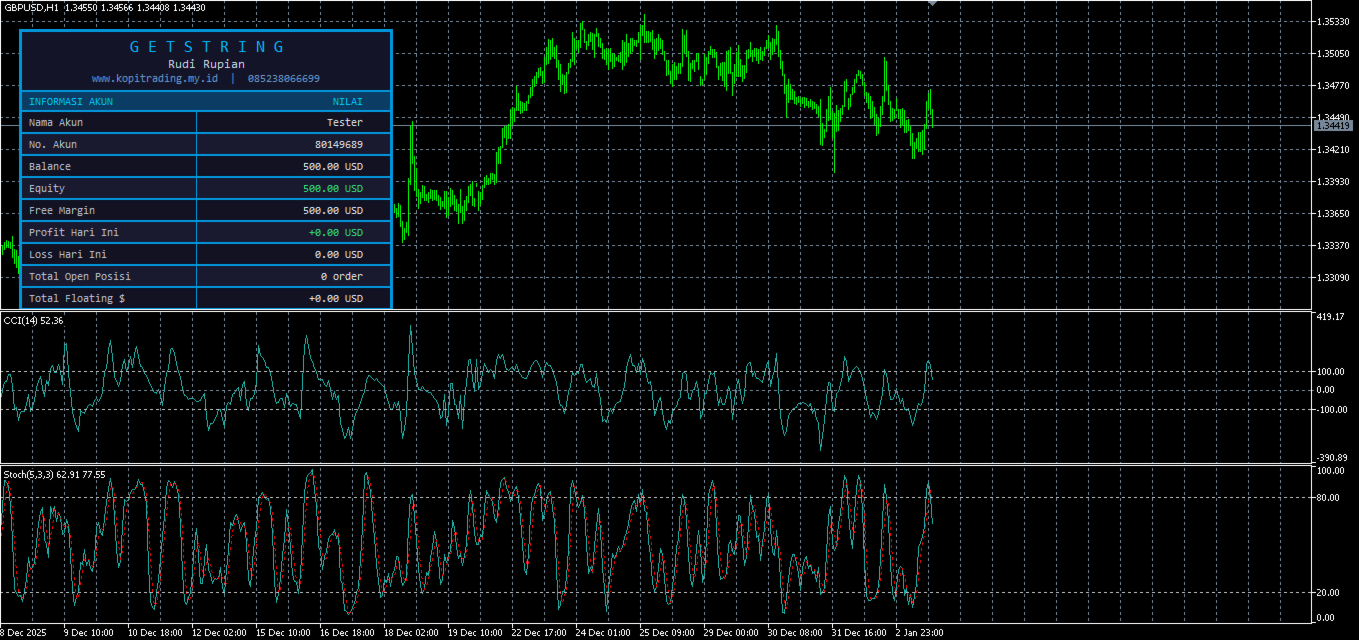
The real power of these two indicators emerges when they are used together. Because the CCI is an unbounded oscillator with no fixed extremes and the Stochastic is bounded between 0 and 100, they measure momentum from different mathematical perspectives. When both indicators align, the resulting signal carries substantially higher confidence.
A high-probability long setup occurs when the Stochastic drops below 20 (oversold) and simultaneously the CCI moves below -100 (also oversold), then both begin to recover upward together. This dual confirmation reduces the likelihood of false signals considerably. For a short setup, the trader watches for both indicators to reach overbought extremes — Stochastic above 80 and CCI above +100 — and then reverse downward simultaneously.
Divergence confirmation is especially powerful with dual indicators. If both the CCI and Stochastic exhibit bullish divergence simultaneously while the price is near a known support level, the probability of a significant bounce increases dramatically. The confluence of multiple signals from technically distinct indicators is a cornerstone principle of robust technical analysis.
Beyond simple entry signals, the combination of CCI and Stochastic also improves trade management and exit timing. When both indicators reach extreme overbought readings simultaneously during an open long trade, this is a strong signal to take partial or full profits. Waiting for one indicator to turn while the other confirms creates a disciplined, rules-based exit process that eliminates emotional decision-making.
Timeframe alignment adds another dimension to this strategy. A trader might use a higher timeframe — such as the daily or 4-hour chart — to identify the dominant trend using CCI direction, then drop to a lower timeframe — the 1-hour or 15-minute chart — to time precise entries using Stochastic crossovers. This multi-timeframe approach filters out counter-trend trades and keeps the trader aligned with the larger market structure.
Risk management must always accompany indicator-based strategies. Stop-loss orders should be placed at logical price levels — beyond recent swing highs or lows — rather than arbitrary pip distances. Position sizing should reflect the trader's overall risk tolerance, typically risking no more than 1–2% of trading capital per trade. The CCI and Stochastic combination, when applied with discipline and sound risk management, forms a complete and time-tested trading methodology capable of generating consistent results across diverse market conditions and timeframes.