
📊 Weekly Trading Review
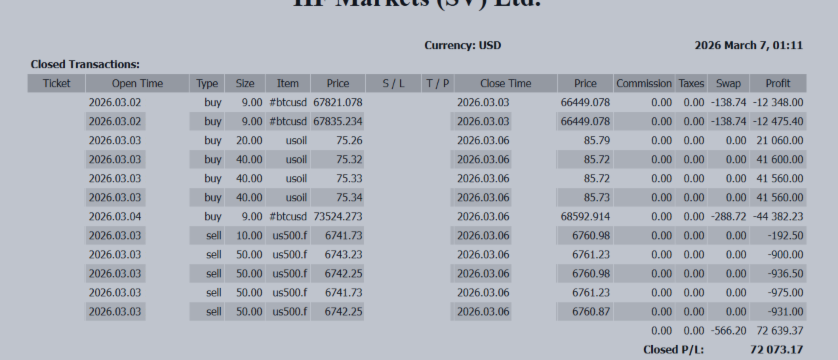
Period: March 2 – March 6, 2026
Weekly P/L: +72,073 USD
■ Profit Structure This Week
This week’s profits were driven almost entirely by one market.
That market was energy.
Amid rising tensions in the Middle East, the oil market formed a clear upward trend, and trades that captured this move significantly boosted weekly performance.
Meanwhile, other major markets showed a completely different picture.
Crypto: Attempted a rebound but remained range-bound
U.S. equities: Lacked clear direction
FX: A selective market centered around the U.S. dollar
In other words,
trends concentrated in commodities, while financial assets moved with uncertainty.
🌍 Macro Environment Overview
March 2 – March 6, 2026
During this period, markets were driven not by monetary policy, but by geopolitical risk.
Reports of military action against Iran by the United States and Israel triggered simultaneous reactions across FX, equities, and energy markets.
This created a classic “crisis market” structure.
Demand for the U.S. dollar as a safe-haven asset surged, pushing the dollar higher against most major currencies.
However, the Japanese yen behaved differently from typical crisis patterns.
Due to the Bank of Japan’s policy stance, the yen received only limited safe-haven demand.
As a result, USD/JPY remained firm and resilient on the downside.
🛢 Oil at the Center of the Market
The most important driver of the market this week was oil prices.
Key factors included:
-
Transportation risks in the Strait of Hormuz
-
Uncertainty surrounding Middle Eastern supply
-
Rising energy prices
This created the following chain reaction:
Rising oil → Inflation concerns → Higher U.S. yields → Dollar buying
This dynamic amplified volatility across financial markets.
Toward the end of the week, ceasefire speculation briefly supported equities, but reports denying the ceasefire and news of further attacks quickly reignited tensions.
Ultimately, the week ended with a clear theme:
Geopolitics-driven dollar strength.
💱 Currency Review
USD/JPY
USD/JPY rose from the low 156 area to near 158.
Following news of military clashes, safe-haven dollar buying accelerated.
The pair briefly approached 158, but traders became cautious near levels where official rate checks had previously been observed.
Still, on pullbacks, buying emerged around the mid-156 level, supported by:
-
Geopolitical risk
-
The BOJ’s cautious policy stance
-
Ongoing deflation concerns in Japan
These factors helped anchor USD/JPY on the downside.
EUR/USD
EUR/USD weakened during the week.
The pair fell from the 1.17 area to the 1.15 range, approaching its lowest levels since last autumn.
Because Europe is heavily dependent on energy imports, prolonged tensions in the Middle East raised concerns about economic impact.
As a result:
-
Dollar buying
-
European economic concerns
-
Rising energy costs
all weighed on the euro.
GBP
The British pound weakened against the dollar while moving sideways against the yen.
Political uncertainty in the U.K. remained a factor, and markets also noted differences in foreign policy positioning between the U.S. and the U.K.
Additional pressure came from:
-
Declining government approval ratings
-
Concerns over policy direction
Although the pound showed occasional rebounds, upside momentum remained limited.
CAD
The Canadian dollar was caught between two opposing forces.
-
Dollar strength
-
Oil-driven demand for commodity currencies
As a result, CAD showed large swings against the dollar, while remaining relatively firm against the yen due to the rise in USD/JPY.
Oil price movements became the dominant driver of CAD direction this week.
AUD
The Australian dollar struggled to find direction.
Because Australia has strong domestic energy resources, the direct impact from Middle East tensions was limited.
However, the currency remained highly sensitive to global risk sentiment.
This produced two simultaneous dynamics:
Against USD: prone to selling pressure
Against JPY: driven largely by USD/JPY movements
📅 Key Events Next Week
March 9 – March 13
The most important events will be U.S. inflation data.
March 11 – U.S. CPI
March 13 – PCE Price Index
With oil prices rising, markets are increasingly concerned about a resurgence of inflation.
Therefore, these inflation releases will determine whether:
geopolitical-driven dollar buying
transitions into inflation-driven dollar strength.
Other key events include:
-
Japan real wages
-
Japan GDP revision
-
China CPI / PPI
-
U.K. GDP
-
Canada employment data
Additionally:
-
The Federal Reserve enters its blackout period
-
The United States shifts to daylight saving time, moving data releases one hour earlier
🔎 Currency Outlook
USD/JPY
As long as Middle East tensions persist, USD/JPY is likely to remain resilient.
Expectations for a Bank of Japan rate hike have faded, leaving few catalysts for strong yen buying.
If inflation data comes in strong, dollar strength could accelerate.
Even if data weakens, significant downside may remain limited.
EUR/USD
The euro continues to face headwinds.
Key factors include:
-
Energy dependency
-
Economic slowdown concerns
-
Persistent dollar demand
As a result, rebounds are likely to remain limited.
🧭 Summary
The dominant force in markets this week was:
Dollar demand driven by geopolitical risk.
Next week adds another key variable:
U.S. inflation data.
This creates a critical period in which:
Middle East tensions set the market foundation,
while U.S. inflation data determines the strength of the dollar.
Afterword | How “Five Minutes” Can Change the Future
Thank you for reading this week’s FX report.
Recent research suggests that adding just five minutes of exercise per day may help lower blood pressure.
Of course, five minutes alone will not dramatically transform health overnight.
The key is adding a small improvement to an existing habit.
This concept applies surprisingly well to trading.
🏃 Small Improvements Create Big Differences
When traders try to improve results, many people make drastic changes:
-
Switching strategies
-
Changing currency pairs
-
Changing timeframes
But in reality, small adjustments often have the greatest long-term impact.
For example:
✔ Waiting 10 seconds before entering a trade
✔ Reducing position size by 5%
✔ Writing a daily trading note
These small habits can dramatically change performance over time.
🧠 Intensity Matters
The study found that the blood-pressure benefits came from exercise with meaningful intensity.
Trading works the same way.
Simply staring at charts for longer hours does not improve results.
What matters is:
-
Rules you truly follow
-
Improvements that genuinely matter
In other words,
five minutes of quality.
📈 Compounding Begins with Habits
Five minutes per day may seem insignificant.
But:
5 minutes × 365 days = 1,825 minutes
Nearly 30 hours per year.
Trading works the same way.
Great traders are not defined by talent alone —
they are defined by never stopping small improvements.
You do not need to pursue drastic change.
Next week, try spending just five minutes improving your trading.
That small investment of time might completely change your results a year from now.
See you next week. 📈