• Informazioni
2 anni
esperienza
5
prodotti
85
versioni demo
0
lavori
1
segnali
0
iscritti
Professionista in Finanza e Business Internazionale con specializzazione in Gestione Finanziaria. Sviluppatore autodidatta in MQL5 e Python con focus sul trading algoritmico, la costruzione di portafogli multi-asset e la gestione quantitativa del rischio.

Il mio lavoro si concentra sulla progettazione, ottimizzazione e validazione di Expert Advisor che operano come un portafoglio coordinato anziché come strategie isolate. Applico l'analisi di correlazione, la mappatura della copertura temporale e la diversificazione per classe di attività per costruire sistemi che non dipendano da un singolo strumento né da un singolo approccio.

Attualmente gestisco portafogli algoritmici che coprono forex, indici, metalli preziosi, energia e azioni statunitensi, operando simultaneamente su più sessioni e timeframe.
Condivido la mia esperienza attraverso articoli tecnici e strumenti open source in questa comunità. Sono convinto che il passaggio dal "costruire EA individuali" all'"ingegnerizzazione di portafogli" sia ciò che separa il pensiero del trader retail da quello istituzionale, e questo principio guida tutto ciò che pubblico qui.
Cristian David Castillo Arrieta
Codice pubblicato Edge Drift Detector
Tests whether live closing deals still match the backtest of an Expert Advisor. A bootstrap-calibrated CUSUM detector raises an alarm and estimates when the drift began, a two-window check separates a short dip from a lasting decline, and an expectancy decomposition shows whether the win rate or the trade sizes changed. The script generates demonstration data on the first run and is written in pure MQL5.
Cristian David Castillo Arrieta
Articolo pubblicato Building a Neural Loss-Pattern Auditor in MQL5
Building a Neural Loss-Pattern Auditor in MQL5

Aggregate metrics like win rate or profit factor miss sequence-dependent behavior, such as sizing up right after a loss. This MQL5 script trains a small native neural network on closed-deal history to estimate loss probability from behavioral and market-context features. It reports accuracy uplift over a baseline, probability calibration, and permutation feature importance, then combines them into a configurable A-F grade with concise, plain-language recommendations.

Cristian David Castillo Arrieta
Articolo pubblicato Did Your Scale Outs Actually Help? A Scale Out Value Analyzer in MQL5
Did Your Scale Outs Actually Help? A Scale Out Value Analyzer in MQL5

The article presents an MQL5 tool that tests whether scaling out improved results rather than only appearing disciplined. It reconstructs positions from closing-deal history and reprices the full volume at the first, last, and best exit rates actually achieved, producing a Value-Add Ratio, a Scale-Out Win Rate, and an Efficiency measure. A single-trade dependence check and a configurable A+ to F grade turn these into clear, decision-ready feedback.

Cristian David Castillo Arrieta
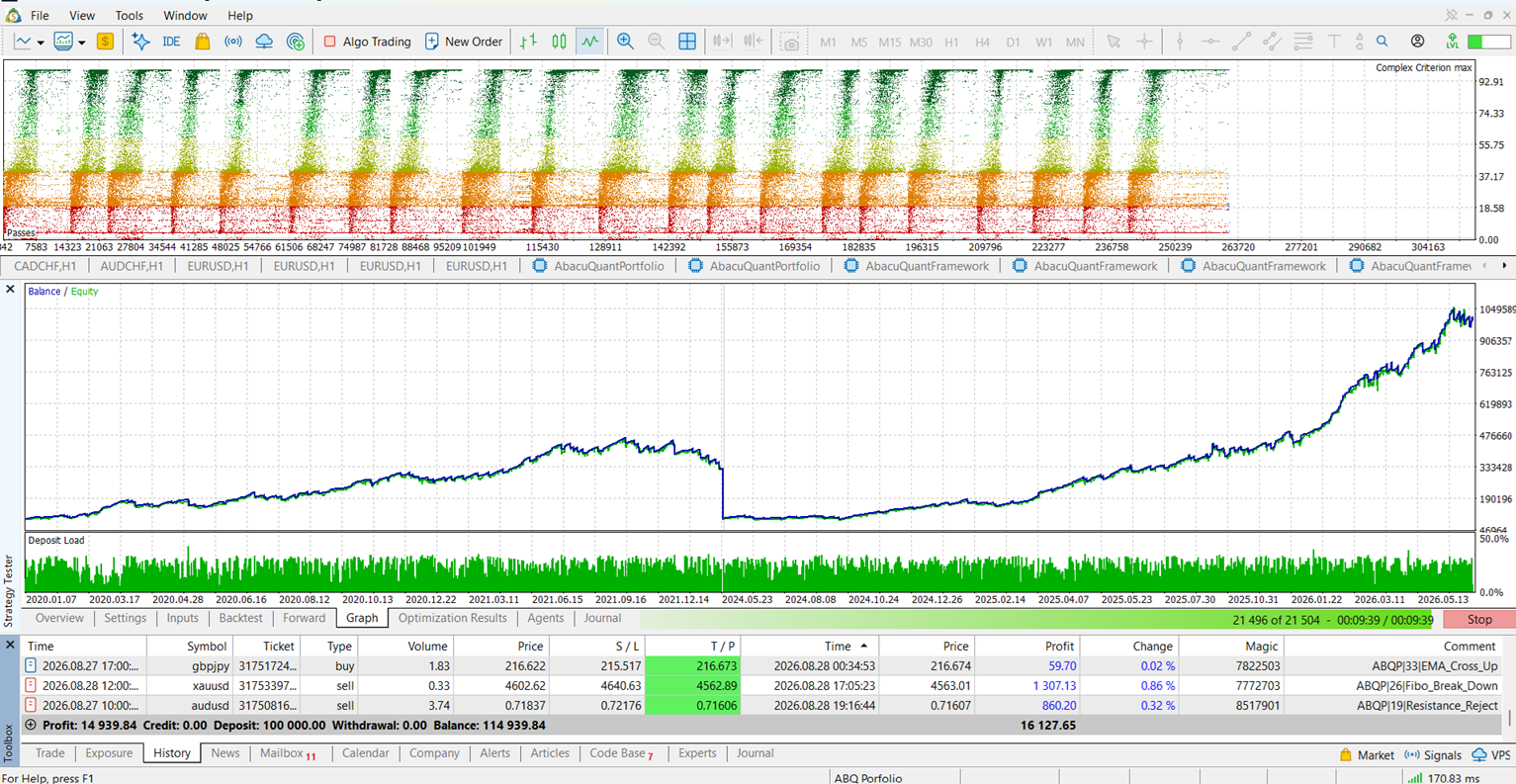
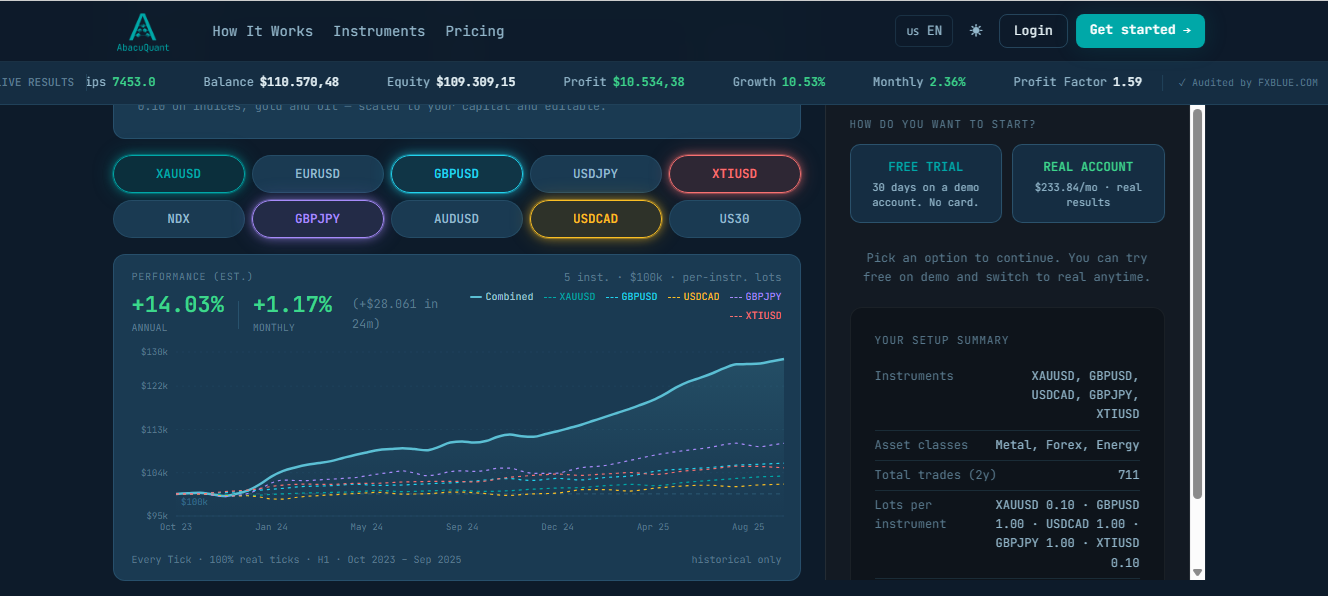
These remarkable optimization results were generated using the AbacuQuant Portfolio EA, available here:
What makes this interesting is that this is not a single strategy being optimized over and over. AbacuQuant Portfolio is designed as a portfolio engine, capable of running multiple independent configurations across different instruments and market conditions from a single MT5 chart.
The process starts by testing different combinations of strategies, trading conditions, parameters, stop/target structures and risk settings. Instead of simply looking for the configuration with the highest profit, AbacuQuant uses a custom optimization criterion designed to evaluate whether the historical win rate provides a meaningful margin above the break-even level implied by the stop and target structure.
The resulting configurations are then combined into a portfolio, allowing different strategies and instruments to operate during different market sessions while a shared risk engine controls total exposure at the account level.
The objective is not to find one “perfect” setup. It is to build a collection of independent configurations that complement each other and create a more robust portfolio.
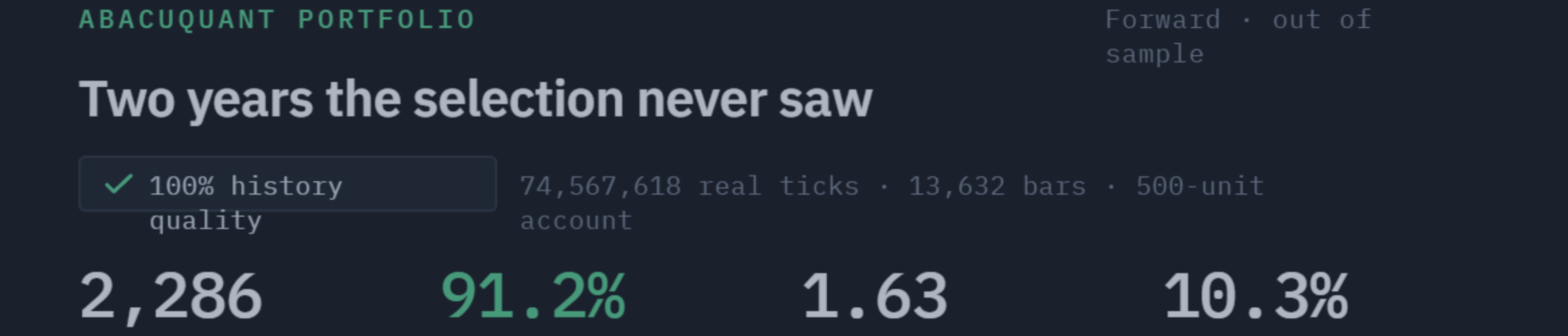
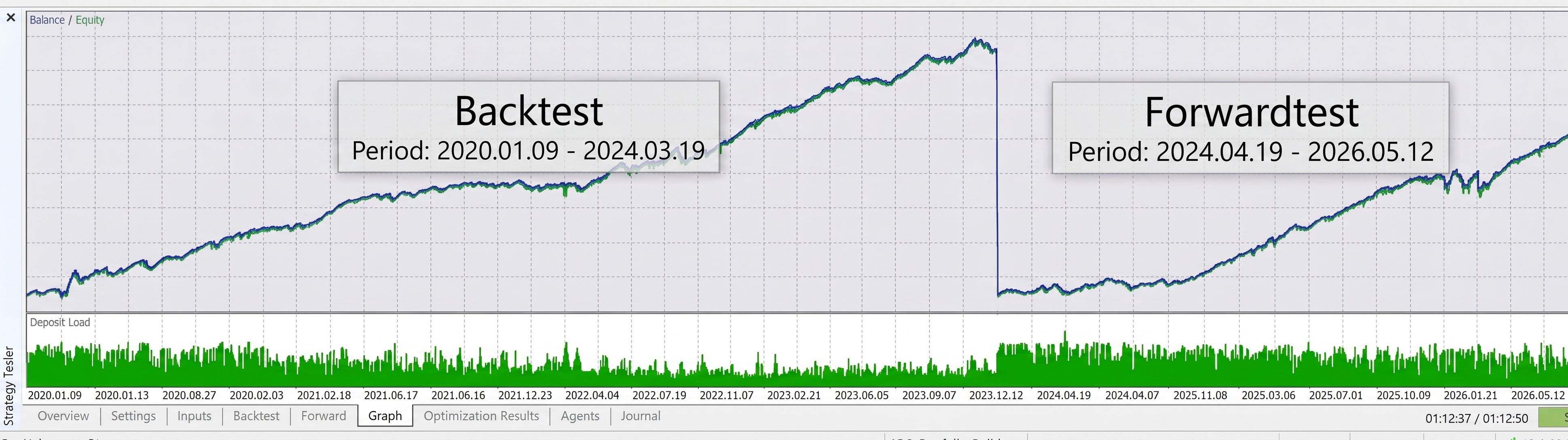
This image shows one of those optimization and portfolio-development results. The robot used to generate it is the AbacuQuant Portfolio EA.
🔗 https://www.mql5.com/en/market/product/191885
Cristian David Castillo Arrieta
Codice pubblicato Neural Loss-Pattern Auditor
Neural Loss-Pattern Auditor addestra una piccola rete neurale feed-forward, scritta da zero in MQL5 nativo, sulla cronologia delle operazioni chiuse per verificare se le caratteristiche comportamentali e relative al contesto di mercato consentano di prevedere quali operazioni abbiano una maggiore probabilità di generare perdite. Fornisce un miglioramento dell’accuratezza rispetto a una linea di base ingenua, una tabella di calibrazione delle probabilità, una classifica di importanza delle caratteristiche basata su permutazioni e un voto composito configurabile da A a F con raccomandazioni. Al primo avvio utilizza un conto demo sintetico integrato, quindi i risultati sono immediatamente visibili senza alcuna configurazione; è sufficiente impostare un parametro su InpUseDemoData=false per analizzare invece la cronologia di un conto reale. MQL5 puro: nessuna libreria esterna, nessun Python e nessun servizio di intelligenza artificiale di alcun tipo.
Cristian David Castillo Arrieta
Introduction AbacuQuant Portfolio is a multi-configuration Expert Advisor for MetaTrader 5. Instead of running one strategy with one set of parameters on one instrument, it runs up to 48 independent configurations at the same time, across EURUSD, GBPUSD, USDJPY and AUDUSD, from a single H1 chart...
Cristian David Castillo Arrieta
After months of research, I've published AbacuQuant Portfolio — a multi-configuration Expert Advisor for MetaTrader 5, and I wanted to share it here first.

Why it's different

Most EAs run one strategy with one set of parameters on one instrument. This one runs up to 48 independent configurations at once, across EURUSD, GBPUSD, USDJPY and AUDUSD, from a single chart. Each configuration owns its own trading hours, its own combination of ten built-in strategies, and its own ATR-based stop and target. A configuration built for the London session simply doesn't trade outside it — and risk is measured across the whole account, not per configuration, so running four instruments together doesn't quietly multiply your exposure.

And it's built the honest way: no martingale, no grid, no averaging into a losing position, no hidden loss-recovery logic. Every stop is attached the moment the trade opens. If you've been burned by an EA with a beautiful equity curve that fell apart the first time the market disagreed with it, this was built specifically against that failure mode.

How it decides a trade

Each active configuration waits for its window, reads only completed H1 bars (never the forming candle), requires several of its enabled strategies to agree, and sizes the position from the stop distance rather than a fixed lot — so a wider stop always means a smaller position, and the money at risk stays constant. Every configuration passed the same acceptance procedure on real-tick data before it shipped: statistical significance over its own break-even line, a minimum number of losing trades to actually measure it, and stops that were genuinely reached rather than just theorized.

Try it before you take my word for it

The demo runs in full inside the Strategy Tester — same presets, same logic, no time limit. Turn on the validated instruments, select "Every tick based on real ticks," and look at the trade list yourself: the stops, the position sizing, the risk ceilings holding across instruments. I'd rather you find out in the tester, for free, than after committing real money.

Link to the product page: https://www.mql5.com/en/market/product/191885
Cristian David Castillo Arrieta Prodotto pubblicato

AbacuQuant Portfolio è un Expert Advisor quantitativo multi-asset e multi-valuta per MetaTrader 5. Opera su 11 mercati decorrelati da un unico grafico H1 mediante un motore istituzionale di gestione del rischio unificato per l'intero conto: senza martingala, senza griglia (grid) e senza mediare le perdite . Ciascun ordine viene inviato a mercato con il rispettivo Stop Loss e Take Profit calcolati matematicamente fin dal primo istante. Mercati validati: EURUSD, USDJPY, AUDUSD, EURJPY, Oro

Cristian David Castillo Arrieta
Articolo pubblicato Building a Hidden Risk of Ruin Auditor in MQL5
Building a Hidden Risk of Ruin Auditor in MQL5

Aggregate metrics alone do not reveal how a trade sequence manages risk. This MQL5 tool analyzes closed positions to flag four structural patterns: post-loss volume escalation, overlapping same-direction entries, asymmetric payoffs, and a classical risk-of-ruin figure. The results are merged into a configurable A-F grade with concise recommendations to guide further review.

Cristian David Castillo Arrieta
Codice pubblicato Scale Out Value Analyzer
A native MQL5 tool that reconstructs closed positions from deal-level history, flags the ones closed through more than one exit, and reprices each one at its own first, last, and best exit rates to measure whether scaling out actually added value. Reports a Value-Add Ratio, a Scale Out Win Rate, an Efficiency figure, and a single-trade dependence check, combined into an A+ to F score with recommendations. Runs out of the box against a built-in demonstration data set; a companion script exports the real input file from your own account history. Pure MQL5, no external libraries.
Cristian David Castillo Arrieta
Codice pubblicato Hidden Risk of Ruin Auditor
Legge la cronologia delle operazioni chiuse (un file CSV o un file generato automaticamente dalla cronologia delle operazioni del conto corrente tramite lo script RuinExport.mq5) e riporta quattro indicatori di rischio indipendenti: aumento del volume a seguito di una perdita, esposizioni sovrapposte nella stessa direzione che determinano in media un prezzo sfavorevole, asimmetria dei rendimenti tra guadagni e perdite e una stima classica del rischio di rovina a un determinato livello di rischio per operazione. I quattro punteggi si combinano in un unico voto da A a F accompagnato da raccomandazioni in linguaggio semplice. Se non viene individuato alcun file CSV, lo script genera automaticamente un registro dimostrativo riproducibile, in modo che il report sia visibile già al primo esecuzione.
Cristian David Castillo Arrieta
Articolo pubblicato Execution Cost and Slippage Sensitivity Analyzer
Execution Cost and Slippage Sensitivity Analyzer

Backtests often understate spread, commission, and slippage. This MQL5 analyzer loads closing deals and simulates rising execution costs to measure robustness. It computes the breakeven cost per deal, the cushion over an assumed cost, the net profit and profit factor at that cost, and how many winners turn into losers, then summarizes the result with an A+ to F grade and targeted guidance.

Cristian David Castillo Arrieta
Articolo pubblicato Creating a Profit Concentration Analyzer in MQL5
Creating a Profit Concentration Analyzer in MQL5

Net profit and win rate tell you how much a strategy made, not how the result is distributed. This article builds a native MQL5 script that reads your closed trades and measures profit concentration: the top-N trade share, the Gini coefficient of the winners, an outlier-dependence stress test that removes the best few winners, and the largest day against a prop-firm consistency limit. It combines these into one A+ to F score with recommendations, running inside MetaTrader 5.

Cristian David Castillo Arrieta
Codice pubblicato Portfolio Correlation and Margin Risk Calculator
Calcola la correlazione storica di Pearson tra un qualsiasi insieme di strumenti e il margine complessivo che il tuo conto dovrebbe detenere per poterli detenere tutti contemporaneamente, espresso in percentuale del tuo capitale proprio. Funziona in modo nativo su MetaTrader 5 senza librerie esterne, senza Python e senza IA: basta impostare l’elenco dei simboli e le dimensioni dei lotti come dati di input e il sistema riporta la matrice completa nella scheda «Esperti» e sul grafico, aggiornandola a intervalli regolari.
Cristian David Castillo Arrieta
Why the same trailing stop breaks the moment Gold changes character

I was in a forum thread today about trailing stops on XAUUSD, and it made me put into words something I've been building my whole approach around for a while: almost every trailing method traders compare — EMA cross, Chandelier, ATR multiples, swing-structure trails — gets judged on a single backtest run over one continuous chunk of history. The "best" multiplier or ladder step that wins that test isn't actually the best method. It's the method that happened to fit whatever mix of trend and chop was sitting in that sample.

The fix I use is simple to describe and annoying to implement properly: split the history into volatility regimes first (I use ATR percentile over a rolling window, expansion vs. compression), then optimize and validate each piece of logic separately per regime instead of once over the whole dataset. A structural trail wins clearly in expansion. In compression it just gets chopped up by noise, and something tighter does better there. Neither method is "the winner" — the regime decides which one applies.

That's the same principle I ended up building AbacuQuant around, just scaled up from one exit rule to an entire portfolio. Instead of one strategy tuned to look good on one backtest, the logic behind each strategy is walk-forward tested and optimized (genetic optimization, not a single curve-fit) across different market regimes and asset classes, forex, metals, indices, energy, ETFs, individual stocks — and then combined into a portfolio specifically to keep cross-asset correlation low (the current version sits under 0.4 correlation across most pairs in the book). The idea isn't "find the one strategy that beats the market." It's "find enough structurally different, regime-validated pieces that the portfolio doesn't fall apart when one regime ends," which is exactly the failure mode people are describing in that XAUUSD thread, just at the position level instead of the portfolio level.

It also runs entirely inside your own MetaTrader account nothing custodial, your funds never move to a third party and the newer version adds the drawdown/consistency rules prop firms check for, since that's become how a lot of people are actually trading it live.

If any of this is useful for how you're thinking about your own trailing logic or portfolio construction, happy to go deeper in the comments. And if you want to see what the regime-validated approach looks like applied across a full portfolio rather than one exit rule, it's at abacuquant.com.

Cristian David Castillo Arrieta
Build your own portfolio and connect it to your demo (free) or live account.

www.abacuquant.com
Cristian David Castillo Arrieta
Codice pubblicato Execution Cost Sensitivity Analyzer
Uno script interamente in MQL5 che misura la robustezza del vantaggio competitivo di una strategia rispetto ai costi di esecuzione. Legge un file CSV contenente data, profitto e volume delle operazioni chiuse e modella il costo di ciascuna operazione come una componente fissa più una componente per lotto. Visualizza il costo di pareggio per operazione, il margine di sicurezza (il multiplo di un costo realistico ipotizzato al quale l’utile netto raggiunge lo zero), l’utile netto e il fattore di profitto ricalcolati in base al costo ipotizzato, la percentuale di operazioni vincenti che il costo trasforma in perdenti e un punteggio composito di robustezza rispetto ai costi da A+ a F con raccomandazioni. Se non è presente alcun file, genera un campione riproducibile e lo analizza, in modo che il risultato sia visibile già al primo esecuzione. Nessuna libreria esterna, nessun Python, nessuna intelligenza artificiale.
Cristian David Castillo Arrieta
Articolo pubblicato Beyond Maximum Drawdown: Building a Drawdown DNA Analyzer in MQL5
Beyond Maximum Drawdown: Building a Drawdown DNA Analyzer in MQL5

Maximum drawdown is one number that hides what really matters: how often an equity curve declines, how long it stays below a previous peak, and how quickly it recovers. This article builds a native MQL5 tool that reconstructs the underwater curve, breaks it into individual drawdown episodes (depth, duration, recovery time), computes the Ulcer Index, Pain Index, and Recovery Factor, and combines them into a single resilience grade with practical recommendations. No external libraries, no Python, no AI.