EMA offset band
- Indicatori
- Minh Vuong Pham
- Versione: 1.0
Description
The EMA Offset Bands indicator is a custom technical analysis tool designed for MetaTrader 5 that displays a central Exponential Moving Average (EMA) line surrounded by percentage-based offset bands. This indicator creates dynamic support and resistance levels that automatically adjust based on the EMA value.
Key Features:
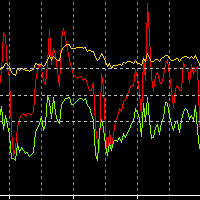
- Central EMA line (default: 200-period, displayed in yellow)
- Four upper offset bands at 1%, 2%, 3%, and 4% above the EMA (shown in lime green)
- Four lower offset bands at 1%, 2%, 3%, and 4% below the EMA (shown in red)
- Customizable EMA period and offset percentages
- Works on any timeframe and trading instrument
- Clean visual representation with dotted lines for bands
Trading Method Guide
Setup & Configuration
Recommended Settings:
- EMA Period: 200 (for long-term trend identification) or 50-100 for shorter-term trading
- Offset Bands: 1%, 2%, 3%, 4% (default settings work well for most markets)
- Timeframe: H1, H4, or Daily for swing trading; M15, M30 for intraday trading
Trading Strategy
1. Trend Identification
- Bullish Trend: Price consistently stays above the central EMA line
- Bearish Trend: Price consistently stays below the central EMA line
- Sideways Market: Price oscillates around the EMA with frequent crossovers
2. Entry Signals
Long (Buy) Positions:
- Wait for price to pull back to one of the lower bands (red dotted lines)
- Enter when price bounces off the -1% or -2% band in an uptrend
- Deeper pullbacks to -3% or -4% bands offer better risk/reward but occur less frequently
- Confirm entry with bullish candlestick patterns (pin bars, engulfing patterns)
Short (Sell) Positions:
- Wait for price to rally to one of the upper bands (green dotted lines)
- Enter when price rejects the +1% or +2% band in a downtrend
- Extended rallies to +3% or +4% bands provide excellent shorting opportunities
- Confirm entry with bearish candlestick patterns
3. Stop Loss Placement
- For Long Positions: Place stop loss below the next lower band or below the recent swing low
- For Short Positions: Place stop loss above the next upper band or above the recent swing high
- Alternative: Use a fixed percentage (1-2%) based on your risk management rules
4. Take Profit Targets
Conservative Approach:
- Take profit at the central EMA line (mean reversion target)
- This offers high probability but smaller gains
Aggressive Approach:
- From lower bands, target the opposite upper bands
- Example: Enter at -2% band, target +2% band
- Use trailing stops to maximize profits in trending markets
Scaled Exit Strategy:
- Close 50% of position at the EMA line
- Let remaining 50% run to the opposite band with a trailing stop
5. Band-to-Band Trading
This method works best in ranging or sideways markets:
- Buy at lower bands (-1%, -2%, -3%)
- Sell at upper bands (+1%, +2%, +3%)
- Use the central EMA as a profit-taking reference point
6. Trend Trading with Bands
In Strong Uptrends:
- Only take long positions on pullbacks to lower bands
- Avoid shorting upper bands against the trend
- The -1% and -2% bands act as dynamic support levels
In Strong Downtrends:
- Only take short positions on rallies to upper bands
- Avoid buying lower bands against the trend
- The +1% and +2% bands act as dynamic resistance levels
Risk Management Rules
- Never risk more than 1-2% of your account per trade
- Confirm band touches with price action - don't enter blindly
- Respect the overall trend - trade with the EMA direction
- Use proper position sizing based on the distance to your stop loss
- Avoid trading during low liquidity or major news events
Best Market Conditions
- High volatility markets: Use wider offset percentages (3-4%)
- Low volatility markets: Use tighter offset percentages (1-2%)
- Trending markets: Trade pullbacks to bands in the trend direction
- Ranging markets: Trade band-to-band reversals
Additional Tips
- Combine this indicator with RSI or MACD for confirmation
- The 200 EMA is widely watched, making these bands psychologically significant
- Price spending time beyond the ±3% or ±4% bands often signals exhaustion
- Adjust offset percentages based on the instrument's Average True Range (ATR)
- Backtest on your preferred instruments to optimize parameters
Common Mistakes to Avoid
- Trading against the EMA trend direction
- Entering too early before price reaches the bands
- Ignoring price action confirmation signals
- Using fixed targets without considering market conditions
- Overtrading in choppy, directionless markets
Disclaimer: This trading method should be tested on a demo account before risking real capital. Past performance does not guarantee future results. Always practice proper risk management and never invest more than you can afford to lose.