• Informations
2 années
expérience
5
produits
85
versions de démo
0
offres d’emploi
1
signaux
0
les abonnés
Professionnel en Finance et Commerce International avec une spécialisation en Gestion Financière. Développeur autodidacte en MQL5 et Python, spécialisé dans le trading algorithmique, la construction de portefeuilles multi-actifs et la gestion quantitative des risques.

Mon travail se concentre sur la conception, l'optimisation et la validation d'Expert Advisors qui fonctionnent comme un portefeuille coordonné plutôt que comme des stratégies isolées. J'applique l'analyse de corrélation, la cartographie de la couverture temporelle et la diversification par classe d'actifs pour construire des systèmes qui ne dépendent ni d'un seul instrument ni d'une seule approche.

Je gère actuellement des portefeuilles algorithmiques couvrant le forex, les indices, les métaux précieux, l'énergie et les actions américaines, opérant simultanément sur plusieurs sessions et horizons temporels.

Je partage mon expérience à travers des articles techniques et des outils open source au sein de cette communauté. Je suis convaincu que le passage de la « construction d'EAs individuels » à « l'ingénierie de portefeuilles » est ce qui sépare la pensée du trader particulier de celle de l'institutionnel, et ce principe guide tout ce que je publie ici.
Cristian David Castillo Arrieta
Code publié Edge Drift Detector
Tests whether live closing deals still match the backtest of an Expert Advisor. A bootstrap-calibrated CUSUM detector raises an alarm and estimates when the drift began, a two-window check separates a short dip from a lasting decline, and an expectancy decomposition shows whether the win rate or the trade sizes changed. The script generates demonstration data on the first run and is written in pure MQL5.
Cristian David Castillo Arrieta
Article publié Building a Neural Loss-Pattern Auditor in MQL5
Building a Neural Loss-Pattern Auditor in MQL5

Aggregate metrics like win rate or profit factor miss sequence-dependent behavior, such as sizing up right after a loss. This MQL5 script trains a small native neural network on closed-deal history to estimate loss probability from behavioral and market-context features. It reports accuracy uplift over a baseline, probability calibration, and permutation feature importance, then combines them into a configurable A-F grade with concise, plain-language recommendations.

Cristian David Castillo Arrieta
Article publié Did Your Scale Outs Actually Help? A Scale Out Value Analyzer in MQL5
Did Your Scale Outs Actually Help? A Scale Out Value Analyzer in MQL5

The article presents an MQL5 tool that tests whether scaling out improved results rather than only appearing disciplined. It reconstructs positions from closing-deal history and reprices the full volume at the first, last, and best exit rates actually achieved, producing a Value-Add Ratio, a Scale-Out Win Rate, and an Efficiency measure. A single-trade dependence check and a configurable A+ to F grade turn these into clear, decision-ready feedback.

Cristian David Castillo Arrieta
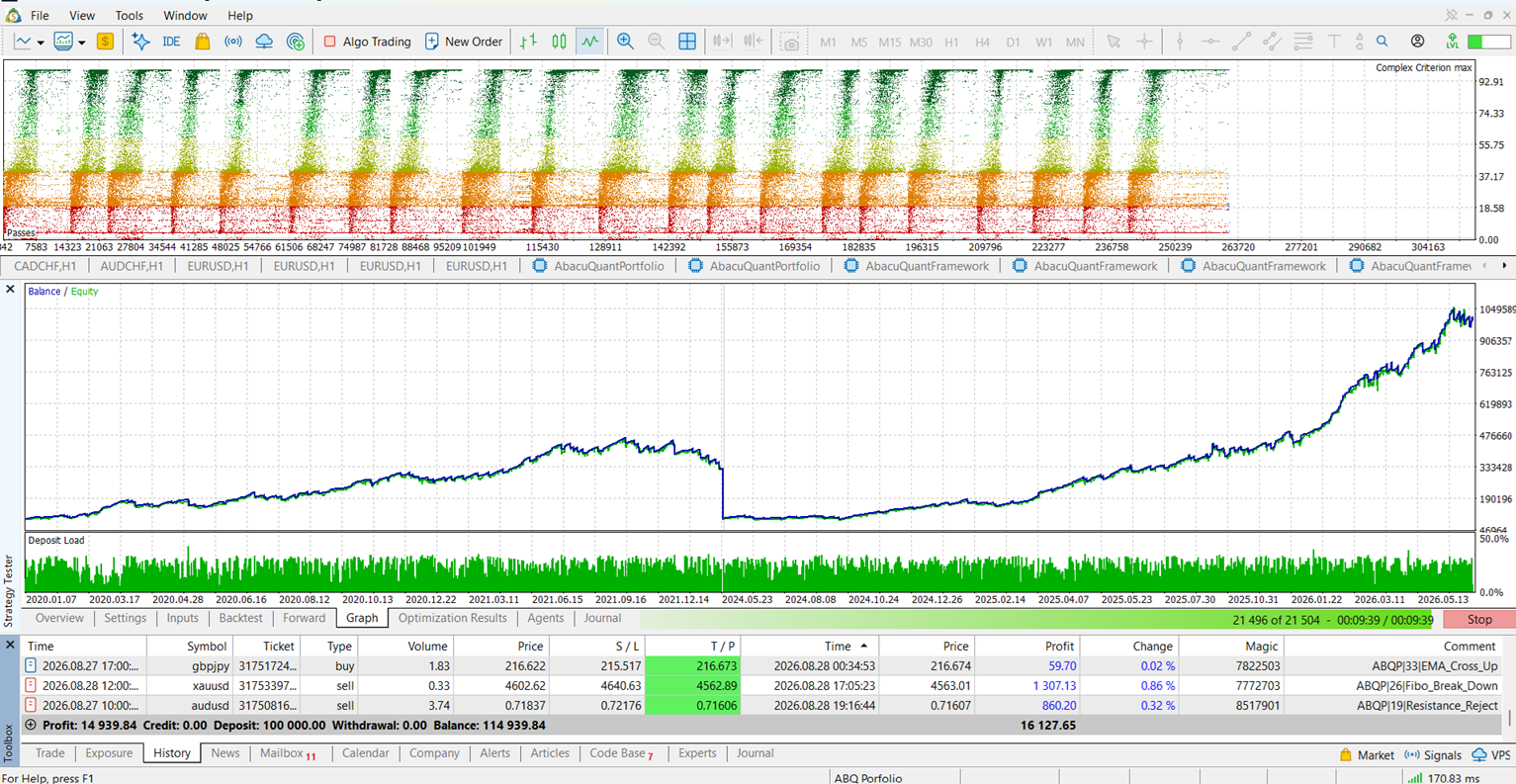
These remarkable optimization results were generated using the AbacuQuant Portfolio EA, available here:
What makes this interesting is that this is not a single strategy being optimized over and over. AbacuQuant Portfolio is designed as a portfolio engine, capable of running multiple independent configurations across different instruments and market conditions from a single MT5 chart.
The process starts by testing different combinations of strategies, trading conditions, parameters, stop/target structures and risk settings. Instead of simply looking for the configuration with the highest profit, AbacuQuant uses a custom optimization criterion designed to evaluate whether the historical win rate provides a meaningful margin above the break-even level implied by the stop and target structure.
The resulting configurations are then combined into a portfolio, allowing different strategies and instruments to operate during different market sessions while a shared risk engine controls total exposure at the account level.
The objective is not to find one “perfect” setup. It is to build a collection of independent configurations that complement each other and create a more robust portfolio.
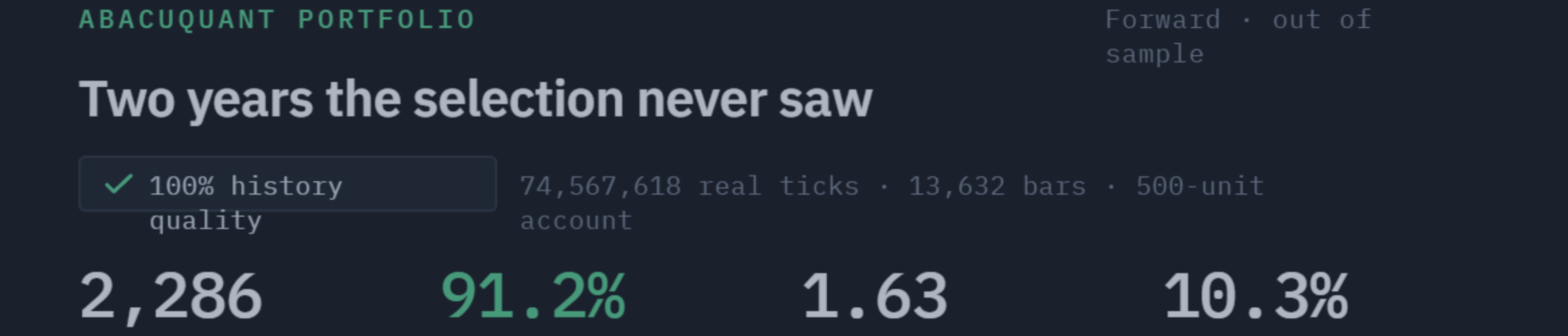
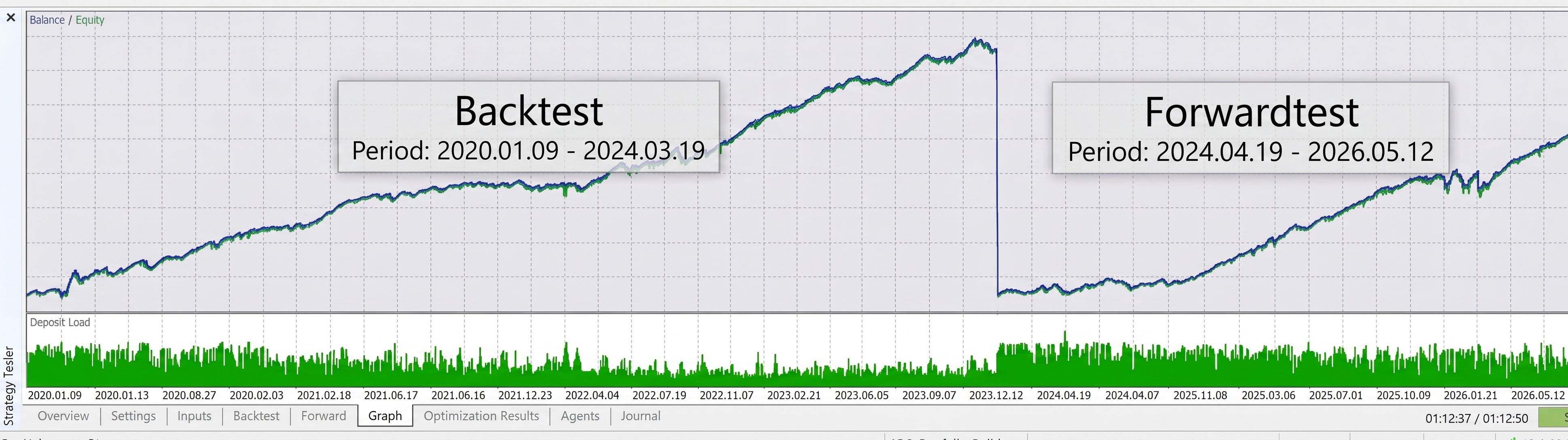
This image shows one of those optimization and portfolio-development results. The robot used to generate it is the AbacuQuant Portfolio EA.
🔗 https://www.mql5.com/en/market/product/191885
Cristian David Castillo Arrieta
Code publié Neural Loss-Pattern Auditor
Neural Loss-Pattern Auditor entraîne un petit réseau neuronal à propagation directe, écrit entièrement en MQL5 natif, sur l'historique des transactions clôturées afin de vérifier si les caractéristiques comportementales et liées au contexte de marché permettent de prédire quelles transactions sont les plus susceptibles d'entraîner des pertes. Il fournit une amélioration de la précision par rapport à une référence naïve, un tableau de calibrage des probabilités, un classement par permutation de l’importance des caractéristiques, ainsi qu’une note composite configurable de A à F accompagnée de recommandations. Lors de la première exécution, il utilise une démo synthétique intégrée, ce qui permet de visualiser immédiatement les résultats sans aucune configuration ; il suffit de définir l'une des entrées sur InpUseDemoData=false pour analyser à la place l'historique d'un compte réel. MQL5 pur : aucune bibliothèque externe, pas de Python et aucun service d'IA d'aucune sorte.
Cristian David Castillo Arrieta
Introduction AbacuQuant Portfolio is a multi-configuration Expert Advisor for MetaTrader 5. Instead of running one strategy with one set of parameters on one instrument, it runs up to 48 independent configurations at the same time, across EURUSD, GBPUSD, USDJPY and AUDUSD, from a single H1 chart...
Cristian David Castillo Arrieta
After months of research, I've published AbacuQuant Portfolio — a multi-configuration Expert Advisor for MetaTrader 5, and I wanted to share it here first.

Why it's different

Most EAs run one strategy with one set of parameters on one instrument. This one runs up to 48 independent configurations at once, across EURUSD, GBPUSD, USDJPY and AUDUSD, from a single chart. Each configuration owns its own trading hours, its own combination of ten built-in strategies, and its own ATR-based stop and target. A configuration built for the London session simply doesn't trade outside it — and risk is measured across the whole account, not per configuration, so running four instruments together doesn't quietly multiply your exposure.

And it's built the honest way: no martingale, no grid, no averaging into a losing position, no hidden loss-recovery logic. Every stop is attached the moment the trade opens. If you've been burned by an EA with a beautiful equity curve that fell apart the first time the market disagreed with it, this was built specifically against that failure mode.

How it decides a trade

Each active configuration waits for its window, reads only completed H1 bars (never the forming candle), requires several of its enabled strategies to agree, and sizes the position from the stop distance rather than a fixed lot — so a wider stop always means a smaller position, and the money at risk stays constant. Every configuration passed the same acceptance procedure on real-tick data before it shipped: statistical significance over its own break-even line, a minimum number of losing trades to actually measure it, and stops that were genuinely reached rather than just theorized.

Try it before you take my word for it

The demo runs in full inside the Strategy Tester — same presets, same logic, no time limit. Turn on the validated instruments, select "Every tick based on real ticks," and look at the trade list yourself: the stops, the position sizing, the risk ceilings holding across instruments. I'd rather you find out in the tester, for free, than after committing real money.

Link to the product page: https://www.mql5.com/en/market/product/191885
Cristian David Castillo Arrieta Produits publiés

AbacuQuant Portfolio est un Expert Advisor quantitatif multi-actifs et multi-devises pour MetaTrader 5. Il négocie 11 marchés décorrélés depuis un unique graphique H1 grâce à un moteur institutionnel de gestion du risque unifié pour l'ensemble du compte : sans martingale, sans grille (grid) et sans moyennage à la baisse . Chaque ordre est envoyé au marché avec son Stop Loss et son Take Profit calculés mathématiquement dès l'ouverture. Marchés validés : EURUSD, USDJPY, AUDUSD, EURJPY, l'Or

Cristian David Castillo Arrieta
Article publié Building a Hidden Risk of Ruin Auditor in MQL5
Building a Hidden Risk of Ruin Auditor in MQL5

Aggregate metrics alone do not reveal how a trade sequence manages risk. This MQL5 tool analyzes closed positions to flag four structural patterns: post-loss volume escalation, overlapping same-direction entries, asymmetric payoffs, and a classical risk-of-ruin figure. The results are merged into a configurable A-F grade with concise recommendations to guide further review.

Cristian David Castillo Arrieta
Code publié Scale Out Value Analyzer
A native MQL5 tool that reconstructs closed positions from deal-level history, flags the ones closed through more than one exit, and reprices each one at its own first, last, and best exit rates to measure whether scaling out actually added value. Reports a Value-Add Ratio, a Scale Out Win Rate, an Efficiency figure, and a single-trade dependence check, combined into an A+ to F score with recommendations. Runs out of the box against a built-in demonstration data set; a companion script exports the real input file from your own account history. Pure MQL5, no external libraries.
Cristian David Castillo Arrieta
Code publié Hidden Risk of Ruin Auditor
Lit l'historique des transactions clôturées (un fichier CSV ou un fichier généré automatiquement à partir de l'historique des transactions du compte courant par le script associé RuinExport.mq5) et fournit quatre indicateurs de risque indépendants : l'escalade des volumes après une perte, le chevauchement d'expositions dans le même sens qui se traduit par un prix moyen moins favorable, l'asymétrie des gains et des pertes, ainsi qu'une estimation classique du risque de ruine pour un risque par transaction donné. Ces quatre indicateurs sont combinés en une note unique allant de A à F, accompagnée de recommandations en langage clair. Si aucun fichier CSV n’est détecté, le script génère automatiquement un journal de démonstration reproductible, permettant ainsi de visualiser le rapport dès la première exécution.
Cristian David Castillo Arrieta
Article publié Execution Cost and Slippage Sensitivity Analyzer
Execution Cost and Slippage Sensitivity Analyzer

Backtests often understate spread, commission, and slippage. This MQL5 analyzer loads closing deals and simulates rising execution costs to measure robustness. It computes the breakeven cost per deal, the cushion over an assumed cost, the net profit and profit factor at that cost, and how many winners turn into losers, then summarizes the result with an A+ to F grade and targeted guidance.

Cristian David Castillo Arrieta
Article publié Creating a Profit Concentration Analyzer in MQL5
Creating a Profit Concentration Analyzer in MQL5

Net profit and win rate tell you how much a strategy made, not how the result is distributed. This article builds a native MQL5 script that reads your closed trades and measures profit concentration: the top-N trade share, the Gini coefficient of the winners, an outlier-dependence stress test that removes the best few winners, and the largest day against a prop-firm consistency limit. It combines these into one A+ to F score with recommendations, running inside MetaTrader 5.

Cristian David Castillo Arrieta
Code publié Portfolio Correlation and Margin Risk Calculator
Calcule la corrélation historique de Pearson entre n'importe quel ensemble d'instruments et la marge combinée dont votre compte aurait besoin pour les détenir tous simultanément, exprimée en pourcentage de vos capitaux propres. Fonctionne nativement dans MetaTrader 5 sans bibliothèques externes, sans Python et sans IA : définissez votre liste de symboles et la taille de vos lots comme paramètres d'entrée, et l'outil affiche la matrice complète dans l'onglet « Experts » et sur le graphique, avec une actualisation automatique à intervalles réguliers.
Cristian David Castillo Arrieta
Why the same trailing stop breaks the moment Gold changes character

I was in a forum thread today about trailing stops on XAUUSD, and it made me put into words something I've been building my whole approach around for a while: almost every trailing method traders compare — EMA cross, Chandelier, ATR multiples, swing-structure trails — gets judged on a single backtest run over one continuous chunk of history. The "best" multiplier or ladder step that wins that test isn't actually the best method. It's the method that happened to fit whatever mix of trend and chop was sitting in that sample.

The fix I use is simple to describe and annoying to implement properly: split the history into volatility regimes first (I use ATR percentile over a rolling window, expansion vs. compression), then optimize and validate each piece of logic separately per regime instead of once over the whole dataset. A structural trail wins clearly in expansion. In compression it just gets chopped up by noise, and something tighter does better there. Neither method is "the winner" — the regime decides which one applies.

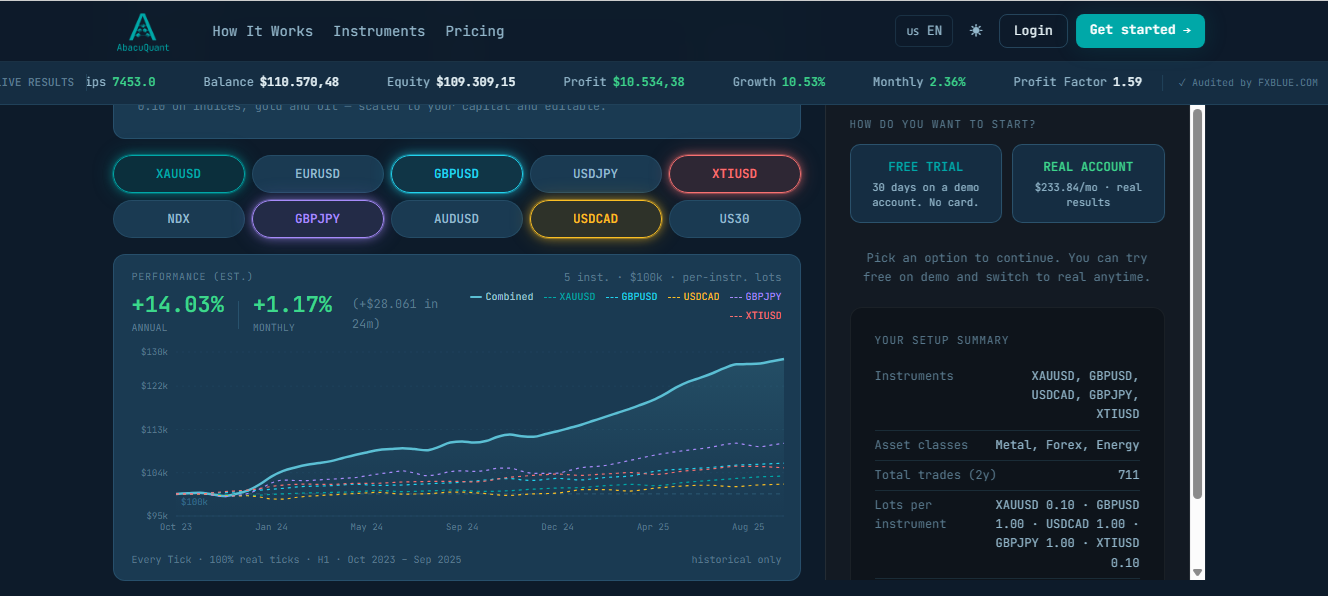
That's the same principle I ended up building AbacuQuant around, just scaled up from one exit rule to an entire portfolio. Instead of one strategy tuned to look good on one backtest, the logic behind each strategy is walk-forward tested and optimized (genetic optimization, not a single curve-fit) across different market regimes and asset classes, forex, metals, indices, energy, ETFs, individual stocks — and then combined into a portfolio specifically to keep cross-asset correlation low (the current version sits under 0.4 correlation across most pairs in the book). The idea isn't "find the one strategy that beats the market." It's "find enough structurally different, regime-validated pieces that the portfolio doesn't fall apart when one regime ends," which is exactly the failure mode people are describing in that XAUUSD thread, just at the position level instead of the portfolio level.

It also runs entirely inside your own MetaTrader account nothing custodial, your funds never move to a third party and the newer version adds the drawdown/consistency rules prop firms check for, since that's become how a lot of people are actually trading it live.

If any of this is useful for how you're thinking about your own trailing logic or portfolio construction, happy to go deeper in the comments. And if you want to see what the regime-validated approach looks like applied across a full portfolio rather than one exit rule, it's at abacuquant.com.

Cristian David Castillo Arrieta
Build your own portfolio and connect it to your demo (free) or live account.

www.abacuquant.com
Cristian David Castillo Arrieta
Code publié Execution Cost Sensitivity Analyzer
Un script entièrement en MQL5 qui évalue la résistance de l'avantage d'une stratégie face aux coûts d'exécution. Il lit un fichier CSV contenant les dates, les bénéfices et les volumes des transactions clôturées, et modélise le coût de chaque transaction comme étant composé d'une partie fixe et d'une partie par lot. Il affiche le coût d’équilibre par transaction, la marge de sécurité (le multiple d’un coût réaliste supposé à partir duquel le bénéfice net atteint zéro), le bénéfice net et le facteur de profit réévalués au coût supposé, la proportion de transactions gagnantes que le coût transforme en transactions perdantes, ainsi qu’une note composite de robustesse face aux coûts (de A+ à F) accompagnée de recommandations. En l’absence de fichier, il génère un échantillon reproductible et l’analyse, de sorte que le résultat soit visible dès la première exécution. Pas de bibliothèques externes, pas de Python, pas d’IA.
Cristian David Castillo Arrieta
Article publié Beyond Maximum Drawdown: Building a Drawdown DNA Analyzer in MQL5
Beyond Maximum Drawdown: Building a Drawdown DNA Analyzer in MQL5

Maximum drawdown is one number that hides what really matters: how often an equity curve declines, how long it stays below a previous peak, and how quickly it recovers. This article builds a native MQL5 tool that reconstructs the underwater curve, breaks it into individual drawdown episodes (depth, duration, recovery time), computes the Ulcer Index, Pain Index, and Recovery Factor, and combines them into a single resilience grade with practical recommendations. No external libraries, no Python, no AI.