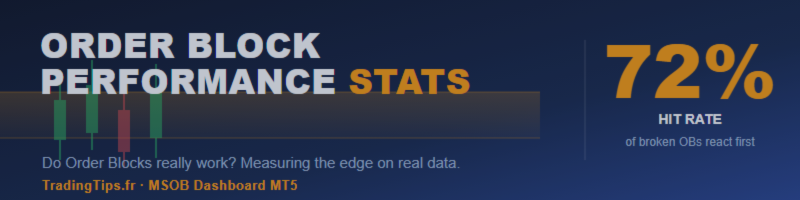
Order Block Performance Stats: How to Measure Which OBs Actually Work in MT5

Last month you marked dozens of Order Blocks on your charts. You took entries on a handful. A few were winners. Most of the zones were never even touched. Sound familiar?
If you trade Smart Money Concepts and cannot answer one simple question — "What is my Order Block hit rate?" — you do not have a strategy. You have a collection of screenshots.
This post is about replacing gut feel with numbers. We will define the metrics that actually describe an Order Block edge, walk through a real 213-OB audit on BTCUSD Daily, and look at what the data says about how Order Blocks behave — including the uncomfortable part most SMC content quietly skips.
This is the follow-up to our previous post on Pending ChoCH detection. If Pending ChoCH was about when to enter, this one is about whether your entries have a measurable edge in the first place.
Why Most SMC Traders Fly Blind
Walk through any Smart Money community — Discord, Telegram, Twitter — and count the win posts versus the loss posts. The ratio is comically skewed. Wins get screenshots. Losses get quietly archived.
The result: traders who have been drawing Order Blocks for two years still cannot tell you, with a straight face, what percentage of the OBs they identify actually get mitigated. They have no idea whether their average zone lasts 8 bars or 80. They cannot say whether their bullish OBs behave differently from their bearish ones, or whether Daily OBs hold better than M15 OBs on the same symbol.
That is not a strategy. That is a hobby with charts.
The fix is not more videos or another paid course. The fix is data — your own data, on your own symbols, on your own timeframes.
The Numbers That Actually Describe an Order Block
An Order Block has a life cycle, and you can only judge it once you track that life cycle across a large sample. Six numbers tell the whole story. They are exactly the ones the MSOB Dashboard prints in its OB Performance panel, but you can compute them by hand too — the definitions are what matter.
Detected. How many Order Blocks the rules identified over the lookback window. This is your sample size. Ten OBs tell you nothing; two hundred start to mean something.
Active. OBs that have not yet been broken — still valid zones price could react to. These are your live, tradeable levels right now.
Mitigated. OBs that price has pushed all the way through (below the zone for a bullish OB, above it for a bearish one). The zone is spent.
Mitigation rate (MIT%). Mitigated divided by Detected. This answers a question almost no SMC trader asks out loud: how many of my Order Blocks eventually get blown through? The answer is usually uncomfortable — and we will see why in a moment.
Hit rate. The key edge metric, and the one most often misunderstood. It is not "how many OBs got touched." It is: of the OBs that were eventually broken, how many first produced a reaction at the retest before price pushed through. In plain terms — when price came back to the zone, did it bounce, giving you a tradeable reaction with a clean invalidation, before the zone eventually failed? A high hit rate means the zones are doing real work even when they don't hold forever.
Average structural strength. Each OB gets a 0–100% quality score built from the displacement candle's body size, its volume relative to the prior bars, and how fresh the structure is. A clean break-of-structure candle on heavy volume scores high; a quiet candle that happened to print at a swing low scores low. Average strength tells you the overall quality of the zones your rules are catching.
Track those six numbers over 100+ Order Blocks on one symbol and you will know more about your edge than any indicator stack will ever tell you.
The Manual Tracking Method (And Why It Eats Your Week)
You can absolutely calculate these metrics by hand. Here is how:
- Every time you mark an Order Block, log it in a spreadsheet — timestamp, symbol, timeframe, OB high, OB low, direction, your subjective strength score.
- Set price alerts at the OB high and OB low.
- Each time an alert fires, log the touch — timestamp, bars elapsed since the OB formed, and whether price produced a clean reaction or simply sliced through.
- After a few hundred samples, aggregate. Compute mitigation rate, reaction rate, average bars-to-touch.
The math is trivial. The data collection is the killer.
A trader watching six symbols across H1 and M15 generates well over a hundred Order Blocks a month. Logging each one, setting alerts, recording touches, and reconciling the spreadsheet eats hours every week. Almost nobody keeps it up past month two.
The result: most SMC traders never build the dataset that would tell them whether their strategy works at all.
Real Data — 213 Order Blocks on BTCUSD Daily
Here is what a clean audit looks like. The figures below are a live read from the MSOB Dashboard's OB Performance panel on BTCUSD Daily, computed in a single pass over the historical lookback the moment the indicator is attached:

| Metric | Value |
|---|---|
| Order Blocks detected | 213 |
| Active (still valid) | 14 |
| Mitigated (broken) | 199 |
| Mitigation rate | 93% |
| Hit rate (reaction before break) | 72% |
| Average structural strength | 61% |
Read the two key numbers together, because the whole story lives in the tension between them.
93% of the Order Blocks were eventually broken. Let that land. On a multi-year Daily sample, almost every single Order Block was ultimately pushed through. An Order Block is not a wall. It is not a level price respects forever. If your mental model is "price will reverse here because it's an OB," the data says you are wrong on the holds-forever question 93% of the time.
But 72% of those broken zones first produced a reaction at the retest. That is the edge. Roughly seven times out of ten, when price returned to the zone, it bounced — enough to offer an entry with a defined invalidation — before it eventually failed. The OB did not have to hold forever to be tradeable. It had to produce one clean reaction, and most of them did.
That is the honest answer to "do Order Blocks work." They work as reaction zones with a stop, not as magic reversal walls. Trade the reaction, define your invalidation at the far side of the zone, and bank profit into the next structure — don't marry the level expecting it to hold, because 93% of the time it won't.
The average structural strength of 61% tells us the detection is catching mostly mid-to-high quality zones rather than noise. Which raises the obvious next question.
Not All Order Blocks Are Equal
Look at the chart above. The dashboard prints a strength percentage on every zone — you can see them ranging from 50% all the way to an 89% supply block near the highs and a 74% demand block down at the lows. That spread is the entire point. An 89% supply zone built on a violent displacement candle is a different animal from a 50% zone that barely qualified.
The dashboard does not hand you a tidy hit-rate-per-strength-bucket table, and you should be suspicious of anyone who shows you suspiciously clean numbers like "strong OBs work 89% of the time." What it gives you is the raw score on every zone, so you can run the experiment yourself: over your next hundred OBs, log the strength score and whether the retest produced a reaction. Almost everyone who does this finds the same thing — the losses cluster in the low-strength zones. Filter those out and the same strategy gets quieter and cleaner.
The lesson is not a magic number. It is this: the score is already on the chart; go measure whether it predicts reactions on your symbol, and trade only the top of your own distribution.
What the Numbers Keep Telling Us
A few patterns show up again and again once you start tracking Order Blocks this way:
An Order Block is a reaction zone, not a reversal guarantee. The 93% mitigation rate on BTCUSD Daily is the cleanest proof. Build your trade management around capturing the reaction, not around the level holding indefinitely.
Mitigation has a fat tail in time. Most OBs that produce a reaction do so within a few dozen bars. A minority fill much later, after price has wandered far enough that the original thesis is dead. If a zone has gone untested for a very long time, treat it as stale and set an expiry rule instead of waiting forever.
Structure quality beats confluence stacking. Traders love to require an OB plus an FVG plus a liquidity sweep plus session timing before they pull the trigger. More often, a single high-strength zone outperforms a low-strength zone wrapped in three confluences. The market reacts to where real orders sat, not to the length of your checklist.
The symbol matters as much as the rules. The same detection logic does not behave identically on every market. Before you spend six months tuning your OB rules, run the audit on the symbol you actually trade and confirm the behaviour is there in the first place.
Automating the Tracking
The manual workflow above is exactly what the OB History Backfill in the MSOB Dashboard automates. On chart attach it scans the historical lookback, identifies every Order Block by the same rules it applies live, simulates the forward price walk on each one, and prints the six metrics in the OB Performance panel:
- Detected / Active / Mitigated counts
- MIT% — mitigation rate
- HIT RATE — reaction-before-break rate (the edge metric)
- AVG STR — average structural strength
Switch timeframe and it recomputes. Switch symbol and it recomputes. Within two minutes you have an objective read on whether Order Blocks behave on the symbol in front of you — instead of guessing for another six months.
Market Structure Order Block Dashboard MT5 — product page
To be clear about what this is and is not: the dashboard will not make you profitable. Nothing does except a verified edge and the discipline to trade it. What it removes is the excuse for never running the verification step in the first place.
How to Read Your Stats and Act on Them
Once the numbers are in front of you, the decisions get simple:
Hit rate below ~50%? The zones are not producing reliable reactions on this symbol and timeframe. Either your detection is too loose — catching noise candles as OBs — or Smart Money behaviour is weak on this market. Change one variable and re-measure after another 100 OBs.
Mitigation rate very high and hit rate low? Price is blowing through your zones without reacting first. That is a trending regime where fading is the wrong play — switch to trend-following execution instead of trying to catch reversals.
Average strength below ~50%? Your filter is too permissive. Demand a stronger displacement leg and a better body-to-wick ratio on the OB candle, then re-audit.
Hit rate looks healthy but you still lose money? Detection is not your problem — entry timing or risk management is. Getting in earlier with a defined invalidation is exactly what the Pending ChoCH method covers.
Wrap-Up
Smart Money trading is sold as a vibe — wicks, narratives, "the market is hunting your stops." The traders who actually make money have something underneath the vibe: a measured process with a documented hit rate, a documented mitigation rate, and a filter rule they did not invent over a weekend.
You do not need a paid course to get there. You need a couple hundred Order Blocks of data on the symbol you actually trade. Collect it with a spreadsheet over six months, or read it off the panel in two minutes — the conclusion is the same either way: an Order Block is a reaction zone with a stop, most of them eventually break, and about seven in ten give you a tradeable reaction before they do. Build your strategy around that reality instead of the fantasy.
Go measure your own. Then come back and tell us what you found.
Related Reading
- Pending ChoCH: How to Detect Market Structure Reversals Before Confirmation — entry timing on the same MSOB framework.
Tools Referenced
- Market Structure Order Block Dashboard MT5 — automated OB detection, multi-timeframe panel, and OB History Backfill with the hit-rate stats shown in this article.
- Position Size Calculator ATR — free risk-based lot sizing companion.
Risk warning: trading leveraged instruments involves substantial risk of loss and is not suitable for all investors. Past performance, including historical statistics computed from chart data, is not indicative of future results. The figures presented in this article are read from historical price data on a single symbol and timeframe and are provided for educational purposes only. They will differ on your broker's feed, on other symbols, and over other periods. Always verify any strategy on your own data, on your own broker feed, and with your own risk parameters before committing capital. This article is not investment advice.