 MetaTrader 5
 Experts
 Indicators
 Scripts
 Libraries
 Storage
Join our fan page
- Views:
- 5344
- Rating:
- Published:
- Updated:
-
 You are missing trading opportunities:
- Free trading apps
- Over 8,000 signals for copying
- Economic news for exploring financial markets
Registration Log inYou agree to website policy and terms of use
If you do not have an account, please register -
 Need a robot or indicator based on this code? Order it on Freelance
Go to Freelance
Need a robot or indicator based on this code? Order it on Freelance
Go to Freelance
The Hybrid Microstructure EA is an advanced, high-frequency scalping Expert Advisor designed specifically for XAUUSD (Gold) on the M1 timeframe. Unlike traditional indicators that rely on lagging OHLC mathematics, this EA operates on Tick-Level Microstructure Dynamics—tracking tick velocity, volume-weighted average price (VWAP) deviations, and liquidity sweep rejections (stop hunts) executed by institutions.
Becktest :
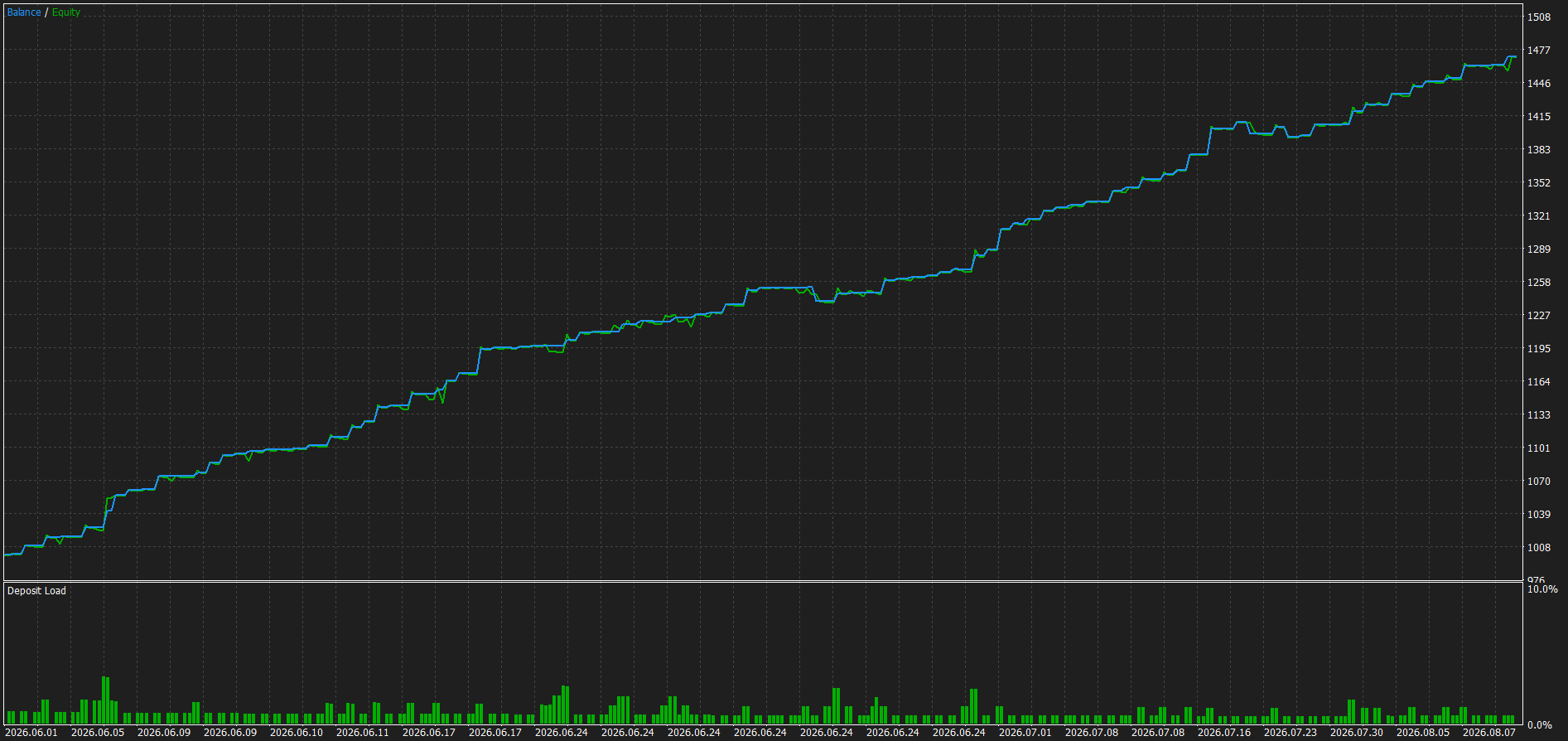
To bridge the gap between deterministic local rules and adaptive intelligence, it features an AI Bridge Decision Layer that supports both an internal weighted scoring engine and an external OpenAI-compatible local AI API (via Python/FastAPI) to act as a final factual gatekeeper before order execution.
Key Features :
- Tick Microstructure Engine: Bypasses lagging indicators by calculating real-time tick velocity windows and ring-buffer VWAP deviations.
- Liquidity Grab & Snapback Guard: Waits for retail stop-losses to be swept beyond extreme VWAP bands and triggers entries only upon confirmed price snapback/rejection.
- Dual-Engine AI Bridge: Integrates a deterministic local scoring matrix and an optional local AI web endpoint ( /analyze ) for multi-factor decision validation.
- Multi-Session & Volatility Filters: Restricts execution to active trading sessions (Asia, London, Middle East) while bypassing dangerous rollover periods.
- Advanced Risk & Money Management: Supports Fixed Lot or Risk-Percent (% of Balance/Equity) sizing with dynamic ATR/Fixed Stop-Loss, Break-Even, and Trailing Stop protection.
1. Code Structure & Workflow :
- OnTick() : The core loop executing spread checks, real-time tick buffer updates, VWAP calculations, and liquidity grab state machines.
- CalculateTickVWAP() : Computes volume-weighted average price and standard deviation bands dynamically from a 500-tick ring buffer.
- AIBridge_Confirm() : The decision gateway acting as a final filter by evaluating multi-timeframe trends (H1, M15, M5), M1 structure, and velocity metrics.
- AIBridge_LocalScore() : Computes a deterministic weighted score (0.0 to 1.0) based on measured market facts.
- AIBridge_WebCall() : Packages live market facts into a strict JSON payload and communicates asynchronously with a local Python/FastAPI server.
- SecureProfits() : Manages automated Break-Even and Trailing Stop modifications safely using MT5 TRADE_ACTION_SLTP requests.
2. Execution Workflow :
- Tick Ingestion & Filtering: Validates incoming ticks against maximum allowed spread, active trading hours, and minimum M1 ATR volatility.
- Microstructure Tracking: Continuously builds a ring buffer to evaluate tick velocity acceleration and VWAP band stretches (+/- StdDev).
- Trigger & AI Validation: When a liquidity sweep exceeds outer bands followed by a snapback rejection, the context is sent to the AI Bridge Layer.
- Decision & Execution: If local scoring or the external AI model approves the trade ( ALLOW=YES with high confidence), ExecuteTrade() calculates dynamic risk-based lot sizing and dispatches the order using optimal filling modes ( IOC / FOK ).
This EA is designed to send HTTP POST requests with a JSON payload in the OpenAI style (containing `messages`, `role: system`, and `role: user`) and expects a JSON response containing `decision`, `confidence`, and `reason`.
To create a Local AI API (local server) capable of responding to these MT5 requests within milliseconds, the ideal programming language is Python using the FastAPI framework. FastAPI is lightweight, lightning-fast, and perfectly suited for processing high-frequency data from MT5.
Below is the complete Python server code. You can later integrate a real Machine Learning model (such as TensorFlow, Scikit-Learn, or even Ollama for a local LLM) into this engine.
1. Python Environment Setup
Ensure Python is installed on your computer. Open the Terminal or Command Prompt and install these two essential libraries:
pip install fastapi uvicorn
2. Python API Code (local_ai_bridge.py)
Create a file named local_ai_bridge.py on your computer and copy the following code: (Python)
from fastapi import FastAPI, Request
from pydantic import BaseModel
from typing import List, Optional
import json
import uvicorn

app = FastAPI(title="MT5 AI Microstructure Bridge")

# --- DATA MODELS (Compatible with the MQL5 data format) ---
class Message(BaseModel):
    role: str
    content: str

class AIRequest(BaseModel):
    model: str
    temperature: float
    response_format: Optional[dict] = None
    messages: List[Message]

# --- MAIN ENDPOINT (/analyze) ---
@app.post("/analyze")
async def analyze_market(payload: AIRequest):
    """
    This endpoint receives tick and microstructure data from MT5,
    analyzes the data, and returns a BUY/SELL/WAIT decision.
    """

    # 1. Extract JSON data from the "user" message sent by MT5
    user_content = "{}"
    for msg in payload.messages:
        if msg.role == "user":
            user_content = msg.content
            break

    try:
        facts = json.loads(user_content)
    except json.JSONDecodeError:
        return {"decision": "WAIT", "confidence": 0.0, "reason": "Invalid JSON format"}

    # 2. Extract market facts
    order_type = facts.get("order_type", "WAIT")
    high_velocity = facts.get("high_velocity", False)
    snapback_pips = facts.get("snapback_pips", 0.0)
    min_snapback = facts.get("min_snapback_pips", 2.0)
    deviation_z = facts.get("deviation_z", 0.0)

    mtf = facts.get("mtf", {})
    m1_structure = facts.get("m1_structure", {})

    # 3. AI / DECISION-MAKING ALGORITHM (Can be replaced with an ML model later)
    # This is a simple example of decision logic

    confidence = 0.0
    decision = "WAIT"
    reason = ""

    # Evaluate the logic when the EA requests SELL confirmation
    if order_type == "SELL":
        score = 0

        # Validate snapback and velocity
        if snapback_pips >= min_snapback and high_velocity:
            score += 0.4

        # Validate extreme deviation (overbought condition)
        if deviation_z > 2.0:
            score += 0.3

        # Validate MTF alignment (at least H1 or M15 must be bearish)
        if mtf.get("h1_down") or mtf.get("m15_down"):
            score += 0.2

        # Validate M1 rejection (long upper wick)
        if m1_structure.get("upper_wick_ratio", 0.0) >= 0.2:
            score += 0.1

        confidence = score
        if confidence >= 0.70:
            decision = "SELL"
            reason = "High velocity drop, MTF align, Z-Score high"
        else:
            reason = f"Score only {confidence:.2f}, lacking momentum"

    # Evaluate the logic when the EA requests BUY confirmation
    elif order_type == "BUY":
        score = 0

        # Validate snapback and velocity
        if snapback_pips >= min_snapback and high_velocity:
            score += 0.4

        # Validate extreme deviation (deviation_z is already direction-adjusted in MQL5)
        if deviation_z > 2.0:
            score += 0.3

        # Validate MTF alignment (at least H1 or M15 must be bullish)
        if mtf.get("h1_up") or mtf.get("m15_up"):
            score += 0.2

        # Validate M1 rejection (long lower wick)
        if m1_structure.get("lower_wick_ratio", 0.0) >= 0.2:
            score += 0.1

        confidence = score
        if confidence >= 0.70:
            decision = "BUY"
            reason = "High velocity bounce, MTF align, Z-Score high"
        else:
            reason = f"Score only {confidence:.2f}, lacking momentum"

    # 4. Send the JSON response back to MT5
    return {
        "decision": decision,
        "confidence": round(confidence, 2),
        "reason": reason[:60]  # Limit the reason to a maximum of 60 characters for MT5
    }

if __name__ == "__main__":
    # Start the local server on port 8787, matching the InpAIEndpoint parameter in MQL5
    print("AI Bridge Server is running on http://127.0.0.1:8787")
    uvicorn.run(app, host="127.0.0.1", port=8787)
3. How to Run the Server & Connect to MT5
- Open the Terminal and navigate to the folder where the Python file is stored.
- Run the command:
- The server will start and listen at [http://127.0.0.1:8787](http://127.0.0.1:8787).
- On the MetaTrader 5 platform, ensure you have added the URL [http://127.0.0.1](http://127.0.0.1) to the list of allowed WebRequest URLs:
- Go to Tools -> Options -> Expert Advisors.
- Check "Allow WebRequest for listed URL".
- Add the URL [http://127.0.0.1](http://127.0.0.1) to the list.
- Run your EA. The EA will now send real-time data to the Python API; Python will analyze it based on parameters within the Python function and send BUY/SELL/WAIT commands back to MT5.
This Python architecture is highly scalable. If, in the future, you wish to store this price movement history in a database (for machine learning training data) or connect it to a prediction model (such as XGBoost or Random Forest), you simply need to modify the section marked with comment # 3—ARTIFICIAL INTELLIGENCE / DECISION ALGORITHM—in the code above.
If successful, the Print Expert will appear as follows:

Creating a Python file (.py) is actually very simple. Essentially, a Python file is just a standard text file (like a .txt file) with its extension changed to .py.
Using MetaTrader 5 (which generally runs on Windows), here are the 3 easiest ways to create the local_ai_bridge.py file:
Method 1: Using Notepad (Fastest & No Additional Apps to Install)
This is the quickest method on the Windows operating system:
- Open the built-in Windows Notepad application.
- Copy the entire FastAPI Python code I provided earlier (above). [2. Python API Code (local_ai_bridge.py)]
- Paste the code into a blank Notepad document.
- Click the File menu > Save As...
- Select the folder where you want to save this file (for example, create a new folder named AI_MT5 in Documents or on the Desktop).
- VERY IMPORTANT: In the "Save as type" section, change the setting from "Text Documents (*.txt)" to "All Files (*.*)".
- In the File name field, type exactly: local_ai_bridge.py
- Click Save. Done!
Additional Tips After Creating the File:
To run it, make sure you open the Command Prompt (CMD) in the folder where the `local_ai_bridge.py` file is located, then type the command to run it:
python local_ai_bridge.py
If successful, your CMD window will display text indicating that the Uvicorn/FastAPI server is running.
//-------------------------
For Python to run the `local_ai_bridge.py` file, the Terminal must be "located" in the same folder as that file. Here are the three easiest ways to do this on Windows (choose the one you prefer):
Method 1: File Explorer "Address Bar" Trick (Easiest & Fastest)
This is a favorite trick among programmers because it is very practical:
- Open File Explorer (the screen where you usually view files and folders).
- Go to the folder where you saved the local_ai_bridge.py file earlier.
- Left-click once on the Address Bar at the top (the long field showing the folder location, e.g., C:\Users\YourName\Documents\AI_MT5).
- The address text will be highlighted in blue. Delete the text, then type: cmd
- Press Enter on the keyboard.
- A black screen (Command Prompt) will immediately open, positioned exactly within that folder.
Execution Steps (If the terminal is already open in the correct folder)
Once the black or blue window opens in the correct folder, you simply need to issue a command to Python to launch the AI robot.
- Type this command:
-
python local_ai_bridge.py
- Press Enter.
If the installation of the libraries (fastapi and uvicorn) was successful, you will see text appear stating "AI Bridge Server is running on http://127.0.0.1:8787" or a message indicating "Uvicorn running on..."
As follows :
AI Bridge Server is running on http://127.0.0.1:8787
INFO: Started server process [4168]
INFO: Waiting for application startup.
INFO: Application startup complete.
INFO: Uvicorn running on http://127.0.0.1:8787 (Press CTRL+C to quit)
The text indicates that:
- Initialization Successful: The EA successfully detected the XAUUSD symbol with a Pip multiplier of 10.0 (correctly detecting a 3-digit/5-digit broker).
- AI Bridge Active: The AIBridge v1.1 module successfully loaded in HYBRID mode, connected to the local endpoint [http://127.0.0.1:8787/analyze](http://127.0.0.1:8787/analyze), and detected that key authorization is not required (anonymous)—which is suitable for our local Python server.
- Multi-Timeframe & Locked Structure: Supporting trend indicators (H1, M15, M5) and the M1 Closed Candle structure are ready to monitor the market.
What Does This Indication Mean?
This means the EA and our local Python server are now running side-by-side and are ready to interact. The EA is no longer "blind"—it possesses a "local brain" that filters every Liquidity Sweep and Velocity signal on the Gold M1 timeframe before deciding whether to execute an order or hold off (WAIT).
Next, simply monitor the chart movements or conduct forward testing on a demo or live account. When the sweep conditions and tick speed requirements are met, you will see decision logs—such as `[AI] SELL HYBRID ... ALLOW=YES` or `NO`—appear in the journal in real-time.
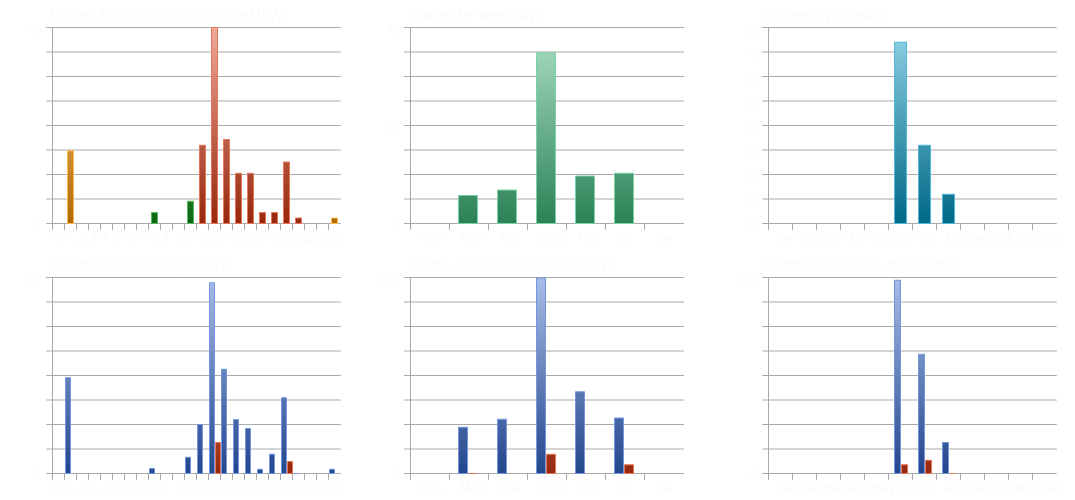
Strategy Tester Visualization :

 AAPL cfd - ORB strategy
Using ORB strategy on AAPL cfd
 EdgeMeter - does your entry signal beat the spread?
Measures whether an entry signal actually beats transaction costs, before you spend weeks building an EA around it. Reports net result after cost, an honest t-statistic on non-overlapping samples, and a random control. Places no orders.
 Wolfe Wave Dashboard
Professional MQL5 indicator (separate window) that automatically scans multiple symbols and timeframes, detects the most recent valid Wolfe Wave patterns (bullish/bearish), displays them in an interactive dashboard, and allows one-click chart opening with full pattern drawing.
SuperTrend Indicator
A custom SuperTrend indicator built from first principles, combining an ATR-based volatility band with a ratchet mechanism to produce a clean, non-repainting trend line. Internal recursive state is managed through properly registered calculation buffers, avoiding the state-loss bugs common in manually-managed array implementations. From the article series "Making Custom Indicators for Beginners."