 MetaTrader 5
 Experts
 Indicators
 Scripts
 Libraries
 Storage
Join our fan page

GoldLondonBreakout - expert for MetaTrader 5

- Views:
- 4009
- Rating:
- Published:
- Updated:
-
 You are missing trading opportunities:
- Free trading apps
- Over 8,000 signals for copying
- Economic news for exploring financial markets
Registration Log inYou agree to website policy and terms of use
If you do not have an account, please register -
 Need a robot or indicator based on this code? Order it on Freelance
Go to Freelance
Need a robot or indicator based on this code? Order it on Freelance
Go to Freelance
Gold London Breakout EA
The idea behind it
Gold has a well-worn behavioural pattern: it tends to compress during the Asian session and then expand hard once London desks come online. This EA does not predict that expansion — it measures the Asian range for the day, then places a pending BuyStop just above it and a pending SellStop just below it, so whichever direction the market actually breaks is the one that gets traded. The two orders are OCO (one-cancels-other): the moment either one fills, the EA cancels its twin, so you are never carrying both sides at once.
Symbol and timeframe matter more here than in most EAs, because the whole idea depends on the instrument actually having this session-compression behaviour: it is written and intended for XAUUSD (Gold), on a M15 chart. M15 is recommended specifically because the hour-boundary checks that lock in the range and open the trading window need enough resolution to catch the transition cleanly without processing every single tick.
How to interpret it
- The Asian range window — from InpAsianStartHour to InpAsianEndHour, server time. The EA watches every bar in that window and records the session high and low the moment the window closes.
- The range filter — the Asian range is compared against the symbol's own daily ATR rather than a fixed point count, so the filter self-calibrates to whatever price level and volatility regime the instrument is currently in instead of needing manual recalibration every time gold (or any symbol) moves to a new price range. If the session range comes in below InpMinRangeATRFrac or above InpMaxRangeATRFrac of daily ATR, the EA sits out for the day. A range that tight usually means a dead session with no real breakout to trade; a range that wide usually means the compression the strategy depends on never happened.
- The breakout orders — placed once the clock reaches InpLondonStartHour, sitting a small ATR-scaled buffer outside the locked range. Stops and targets are set from ATR at the moment of placement, not from the range width, so trade risk stays consistent regardless of how wide or narrow that day's range was.
- The expiry — if neither pending order has triggered by InpLondonEndHour, both are cancelled. The strategy only wants the breakout while London is actually opening; a move that starts hours later is a different setup entirely.
External variables (inputs)
| Input | Default | Purpose |
|---|---|---|
| InpAsianStartHour / InpAsianEndHour | 0 / 7 | The window the Asian range is measured over, broker/server time. |
| InpDailyAtrPeriod | 14 | Period of the Daily-timeframe ATR used purely to scale the range filter — independent of the ATR used for stops below. |
| InpMinRangeATRFrac / InpMaxRangeATRFrac | 0.15 / 0.70 | Filters out days where the Asian range is too small a fraction of daily ATR (no real compression) or too large (compression already broke down), expressed relative to the instrument's own current volatility rather than a fixed point count. |
| InpLondonStartHour / InpLondonEndHour | 7 / 11 | Window during which the breakout orders are live; they are cancelled at the end hour if untouched. |
| InpAtrPeriod | 14 | ATR period used for the entry buffer and the stop distance. |
| InpBreakoutBufferATR | 0.15 | How far outside the range, in ATR, the pending orders sit — enough to avoid triggering on noise right at the range edge. |
| InpStopATRMult | 1.2 | Stop-loss distance from entry, in ATR. Independent of range width, so risk stays consistent day to day. |
| InpRewardMultiple | 1.8 | Take-profit as a multiple of the stop distance (R). |
| InpRiskPercent | 1.0 | Risk per trade as a percentage of account equity; position size is derived from this and the actual stop distance. |
| InpMaxSpreadPoints | 350 | Skips placing orders for the day if the spread is wider than this at the moment of placement — gold spreads can run wide around the open. |
| InpMagicNumber / InpDeviationPoints | 20260801 / 50 | Standard trade-identification and slippage tolerance settings. |
Recommended use
Built for XAUUSD on M15. It will compile and run on other symbols and timeframes, but the whole premise — Asian compression, London expansion — is a gold-specific pattern, so results elsewhere should not be expected to carry the same logic. Check your broker's server time against London's actual opening hour before trusting the default session inputs; server time offsets vary by broker and by daylight-saving changes on each side.
One account-type note worth flagging honestly: this was written assuming a hedging-enabled account, where the EA's own position is unambiguous. On a netting account, if another position already exists on the same symbol when a breakout order fills, MetaTrader nets it into the existing position rather than opening a separate one, which can affect how cleanly the EA's own magic-number tracking reflects what is actually open. If you run a netting account, keep this EA on a symbol nothing else is trading.
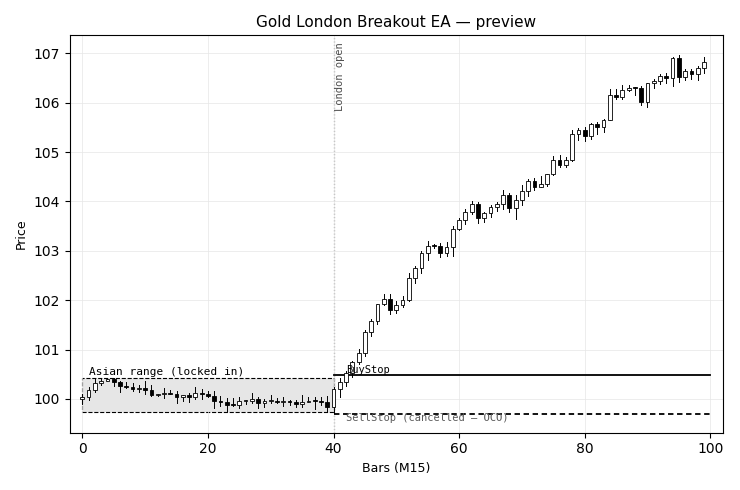
Fig. 1. The Asian range lock-in, followed by the OCO BuyStop/SellStop pair around it at the London open. Rendered in black and white per the Code Base image guidelines.
 RSI Histogram
This is an MQL5 custom indicator for MetaTrader 5 called RSI Histogram. It plots the standard RSI line in a separate window, plus a color-coded histogram version of the same RSI values that changes color based on momentum:
EVT Crash Gauge
Extreme Value Theory (EVT) ported into MQL5 for gauging potential crashes and upsets in the market.
SHK Heikin Ashi MACD Signal Arrows
A MetaTrader 5 chart indicator that draws Heikin Ashi candles, confirmed buy and sell arrows, optional MACD histogram divergence filtering, and configurable alerts.
 Portfolio Correlation Analyzer
Read-only analytics for accounts that run several Expert Advisors. It groups closed trades by magic number and measures what running those systems together actually saves you: standalone versus combined drawdown, the pairwise correlation matrix drawn as a heat map on the chart, and a Monte Carlo reshuffle of the portfolio's period returns.