Gold Doesn't Forgive Mistakes: 7 XAUUSD Traps That Empty Accounts (+ Live Proof How to Avoid Them) | Black Friday Inside

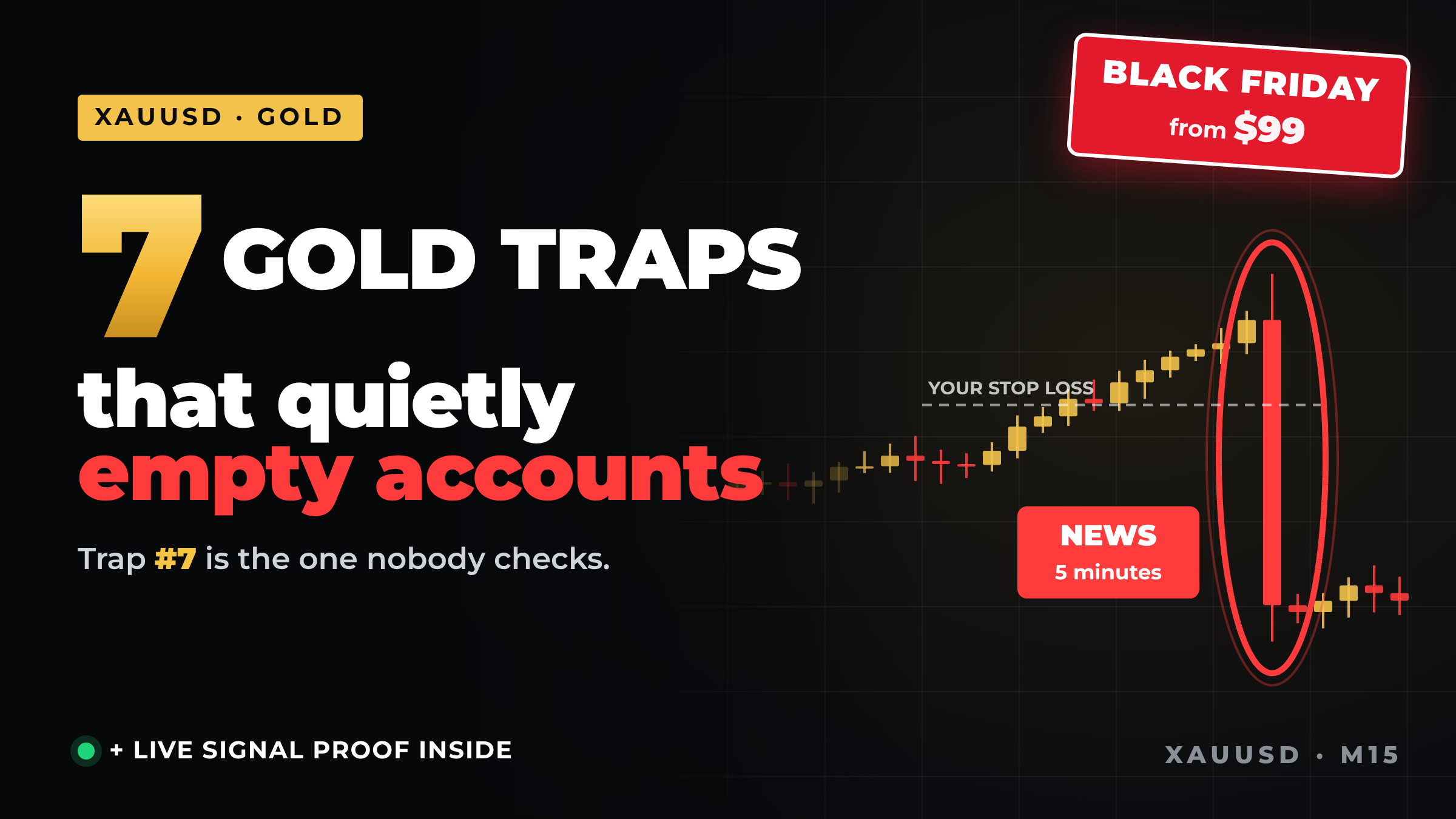
Black Friday: Trend Sniper X, X-Aurum EA and X-Prime EA are available from $99 for a limited time. Details are at the end of the article.
Gold is one of the most rewarding instruments a retail trader can work with. It trends cleanly, it reacts strongly to macro data, and its daily range gives room for both intraday and swing approaches. The same qualities make it one of the least forgiving.
Over the years of trading XAUUSD and developing automated systems for it, I have noticed that most losing accounts fail for the same handful of reasons. They are rarely about the entry signal itself. More often they come from how gold behaves at certain hours, around certain events, and under certain broker conditions that a backtest does not show.
Below are the seven I consider most important. For each one I describe what happens, what a trader can do about it, and where relevant, how I deal with it in my own systems, with live signals you can verify. The last point is the one I see overlooked most often.
1. Treating every session the same
Gold has a distinct character in each trading session. The Asian session is usually quiet, with a narrow range and a high rate of failed breakouts. The London open tends to break that range, often with a false move first. The New York session, particularly when US data is released, produces the largest and fastest moves of the day.
A strategy tuned for London volatility will often bleed slowly during Asian hours, and a range strategy that works overnight can be run over in New York. Before evaluating any system, it is worth splitting its results by session. The difference is often larger than expected.
To keep session boundaries visible on the chart, I use Session Master, a free indicator that marks the Sydney, Tokyo, London and New York sessions.
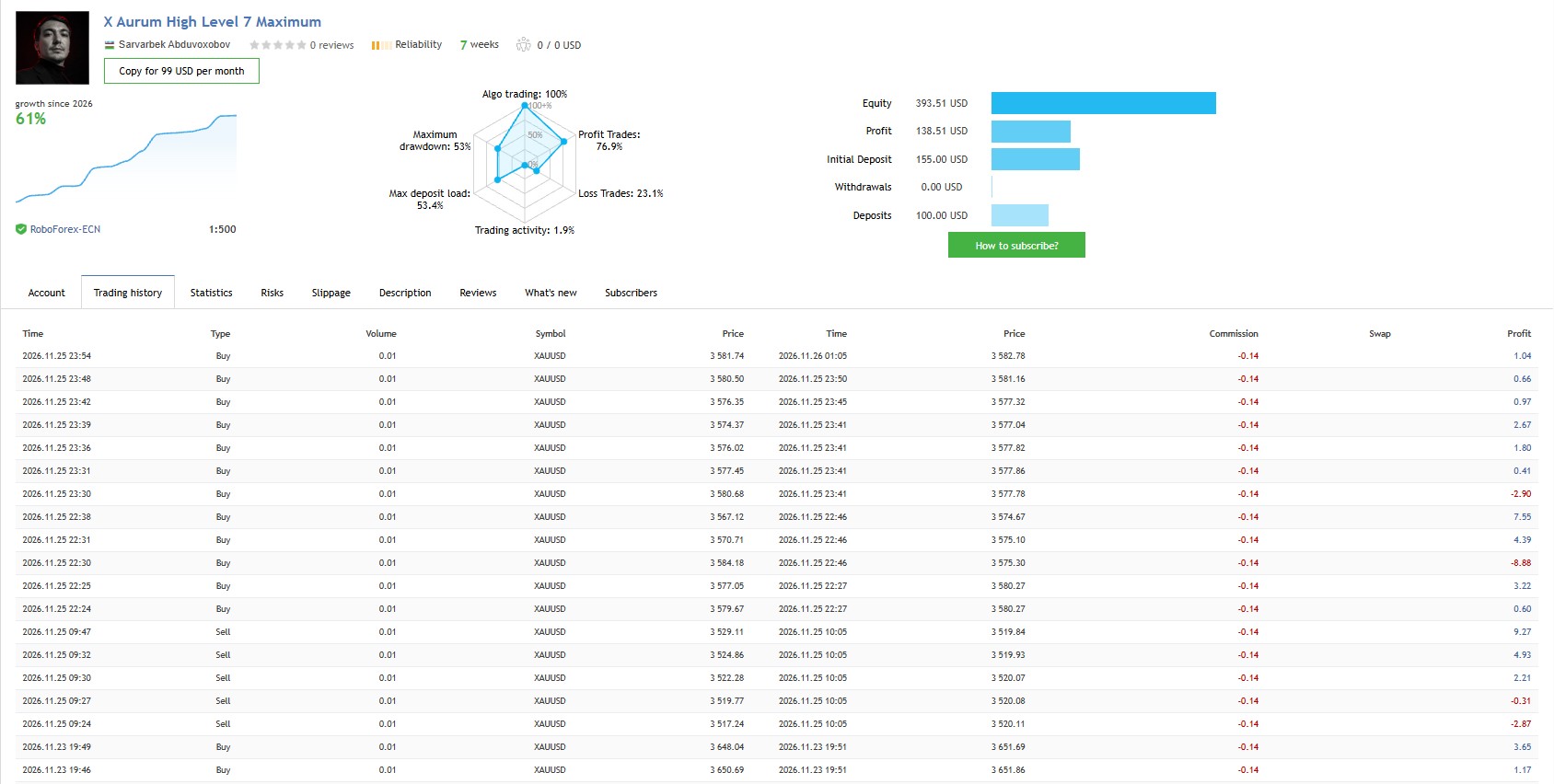
In automated trading, I handle this in X-Aurum EA, which runs eleven independent strategies, each with its own session window and entry confirmation. The live results are public: X-Aurum live signal.
2. Trading against the trend, or trading a flat market
Gold tends to trend more persistently than most currency pairs. Repeatedly selling into a strong advance in the hope of catching the top is one of the most common ways traders lose on this instrument. The opposite error is equally expensive: taking every small move while the market is going sideways and paying the spread each time.
A simple discipline helps with both. Define the direction on a higher timeframe such as H1 or H4, trade only in that direction on the lower timeframe, and stand aside when the higher timeframe has no clear structure.
This is the logic behind Trend Sniper X. It does not repaint, it includes a filter that suppresses signals in flat conditions, and its multi-timeframe panel shows the trend state across timeframes in one place. It currently holds a 4.9 rating from 41 user reviews. An MT4 version is also available: Trend SniperX MT4.

3. Ignoring the spread
The XAUUSD spread is not constant. Around the daily rollover, roughly at midnight server time, and in the minutes before major releases, it can widen several times over its normal level. A stop placed close to the market can be triggered by the spread alone, even if the price on the chart never appears to reach it.
In practice this means avoiding new positions around rollover, checking the current spread before entering, and making sure that any expert advisor you run has a spread condition rather than trading at any cost.
4. Using a fixed stop loss
A stop of a fixed size means something very different on a quiet day and on a day with a central bank decision. On the first it may be far too wide; on the second it may be inside normal noise. If the stop is fixed, the real risk of the trade changes from day to day without the trader deciding it.
A more consistent approach is to size the stop according to current volatility, for example with ATR, and then adjust the position size so that the amount at risk stays the same. On volatile days this means a wider stop and a smaller lot, not a tighter stop.
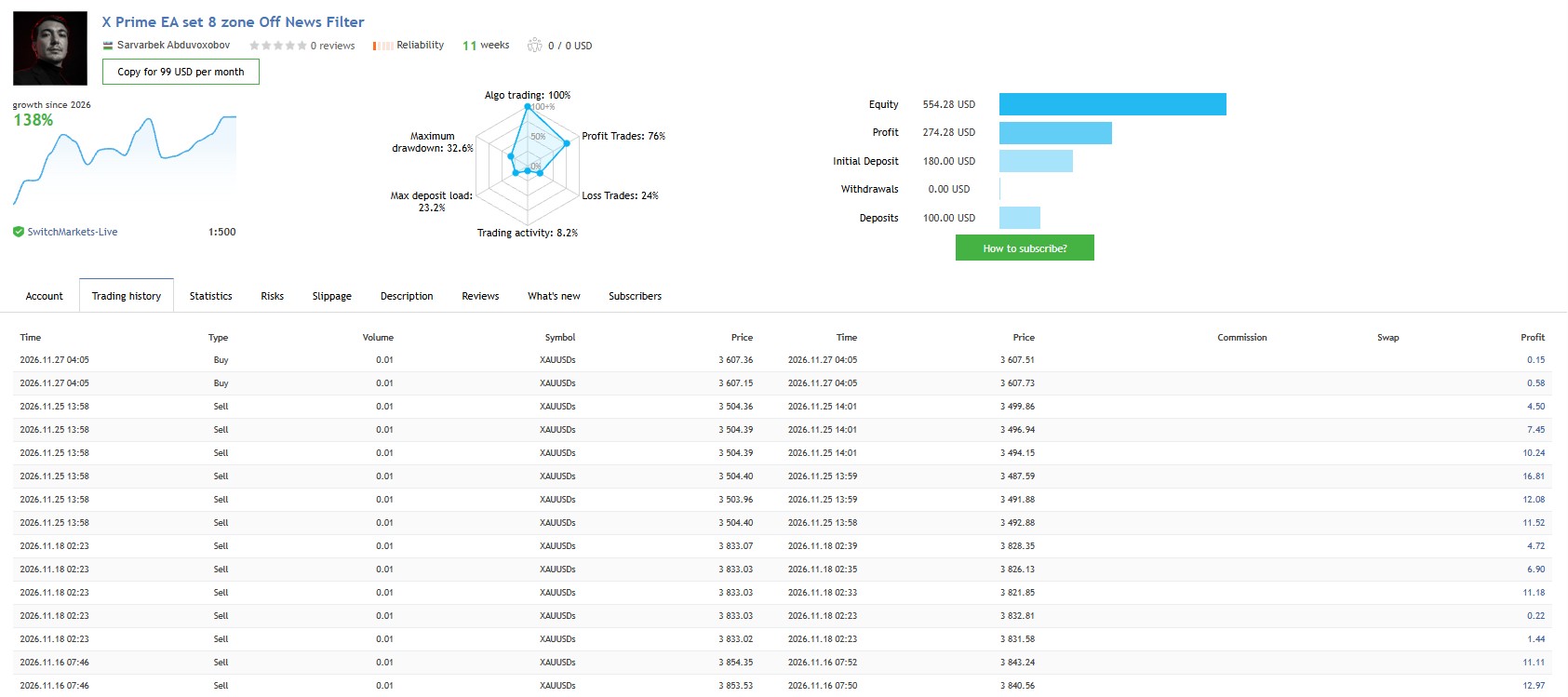
X-Prime EA is built on this principle. It combines market structure analysis with volatility-based trade management and strict capital protection. Live results: X-Prime live signal.
5. Trading through high-impact news without a plan
On days with CPI, Non-Farm Payrolls or an FOMC decision, gold can move more in a few minutes than in the entire previous session. Spreads widen, execution slips, and stops on both sides of the market are often taken out before a direction is established.
There are two reasonable approaches: stay out of the market around these releases, or use a strategy designed specifically for them. What causes damage is being in a position by accident when the number comes out. Checking the economic calendar at the start of each day takes a minute and prevents most of these situations.
6. Taking too much risk and too many trades
Large daily ranges encourage large positions. One lot of gold does not carry the same value as one lot of EURUSD, and contract specifications differ between brokers, so many traders risk five or ten percent per trade without realising it. Grid and martingale methods magnify this: they produce smooth equity curves for long periods and then fail in a single move.
The rules that protect an account are simple. Risk a fixed percentage per trade, typically one to two percent, and calculate the lot size from it. Use a stop loss on every position. Set a daily loss limit and stop trading once it is reached.
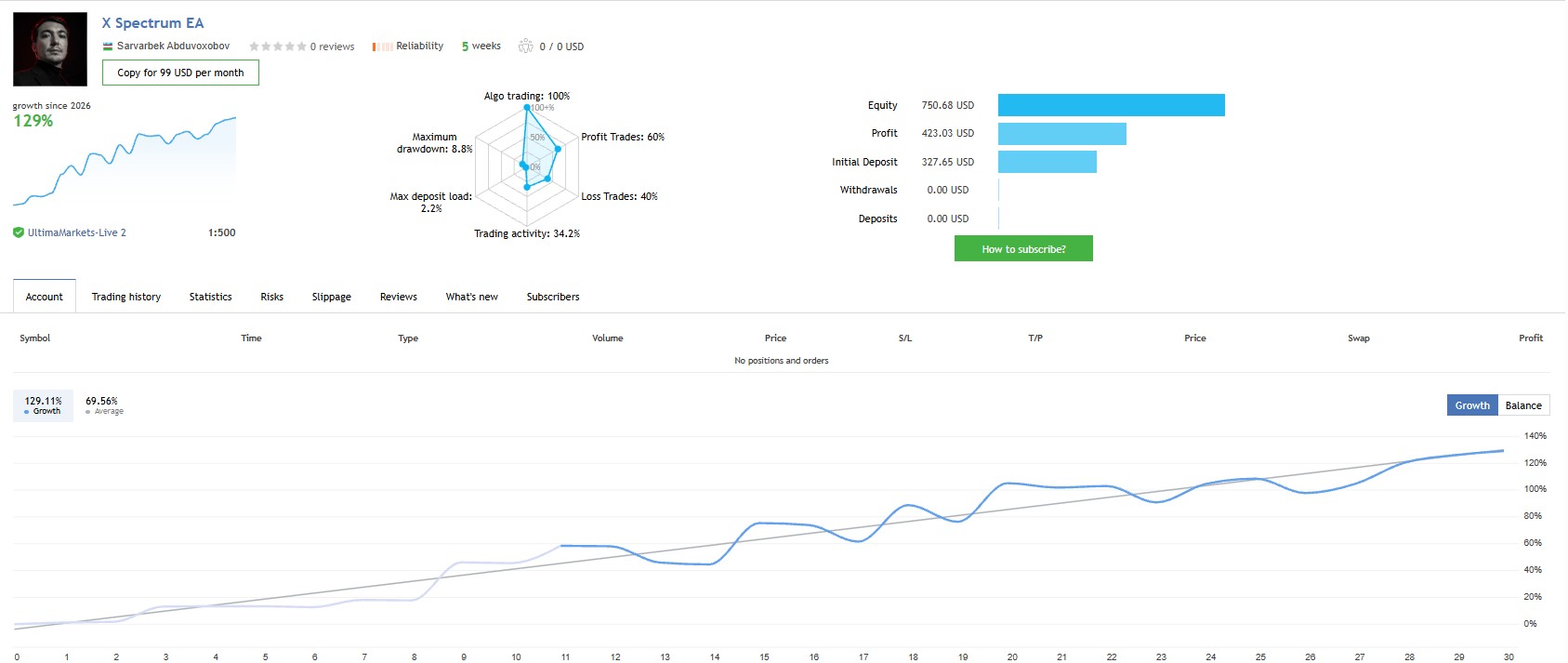
X-Spectrum EA follows these rules strictly. It trades five markets from a single chart (XAUUSD, USDJPY, BTCUSD, US30 and DE40), opens at most one trade per day, places a stop loss on every position, and uses no grid or martingale. Live results: X-Spectrum live signal.
For traders working on prop firm evaluations, where a single bad day can end the challenge, I developed Prop Guardian EA, a semi-automated system with risk management designed around evaluation rules.
7. Overlooking the swap
This is the cost I see ignored most often. Gold usually carries a negative swap, frequently on both long and short positions, and many brokers charge it three times on one day of the week. For a strategy that holds positions for several days, or a grid that keeps many positions open, the swap accumulates quietly. The backtest may look fine while the live account slowly loses ground.
The swap values for XAUUSD are shown in MetaTrader under Symbol, then Specification. It is worth checking them with your broker, avoiding a large overnight exposure on the triple-swap day, and including swap in any evaluation of a long-holding strategy.
For traders who do use grid methods, drawdown control is essential. Cent Guardian EA uses a dynamic grid with adjustable drawdown limits and continuous balance protection, and works on both cent and standard accounts.
A short checklist before each XAUUSD trade
- Which session is the market in?
- Is the trade in the direction of the higher timeframe, and is there a trend at all?
- Is the spread at its normal level?
- Is the stop based on current volatility?
- Is any high-impact USD data due?
- Is the risk on this trade within one to two percent?
- If the position is held overnight, what will the swap cost?
None of these questions takes long to answer, and together they remove most of the avoidable losses on gold.
Black Friday offer
For a limited time, the following three products are available from $99:
- Trend Sniper X: a non-repainting multi-timeframe trend indicator with a flat-market filter, MTF panel and alerts. Available for MT5 and MT4.
- X-Aurum EA for MT5: eleven session-based strategies for XAUUSD. Live signal.
- X-Prime EA for MT5: market structure and volatility-based trading on XAUUSD with strict capital protection. Live signal.
Other expert advisors for MT5:
- X-Spectrum EA: five markets, one trade per day at most, stop loss on every position, no grid or martingale. Live signal.
- Cent Guardian EA: dynamic grid with drawdown control for cent and standard accounts.
- Prop Guardian EA: semi-automated system for prop firm evaluations.
Free tools: Session Master and Trend Pulse MTF.
All products, signals and contact details are on my profile.
I would be interested to hear which of these points has cost you the most in your own trading. Feel free to share in the comments; I read and reply to all of them.
Trading involves risk. Past performance does not guarantee future results.


