Traders talk about the London open, the New York cash open and “news hours” as if those labels were already a measurement. This note measures them. It takes every H1 bar of XAUUSD on one broker server, from 2 January 2020 to 13 November 2026, and asks a simple question: in which hour of the day, and on which weekday, is the typical high–low range of gold actually larger?
All figures come from 40,608 XAUUSD H1 bars (1,774 trading days) exported from a MetaTrader 5 terminal connected to FreshForex-MT5. The first bar in the window is 2 January 2020, 04:00 server time; the last is 13 November 2026, 23:00. Times below are that server’s clock. There are no Saturday or Sunday H1 bars in this sample. Your broker’s prices and session clock may differ slightly. Nothing here is a promise of results; past data does not guarantee future results.
The hour matters; the weekday barely does
The median high–low range of all H1 bars in the sample is 5.10 USD (the mean is 8.19, pulled up by the heavy tail). Split the same bars by weekday and the medians barely move:
| Weekday | Bars | Median H1 range | Mean | 90th percentile |
|---|---|---|---|---|
| Monday | 8,058 | 5.21 | 8.34 | 16.90 |
| Tuesday | 8,222 | 5.02 | 7.96 | 16.88 |
| Wednesday | 8,173 | 5.04 | 8.09 | 17.34 |
| Thursday | 8,176 | 5.15 | 8.32 | 17.67 |
| Friday | 7,979 | 5.09 | 8.23 | 17.07 |
The largest weekday median is only 3.8% above the smallest. Thursday has a slightly heavier right tail (the 90th percentile is 17.67 USD), but the typical hour of gold is almost the same on Monday as on Friday.
Split the same bars by the hour of the bar’s open, and the picture changes by a factor of three. Hour 00 is omitted from the ranking: the server has only 123 such bars in six years, around the daily rollover, and their mean range (11.32) is much larger than their median (4.12) because of occasional gaps. Every other hour has about 1,590 to 1,774 bars.
| Server hour | Bars | Median range | Mean | 90th percentile | Share of that day’s H1 ranges |
|---|---|---|---|---|---|
| 01 | 1,769 | 3.25 | 7.02 | 15.80 | 3.24% |
| 02 | 1,769 | 3.29 | 6.32 | 13.87 | 2.98% |
| 03 | 1,769 | 4.51 | 8.69 | 19.32 | 4.19% |
| 04 | 1,773 | 5.18 | 9.21 | 21.25 | 4.60% |
| 05 | 1,773 | 4.03 | 6.90 | 15.81 | 3.52% |
| 06 | 1,773 | 3.21 | 5.47 | 12.80 | 2.82% |
| 07 | 1,773 | 3.45 | 6.01 | 12.63 | 3.00% |
| 08 | 1,773 | 4.35 | 7.56 | 16.73 | 3.81% |
| 09 | 1,773 | 5.40 | 7.86 | 15.96 | 4.40% |
| 10 | 1,773 | 6.01 | 8.35 | 15.75 | 4.74% |
| 11 | 1,773 | 5.21 | 7.70 | 14.92 | 4.24% |
| 12 | 1,773 | 4.75 | 6.85 | 13.87 | 3.83% |
| 13 | 1,773 | 4.69 | 7.10 | 13.69 | 3.85% |
| 14 | 1,773 | 5.38 | 8.09 | 15.70 | 4.40% |
| 15 | 1,773 | 9.70 | 13.25 | 25.28 | 7.82% |
| 16 | 1,774 | 10.32 | 13.97 | 26.57 | 8.02% |
| 17 | 1,774 | 9.59 | 13.47 | 25.49 | 7.63% |
| 18 | 1,774 | 6.65 | 10.01 | 20.19 | 5.50% |
| 19 | 1,774 | 5.24 | 7.84 | 16.03 | 4.23% |
| 20 | 1,755 | 4.84 | 7.52 | 14.76 | 3.98% |
| 21 | 1,747 | 4.01 | 7.05 | 14.97 | 3.66% |
| 22 | 1,714 | 3.91 | 6.73 | 14.26 | 3.37% |
| 23 | 1,590 | 2.88 | 4.67 | 9.57 | 2.41% |
(Chart: chart_xau_hour_weekday.png.)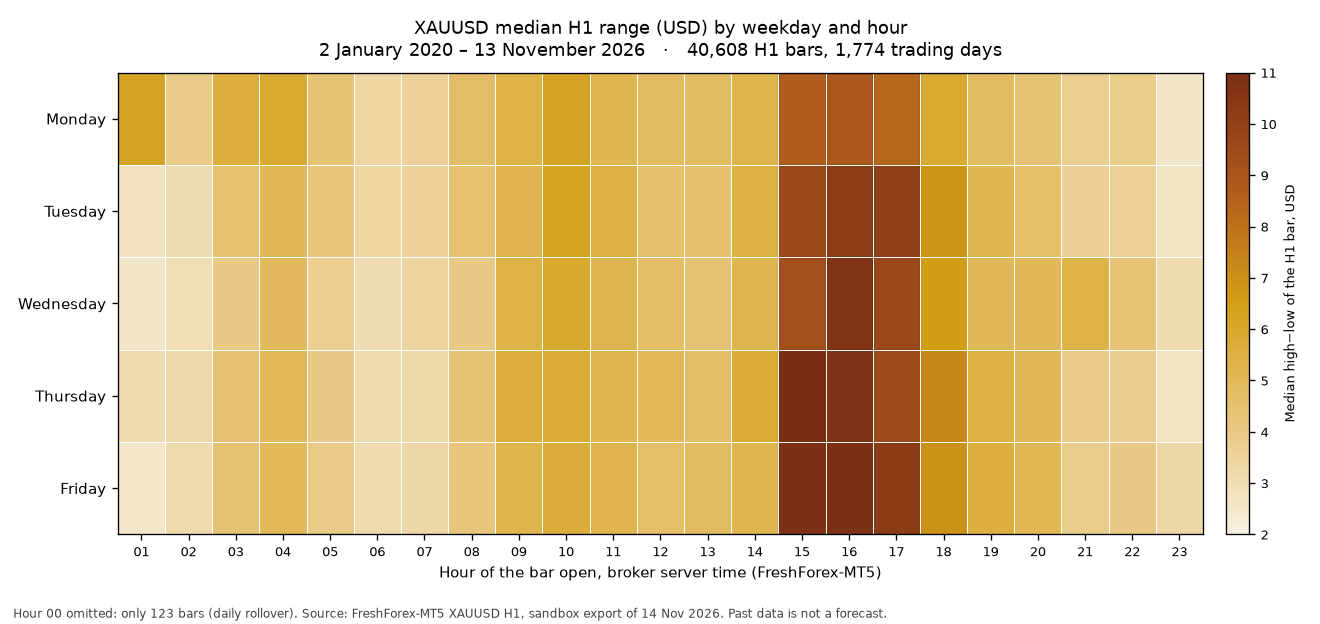
The three hours 15, 16 and 17 are in a class of their own. Their medians are 9.70, 10.32 and 9.59 USD. Hour 16 is 3.6 times the quietest regular hour (hour 23, median 2.88) and twice the sample median of 5.10. Together, those three hours contribute on average 23.5% of the sum of that day’s H1 ranges, about twice what three average hours would contribute. The 90th percentiles sit between 25 and 27 USD: a “typical busy hour” on gold in this sample is already a 10-dollar bar, and one hour in ten is a 25-dollar bar.
How to read the server clock
On this server the clock in mid-November 2026 was GMT+2 (winter time). With that offset:
- Hour 15 is 13:00–14:00 GMT, which in US winter time is 08:00–09:00 Eastern, the window that contains the 08:30 data releases.
- Hour 16 is 14:00–15:00 GMT, 09:00–10:00 Eastern, the window that contains the 09:30 cash open of US equities.
- Hour 17 is 15:00–16:00 GMT, 10:00–11:00 Eastern.
- Hour 10 is 08:00–09:00 GMT, the London cash open in winter.
- Hour 04 is 02:00–03:00 GMT, 10:00–11:00 in China.
The map shifts by one hour when the server, London or the United States moves the clock. The ranking of the hours is a fact about this server’s tape; the city names are only a translation.
Two quieter peaks, and the quiet hours
The next rung below the US block is hour 10 (median 6.01), then hour 18 (6.65) and hour 09 (5.40). That is the London morning and the hour after the US burst. There is also a clear Asian bump: hours 03 and 04 (medians 4.51 and 5.18) are livelier than the hours on either side.
The quietest regular hours are 23, 06, 01, 02 and 07 (medians 2.88 to 3.45). Hour 06, just before the European morning, is the calmest hour that is not the daily close.
Monday is the one weekday that leaves a mark on the heatmap, and it does so at the open, not in the US block. The median range of Monday’s hour 01 is 6.18 USD; Tuesday’s hour 01 is 2.76. The US hours are actually milder on Monday (hour 16 median 8.87) than on Tuesday (10.17) or Friday (10.86). The single hottest cell in the weekday–hour grid is Thursday’s hour 15, at 10.94 USD.
The pattern is stable, the size is not
In every year from 2020 to 2026 the three largest median hours are 15, 16 and 17, almost always in the order 16, then 15 or 17. The ratio of hour 16 to hour 23 stays between 2.7 and 5.3. What does change is the scale. For 2020–2024 the median H1 range of the whole tape was 4.01 USD and hour 16 was 8.44; for 2025–2026 those figures are 12.54 and 21.61. In 2025 and 2026 hour 04 also climbed into the top five, ahead of the London morning hour. Gold became more expensive and more volatile, but it did not change the time of day at which it moves.
What this is useful for
A stop or a take-profit that is comfortable at 06:00 can be ordinary noise at 16:00. If you size from an ATR computed over a full day, you are averaging a 3-dollar hour with a 10-dollar hour. If you test an entry rule, a back-test that is allowed to trade at any hour is answering a different question from one that trades only in hours 15–17, or only in hours 01–07.
The figures do not say that gold “must” move at 16:00, and they do not say that a weekday is safe. They only say that, on this tape, the typical H1 range is decided by the hour of the day, not by the name of the weekday, and that the three hours around the US morning have been the busiest every year since 2020.
In our own EA, Golden Sniper XAU, the same XAUUSD H1 chart is the working timeframe. The numbers above describe the market, not a particular set of rules: https://www.mql5.com/en/market/product/207995