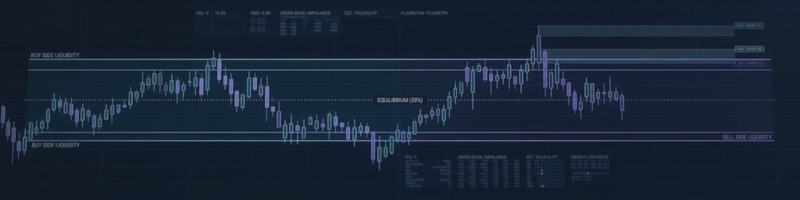
The Mechanics of Pre Market Liquidity Accumulation: How Institutional Order Flow Dictates the Nasdaq Cash Open

The Opening Bell Illusion
Every trading day at 09:30 Eastern Time, retail traders across the globe watch index charts violently surge. Breakout buyers jump into rising green candles, while breakdown sellers place market orders as soon as price breaches a visible structural level.
Within minutes, the rally stalls. Market makers use clustered retail stop orders to fill massive institutional positions, triggering sharp reversals that run through the entire morning range.
This pattern is neither random nor unpredictable. In Smart Money Concepts and Auction Market Theory, this represents the foundational law of price delivery: markets must seek liquidity before they can engineer genuine directional displacement.
Phase One: Session Liquidity Accumulation (02:00 to 09:30 Eastern Time)
Before any trade can be validated, algorithmic models must define where market makers have engineered resting stop loss pools. In institutional order flow modeling, this accumulation period spans from the London open (02:00 Eastern Time) to the New York cash open (09:30 Eastern Time).
During this seven and a half hour window, three structural benchmarks are established:
- Buy Side Liquidity Ceiling: The highest price achieved during the pre market accumulation window. Clustered above this boundary are retail breakout buy orders and short sellers protective stops.
- Sell Side Liquidity Floor: The lowest price recorded during the session. Clustered beneath this boundary are breakdown sell orders and buyers protective stops.
- Equilibrium Midline (Fair Value): The exact arithmetic midpoint between Buy Side Liquidity and Sell Side Liquidity. Prices above this level represent premium valuation, while prices beneath represent discount valuation.
Phase Two: Institutional Execution Pathways
Once the opening bell rings at 09:30, the pre market boundaries become fixed reference levels. Systematic models do not gamble on opening direction. Instead, they track institutional participation through two distinct structural pathways:
Pathway One: Turtle Soup Sweeps and Market Structure Shifts
When an opening candle wicks outside the accumulation boundary but fails to maintain body acceptance past an expansion threshold, buyers or sellers lack institutional backing.
The algorithm monitors subsequent bars for a decisive Market Structure Shift, confirmed when a candle closes beyond the immediate swing point formed during the sweep. This confirms that smart money has absorbed liquidity and taken control of order flow. Protective stops anchor safely beyond the sweep wick, targeting the Equilibrium Midline as initial target and the opposing liquidity boundary as secondary target.
Pathway Two: Displacement Expansion and Mitigation Retests
When major macroeconomic catalysts are present, market makers do not reverse; they displace aggressively.
A full candle body closes decisively beyond the accumulation extreme. Rather than chasing momentum, the system waits for an institutional retracement back to the broken boundary, known as the Mitigation Order Block retest. A continuation entry executes on touch of the retest level, with protective stops anchored at the Equilibrium Midline.
The Asymmetric Profit Engine: Dual Target Distribution
A critical vulnerability in retail trading is the all or nothing exit. Exiting an entire position early leaves substantial macro runners behind, while holding everything for distant targets often allows winning trades to reverse into full losses.
| Target Tier | Allocation | Objective Level | Capital Protection Action |
|---|---|---|---|
| Take Profit One (Bank Target) | 50 percent of volume | Equilibrium (50 percent Fair Value) | Secures realized cash profit early in the expansion phase. |
| Automated Breakeven Shield | Remaining volume | Entry price plus point lock | The microsecond Take Profit One fills, the stop loss on remaining volume moves to breakeven, removing all risk. |
| Take Profit Two (Macro Runner) | 50 percent of volume | Opposing Liquidity Pool | Participates in extended daily session trends completely risk free. |
Capital Protection for Funded Evaluation Accounts
Trading volatile equity indices such as Nasdaq 100 on funded prop firm accounts requires strict risk controls:
- Daily Equity Loss Circuit Breaker: Dynamically tracks day start equity. If equity loss touches a pre configured threshold (such as 4 percent), all positions and orders close immediately, halting trading until the next calendar day.
- Strict Trade Frequency Discipline: Restricts execution to validated session setups, preventing emotional revenge trading.
- Zero Toxic Mechanics: Strictly NO martingale, NO grid averaging, and NO cost averaging. Every trade carries a hard server side stop loss upon order dispatch.
Testing and Operational Specifications
To evaluate this methodology effectively on MetaTrader 5:
- Attach the strategy to a Nasdaq 100 (NAS100, USTEC, US100) chart on the 2 Minute (M2) or 5 Minute (M5) timeframe.
- Ensure server time calculation aligns with New York session hours through automated GMT offset conversion.
- For backtesting simulations, select Every Tick Based on Real Ticks in the Strategy Tester to guarantee authentic spread and execution quality.
Conclusion
Market makers do not operate on lagging oscillators; they operate on liquidity pools, session timing, and order book imbalances. By aligning execution with pre market accumulation boundaries and systematic displacement rules, traders transform from being hunted retail liquidity into systematic participants executing alongside smart money.
Risk Disclosure
Trading leveraged financial products, including stock index futures and foreign exchange, carries significant financial risk. Past results demonstrated in simulated environments do not guarantee future performance. Always test algorithmic software thoroughly on demo accounts prior to deploying live capital.