The Mechanics of Candlestick Liquidity Sweeps: Trading Institutional Trend Reversals

1. The Retail Breakout Dilemma
In modern financial markets, the most common retail trading setup is also the most consistently unprofitable: the standard breakout. Retail traders are taught to place buy stop orders above previous highs and sell stop orders below previous lows. They expect instant momentum expansion when price crosses those visible structural levels.
However, institutional market makers and algorithmic liquidity providers do not view previous candle highs and lows as breakout points. Instead, they view those levels as dense pools of resting buy stop orders and protective stop losses. When institutional participants need to fill massive sell positions without driving market prices against their own books, they intentionally push price slightly beyond the previous high. This triggers retail buy stops, generates an immediate surge of retail buying liquidity, and allows institutions to sell into that liquidity at premium prices.
The moment institutional absorption is complete, buying volume evaporates. Price reverses aggressively back inside the previous range, trapping breakout traders in deep drawdown and hitting their protective stops. This exact phenomenon is known in Inner Circle Trader concepts and Smart Money Concepts as a liquidity sweep.
2. The Anatomy of an Institutional Liquidity Sweep
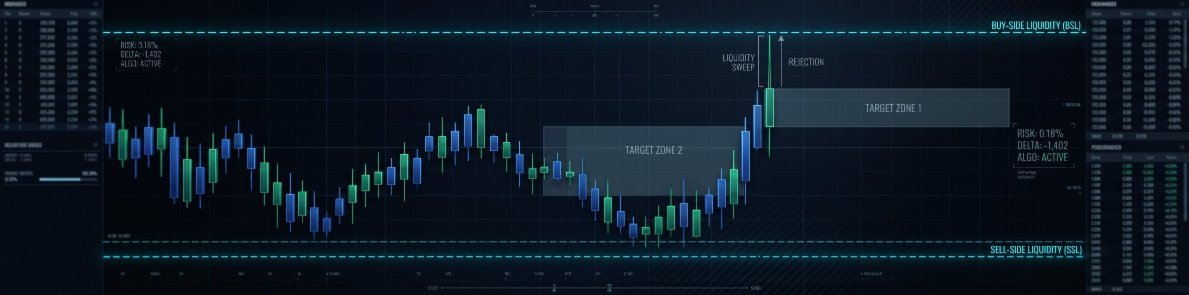
To understand how liquidity sweeps operate on high resolution candlestick charts, we examine the micro mechanics of a two bar liquidity sweep:
- The Structural Benchmark: Bar one establishes a distinct high and low boundary, representing short term liquidity reference points.
- The Liquidity Piercing: Bar two opens and surges beyond the extreme of bar one. On lower timeframes or retail heatmaps, this appears as an active breakout.
- The Institutional Absorption: Massive resting liquidity is absorbed at the extreme. Institutional limit orders consume all retail breakout volume.
- The Rejection Close: Bar two fails to maintain acceptance outside the boundary. Instead, bar two closes back inside the body range of bar one, leaving an elongated wick piercing beyond the structural extreme.
This rejection close is the definitive signature of smart money intervention. When this pattern occurs in alignment with macro trend direction, it represents one of the highest expectancy reversal and trend continuation setups available in quantitative trading.
3. Why Manual Execution Fails on Liquidity Sweeps
While the technical logic of candlestick sweeps is straightforward, executing them manually presents severe psychological and structural hurdles:
- Psychological Hesitation: Entering at the exact moment a sweep occurs requires buying when the immediate price action looks violently bearish, or selling when the immediate candle appears strongly bullish. Most discretionary traders hesitate, waiting for confirmation, only to enter after the majority of the move has already transpired.
- Latency and Slippage: On fast moving assets such as Nasdaq 100, US30, or Gold, reversal impulses happen in fractions of a second. Discretionary click execution frequently suffers from execution delays and adverse slippage.
- Order Entry Indecision: Choosing between a market execution on candle close versus a pending stop order at the sweep extreme requires disciplined rule adherence. A pending order ensures that price must confirm momentum before filling the position, eliminating false triggers.
- Risk Management Inconsistency: Manual traders frequently adjust stops, widen targets, or fail to move protective orders to breakeven, turning mathematically profitable strategies into losing accounts.
4. The Algorithmic Solution: Apex Reversal Pro MT5
To eliminate human emotion, manual latency, and inconsistent trade management, we engineered Apex Reversal Pro for MetaTrader 5. Apex Reversal Pro translates pure institutional liquidity mechanics into a systematic, rule based execution engine.
Core Algorithmic Workflow
- Macro Trend and Bias Identification: The algorithm maps market bias through ICT Market Structure (identifying Higher Highs and Higher Lows for bullish regimes versus Lower Lows and Lower Highs for bearish regimes) paired with an Institutional Baseline Moving Average. Trading occurs strictly in the direction of institutional order flow.
- Micro and Swing Liquidity Detection: The algorithm monitors incoming ticks to identify sweeps of preceding candle extremes or multi bar swing pullback levels.
- Momentum Confirmation Entry: Rather than chasing market price, the Expert Advisor automatically places a Pending Stop Order at the sweep candle extreme plus a configurable offset. This guarantees that capital is committed only when price decisively breaks out in the reversal direction.
- Calculated Stop Loss Anchor: The protective stop is mathematically anchored directly to the extreme of the sweep candle plus an institutional buffer. This provides a tight, logical invalidation level with minimal dollar exposure.
5. Dual Target Runner Architecture
A critical limitation of retail trading algorithms is the all or nothing exit strategy. Exiting an entire position at a modest profit leaves massive trend runners behind. Conversely, holding an entire position for extreme targets often results in winning trades reversing into full losses.
Apex Reversal Pro solves this challenge through an institutional dual target profit architecture:
| Execution Tier | Volume Allocation | Target Distance | Strategic Function |
|---|---|---|---|
| Take Profit 1 (Bank Target) | 50 percent of total position | 1 to 1 Risk to Reward Ratio | Secures realized profit early in the expansion phase. |
| Automated Breakeven Shield | Remaining position | Entry price plus point lock | The microsecond Take Profit 1 is executed, the stop loss on the remaining volume moves to breakeven plus a profit buffer, completely removing risk. |
| Take Profit 2 (Macro Runner) | 50 percent of total position | 1 to 2 Risk to Reward Ratio (or higher) | Captures extended trend continuation risk free, maximizing total mathematical expectancy. |
6. Prop Firm Capital Protection Suite
Modern quantitative trading requires strict adherence to institutional capital protection metrics, especially for traders managing funded prop firm accounts such as FTMO, FundedNext, and Topstep. Apex Reversal Pro integrates hardware grade circuit breakers:
- Daily Equity Loss Circuit Breaker: The algorithm calculates equity loss relative to daily starting equity. If the user defined threshold (such as 4 percent) is breached, all open positions and pending orders are instantly terminated, and trading is suspended until the next calendar day.
- Maximum Total Drawdown Guard: Continuous monitoring of peak equity guarantees that trailing drawdown limits are never violated.
- Trade Frequency and Consecutive Loss Caps: Limits the number of executions allowed per calendar day and halts operations after a preset count of consecutive losses to prevent emotional overtrading during choppy market conditions.
- Zero Toxic Mechanics: The system employs strictly NO martingale, NO grid averaging, NO cost averaging, and NO toxic latency arbitrage. Every position carries a hard server side stop loss upon order transmission.
7. Recommended Operational Setup
For optimal performance and consistent order fills, the following configurations are recommended:
- Target Instruments: Nasdaq 100 (NAS100 / USTEC), US30, Gold (XAUUSD), EURUSD, and GBPUSD.
- Recommended Timeframes: 1 Minute (M1), 2 Minute (M2), and 5 Minute (M5).
- Account Architecture: Raw Spread or ECN account with minimal commission and direct market access.
- Execution Latency: Low latency Virtual Private Server (VPS) located close to broker trading servers for sub millisecond routing.
- Testing Model: Always conduct MetaTrader 5 Strategy Tester simulations using Every Tick Based on Real Ticks for authentic spread, slippage, and execution fidelity.
8. Conclusion and Downloadable Strategy Demo
Financial markets are designed to transfer capital from participants who trade lagging indicator signals to institutional participants who understand liquidity pools. By identifying candlestick sweeps within established trend structures and deploying automated pending stop execution, traders can systematically capture institutional order flow.
You do not need to execute these demanding setups manually or sit in front of charts for hours waiting for candle closes. Experience the quantitative precision of Apex Reversal Pro MT5 on your own charts today.
Explore Apex Reversal Pro MT5 on the Official MQL5 Market
Download the free Strategy Tester demo, review the transparent telemetry HUD, and test the algorithm across historical market conditions.
Risk Disclosure
Trading foreign exchange, equities, indices, and leveraged derivatives carries substantial financial risk and is not suitable for all investors. Past performance demonstrated in historical testing does not guarantee future results. Always verify software thoroughly on demo accounts before deploying live capital.