COPYLATOR – MT5 Trade Copier: The 80% Zone — What to Do When You Are Close to Your Drawdown Limit

Product link:
https://www.mql5.com/en/ market/product/191385
Drawdown protection has two states: not triggered and triggered. Many traders think about it in those terms. The limit is a line, and the account is either below it or has reached it.
In practice, there is another important stage: the zone between roughly 70% and 99% of the drawdown limit. At this point, the account has used most of its permitted drawdown, but the protection has not yet been triggered. This is the 80% zone, and having a plan for it can help traders manage risk before the configured threshold is reached.
What Makes the 80% Zone Different?
An account that has used only 20% of its drawdown allowance may have considerable room before reaching its configured limit. An account that has used 85% has much less room to absorb further losses.
A single adverse trading session, several correlated positions, or an ordinary losing sequence could push the account closer to the threshold. However, the trading strategy may continue opening positions at its usual size, and the copier may continue copying orders according to its configuration.
Drawdown protection is designed to respond when its configured conditions are met. Unless a separate risk-management rule is in place, it does not necessarily reduce exposure gradually as the account approaches the limit.
The Case for Doing Nothing
The first option is to make no changes, and this approach deserves consideration.
If the strategy has historically experienced similar drawdowns and recovered within its expected range, reducing position size every time the account reaches 80% of its drawdown allowance may interfere with the strategy's planned risk allocation.
Repeatedly reducing position size can also change the strategy's realized returns. If the original drawdown limit was chosen to accommodate normal fluctuations, intervening too early may effectively impose a tighter limit than originally intended.
Doing nothing can be reasonable when the drawdown remains consistent with the strategy's historical behavior, the account's risk limits are appropriate, and the trader has accepted the possibility of reaching the configured threshold.
Historical recovery is not a guarantee of future recovery, however. The decision should consider current exposure and market conditions as well as past performance.
The Case for Partial De-Risking
The second option is to reduce the size of new copied trades without stopping copying entirely.
The principle is straightforward: smaller positions generally create less exposure to subsequent price movements. If the account is already close to its drawdown limit, reducing the size of new trades may help limit additional losses, depending on market conditions and existing positions.
For example, a trader using a lot multiplier of 1.0 might decide in advance to reduce it to 0.5 when a predefined drawdown threshold is reached. If the copier applies the new multiplier as configured, subsequent trades would be opened at approximately half the usual calculated size.
This approach has a trade-off. Smaller positions can reduce losses, but they also reduce profits from winning trades. They do not guarantee that the account will avoid its drawdown limit, particularly when several positions are already open or markets move sharply.
The objective is not to eliminate risk. It is to reduce exposure during a period when the account has less room to absorb further losses.
The Case for Pausing Copying
The third option is to pause copying when the account enters the 80% zone.
This may be appropriate when the drawdown is unusually large, the cause is unclear, or the trader needs time to review the strategy, current positions, market conditions, or copier configuration.
Pausing is a discretionary risk-management decision. It is different from the copier's drawdown protection being triggered automatically at its configured threshold.
Pausing also has a cost: the account may miss profitable trades during the recovery period. Conversely, it may avoid some losses. Neither outcome can be known in advance.
Before pausing, check what happens to positions that are already open. Stopping or pausing copying does not necessarily close existing receiver positions. Their management depends on the copier's behavior and the actions taken on the trading account.
The Diagnostic Question
Before choosing among these three responses, ask:
Is the current drawdown within the strategy's historical range, or is it unusually large compared with its previous behavior?
- Within the historical range: Maintaining the existing risk settings may be reasonable if the strategy, market conditions, and account limits remain consistent with the original plan.
- Outside the historical range: Review whether market conditions, the sender's trading behavior, position sizing, symbol mapping, or account configuration has changed. Reducing exposure or pausing while investigating may be appropriate.
Historical drawdown data can inform the decision, but it cannot establish what the next trade will do. Ideally, this diagnostic process should be defined before the account enters the 80% zone.
The Pre-Commitment Principle
A useful 80% zone policy is one that is decided in advance.
When traders make risk decisions while watching an account approach its drawdown limit, the pressure of the situation can influence their judgment. A written plan helps make the response more consistent.
For example, a trader might define the following policy:
- At 80% of the drawdown allowance used, reduce the lot multiplier according to a predetermined rule.
- At 90%, pause copying and review the account's exposure and recent performance.
- If the configured drawdown protection is triggered, follow the account's established recovery and review procedure.
- Restore the normal multiplier only after the account reaches a predefined recovery threshold and the conditions for resuming normal risk are satisfied.
These percentages are examples, not universal recommendations. The appropriate thresholds depend on the strategy, account rules, drawdown calculation, open exposure, and the trader's risk tolerance.
The Mechanics of Partial De-Risking
If partial de-risking is the chosen policy, it is important to understand how the change affects the account.
Reducing the lot multiplier: Lowering the multiplier can reduce the calculated size of subsequent copied trades. For example, changing a multiplier from 1.0 to 0.5 may halve the calculated size of new trades, subject to the copier's lot-sizing rules and broker volume constraints.
Changing the multiplier does not automatically reduce the size of positions that are already open. Existing positions generally retain their current volume unless they are separately modified or partially closed.
Reducing existing exposure: Partially closing selected positions can reduce current exposure more directly. However, this realizes part of the position's current profit or loss and may affect the intended trading strategy. It should be done only when consistent with the account's risk-management plan.
The appropriate action depends on the account's situation. If several substantial positions are already open, changing the size of future trades alone may not reduce current exposure sufficiently. If no positions are open, adjusting the multiplier may be enough to implement the planned reduction in new-trade size.
The Symmetry Problem
A partial de-risking policy should define both when to reduce position size and when to restore it.
If the account reduces size at 80% of its drawdown allowance but never returns to normal size, the strategy may continue operating with a permanently lower allocation. This can reduce future profits as well as future losses.
Alternatively, a trader might reduce size at 80% and restore the normal multiplier only after the drawdown has fallen to 40% or 50% of the allowance used. This creates a wider gap between the reduction and recovery thresholds.
That gap can help prevent frequent changes between normal and reduced sizing. However, a symmetric policy is not automatically better for every strategy. The recovery threshold should be chosen in advance and tested against the strategy's behavior, account rules, and risk objectives.
Avoiding the False Recovery
One potential problem is a false recovery.
The account enters the 80% zone, the trader reduces position size, and a few winning trades bring the drawdown back to 60%. The trader immediately restores normal size. Another losing sequence then pushes the account back into the danger zone.
If the trader repeatedly switches between normal and reduced size at nearly the same threshold, the account can experience frequent changes in exposure without resolving the underlying cause of the drawdown.
A predefined recovery threshold can reduce this back-and-forth behavior. For example, if the policy calls for reducing size at 80%, the trader might require the drawdown to fall below 50% before restoring normal sizing.
The exact values should reflect the strategy's historical behavior and the account's risk requirements. A recovery threshold is a control rule, not proof that the strategy's losing phase has ended.
Combining the 80% Zone with a Drawdown Cooldown
The 80% zone policy and a drawdown cooldown serve different purposes and can be considered together.
- Early response: Reduce exposure or review the account before the configured drawdown limit is reached.
- Protection threshold: Allow COPYLATOR's configured drawdown protection to take the action specified by its settings when the relevant limit is triggered.
- Post-trigger review: Use a predefined procedure before resuming normal copying, rather than immediately restarting without investigating the cause.
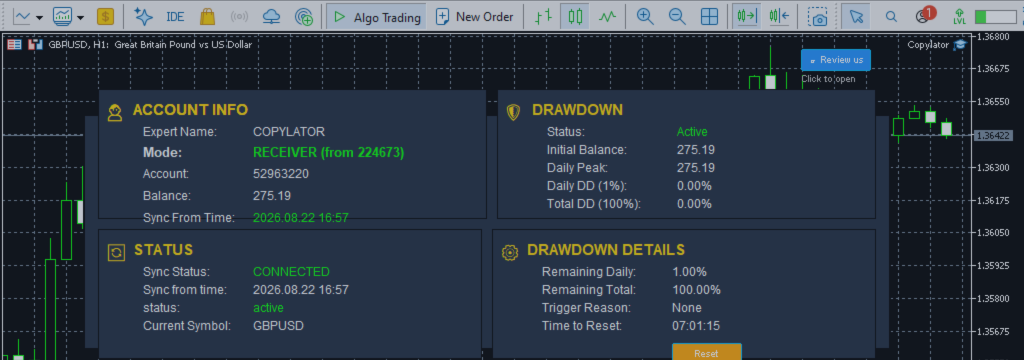
In COPYLATOR, drawdown-protection behavior depends on the configured settings. When CloseOrdersOnDrawdown=true , the configured response includes closing positions and deleting pending orders when the protection is triggered. When it is set to false , copying is blocked without the automatic position-closing and pending-order-deletion actions described above.
These settings should be checked before trading. Account conditions, broker execution, slippage, gaps, and other factors can affect the final outcome, so drawdown protection should not be treated as a guarantee of a precise maximum loss.
A cooldown or manual review process should also specify when copying may resume and what happens to positions that remain open.
What to Record
Record the 80% zone policy in writing. Include the thresholds, actions, recovery conditions, and review process.
A useful record can include:
- The configured daily and total drawdown limits.
- The percentage of the drawdown allowance used when the response begins.
- The action taken: no change, reduced lot multiplier, partial position closure, or pause.
- The threshold required before normal sizing resumes.
- The number and size of open positions when the threshold is reached.
- The market conditions and any configuration changes that may have contributed to the drawdown.
- The outcome after the intervention, including whether the account reached its protection threshold.
Reviewing these records over time can help determine whether the policy is useful. Frequent visits to the zone may indicate that the strategy naturally experiences substantial drawdowns, the risk limits need review, or the current market environment differs from the historical sample. Infrequent visits do not automatically mean the limits are too loose.
Summary
The 80% zone is the period when a substantial portion of the drawdown allowance has been used, but the configured protection threshold has not yet been reached. It provides an opportunity to review risk before the protection acts.
Three broad responses are available:
- Do nothing when the drawdown is consistent with the strategy's expected behavior and the original risk plan remains appropriate.
- Reduce position size when limiting additional exposure is a priority.
- Pause copying when the drawdown is unusual or its cause needs investigation.
The best response depends on the strategy, account conditions, current exposure, and risk limits. Decide on the policy in advance, define both the reduction and recovery thresholds, and record the results for later review.
The drawdown limit is where the configured protection responds. The 80% zone is where a trader may choose to act earlier. Planning that response can make risk management more deliberate, although no policy can eliminate trading risk or guarantee that the account will remain below its limit.
Product link:
https://www.mql5.com/en/ market/product/191385