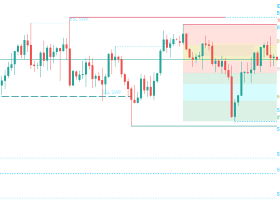

How does a trader actually generate income? At first, the answer seems simple: buy at a lower price and sell higher, or open a short positiob and close it at a lower price. But a winning trade and a profotable trading system are not the same thing. The outcome also depends on position size, the distribution of wins and losses, trading costs, and the size of losses during adverse conditions.
This article explains how trade results are calculated, illustrates expectancy with a simple example, and shows why drawdown matters as much as profit. If you are interested in MQL5 and automated trading, visit my profile and add me as a friend to follow future technical publications.

1. Where does trade profit come from?
With a long position, a trader buys an asset expecting its price to rise. If the closing price is above the entry price, the trade produces a gross profit before costs. With a short position, the trader sells first and hopes to buy back at a lower price. In both cases, the financial result depends on the price difference and position size.
For example, buying 10 shares at 100 and selling them at 110 produces a gross profit of 100 monetary units. If the price falls to 90 and the position is closed, the gross result is a loss of 100 units. This example explains the calculation; it is not a forecast or trading recommendation.
2. Why one winning trade proves very little
Performance should be evaluated across a series of trades. A system may record many small wins but occasionally suffer much larger losses. Despite a high win rate, its overall result can still be negative.
A simple measure is mathematical expectancy:
Expectancy = win probability × average win − loss probability × average loss.
Suppose a system wins 60% of trades, with an average win of 20 pips and an average loss of 25 pips. Its expectancy before costs is 0.6 × 20 − 0.4 × 25 = 2 pips per trade. After spreads, commissions, swaps, and slippage, that advantage may shrink or disappear.
3. Risk management
Positive expectancy does not eliminate drawdown. Losing streaks are a normal part of a probabilistic process, and oversized positions can turn an ordinary sequence of losses into a serious threat to account equity.
Before entering a trade, define the exit conditions, estimate the potential loss, and choose a position size that fits your capital and risk limits. A stop-loss order can help structure an exit, but it does not guarantee an exact fill during gaps or sharp mqrket moves.
4. Grid systems and averaging
Some trading systems open positions in a series and manage exits based on the combined position structure. Their logic may include partial closing and averaging. However, adding positions also increases overall market exposure.
VR Smart Grid is an example of an Expert Advisor for MetaTrader 4 and MetaTrader 5 that manages position grids and can close positions partially; when the market moves adversely, averaging can increase total exposure and drawdown.
A grid system should therefore not be evaluated only by how often it closes a profitable series. Maximum drawdown, margin requirements, position count, behavior during prolonged trends, and configured risk limits also matter.
5. How to test a strategy
Testing should include historical data, realistic trading costs, and different market periods. Key metrics include net profit, maximum drawdown, average win and loss, number of trades, and recovery time after a decline in equity.
Parameters optimized for a short historical period may not remain robust. Separate development data from validation data, then test the system on a demo account. Neither historical testing nor demo trading guarantees similar results in the future.
Conclusion
Trading income is not a reward for one accurate prediction. It is the outcome of the entire process: entry and exit rules, position size, trading costs, and risk control. Start with a clear strategy, evaluate a meaningful series of trades, and never ignore adverse scenarios.
If you develop Expert Advisors or study algorithmic trading, add the author as a friend on MQL5 to follow future publications.
Tags: trading, Forex, expectancy, trading strategy, risk management, MetaTrader, algorithmic trading, VR Smart Grid