Weekend Gaps and Drawdown Protection — When the Market Opens Above Your Stop

Product link:
https://www.mql5.com/en/ market/product/191385
Drawdown protection is designed to act when losses reach a configured threshold. It monitors account equity, compares it with the specified limit, and initiates protective actions when the relevant conditions are met. Under normal market conditions, equity may decline gradually, allowing the protection to detect the breach and respond.
Weekend gaps create a different situation. The market closes on Friday and reopens on Sunday or Monday at a price that may differ significantly from Friday's closing price. Account equity can change sharply before the protection has an opportunity to respond.
The protection may trigger as soon as the new equity value is detected, but the loss caused by the gap has already occurred. This is a market risk that no copier can eliminate. Managing it requires appropriate configuration and preparation rather than simply choosing a different copier.
How a Weekend Gap Can Bypass Drawdown Protection
A weekend gap occurs when a market reopens at a price significantly different from its previous closing price. The difference may result from economic announcements, geopolitical developments, changes in market sentiment, or other events that occur while the market is closed.
For a position held over the weekend, an adverse gap can immediately increase the unrealized loss. The account may open the new trading week with equity already below the configured drawdown threshold.
Drawdown protection evaluates account conditions according to its monitoring and execution logic. When it detects that the threshold has been breached, it can initiate the configured protective actions. However, it cannot retroactively close a position at Friday's closing price if the market has reopened at a substantially different level.
The protection may therefore close positions at available post-gap prices, potentially realizing a loss greater than the configured drawdown limit.
Why the Stop Loss Does Not Guarantee Protection Against Gaps
A trader might reasonably ask why the stop loss on each position did not prevent the loss. The reason is that stop-loss execution depends on available market prices and the broker's execution conditions.
For example, a stop loss placed at 1.0950 on a Buy position does not guarantee an exit at exactly 1.0950. If the market reopens at 1.0900, the stop may be executed at the first available price, which could be 1.0900 or another less favorable price.
The stop-loss instruction has still served its purpose by requesting an exit when its trigger condition is met. However, it cannot guarantee the specified execution price when the market gaps beyond the stop level.
This is an important distinction: a stop loss can help control trading risk, but it does not guarantee the maximum loss on a position when markets reopen beyond the stop price.
The Relationship to Drawdown Protection
A gap-related loss may exceed the configured drawdown limit before the protection has an opportunity to act.
For example, suppose an account has a total drawdown limit of 10%, but an adverse weekend gap causes account equity to fall by 15%. When the protection detects the breach, the account is already down 15%, rather than 10%.
The protection can still help prevent further losses by initiating the configured response. However, it cannot reverse the loss that has already occurred because of the gap.
Which Strategies Are Exposed?
Not all trading strategies have the same exposure to weekend gaps.
- Intraday strategies: A strategy that closes all positions before the weekend avoids direct exposure to weekend gaps on those positions.
- Swing strategies: Strategies that hold positions for several days or weeks remain exposed whenever positions are carried through a weekend.
- Long-term position strategies: Strategies that hold positions for months may experience multiple weekend gaps during the holding period. Individual gaps can still have a substantial effect, depending on position size and market conditions.
The practical implication is that weekend exposure depends primarily on whether positions remain open while the relevant market is closed. Longer holding periods may increase the number of weekends during which a position is exposed, but the size and direction of any particular gap cannot be predicted reliably.
The Role of Correlation
Weekend gap risk can be amplified when a portfolio contains several positions exposed to the same market developments.
For example, a trader holding multiple long positions in positively correlated instruments may experience adverse price movements across several positions when markets reopen. The combined effect on account equity can be greater than the loss associated with any single position.
However, correlated instruments do not necessarily gap by the same percentage or even in the same direction. The overall impact depends on each instrument's price movement, position size, contract specifications, and contribution to account equity.
This is why traders should evaluate portfolio-level exposure rather than considering each position in isolation.
The Geographical and Market-Opening Dimension
Different financial markets reopen at different times. Events that occur over the weekend can affect markets as they become active, and prices may continue to adjust as additional markets open and liquidity develops.
A trader holding positions across multiple instruments may therefore observe changes in exposure at different times. Some positions may be affected before others, and the account's equity may continue to change as more instruments become tradable.
The exact sequence depends on the instruments, their trading sessions, and the broker's trading conditions. Traders should not assume that all markets will reopen simultaneously or that the first available prices will represent the final direction of the market.
What Can Be Done Before the Weekend?
One of the most direct ways to reduce weekend gap exposure is to close positions before the relevant market closes for the weekend.
An account with no open positions in a particular market during its closure has no direct position exposure to that market's reopening gap. This can substantially reduce weekend risk, although it does not eliminate every possible risk associated with account holdings, pending orders, or other instruments.
Closing positions may also mean giving up potential profits if prices move favorably while the market is closed. Whether this trade-off is appropriate depends on the strategy and its trading rules.
For strategies designed to hold positions through weekends, other risk-reduction measures may be more appropriate.
Reducing Position Size Before the Weekend
Another approach is to reduce exposure before the weekend.
For example, if a strategy normally holds five positions, closing three before the weekend reduces the number of positions carried through the closure. The actual reduction in financial risk depends on the sizes, instruments, directions, and correlations of the positions closed and retained.
The positions closed on Friday could be reconsidered when the market reopens, provided the strategy's rules still support entering them. Reopening should not be automatic if the market conditions or the original trade rationale have changed.
This approach can reduce weekend exposure without eliminating it. The trade-off is that the account may miss favorable price movements while the positions are closed.
The Drawdown Limit and the Gap
The drawdown limit determines when the protection is intended to act. It cannot prevent the market from opening at a different price.
Consider two accounts exposed to the same adverse gap:
- Account A: The total drawdown limit is 10%, and the gap causes a 15% equity decline. The protection may trigger after the account has already exceeded the limit.
- Account B: The total drawdown limit is 20%, and the same gap causes a 15% equity decline. The protection may remain inactive if its trigger conditions have not been met.
These examples assume that the stated losses represent the account's drawdown under the protection's actual calculation method. The precise behavior depends on the account's equity, the configured drawdown settings, and the copier's implementation.
The choice of threshold affects when protective action begins, but it does not determine whether a gap occurs or guarantee the maximum loss. A drawdown limit should therefore be treated as a trigger for risk-management action, not as a guaranteed loss ceiling.
The Reset After a Gap
If a weekend gap triggers drawdown protection, the account may be blocked from further copying, and positions may be closed according to the configured protection settings.
Before resetting the protection, traders should assess the account's current condition and determine whether the original strategy and risk settings remain appropriate.
A gap can reveal how much exposure the account carries when markets reopen under adverse conditions. That information can help guide decisions about position sizing, portfolio concentration, and whether positions should be held over future weekends.
Resetting protection should not be treated as an automatic response. The trader should first understand why the threshold was breached and decide whether continuing to copy trades is consistent with the intended risk limits.
The Dashboard and the Gap
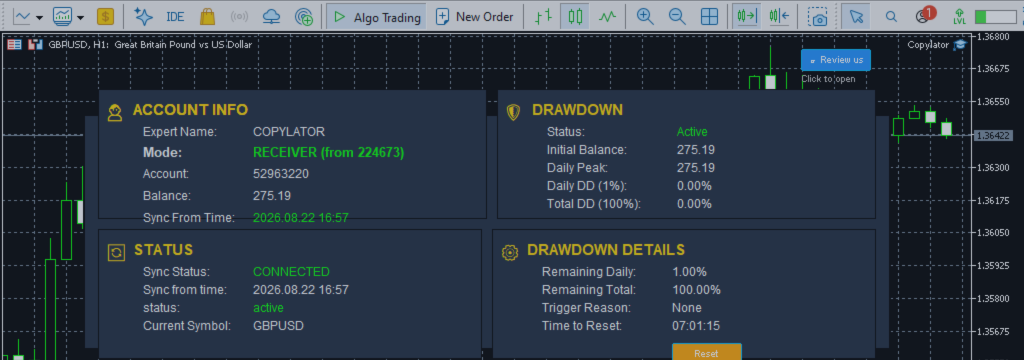
The drawdown dashboard can help traders understand the account's condition when a gap occurs, but its displayed values should be interpreted in context.
- Useful information: The displayed drawdown can help identify the severity of the equity decline when the protection triggers.
- A sudden change: Rather than gradually increasing, the displayed drawdown may jump sharply when the market reopens and new prices become available.
- Additional verification: The terminal's account history, trade records, and logs can help clarify when positions were closed and how the account's equity changed.
For a clearer assessment, review the account history and available logs after a gap-related trigger. These records can help distinguish the market movement that caused the loss from the protective actions taken afterward.
Summary
Weekend gaps are a market risk that drawdown protection cannot prevent. When a market reopens at a price far from its previous close, account equity can change before the protection has an opportunity to act.
The protection may then close positions at available post-gap prices. As a result, the realized loss can exceed the configured drawdown threshold.
Closing positions before the weekend is one of the most direct ways to reduce exposure to weekend gaps. Reducing position sizes is another option for traders who need to retain some positions. Both approaches involve trade-offs, and neither eliminates every form of market risk.
The key principle is simple: a drawdown limit is a threshold for protective action, not a shield against market gaps. Understanding this distinction helps traders establish more realistic expectations and prepare their accounts for risks that cannot be eliminated through copier settings alone.
Product link:
https://www.mql5.com/en/ market/product/191385