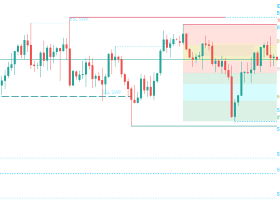

Averaging is a trading approach in which a robot opens additional orders when the market moves against the initial position. The main idea is to change the average entry price of the combined position. If the market subsequently reverses, a smaller price movement may be required to reach a specific financial target.
However, averaging changes more than the average entry price. It affects the total position volume, the interaction between orders, and the logic used to manage the entire trade sequence.
How Does Averaging Work?
Imagine that an Expert Advisor opens a buy position, but the price moves lower. The algorithm opens another buy order at a lower price. The average entry price of the combined position is now between the individual entry prices.
If the market reverses upward, the combined position may reach breakeven sooner than the original trade would have without the additional order. The actual result depends on position sizes, trading costs, and the rules used to manage the trade sequence.
What Changes When Additional Orders Are Opened?
1. Average Entry Price
Every additional order changes the average entry price of the combined position. The Expert Advisor must therefore account for all open trades when calculating the current result and the target exit level.
2. Total Position Volume
Opening additional orders increases the total position volume. The same price movement can then have a different effect on the financial result. If the algorithm also increases the volume of new orders, the impact can become even more significant.
3. Basket Management
Instead of managing every trade independently, a robot can treat all open positions as a single basket. In this case, exit conditions are determined by the combined result rather than by the performance of an individual order.
4. Distance Between Orders
The frequency of additional entries depends on the spacing between orders. A smaller step leads to more frequent entries, while a larger step changes the structure of the basket and the way it must be managed.
5. Exit Conditions
The algorithm must determine when to close the entire basket: when a profit target is reached, when the price reaches a specified level, or when another predefined condition is met. Exit rules play a major role in determining the behavior of the entire system.
Why Is It Important to Test the Entire Basket?
When developing Expert Advisors that use averaging, testing the initial entry alone is not enough. It is important to analyze the full sequence of algorithmic actions under different market scenarios.
- How the average entry price changes as new orders are added.
- How the total position volume increases.
- How many orders can accumulate in a basket.
- How the conditions for closing the entire basket are calculated.
- How the results change under different algorithm settings.
This analysis helps developers better understand how trading systems work. In my MQL5 profile and publications, I explore different approaches to Expert Advisor development, trading logic, and position management.
Conclusion
Averaging is more than simply adding another trade. It changes the relationship between orders and turns individual position management into the task of managing an entire sequence of trades.
How does averaging work in your Expert Advisors? Do additional order volumes remain fixed, or do they depend on market conditions?