One Strategy, Different Ways to Trade It: EA, Signals and Manual Execution

Why the same trading logic can be implemented in very different ways - and why execution matters as much as the strategy itself.
If you follow automated trading for long enough, you eventually notice something interesting.
Two traders can use the same strategy, trade the same currency pairs, and even receive the same entry signals - yet have completely different experiences.
One runs an Expert Advisor on a VPS.
Another follows a copy-trading account.
- A third receives signals and decides manually whether to enter.
And someone else may use the same strategy only as a source of ideas for their own trading.
So what actually makes these approaches different?
More importantly:
Does the way a strategy is implemented matter as much as the strategy itself?
After years of developing and running automated Forex systems, I would say the answer is yes.
A trading strategy is not just a set of entry rules.
It is a process that has to go from an idea → to a decision → to an execution → to a monitored live result.
And there is more than one way to build that process.
🧠 A Strategy Is Not the Same as Its Implementation
Let's start with a simple distinction.
A trading strategy answers a question:
Under what market conditions should I trade?
An execution system answers another:
How should that trading decision actually reach the market?
These may sound like the same thing, but they are not.
Imagine that a strategy identifies a potential EURAUD short position.
The strategy has already done its job.
It has evaluated the market and decided: Conditions met → potential entry.
But what happens next?
An Expert Advisor may open the position automatically.
A copy-trading system may replicate the trade on another account.
A trader receiving a signal may look at it and decide whether to enter.
All three can originate from exactly the same underlying trading logic.
The difference is how the decision is implemented.
And that difference can affect the entire trading experience.
🤖 1. Running the Strategy Through an Expert Advisor
The most direct form of automated trading is also the one most people probably think about first: an Expert Advisor running directly on your MetaTrader account.
The logic is inside the EA.
The system monitors the market.
When the required conditions are present, it generates the corresponding trading action.
There is no need to manually watch charts and wait for an entry.
There is also no need to decide whether you feel like taking the trade.
That can be a major advantage.
But automation does not mean that everything becomes irrelevant.
Quite the opposite.
When an EA is running live, the trading environment becomes extremely important:
-
broker conditions;
-
account type;
-
spread;
-
commission;
-
execution;
-
slippage;
-
VPS stability and latency;
-
swaps;
-
trading hours;
-
risk settings;
-
characteristics of the traded instruments.
This is something I discussed in detail in the previous articles about broker conditions and the transition from backtesting to live trading.
A good algorithm still has to operate in a suitable environment.
Our own approach
Our automated trading technology is based around SCR_NightScalper.
It is the foundation behind the automated systems we have developed and continue to test in live conditions.
For traders who want to run the EA themselves, we provide the SCR_NightScalper trading robot.
The important point, however, is not simply "we have an EA."
The more important point is that the EA is only one implementation of the underlying strategy.
The same research and trading logic can also be implemented in other ways.
And this is where things get interesting.
📊 2. Following a Monitored Trading Signal
Not every trader wants to install, configure and maintain an Expert Advisor.
And that's perfectly understandable.
Some traders are interested in automated strategies but don't want to deal with: VPS → EA settings → broker configuration → updates → technical monitoring.
For them, another approach is to follow a live trading signal.
Instead of running the strategy themselves, they can observe a real trading account and, depending on the service and their own setup, use copy trading to replicate its activity.
This changes the role of the trader.
With an EA, the trader is responsible for the implementation.
With a signal, the trader can focus more on selecting the strategy and managing their own account.
But there is an important distinction:
Copying a strategy does not eliminate risk. It simply changes where the execution takes place.
The follower still needs to consider:
-
account size;
-
risk settings;
-
broker;
-
execution conditions;
-
drawdown tolerance;
-
capital allocation;
-
copying parameters.
This is one reason why I prefer looking at trading systems as a combination of strategy + execution + risk management, rather than treating a signal's historical performance as the whole story.
Our live signal implementations
We currently use this approach with two systems built around the same underlying technology:
- SCR_EURAUD
A more focused portfolio built around selected currency pairs.
- SCR_EURAUD_advanced
A broader implementation designed to work across a larger group of currency pairs.
View SCR_EURAUD_advanced on MQL5
Both are based on the same general philosophy we've discussed throughout this blog series: selective trading → suitable market conditions → controlled execution → long-term observation.
They are not simply different names for the same account.
They represent different ways of structuring the trading portfolio.
I'll go deeper into that distinction in a future article.
📱 3. Receiving Signals and Making the Final Decision Yourself
There is also a completely different group of traders.
They don't necessarily want full automation.
They don't necessarily want copy trading either.
They simply want to know:
"When does the strategy see a trading opportunity?"
And then make the final decision themselves.
This is where manual signal delivery can make sense.
The strategy identifies a potential opportunity.
The signal is delivered to the trader.
The trader decides:
Take it.
or
Skip it.
This approach provides a completely different level of control.
The trader can consider additional factors before entering:
-
current market conditions;
-
their own risk;
-
account exposure;
-
other open positions;
-
broker conditions;
-
news;
-
personal trading plan.
Of course, this also introduces something that fully automated trading tries to eliminate:
human discretion.
And that's not necessarily good or bad.
It simply means that the trader becomes another part of the system.
Our free Telegram signals
This is one of the reasons we also maintain free Telegram channels for traders who prefer to receive trading ideas rather than run the entire system automatically.
- You can find our free channel here:
- We also have a VIP channel:
The important thing here is not the platform itself.
Telegram is simply another delivery mechanism.
The underlying idea remains the same: strategy → signal → execution decision.
🔄 4. One Strategy — Different Levels of Automation
This gives us an interesting picture.
The same underlying trading philosophy can be implemented at several different levels.
| Approach | Who makes the trading decision? | Who controls execution? | Automation |
|---|---|---|---|
| Expert Advisor | Algorithm | Algorithm / trader's account | 🤖 High |
| Copy Trading Signal | Algorithm | Signal + follower settings | 🤖 High |
| Telegram Signal | Algorithm + trader | Trader | ⚙️ Medium |
| Manual Trading | Trader | Trader | 👤 Low |
None of these approaches is automatically "better."
That's an important point.
There is a temptation in trading to assume that more automation must always be better.
I'm not convinced.
The better question is:
Which implementation is appropriate for the trader using it?
Someone with good technical knowledge and a suitable VPS may prefer running an EA.
Someone who doesn't want to manage the infrastructure may prefer following a signal.
Someone who wants complete control over every entry may prefer receiving signals and deciding manually.
And another trader may simply want to study the strategy and use some of its ideas in their own approach.
The strategy doesn't necessarily need to change.
The interface with the strategy changes.
🧩 The Important Part: Keeping the Underlying Logic Consistent
This is where our own experience becomes particularly relevant.
When you build several trading products, it is tempting to create completely different strategies for each one.
One EA.
One signal.
One Telegram channel.
Another portfolio.
Another set of rules.
Eventually you end up managing several unrelated systems.
We prefer a different approach.
Our different implementations are connected by the same underlying research and trading technology.
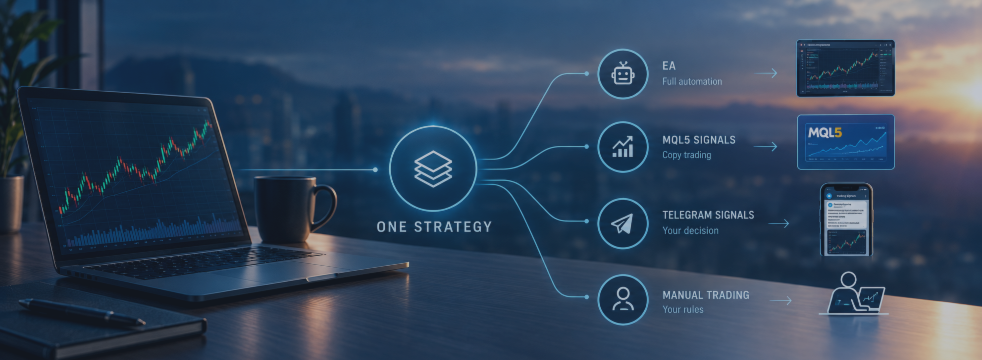
At a simplified level:
SCR_NightScalper
⬇
Trading logic & market conditions
⬇
Portfolio construction
⬇
Different implementation methods
⬇
EA / MQL5 Signals / Telegram Signals
This structure is important because it allows us to learn from the same underlying system across different environments.
🔬 Why This Matters During Development
Suppose we change something in the strategy.
Perhaps we discover that a particular currency pair behaves differently under certain market conditions.
Or we identify an execution issue.
Or we find that a certain trading condition should be filtered more carefully.
If everything is built around one coherent research process, the knowledge gained from live trading can be used to improve the overall system.
This is much more useful than treating every product as an isolated project.
And this is also why we don't stop developing a system simply because it is already live.
Live trading is another source of information.
Not a final exam.
There is another misconception worth addressing.
People sometimes hear:
"It's automated."
And interpret that as:
"You can turn it on and forget about it."
That's not how we approach automated trading.
A live automated strategy still needs to be monitored.
We need to understand:
-
whether execution remains within expected parameters;
-
whether broker conditions have changed;
-
whether spreads behave normally;
-
whether instruments remain suitable;
-
whether market behaviour is changing;
-
whether the live system is behaving consistently with the research behind it.
This is exactly why we emphasized in earlier articles that backtesting is only one stage of the process.
The real lifecycle looks more like:
Idea
↓
Backtest
↓
Robustness testing
↓
Forward testing
↓
Live trading
↓
Monitoring
↓
Research & improvements
↓
Live trading again
It is a cycle.
Not a straight line.
🎯 So Which Approach Is Right?
There is no universal answer.
And I think that's actually a useful conclusion.
If you want maximum automation and technical control, an Expert Advisor may be the most appropriate approach.
If you prefer to follow an already-running implementation, a trading signal may be more convenient.
If you want to retain the final decision yourself, a manual signal may be more suitable.
And if you simply want to understand how an automated trading strategy works, following the research and live results can be valuable without necessarily trading it at all.
The technology doesn't determine the trader.
The trader chooses the level of automation that fits them.
🧠 One Strategy, Many Ways to Use It
After years of working with automated Forex systems, I've come to think about this less as a question of "EA vs signals vs manual trading" and more as a question of architecture.
The important components are:
Strategy
What market conditions are we trying to exploit?
Execution
How does the trading decision reach the market?
Risk
How much capital is exposed and under what conditions?
Infrastructure
Is the technical environment suitable?
Monitoring
Does the live system continue to behave as expected?
When these pieces are considered together, an Expert Advisor, a copy-trading signal and a manual signal are simply different ways of connecting a trader to the same underlying research process.
And that's how we approach our own systems.
🚀 What's Next?
So far in this series, we've talked about:
-
what we learned from years of live automated trading;
-
how we select currency pairs;
-
why broker conditions matter;
-
why backtests don't tell the whole story;
-
why a good strategy doesn't need to trade every market movement;
-
and how the same trading logic can be implemented in different ways.
The next logical question is:
What is actually inside the strategy itself?
Not the exact parameters.
Not a list of secret indicators.
And not a "magic formula."
Instead, I want to explain the philosophy behind SCR_NightScalper - how we think about market conditions, entries, selectivity, risk and automated decision-making when designing a system that is intended to operate in real markets for years rather than simply look impressive in a backtest.
That's where things get more interesting.
To be continued.