MT5 Trade Copier: Choosing the Right Daily Reset Time for Drawdown Protection

Product link:
https://www.mql5.com/en/ market/product/191385
Every drawdown protection system has a reset hour setting. Most traders leave it at the default, or set it to midnight because that feels like the start of a new day. Both choices are usually wrong. The reset time determines when the daily drawdown counter clears, and that timing has a direct effect on how the protection behaves during the sessions that matter most.
What the Reset Time Actually Controls
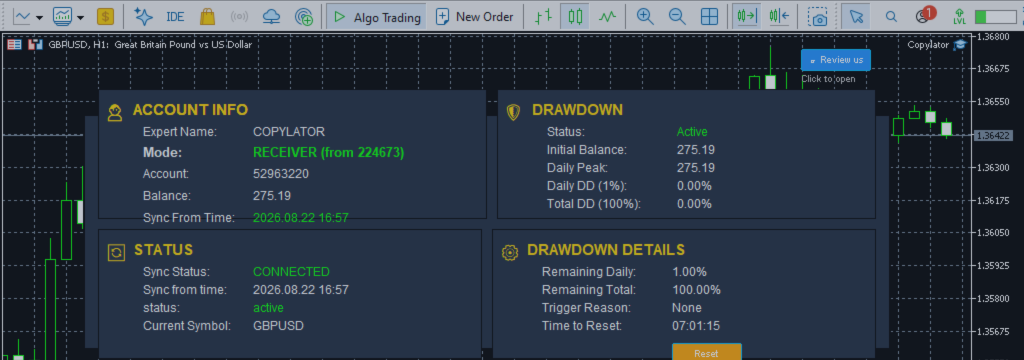
The reset hour does one specific thing: it clears the daily drawdown percentage and removes the trading block, if one is active. It does not change the total drawdown baseline. It does not close positions. It does not affect anything else.
This narrow scope is important to understand, because many traders expect the reset to behave like a general refresh of the protection system. It does not. It resets one counter, at one moment, every twenty-four hours.
The daily peak value—the highest equity or balance reached during the current day—is also reset at this time. The new day begins with the current equity as its starting peak, and drawdown is measured from that point forward.
The Midnight Default and Why It Is Often Wrong
Midnight is a natural choice because it matches the calendar day. But the trading day does not align with the calendar day, and in most cases midnight falls in the middle of an active session.
If the broker's server time is GMT+2 or GMT+3, midnight server time often falls during the Asian session. If the trader copies a strategy that operates primarily during the London or New York sessions, the reset occurs hours before the strategy's most active period. Any drawdown accumulated during the previous London session is cleared, and the daily counter starts fresh just before the next one begins.
The practical effect is that the daily limit becomes almost impossible to trigger, because the counter resets before the strategy has a chance to accumulate losses within a single active session. The protection exists but rarely activates when it is needed.
The Opposite Problem: Resetting After the Session
A trader who understands this problem may move the reset to a time after the trading session ends—say, 22:00 or 23:00 server time. This is better in principle, but it introduces a different issue.
If the reset happens after the session but before the trader has reviewed the day's results, the daily drawdown counter clears before the trader can see how close the account came to the limit. The information is lost. The trader loses visibility into how often the protection was nearly triggered.
A better placement is a few hours after the session ends, when the trader has had time to review the day but before the next session begins. In practice, this often lands around 02:00 to 04:00 server time for strategies that trade the London and New York sessions.
Aligning With the Strategy's Active Hours
The cleanest approach is to set the reset time so that the entire active trading period of the strategy falls within a single daily cycle.
If the strategy trades from 08:00 to 17:00 GMT, the reset should occur outside that window—before 08:00 or after 17:00. Setting it at 03:00 GMT means the daily cycle covers 03:00 to 03:00 the next day, encompassing the entire session without splitting it.
Setting the reset in the middle of the session—say, 12:00 GMT—splits the strategy's activity across two daily cycles. A drawdown that begins before noon is cleared at noon, and the afternoon starts with a fresh counter. The daily limit is effectively doubled without the trader realizing it.
This is the most common configuration error, and it is invisible until a large loss occurs in a single session that the protection should have caught.
The Triple Swap and Rollover Consideration
A secondary factor is the daily rollover, which typically occurs at 22:00 or 23:00 server time depending on the broker. This is when swap is charged and when spreads often widen briefly.
Setting the reset time during the rollover window is generally a poor choice. The account equity may fluctuate during the rollover as swap is applied, and resetting the daily peak at that moment can produce an artificially low starting point for the new day.
A reset time one to two hours after rollover avoids this entirely. The swap has been applied, spreads have normalized, and the equity reading is stable.
Prop Firm Accounts: A Special Case
Prop firm accounts often have their own daily drawdown rules, and the firm's reset time is fixed. It is usually based on the firm's server time, which may differ from the trader's broker server time.
In this case, the copier's daily reset should be aligned as closely as possible with the firm's reset. If the firm resets its daily drawdown at 00:00 CE(S)T and the broker server is GMT+2, then 00:00 server time is correct. If the broker server is GMT+3, the correct setting is 01:00 server time.
Mismatching these times creates a window in which the firm has reset its daily counter but the copier has not—or vice versa. During that window, the copier's daily limit and the firm's daily limit are measuring different things, and one may trigger while the other does not. For prop firm traders, this alignment is not optional.
Testing the Reset Time
The reset time cannot be validated by reading the settings. It has to be observed.
Run the copier on a demo account with the intended reset time. Note the equity reading a few minutes before the reset, then again a few minutes after. The daily drawdown percentage should return to zero, the daily peak should update to the current equity, and any active block should clear.
Then observe the protection over the following days. If the daily limit triggers frequently, the reset time may be splitting the session. If it never triggers, the reset may be clearing the counter before the strategy has a chance to accumulate losses.
A Practical Starting Point
For most traders copying strategies that operate during the London and New York sessions on a broker with GMT+2 or GMT+3 server time, a reset time between 02:00 and 04:00 server time works well. It falls after the daily rollover, after the previous session has closed, and before the next London open.
This is not a universal answer. It depends on the strategy's active hours, the broker's server time, and whether the account is subject to prop firm rules. But it is a reasonable default that avoids the two most common errors: splitting the session and resetting during rollover.
Summary
The daily reset time is a small setting with a disproportionate effect. Set at midnight, it often clears the daily counter in the middle of the strategy's active session, making the daily limit nearly impossible to trigger. Set during rollover, it can produce unstable peak values. Set without regard to prop firm rules, it can misalign the copier's protection with the firm's own limits.
Choose the reset time so that the strategy's full active period falls within a single daily cycle. Avoid the rollover window. Align with any external rules that apply. Then verify the behavior on demo.
The reset time does not need to be perfect. It needs to be deliberate. A default left unchanged is a decision that was never made.
Product link:
https://www.mql5.com/en/ market/product/191385