I Analyzed All 70 EAs on the MQL5 Market Front Page — Here's What Actually Sells in 2026

Data study · 2 October 2026 · MetaTrader 5 Expert Advisors
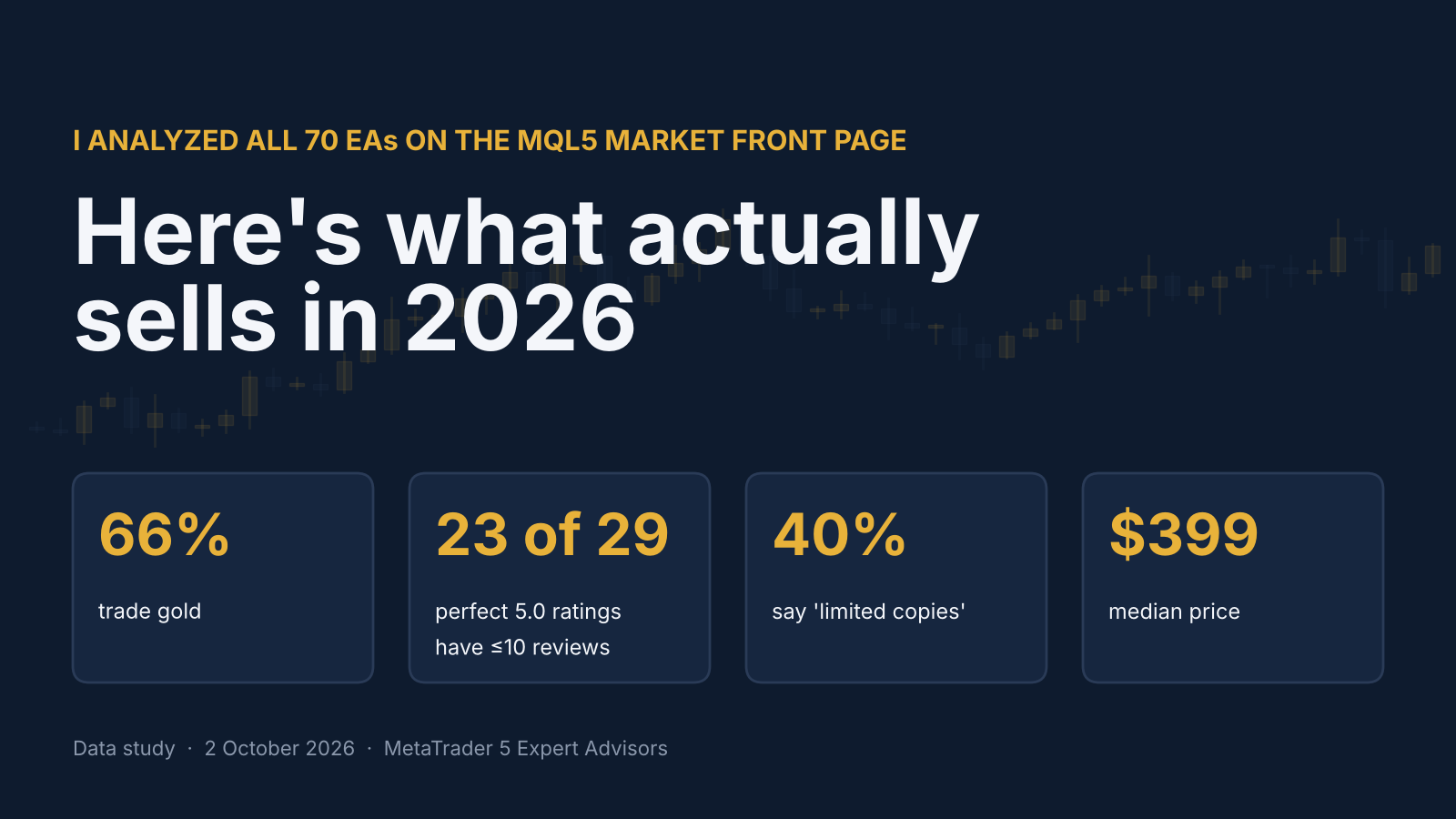
I analyzed all 70 EAs on the MQL5 Market front page: 66% trade gold, 23 of 29 perfect ratings have 10 reviews or fewer, 40% say limited copies, median price $399">
Every day, new Expert Advisors land on the MQL5 Market with a smooth equity curve and a "final copies" banner. But what does the market itself say? Which products actually make it to the top, how are they priced, and what do they promise?
I went through every one of the 70 Expert Advisors on page 1 of the MetaTrader 5 "Popular" list and logged the same data points for each: main symbol, price, star rating, number of reviews, and what the visible description leads with. No opinions, no product reviews — just the numbers.
Some of the results confirmed what many of us suspect. A few genuinely surprised me.
How I collected the data
- Source: MQL5 Market → MetaTrader 5 → Experts → "Popular" sort, page 1 (70 products).
- Date: read on 2 October 2026. The list changes daily, so treat this as a snapshot.
- Fields: name, seller, current price, rating, review count, main symbol, and keywords in the description preview (live signal, scarcity, "no grid", AI, grid).
- Limits: I only read the preview text shown in the list, not every full product page. Description counts are therefore a minimum.
1. Gold is not a niche — it is the market
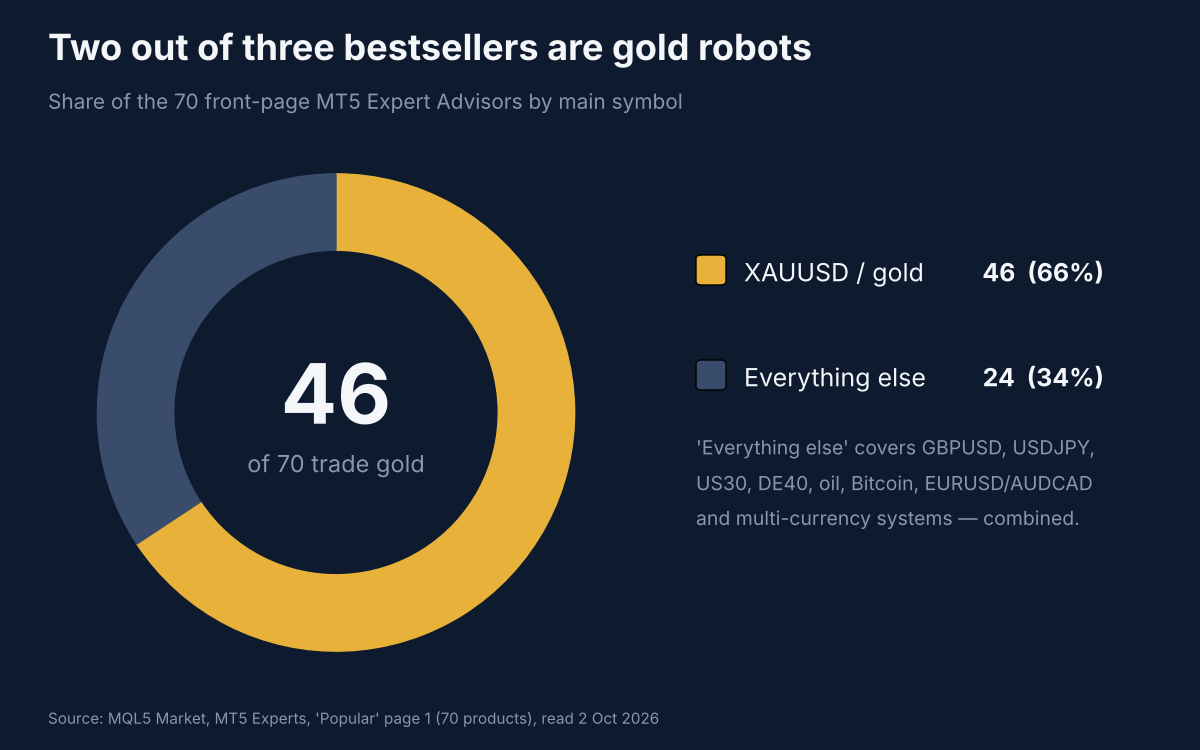
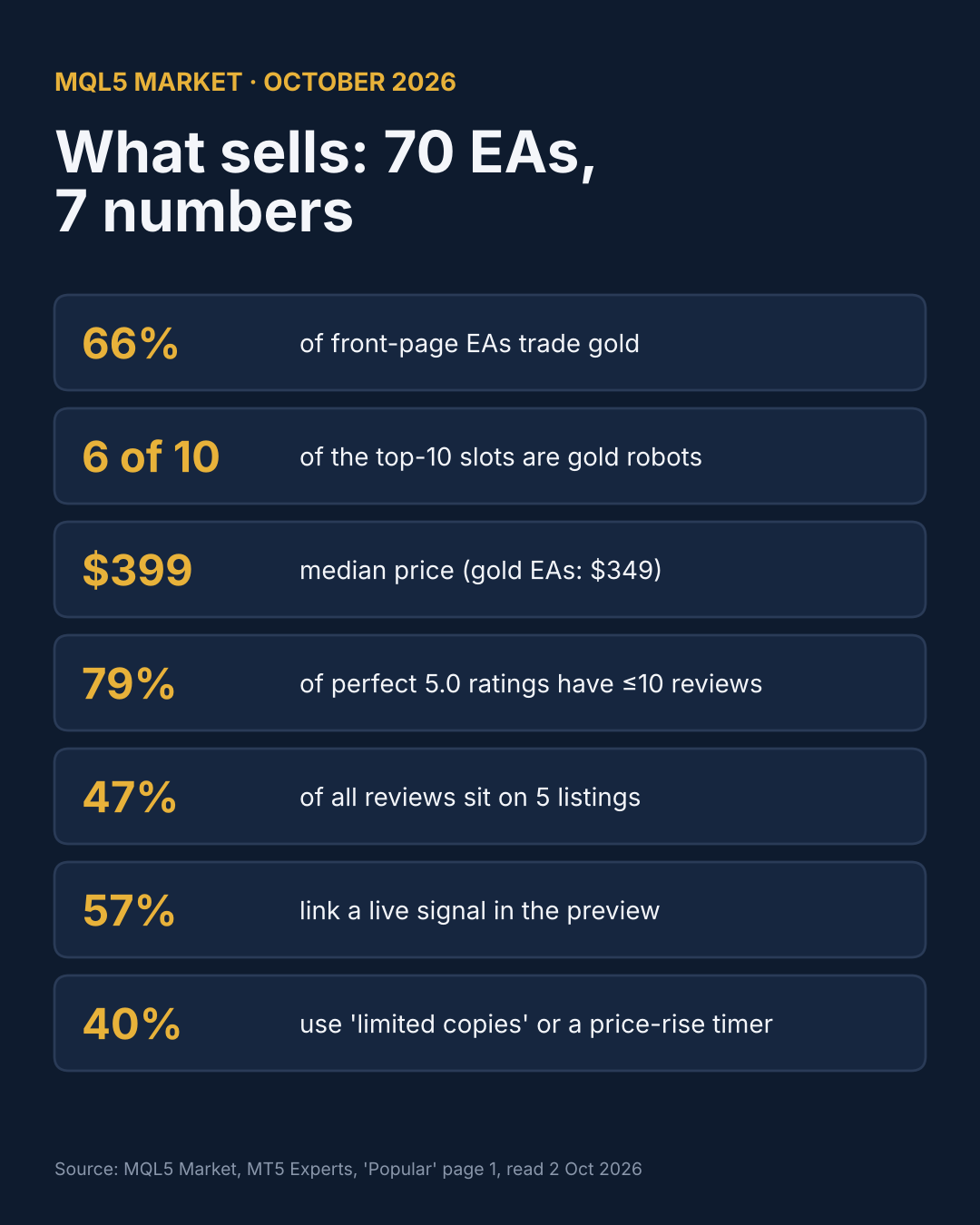
46 of the 70 front-page EAs (66%) are built for XAUUSD. Six of the top ten slots are gold robots. Everything else — GBPUSD, USDJPY, US30, DE40, oil, Bitcoin, EURUSD/AUDCAD and multi-currency systems — shares the remaining third.
Gold's volatility and trend strength over the past two years explain the demand. The side effect is a very crowded shelf: if you are buying a gold EA, you are choosing among dozens of strategies that look similar on the surface, so the details (stop loss, position sizing, live track record) matter more than ever.
Interesting detail: the median price of a non-gold EA on page 1 is $499, versus $349 for gold EAs. Less competition seems to support higher prices.
2. The price sweet spot is $200–$400
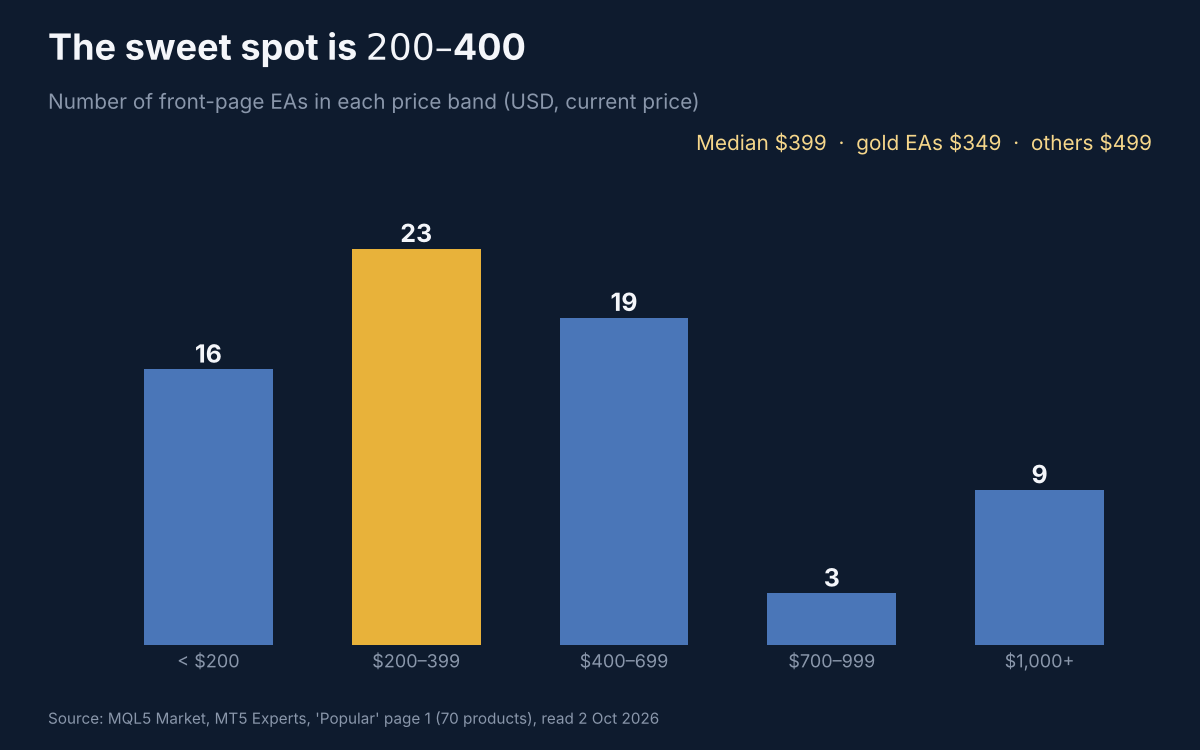
The median price is $399 and the single biggest band is $200–$399 (23 products). Prices range from $99 to $1,799, and nine products sit above $1,000.
One small observation that every marketer will recognise: 49 of the 70 prices end in "99" ($299, $399, $599.99…). Charm pricing is alive and well in algo trading.
3. A perfect 5.0 rating usually means "few reviews so far"
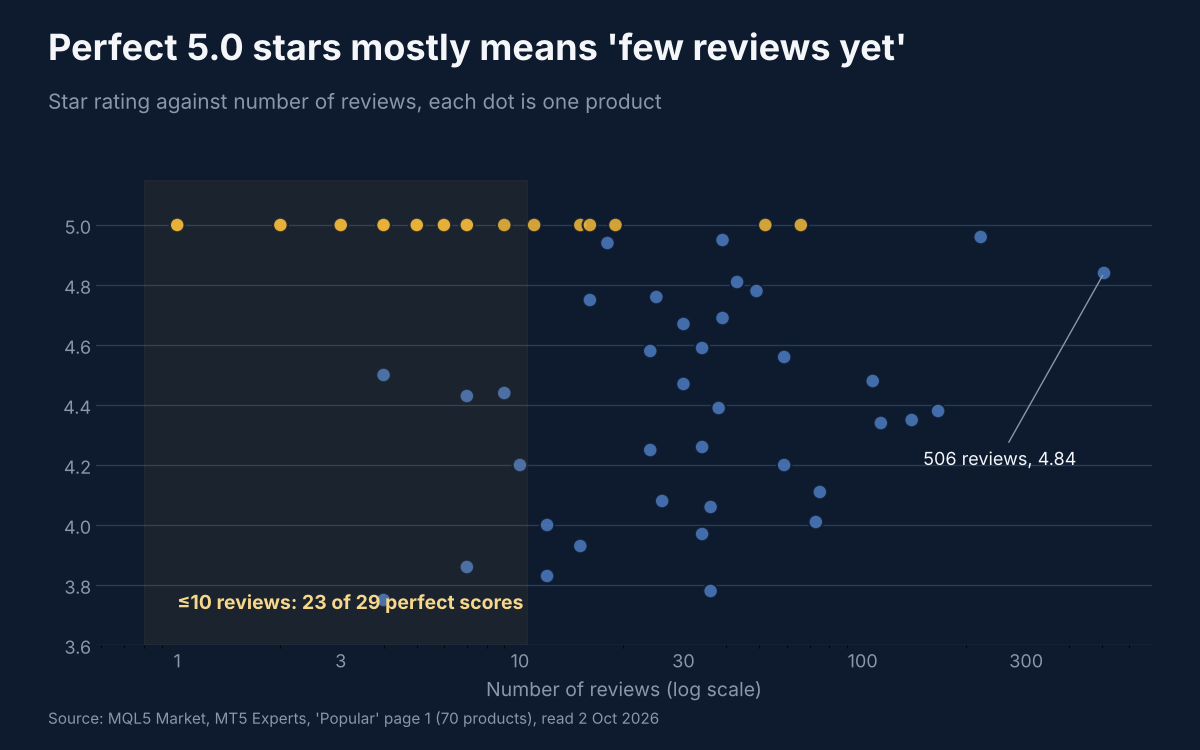
This was the clearest pattern in the whole dataset. 29 products show a perfect 5.0 rating — and 23 of them (79%) have 10 reviews or fewer.
| Number of reviews | Products | Average rating | Perfect 5.0 |
|---|---|---|---|
| 1–10 | 29 | 4.83 | 23 |
| 11–50 | 25 | 4.50 | 4 |
| 51+ | 12 | 4.52 | 2 |
As soon as a product passes about ten reviews, the average settles around 4.5. That is not a criticism of new products — it is simple statistics. A small sample can only tell you so much. A 4.5 with 200 reviews is stronger evidence than a 5.0 with 3.
4. Five listings hold almost half of all reviews
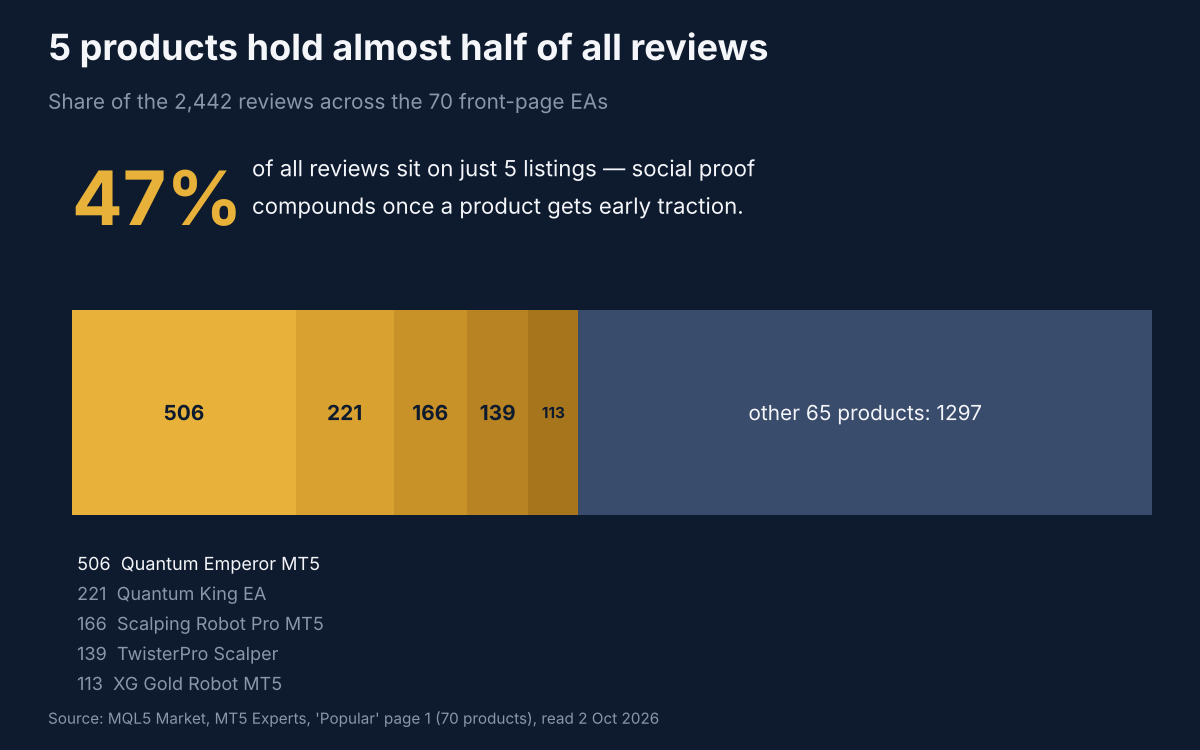
Across the 70 products there are 2,442 reviews in total. The top five listings hold 47% of them, led by Quantum Emperor MT5 with 506 reviews.
Seller concentration is just as strong: one developer (Bogdan Ion Puscasu) has 6 of the 70 front-page slots and around 35% of all reviews on the page. Popularity compounds — reviews bring visibility, visibility brings buyers, buyers leave more reviews.
Remember: the "Popular" list is ranked by popularity signals (time on the Market, sales, rentals, downloads and reviews), not by trading results. A product can be high on the list because it has been around longer, and a strong newcomer can sit much lower.
5. What the listings lead with
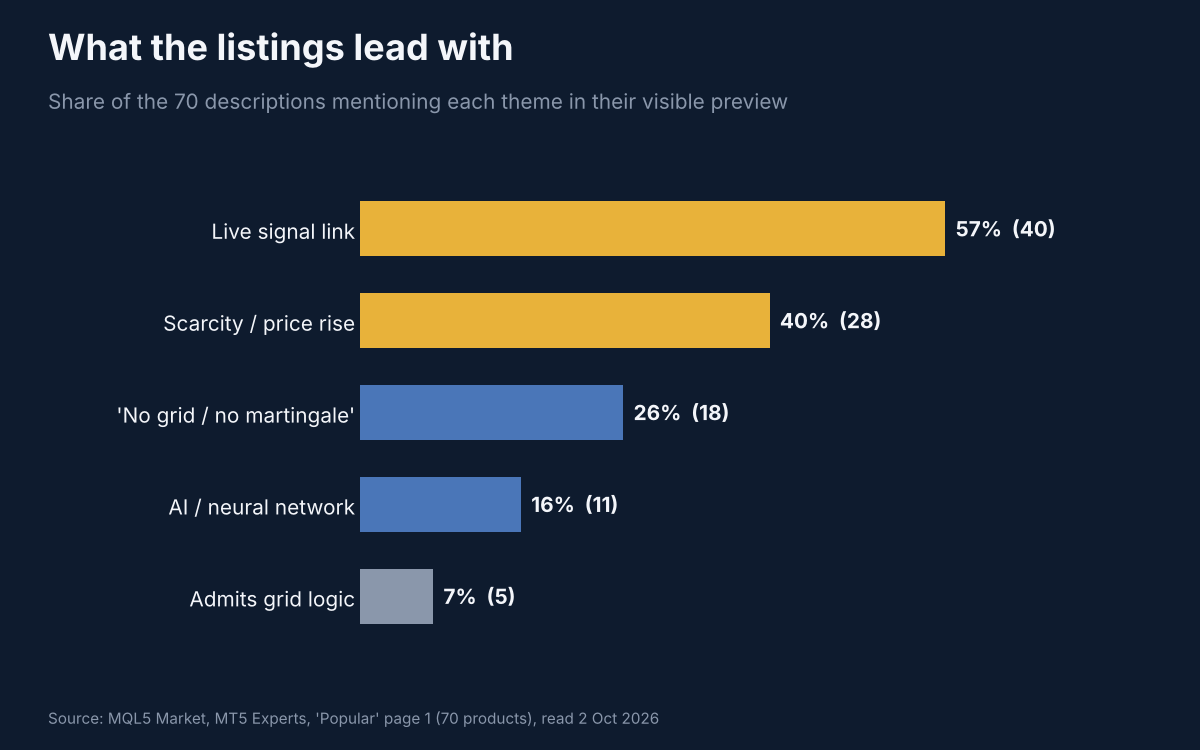
- 57% link a live signal right in the preview. For a front-page EA, a public track record is close to mandatory now.
- 40% use scarcity — "only X copies left", "price goes up soon", countdowns.
- 26% explicitly say "no grid / no martingale", while only 7% openly describe grid or basket logic. "No martingale" has become a selling point in itself.
- 16% lead with AI or neural networks — lower than I expected, given how much "AI" appears in trading marketing elsewhere.
Everything on one page
What this means if you are buying an EA
- Open the live signal before the backtest. More than half of the top products offer one — if a product doesn't, ask why.
- Read the rating together with the review count. Under 10 reviews, a 5.0 tells you very little either way.
- Treat "last copies" as marketing, not information. 40% of the page uses it. Decide on the strategy and the risk, not on the timer.
- Check how losses are handled. "No grid" in the title is a claim; a hard stop loss on every trade in the strategy tester is evidence.
- Don't confuse "Popular" with "best". Use the list to discover products, then compare them on the same live period, drawdown and deposit load.
What this means if you are selling an EA
- Gold is where the buyers are — and where the competition is. A well-built EA on a less crowded symbol can stand out and hold a higher price.
- A live signal is table stakes. Start one early; nothing replaces months of public history.
- Your first 10 reviews matter most. That is where visibility starts to compound.
- Explain your risk logic clearly. Buyers are actively searching for stop-loss and no-martingale information.
- Honesty differentiates. When everyone has a "final price" banner, a clear explanation of how the EA wins and loses is the rarer message.
Your turn
Which number surprised you the most? And what is the first thing you check before buying an EA — the signal, the reviews, or the backtest? Tell me in the comments. If there is interest, I will repeat this study every quarter and track how the market changes.
Data: MQL5 Market, MetaTrader 5 Experts, "Popular" sort, page 1 (70 products), read on 2 October 2026. Prices, ratings and rankings change daily. Product names are mentioned for statistical purposes only; this is not a recommendation to buy or avoid any product. Trading involves substantial risk and past performance does not guarantee future results.