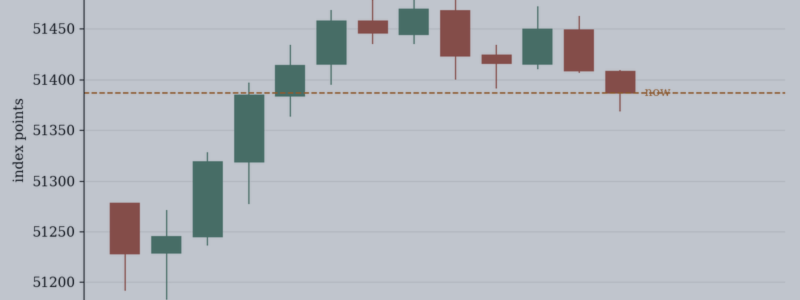
In the move or beside it: a study on re-entries, and why I need ten minutes of your time

An observation from my own trading, and a study I am running on it with more than one participant. When I have been in a move from the start, the pullback looks like a place where I might have to pay twice: I re-enter later, deeper, or not at all, but I add to the position I already have. When I have missed the same move, the same pullback looks like a gift, and I am in earlier and at a shallower level. Same chart, two decisions. The market does not know which version of me is looking at it, so one of the two is wrong about the money, and I do not know which.
Two questions, kept apart
The market question. After a directional move, what is a pullback entry worth, conditional on what you can see at that moment: size and age of the move, depth of the pullback, time of day? And is adding to a running position worth anything different from a fresh entry at the same price and stop? The market cannot see the difference, so the honest expectation is no. This part runs on eleven years of DAX, NQ and Dow minute data, net of spread and slippage, against the random-walk yardstick. Its result is held back until the questionnaire closes, so it cannot steer anyone.
The perception question. Does knowing that you were in the move, or that you were stopped out of it at break-even, shift the threshold at which you re-enter? In which direction? And once the forward path is known, does the shifted threshold make or lose money against the unshifted one?
How the perception part works
Twelve real chart situations, drawn mechanically from the same event definition as the market test: a move of at least 0.6 of the median daily range, then a pullback of 35 to 55 percent, cut at the decision point, market and date hidden. Every participant sees all twelve, in random order, each in one of four states, balanced three, three, three, three:
- You are flat. You have not traded this move.
- You have been long since the start of the move. Your open profit is about +1.5 R.
- You have been long since the start of the move. Your open profit is about +5 R.
- You were long from the start and were stopped out at break-even on this pullback.
Per situation: enter now or not, if not then at which depth, size relative to normal risk, confidence, and whether the move feels like yours or like missed. Five belief questions come before the charts, so self-image and behaviour can be compared afterwards. Ten minutes, anonymous, no registration. Hypotheses, definitions and the analysis plan were fixed on 23 September 2026, before the first answer, and the result is published whatever it shows, including a null result. Fewer than 20 participants will be reported as a pilot, not as a finding.
Why I am asking here
Because this is where people trade index CFDs on 5-minute charts and know the situation from the inside. If you have ever hesitated on a pullback because you were already in, or jumped on one because you were not, you are exactly the sample this needs. Everyone who leaves an email gets the result first; nobody gets anything else.
Take part, and read the full pre-registration with hypotheses and analysis plan: Twelve situations, four states, ten minutes. The pre-registration itself: In the move or beside it: does your own state change the re-entry?
Not investment advice. The study collects anonymous answers and an optional email for the result, nothing else.