
The logic behind a selective automated Forex strategy
The logic behind a selective automated Forex strategy
If you watch enough automated trading systems, you will notice something interesting.
Some Expert Advisors are constantly active. Trades appear one after another. Several positions may be open at the same time.
The system seems to be looking for an opportunity almost everywhere.
Our approach is different.
Sometimes the system simply does nothing.
- No entry.
- No position.
- No attempt to "find" a trade.
And that is intentional. After years of developing and running automated Forex strategies, I have come to believe that one of the most important characteristics of a trading system is not how often it trades, but how carefully it decides when not to trade.
This article is about that idea.
It is also the next step in the series I have been writing about automated trading - from building a complete trading system, to selecting currency pairs, understanding execution conditions, and finally validating a strategy beyond the backtest.
In my previous article, Backtest vs Live Trading: What Really Changes When an EA Goes Live?, I described why a profitable backtest should be considered the beginning of the validation process rather than the end.
Now I want to look at something closer to the actual trading logic.
Why doesn't an automated strategy simply trade every interesting market movement?
Price is always moving. That doesn't mean there is always a trade.
Price is always moving. That doesn't mean there is always a trade.
This sounds obvious, but it is surprisingly easy to forget. The Forex market is moving almost continuously.
- Prices rise.
- Prices fall.
- Ranges develop.
- Levels are broken.
- Volatility expands and contracts.
From a purely technical perspective, there are always things happening on the chart. But a trading strategy is not supposed to react to everything that happens.
A movement becomes interesting only when it matches the conditions that the strategy was designed to exploit.
This is a very important distinction.
A strategy should not ask:
"Can I find a reason to open a trade?"
It should ask:
"Does the current market provide the specific conditions that my strategy needs?"
Those are very different questions. The first approach encourages activity. The second encourages selectivity. And for the systems we develop, selectivity is an important part of the design.
More signals do not automatically mean more opportunity
There is a natural temptation in automated trading to associate activity with performance.
If one EA produces 100 trades and another produces 10, it can be tempting to think that the first system is somehow doing more work.
But the number of trades by itself tells us very little.
A trading strategy may be designed around frequent small opportunities.
Another may wait for relatively specific combinations of market conditions.
Neither approach is automatically better or worse simply because of the number of trades.
Trade frequency is a characteristic of a strategy, not a quality metric by itself.
This is one of the reasons why I am cautious about comparing automated systems simply by looking at how active they are.
The more useful question is: What conditions cause the system to enter a trade?
That is where the actual strategy begins.
What are we actually looking for?
Without revealing proprietary parameters or the implementation details of our algorithms, I can describe the general philosophy behind our approach.
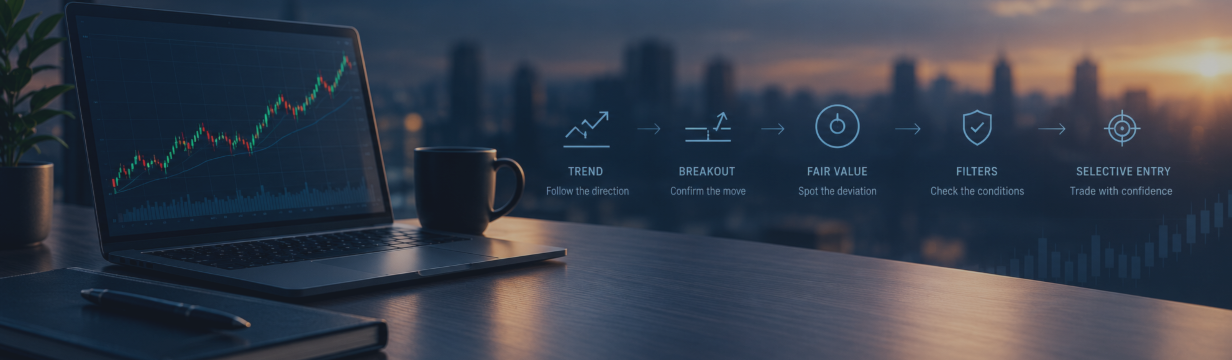
The trading logic combines several different types of market behavior rather than relying on one isolated indicator.
Among the concepts we use are:
- trend-following conditions;
- level-break and breakout behavior;
- temporary price deviations;
- and the possibility of a return toward what we consider a more representative or "fair" price level.
Each of these concepts can be useful on its own. But none of them is sufficient by itself.
A breakout does not automatically mean that a trade should be opened.
A price deviation does not automatically mean that the market will return.
A trend does not automatically continue.
And an indicator reaching an extreme level does not automatically create an opportunity.
The interesting part is what happens when several pieces of information point in the same direction and the surrounding market conditions are also suitable.
That is where a selective strategy can become much more interesting than a simple collection of indicators.
Trend is not enough
Let's take trend-following as an example.
Suppose a currency pair has been moving upward for several hours.
A very simple system might say: Price is going up → buy.
But this immediately raises more questions.
- How strong is the movement?
- Where did it start?
- Is the current price already significantly extended?
- Is liquidity suitable?
- Is the trading session appropriate?
- Has the price just broken a meaningful level, or is it simply moving inside a range?
- Is the expected opportunity large enough to justify the transaction costs and execution risk?
The direction of the market is only one piece of the puzzle.
This is why we don't consider a single market condition to be a complete trading signal.
A breakout is not automatically a trade either
Breakouts provide another good example.
A price can move through a previous high or low for many different reasons.
Sometimes the move develops into a meaningful continuation.
Sometimes it quickly reverses.
Sometimes the movement is simply the result of temporary liquidity conditions.
An automated system therefore needs more than:
"The level was broken."
It needs to determine whether the surrounding conditions make the breakout relevant to the strategy.
This is one of the reasons why our trading logic does not depend on a single trigger.
The entry decision is the result of a combination of conditions.
The other side of the equation: returning toward fair value
There are also situations where the interesting opportunity is not continuation, but the opposite.
A short-term price movement can create a temporary imbalance.
The market moves away from an area that, under the assumptions of the strategy, can be considered closer to its temporary fair value.
If the deviation becomes sufficiently meaningful and other conditions are suitable, the possibility of a return can become interesting.
This is a very different idea from simply buying an oversold market or selling an overbought one.
The important question is not:
"Is the price high or low?"
It is:
"Has the price moved sufficiently away from the conditions that our strategy considers normal, and is there evidence that the deviation may be temporary?"
Again, this is not a single indicator. It is a combination of market information.
Why combining different signals matters
One of the common questions people ask about an EA is:
"Which indicator does it use?"
- RSI?
- Moving average?
- CCI?
- Stochastic?
- Something else?
I understand why this question is popular.
Indicators are easy to name and easy to compare.
But after working with automated systems for years, I think the more important question is: How is the information combined?
An indicator can tell you something about the market.
It doesn't necessarily tell you what to do.
For example:
- A market can be oversold and continue falling.
- A market can break a level and immediately reverse.
- A market can be trending and still be a poor place to enter.
A deviation can become even larger before it starts reverting.
The strategy therefore needs to evaluate the context around the signal.
That is where a trading system becomes more than an indicator-based rule.
Sometimes the best decision is to wait
This is probably the most important part of the philosophy.
There will be periods when the market simply does not provide the conditions we are looking for.
When that happens, the EA does nothing.
This can be difficult for a trader to accept.
Especially when you look at a chart and see price moving.
It is easy to think:
"The market is moving. Why isn't the robot doing anything?"
Because movement itself is not the objective.
The objective is to find situations that fit the strategy.
If the conditions are not there, opening a position simply because the market is active would mean changing the strategy.
And that is something we deliberately try to avoid.
No signal is also a decision
I think this is an important concept in automated trading.
A trading algorithm makes decisions in two directions:
Trade or Do not trade.
The second decision is often invisible.
Nobody sees the hundreds or thousands of market situations that the EA evaluates and rejects.
They only see the trades that actually appear in the account history.
But those rejected situations are part of the strategy too.
In fact, they are an important part of its risk control.
A selective system is essentially saying:
"I don't need to participate in every movement. I only need to participate when the conditions match my methodology."
This is one of the reasons why our systems can have periods with relatively little trading activity.
That does not necessarily mean that the system is inactive.
It may simply mean that it is waiting.
What the system does not do is also important
When evaluating an automated strategy, I think it is useful to ask not only: "What does it do?"
but also: "What doesn't it do?"
For our trading approach, some principles are particularly important.
The system does not use martingale-style position sizing.
It is not designed to continuously increase exposure simply because the previous trade was unsuccessful.
It does not need to open a new position just because a certain amount of time has passed since the previous trade.
And it does not need to trade every day simply to maintain a certain level of activity.
The current SCR_NightScalper product description also states that the EA is fully automated, uses stop losses and does not use martingale-style trading.
These characteristics are not marketing features for us.
They are part of how we think about the system.
One trade is not the strategy
Another common mistake is judging an automated system by individual trades.
Imagine that the EA opens a position.
It loses.
Does that mean the strategy doesn't work?
Obviously not.
Now imagine that the next trade makes three times as much.
Does that prove that the strategy is excellent?
Also no.
A strategy is a statistical process.
Individual trades are individual observations within that process.
The same applies to short periods.
One day can be profitable.
Another day can be flat.
Another can produce a loss.
There can be weeks with very little activity.
There can be periods with significantly more opportunities.
This is normal for a strategy that is selective.
The more important question is whether the underlying process continues to behave as expected over a sufficiently long period.
This is exactly why, in the previous article, I emphasized the importance of long-term live observation rather than focusing on one attractive backtest or one particularly good month.
Selectivity also affects currency-pair selection
This connects directly with another topic I discussed earlier in the series.
A strategy should not simply be placed on every available currency pair.
Different pairs behave differently.
They have different volatility characteristics, trading costs, liquidity and correlations.
And a strategy that is selective about its entries should be selective about its instruments as well.
In our previous research on currency-pair selection, we described how we moved away from simply asking which pairs produced the highest historical returns. Instead, we look at whether an instrument provides the characteristics that the methodology actually needs.
This is also why adding more pairs is not automatically the same thing as improving a strategy.
The question is not:
"How many pairs can we trade?"
It is:
"What does each additional pair add to the overall system?"
That distinction becomes particularly important when building a portfolio.
The same principle applies to trading hours
The market is not identical throughout the day.
Spread, liquidity, volatility and price behavior change between sessions and around major market transitions.
Therefore, a strategy can be selective not only about what it trades, but also about when it trades.
This is another reason why I prefer thinking about an automated system as a combination of components rather than as a piece of code.
The EA is only one part.
The instrument, trading session, broker and execution environment all influence how the strategy behaves in practice.
That was one of the main conclusions from the earlier articles in this series.
This is where SCR_NightScalper comes in
The philosophy described above is not theoretical for us.
It is part of the thinking behind our own SCR_NightScalper technology.
The original system was developed around a focused group of currency pairs and later evolved to work with a broader selection of instruments. The EA is fully automated and is the technology underlying our SCR trading systems.
What matters here, however, is not the name of the robot.
The important part is the philosophy: We are not trying to predict every market movement.
We are trying to identify particular market conditions that fit the strategy.
That distinction has influenced the development of the system from the beginning.
From the EA to a trading system
This is also why I don't think of SCR_NightScalper as the entire product.
The EA is the execution engine.
But the actual trading system includes much more:
Strategy + instruments + trading hours + execution environment + costs + infrastructure + risk management.
That idea was one of the main conclusions of the first article in this series, where I discussed the difference between creating an EA that looks good in a backtest and building an automated system designed to operate in the real market over a long period.
The same philosophy led to the development of our SCR_EURAUD system, which uses a focused portfolio of EURAUD and AUDCAD. Its public description explains that the strategy looks for short-term price inefficiencies and temporary imbalances, with relatively selective signal generation.
We also developed SCR_EURAUD_advanced, which applies the broader portfolio concept to the same general methodology.
The purpose was not simply to create more trades.
It was to investigate whether a broader selection of instruments could provide complementary opportunities and different portfolio behavior.
That is an important distinction.
More trades are not the objective. Better portfolio behavior is the objective.
Why this matters if you are evaluating an EA
If you are considering an automated trading system, I think there are better questions to ask than:
How many trades does it make?
or:
What is its monthly return?
Instead, consider asking:
1. What conditions does the strategy actually trade?
- Does it follow trends?
- Does it trade breakouts?
- Does it rely on mean reversion?
- Does it combine several concepts?
2. What conditions does it avoid?
- Are there specific market environments where the EA intentionally stays out?
3. How does it behave after a losing trade?
- Does it increase exposure?
- Does it average positions?
- Does it wait for a completely new signal?
4. How dependent is it on execution?
- What spreads does it require?
- How sensitive is it to slippage?
- Does the trading session matter?
5. What does the long-term live history look like?
- Not just the best month.
- Not just the backtest.
- The whole history.
These questions tell you much more about an automated strategy than a single performance number.
Selective trading changes how you look at performance
Once you understand the philosophy, periods of low activity start to look different.
A quiet month is not automatically a problem.
A large number of trades is not automatically an advantage.
A high percentage of winning trades does not automatically mean the strategy is robust.
And a short period of losses does not automatically mean the underlying methodology has stopped working.
The context matters.
This is one reason why we continue to publish real performance information even when the numbers are not particularly exciting.
For example, our August 2026 update described relatively low trading activity and very modest monthly results, while emphasizing that periods of low activity are part of the longer-term behavior of the systems.
I think this is important because automated trading is often presented as a continuous stream of exciting results.
Real systems are usually less exciting.
And that is perfectly normal.
The goal is not to predict everything
After many years of working on automated trading, I have become less interested in trying to answer:
"Where will the market go next?"
And more interested in answering:
"Under what conditions does our strategy have a reason to participate?"
That is a much narrower question.
And I think that is an advantage.
We don't need to understand every movement in the market.
We don't need to trade every session.
We don't need to open a position every day.
We need to know what type of market behavior our strategy was designed around — and then be disciplined enough to wait for it.
Final thoughts
The Forex market provides an almost endless number of opportunities to do something.
That doesn't mean we should.
For an automated trading system, not trading is a legitimate decision.
A selective strategy may spend considerable time waiting.
It may reject hundreds of situations that look interesting on a chart.
It may have periods with relatively few trades.
But those characteristics can be part of the strategy rather than a flaw in it.
The important question is not: "How often does the EA trade?"
It is: "Why does the EA decide to trade when it does?"
That is the question I would encourage anyone evaluating an automated strategy to ask.
Because once you understand the logic behind the decisions, performance statistics become much easier to interpret.
And that is ultimately what we are trying to build with our own systems:
Not an algorithm that reacts to every market movement.
But an automated system that knows what it is looking for - and is willing to wait when it isn't there.
Learn more
Learn more
If you want to see how this philosophy is implemented in a real automated trading environment, you can explore the technology and systems behind this approach:
SCR_NightScalper Expert Advisor - the automated trading technology behind our systems. SCR_NightScalper Expert Advisor
SCR_EURAUD - our focused automated trading system based on EURAUD and AUDCAD. SCR_EURAUD trading system
SCR_EURAUD_advanced - the broader portfolio implementation of the methodology. SCR_EURAUD_advanced
The live trading history of both systems is also publicly available through MQL5 Signals:
SCR_EURAUD MQL5 Signal: View SCR_EURAUD on MQL5 Signals
SCR_EURAUD_advanced MQL5 Signal: View SCR_EURAUD_advanced on MQL5 Signals