A lower profit factor after a stress test is not automatically a reason to reject an EA. If spreads, commission or slippage were deliberately made worse, some deterioration is expected. The useful detail is how far costs had to rise before the profit disappeared.
Repeating a backtest under identical conditions checks reproducibility. Robustness testing examines a different property: how dependent the result is on the conditions that produced it. Both matter, but a successful repeat of the base test does not answer the second question.
Move away from the best-looking conditions
Start with the base backtest and change an assumption. That might mean a nearby parameter value, higher execution costs, a different trade sequence or another historical period. The purpose is to expose dependencies that are not apparent in the original report.
“Robust” does not mean profitable in every conceivable environment. It means there is evidence that the result is not confined to one unusually favorable setup. A strategy that weakens gradually as conditions become harder presents a different risk from one whose edge disappears after a small adjustment.
Match each test to a specific weakness
Monte Carlo analysis can vary trade order or outcome paths under stated assumptions. It is useful for examining dependence on one favorable sequence of gains and losses, rather than treating the historical drawdown as the only possible path.
Parameter variation examines the area around the selected setting. If 17 works exceptionally well but 16 and 18 collapse, the strategy may depend on a narrow historical optimum. Similar behavior across values from 15 to 19 would offer a different kind of evidence, though not a guarantee.
Cost stress increases spreads, commission or adverse slippage to examine the strategy's dependence on favorable execution. A walk-forward test repeatedly fits or selects settings in an earlier window and evaluates them in the following window, moving the windows through history. That is not the same as collecting a live forward record. The window lengths, selection procedure and execution assumptions still need to be disclosed.
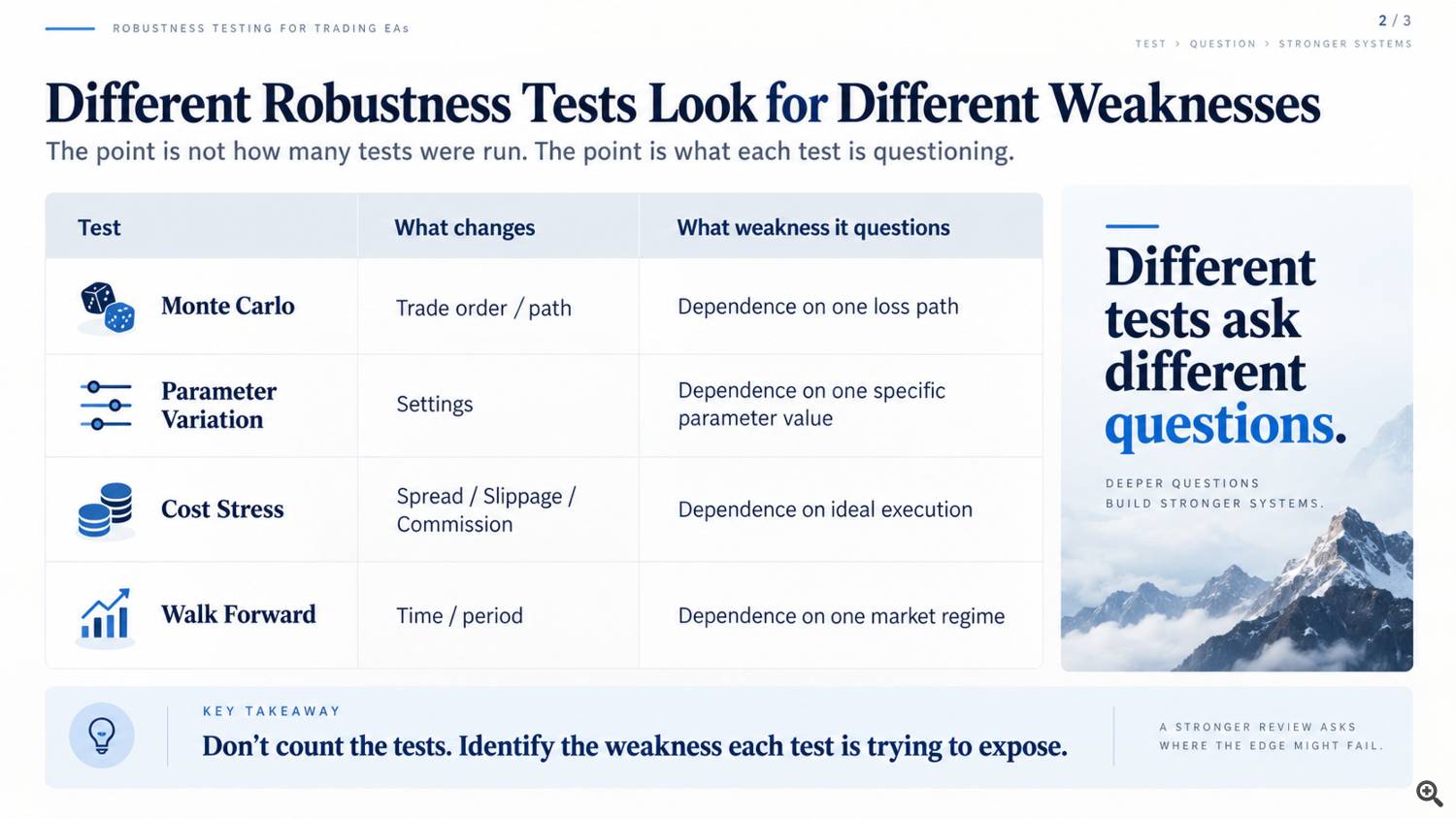
AI-generated overview of the dependencies each test examines, not a product test history or a record of passed checks.
These tests are not interchangeable. Passing a cost test does not establish that a strategy can tolerate a different loss sequence. A useful robustness report therefore explains the weakness each test investigated instead of relying on the number of tests completed.
Compare the response, not just the base PF
Consider two illustrative responses to increasing stress. Both start at PF 1.50. One moves to 1.43 and then 1.34; the other falls to 1.08 and then 0.82. These numbers are examples, not results for either EdgeDriven product.
Both deteriorated, but the first retained profit over more of the tested range. The second lost its edge much closer to the original conditions. That difference is hidden when the comparison stops at the base PF.
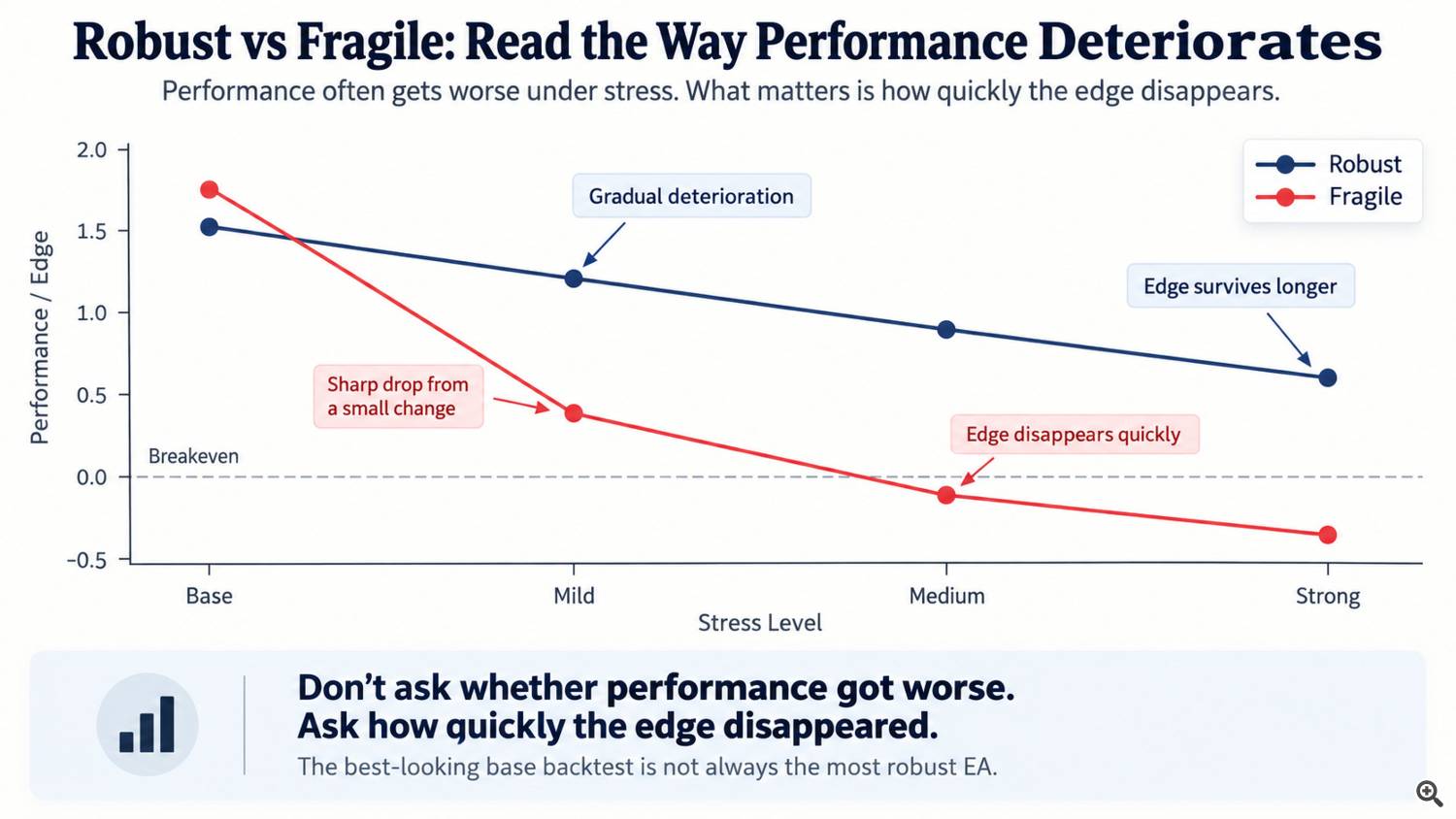
AI-generated sensitivity sketch. The vertical axis is an abstract performance scale, not PF; it is separate from the numerical PF example in the text.
The same reasoning applies when the more fragile strategy starts with a better result. An exceptional result at one setting may be less useful than a more modest result that holds up across nearby settings. It is the response around the selected point that helps explain the dependency.
Real results will not always form smooth, steadily declining curves. Randomized paths and parameter changes can produce uneven outcomes. The conceptual comparison is a way to read sensitivity, not a requirement that every test trace a particular shape.
What a robustness claim should let you inspect
Look for the base assumptions, the changes applied and the resulting profit and drawdown. A label such as “Monte Carlo passed” is difficult to interpret without knowing what was randomized, just as “cost stress passed” is incomplete without the cost levels.
At EdgeDriven Algo, this approach is intended to question an attractive result before relying on it. The useful outcome is a clearer account of which changes the EA tolerated, where it became fragile and which risks the tests did not cover. It leaves uncertainty, but identifies which assumptions deserve attention before the EA is used.
Product details and testing conditions
For a product-level robustness claim, the stated test conditions and results matter more than the name of the test.
Specifications, published historical results and operating limits: EdgeDriven Gold Portfolio — XAUUSD · EdgeDriven Dollar Yen Portfolio — USDJPY.
The examples in this article explain evaluation methods; they are not test results for those products. Historical simulations do not guarantee future results. Leveraged trading can cause substantial losses.