Aurum Vector Motion 1.22: Design Update and a 12-Month XAUUSD Test Review
4 September 2026, 08:13

0
127
Aurum Vector Motion is an Expert Advisor developed for selective directional trading on XAUUSD M1. Its objective is not to remain permanently active or to generate the highest possible number of trades. It waits for agreement between completed-candle structure, live price motion, directional quality, an adaptive evidence gate and execution conditions.
Version 1.22 introduces a revised default position-sizing configuration and additional safeguards while preserving the calibrated XAUUSD entry and position-management logic. This article explains the current design, the update and the results of a recent 12-month Strategy Tester study.
Strategy structure
Every potential entry passes through several stages.
1. Completed-candle structure
The EA examines the body, wick and directional movement of completed M1 candles. This reduces reliance on an unfinished candle whose shape can change before the bar closes.
2. Live motion analysis
Price velocity and acceleration are evaluated to determine whether current movement supports the direction identified by the candle structure.
3. Directional-quality checks
Fast and slow directional-efficiency measurements are used to distinguish cleaner movement from unstable or structurally weak conditions.
4. Adaptive evidence gate
The evidence gate uses prior completed observations. Depending on the available evidence, the EA can operate in normal, reduced or paused mode. Reduced mode accepts fewer otherwise valid entries. A paused gate can recover when its completed observations meet the internal requirements.
5. Execution and risk checks
Before an order is requested, the EA checks the trading schedule, spread, requested volume, broker volume step, stop-distance requirements, available margin and whether a strategy position already exists.
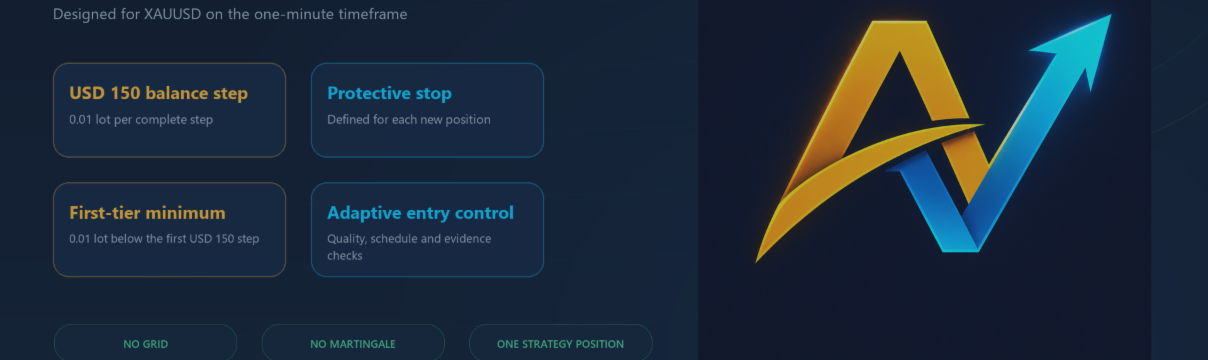
The strategy does not use a grid or martingale sequence. It manages one strategy position on the attached symbol. A protective stop is placed for each new position, while favorable movement is managed by progressive trailing logic. Entry filters do not disable management of an existing position.
What changed in version 1.22
The most visible change is the factory-default position sizing.
The default is now 0.01 lot for every complete USD 150 of closed account balance. The calculation is:
Requested lots = maximum of 1 and floor(balance divided by 150), multiplied by 0.01 lot.
Examples:
- A balance below USD 150 requests 0.01 lot.
- USD 150 to USD 299.99 requests 0.01 lot.
- USD 300 to USD 449.99 requests 0.02 lot.
- USD 450 to USD 599.99 requests 0.03 lot.
- USD 600 to USD 749.99 requests 0.04 lot.
- USD 1,500 to USD 1,649.99 requests 0.10 lot.
The calculation uses closed account balance, not floating equity. Consequently, the requested volume changes only after closed trading results move the account into another balance tier.
An account below the first USD 150 tier no longer remains inactive solely because it has not reached the first step. It requests the minimum configured 0.01-lot tier. This does not mean that a small balance is suitable for XAUUSD trading. The order still requires sufficient free margin and must comply with the broker's minimum volume and other symbol rules.
Fixed-volume mode remains available. Users can also set MaximumDynamicLots to a positive value when they want the EA to impose a ceiling on balance-step sizing. A value of zero means that no separate user-defined ceiling is applied, although the broker's limits continue to apply.
Version 1.22 also adds two operational safeguards:
- On symbols other than XAUUSD, the compatibility path uses the conservative BaseLots value instead of converting a large account balance into a large order.
- The symbol's directional volume limit is checked in addition to its normal maximum-lot rule.
These safeguards were added for safer cross-symbol validation and do not change the calibrated XAUUSD signals or XAUUSD balance-step formula.
The current defaults also retain the calibrated entry-quality protection and block new entries during raw broker-server hours 12 and 20. These hours affect new entries only; an open position continues to receive normal stop and trailing management.
The 12-month Strategy Tester study
The reference study used the following conditions:
- Period: 15 August 2025 to 15 August 2026
- Symbol: XAUUSD
- Timeframe: M1
- Modeling: Every tick based on real ticks
- History quality: 100 percent
- Initial deposit: USD 500
- Leverage: 1:500
- Balance step: USD 150 per 0.01 lot
- Maximum spread setting: 35 broker points
- Entry schedule: 02:00 to 23:15 broker-server time
- Protected broker hours: 12 and 20
The report contained 354,021 bars and 71,553,995 ticks.
Test results
- Initial balance: USD 500.00
- Final balance: USD 2,345.32
- Total net result: USD 1,845.32
- Gross profit: USD 3,031.01
- Gross loss: USD 1,185.69
- Profit factor: 2.56
- Total trades: 330
- Profitable trades: 211, or 63.94 percent
- Losing trades: 119, or 36.06 percent
- Long trades: 172, with 65.70 percent profitable
- Short trades: 158, with 62.03 percent profitable
- Maximum balance drawdown: USD 61.07, or 2.54 percent maximal
- Maximum equity drawdown: USD 74.51, or 3.08 percent maximal
- Relative equity drawdown: 8.29 percent, or USD 44.91
- Recovery factor: 24.77
- Average holding time: 2 minutes 39 seconds
- Longest holding time: 20 minutes 23 seconds
How I interpret the result
The result shows a positive historical balance curve across the selected period, with both long and short trades contributing. The profit factor of 2.56 indicates that gross profit exceeded gross loss in this particular simulation. The 330 completed trades provide more observations than a very small test, but they do not remove uncertainty.
The balance-step model also changes the meaning of the monetary result. Position size increased as closed balance crossed successive USD 150 tiers. Therefore, the USD 1,845.32 net result should not be compared directly with a fixed 0.01-lot test. The increasing volume amplified both later profits and later risk.
Maximum drawdown should be read together with this changing exposure. Percentage drawdown, the shape of the balance and equity curves, trade count, broker conditions and the distribution of results all matter. Net profit alone is not sufficient for evaluating an automated strategy.
Important version disclosure
The source report for this study was generated with version 1.20. Version 1.22 preserves the same calibrated XAUUSD strategy and the same USD 500 balance-step path used by that test. The later changes concern the below-first-tier behavior and safer volume handling during compatibility validation.
For complete transparency, the results above should be treated as the version 1.20 reference study until a full version 1.22 reproduction is completed. They are not presented as live-account results.
Practical setup notes
The intended setup is the broker's XAUUSD symbol on M1. Broker suffixes or prefixes may be accepted, but another metal contract should not automatically be treated as identical because its point value, contract size, margin requirements and trading sessions can differ.
A hedging account is recommended. Netting is supported when XAUUSD is dedicated to this strategy, because manual trades or another EA on the same netting symbol can merge into the shared position.
After installing an update, existing presets do not automatically adopt the new factory values. Users should click Reset in the Inputs tab or reattach the EA, verify the lot-sizing mode, step size, maximum volume, spread and schedule, and test the exact configuration before enabling live algorithmic trading.
Why broker-specific testing matters
Two brokers can produce different results over the same dates because of differences in tick history, spread, commission, swaps, server time, stop-distance requirements, execution and XAUUSD contract specifications.
For this reason, the most useful next steps are:
1. Reproduce the test with version 1.22 and unchanged inputs.
2. Repeat it using the intended broker's real-tick history.
3. Conduct forward observation on a demo account.
4. Verify the requested lot at every important balance tier.
5. Consider a positive MaximumDynamicLots ceiling before live use.
6. Review the Experts and Journal tabs for rejected orders or symbol-specific restrictions.
Conclusion
Aurum Vector Motion 1.22 combines selective XAUUSD M1 entries, an adaptive evidence process, defined position protection and balance-step sizing. The update makes the first balance tier operational below USD 150 and adds safer volume handling during compatibility checks.
The 12-month historical study is encouraging within its stated conditions, but it remains a simulation. It does not guarantee that the same profit, drawdown, win rate or trading frequency will occur in the future. The appropriate evaluation is an exact version 1.22 retest, followed by broker-specific demo observation and exposure limits chosen by the user.
Automated trading involves risk. Historical and simulated results are not a promise or forecast of future performance.