Why Andromeda Can Be One of the Safer Approaches to Grid Trading

Grid trading has a controversial reputation in algorithmic trading.
The reason is simple. Many traders associate the word grid with martingale, aggressive position stacking, very small grid distances, and increasing exposure whenever the market moves against the initial position.
But a grid does not have to work that way.
Andromeda was designed around a different philosophy: instead of trying to survive every market condition by continuously adding positions, it attempts to identify meaningful pullbacks and use them selectively.
This distinction is important.
No Martingale
One of the biggest risks associated with grid systems is martingale.
A typical martingale approach increases lot size after losing trades:
0.01 → 0.02 → 0.04 → 0.08 → 0.16...
The problem is not the first few trades. The problem is what happens when the market continues moving in one direction for an extended period.
Exposure can grow exponentially while the trader is effectively betting that the market will eventually reverse.
Andromeda does not use martingale.
The position size is not multiplied simply because the previous position is losing.
This means that a temporary drawdown does not automatically turn into exponentially increasing exposure.
That is a fundamental difference between a controlled grid concept and a traditional martingale grid.
It Does Not Continuously Stack Positions at Extremely Tight Intervals
Another common characteristic of aggressive grid systems is extremely tight position spacing.
For example, an EA may open a new position every few points as price moves against it.
The result can be dozens of positions accumulated in a relatively small price range.
This creates a problem:
The number of positions can grow much faster than the actual market opportunity.
Andromeda takes a different approach.
The system is not designed to simply say:
"Price moved against me, therefore open another position."
Instead, it evaluates the market structure and looks for a meaningful pullback before adding exposure.
This reduces the tendency to turn every small fluctuation into another trade.
The Objective Is Not to Predict Every Tick
Gold can move extremely quickly.
XAUUSD can produce sharp expansions, sudden reversals and short-lived spikes that make traditional grid logic particularly vulnerable.
Trying to predict every small movement is therefore unnecessary.
Andromeda focuses on something more important:
Has the market actually pulled back?
A pullback is different from simply seeing price move a few points in the opposite direction.
A meaningful pullback represents a temporary retracement within the current market movement.
The system is designed to distinguish between ordinary market noise and conditions that provide a more meaningful opportunity for another entry.
Why Not Simply Use ATR Everywhere?
ATR is a useful volatility indicator.
But using ATR does not automatically make a trading system safer.
One common approach is to build an entire grid around dynamic ATR distances:
Higher ATR = wider grid
Lower ATR = tighter grid
This sounds sophisticated, but volatility alone does not tell you why price is moving.
A high ATR environment can occur during:
- news releases
- breakouts
- liquidity events
- trend acceleration
- violent reversals
Simply adjusting the grid according to ATR does not necessarily identify whether the market is actually offering a tradable pullback.
Andromeda's philosophy is different.
The system does not depend on a "fancy ATR formula" to decide when the market has given another entry opportunity.
Instead, it focuses on the actual behavior of price.
Real Pullbacks Instead of Mechanical Averaging
This is perhaps the most important concept behind Andromeda.
There is a major difference between:
Averaging every X points
and
Adding only when market conditions indicate a pullback.
The first approach is purely mechanical.
If the market continues moving against the position, the system continues building exposure according to the grid.
The second approach is selective.
Andromeda attempts to identify when price has actually retraced enough to justify another entry.
This means the grid is not simply a collection of equally spaced orders.
It is a market-condition-based grid.
Multiple Strategies Instead of One Single Grid Logic
Another important component of Andromeda is that it is not based on one entry condition.
The system contains multiple strategies, each designed to identify different market behaviors.
Markets are not always behaving the same way.
Sometimes price is trending.
Sometimes it is ranging.
Sometimes it is making short-term reversals.
Sometimes volatility expands rapidly.
A system that relies on one universal entry condition can struggle when market behavior changes.
The idea behind Andromeda is therefore not to force one strategy onto every situation.
Instead, different strategies can look for different types of opportunities.
Why This Matters During Strong Trends
The biggest question for any grid system is:
What happens if the market does not reverse?
This is where martingale and aggressive grids can become dangerous.
If a system continuously adds larger positions while the market moves in one direction, exposure can increase dramatically.
Andromeda does not attempt to solve a losing position by simply increasing the lot size.
There is no exponential martingale progression.
The objective is to keep the exposure more controlled and allow the underlying strategy logic to determine whether another entry is justified.
Of course, no grid system can eliminate market risk.
A strong, persistent move against a strategy can still produce drawdown.
That is simply part of trading.
The difference is how the system responds to that situation.
"Grid" Does Not Automatically Mean "Martingale"
This distinction is often lost in discussions about automated trading.
A grid is essentially a method of organizing entries around price movement.
Martingale is a position-sizing methodology.
They are not the same thing.
You can build:
Grid + Martingale
or
Grid + fixed/controlled exposure
or even a much more selective grid based on market structure.
Andromeda belongs to the latter philosophy.
The goal is not to increase risk until the market finally reverses.
The goal is to use grid entries selectively when the system detects conditions that justify them.
Designed With Risk in Mind
There is no such thing as a risk-free EA.
No algorithm can guarantee that every pullback will occur, that every trade will recover, or that a particular market regime will never produce significant drawdown.
Therefore, calling any trading system "safe" without qualification would be misleading.
A more useful question is:
What mechanisms does the EA use to control risk?
In Andromeda's case, the design principles include:
- No martingale position multiplication
- No aggressive exponential exposure
- No dependence on extremely tight grid spacing
- Selective entries instead of blindly averaging
- Detection of meaningful pullback conditions
- Multiple strategies for different market behaviors
- A focus on controlled exposure rather than constant position accumulation
These principles do not remove risk.
They are intended to reduce unnecessary exposure created by aggressive grid mechanics.
The Philosophy Behind Andromeda
The idea behind Andromeda can be summarized very simply:
Do not add a position just because price moved. Add a position when the market gives a reason.
That is the fundamental difference.
A traditional grid asks:
"How far did price move?"
A more adaptive grid asks:
"What did the market actually do after that movement?"
This second question is much more important.
Markets are dynamic.
A fixed distance does not understand market structure.
A martingale does not understand market structure.
Increasing lot size does not create a better entry.
A genuine pullback, however, can provide a completely different opportunity.
And that is the principle around which Andromeda was designed.
Final Thoughts
Andromeda should not be considered "safe" simply because it is a grid EA.
Grid trading always carries risk, particularly on instruments such as gold where large directional movements can happen quickly.
However, Andromeda's architecture is deliberately different from the aggressive grid and martingale models that have given grid trading its reputation.
It does not attempt to recover losses by exponentially increasing position size.
It does not continuously stack positions at extremely tight intervals.
It does not rely on complicated volatility formulas simply to determine where the next order should be placed.
Instead, it attempts to identify real market pullbacks and use them as opportunities for controlled additional entries.
That makes Andromeda less about:
"Keep adding until price comes back."
and more about:
"Wait for the market to actually give us a pullback."
And for a grid system, that difference can matter enormously.
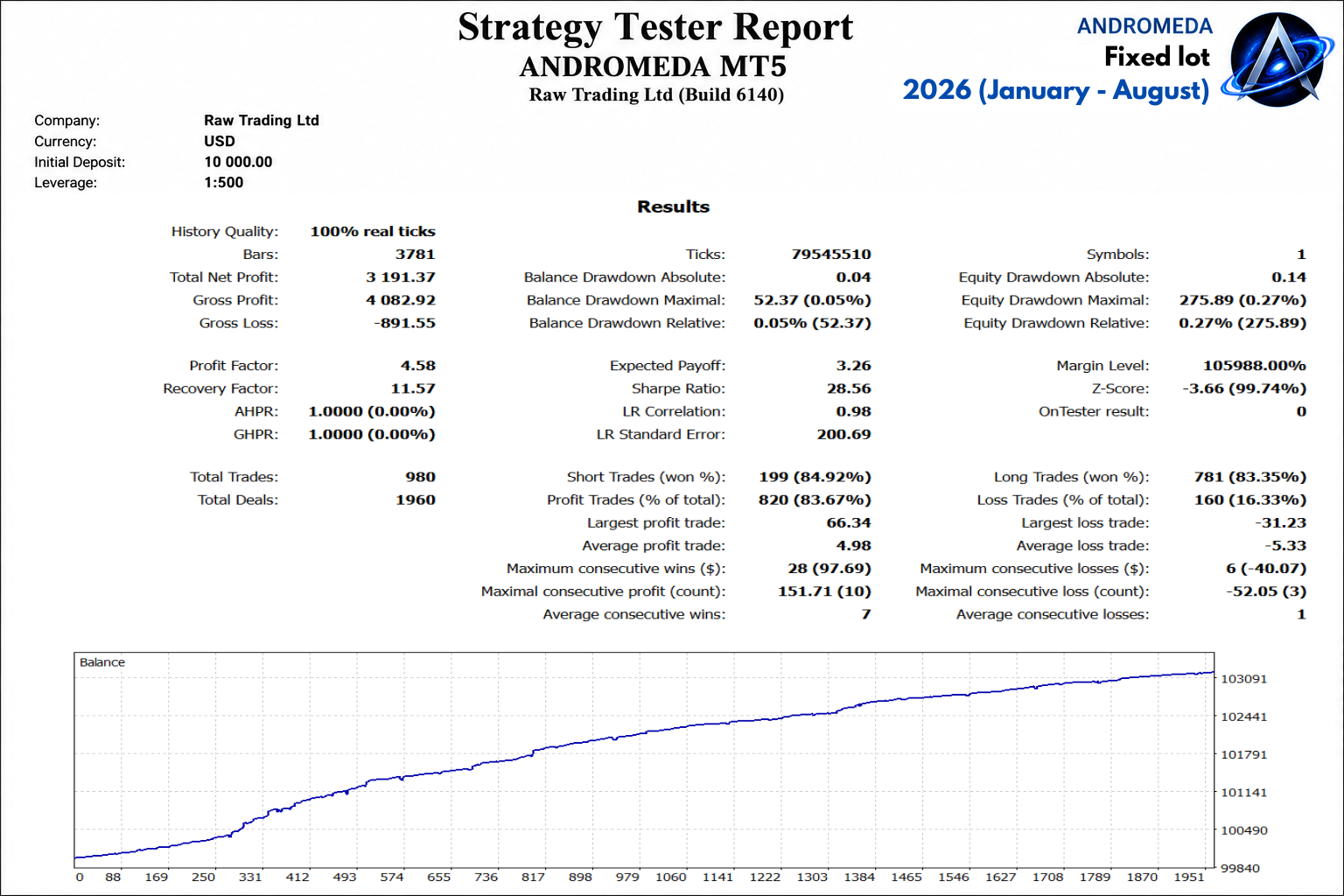
Backtest your Andromeda and show your results!
https://www.mql5.com/en/market/product/191518?source=Site+Profile+Seller