You bought an Expert Advisor, or you are copying somebody's signal, and after a few weeks you want to know one thing. Is it doing anything dangerous behind your back?
Specifically: when a trade goes against it, does it open a second, bigger one to rescue the first? That habit has a name, martingale, and it is the most common single reason an account that looked excellent for eight months disappears in one afternoon.
The History tab is right there. So this should take an evening.
It does not, and the reason is worth knowing whether or not you ever use a tool for it.
Your history is not a list of trades
Open the History tab and you see rows. It is natural to read one row as one trade. It is not.
MT5 records executions. Every time something is bought or sold, that is a row. But a single trade in the ordinary sense, one decision from open to close, can produce several rows.
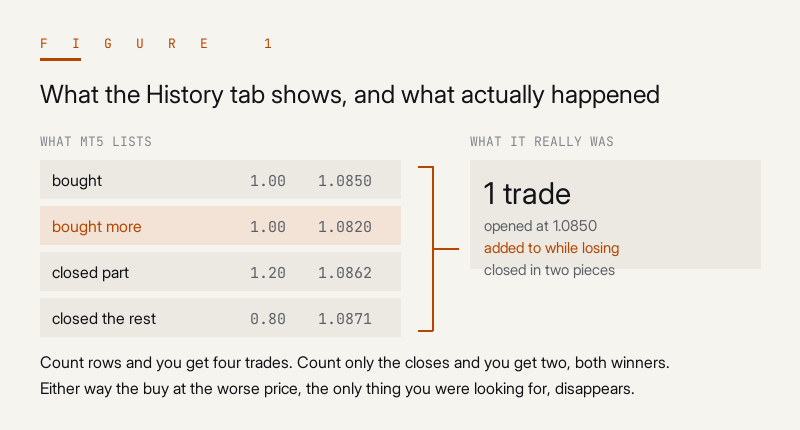
Count them. Four rows. Two of those rows are closes, and both closed at a profit.
If you count rows, you had four trades. If you count only the closes, you had two trades and both won. The truth is that you had one trade, it went against you, something bought more while it was losing, and it eventually came out ahead.
Both of the easy ways to count hand you a better win rate than really happened. And the one thing you opened the History tab to find, that second buy at a worse price, disappears in every version except the correct one.
This is not a flaw in MT5. It is what the terminal is for. It records what was executed. It does not keep a diary of intentions.
To get real trades back, the rows belonging to one position have to be grouped, the price you truly paid averaged across all the parts, and the trade treated as closed only at the last exit rather than the first. Get that wrong and every number computed afterwards is confidently wrong.
The stop loss you can see is not the one it started with
Second question, just as reasonable: did it use a stop loss at all?
If a trade is still open you can look at its stop right now. But "right now" is after any trailing, after any move to break even. It tells you where the stop sits today. It tells you nothing about whether the trade was protected in its first second, which is the only moment that matters.
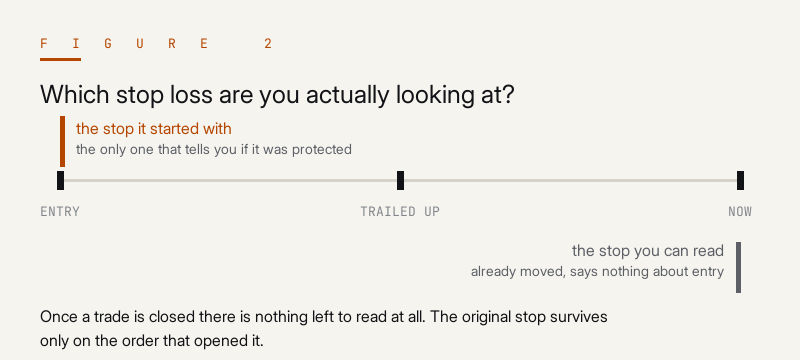
And once a trade is closed there is nothing left to look at. The position is gone.
The answer is still recoverable, but not from the trade. It survives on the order that opened it, which remembers the stop that was submitted alongside it. That is exact, and it is the only exact source.
One honest caveat, because it will otherwise mislead you. Some EAs send the order first and attach the stop a fraction of a second later. That trade genuinely was unprotected at entry, so it reads as unprotected, even though a stop appeared almost immediately. If a report tells you every single trade was naked, do not conclude the EA is reckless. Conclude that you have learned how it places orders, and go and ask about that.
"How much did it risk?" needs a number nobody keeps
Risk is usually expressed as a share of the account. Two percent, one percent, whatever the seller promised.
To check it you need the balance at the moment that trade opened. Not today's balance. The one from that Tuesday in March.
MT5 does not store a balance history. It has to be rebuilt, deposit by deposit and trade by trade, from the very beginning of the account.
This is where most homemade audits quietly break. Point the calculation at this year only and the original deposit sits outside the window. The running balance starts from zero, and every risk percentage that comes out is meaningless. It will still print a confident-looking number.
The trap that catches almost everybody
Here is the one that matters most, and it is why "just compare the lot sizes" does not work.
Take an honest, well-behaved EA that risks a fixed one percent of the account on every trade. The account grows from 1,000 to 2,000 over a year. Its trade sizes double, because one percent of 2,000 is twice one percent of 1,000. That is correct behaviour. That is what you paid for.
Now take a martingale EA that doubles its size after a loss. Its trade sizes also grow.
Looking only at lot sizes, these two are indistinguishable. Any check that flags "the size went up after a loss" will accuse every properly compounding account of martingale, which makes its warnings worth nothing.

The way out is to stop looking at size on its own and compare it against the balance. Did the trade grow faster than the account did?
Flat lots on a drifting account: size and balance move together. Honest percentage risk on a growing account: size and balance move together. Doubling after a loss: the size jumps while the balance has just gone down. The two travel in opposite directions, and nothing innocent produces that.
Two more rules keep the count fair. Compare like with like, so gold against gold and never gold against a currency pair, because 0.10 lots of one is nothing like 0.10 of the other. And check that the second trade actually opened afterthe first one closed. If they overlap it is not a doubling-down sequence at all, it is one position being added to while it is still running. That is a different behaviour with a different name, and counting it under both labels is exactly how audits produce frightening numbers that fall apart the moment somebody looks at the actual trades.
The one answer a checking tool must never give
A tool like this has one genuinely unacceptable output, and it is not a false alarm.
It is saying "clean" when it actually failed to read.
If the terminal has not finished downloading the history, or the read fails, the honest answer is "history not loaded". Never green. Green means checked and fine, and you will act on it.
The same applies to small samples. An average built on two winning trades is not an average, it is two numbers. Below a handful of wins and losses the right output is "not enough data", not a ratio that looks authoritative.
A tool that says fine when it means unknown is worse than having no tool at all.
Why this matters to me
Every product I publish carries the same line: no martingale, no grid, no averaging down.
That is a very easy sentence to write. Everyone writes it. What I would rather do is hand you the means to check it, on my account or on anybody else's, without taking my word for any part of it.
So the checker is free. It reads your account, reconstructs the real trades, scores the behaviour, and exports the trades it flagged so you can look at them yourself rather than trusting a verdict.
It is Trade Auditor TechnoTrader, it is on the Market, and it costs nothing.