
Product link:
https://www.mql5.com/en/market/product/191385
One of the most important factors affecting trade replication in MetaTrader 5 is the type of trading account being used. MT5 accounts generally operate under either a Hedging or Netting position system.
Understanding the difference between these two account structures is essential when using an MT5 Trade Copier. The way positions are created, modified, closed, and synchronized can be significantly different between Hedging and Netting accounts.
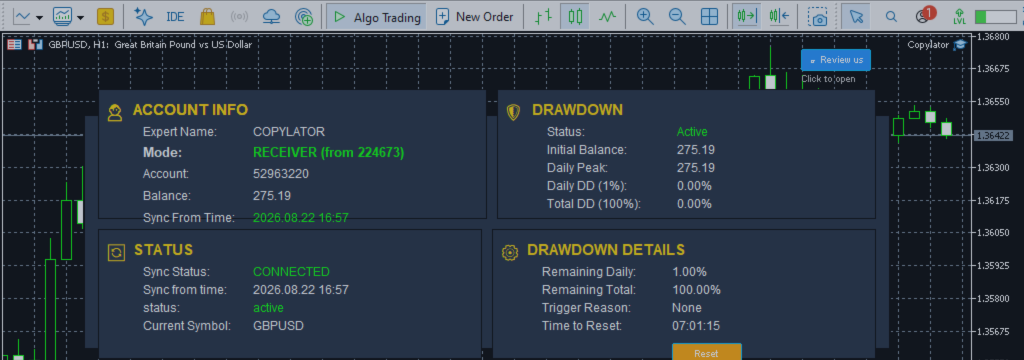
A professional trade copier should therefore be able to recognize the account type and apply the appropriate synchronization logic automatically. COPYLATOR supports both account structures and automatically detects the account type without requiring manual configuration. 1
What Is a Hedging Account?
A Hedging account allows multiple independent positions to exist on the same symbol at the same time.
For example, a trader can have:
- Buy EURUSD 0.50 lot
- Buy EURUSD 0.30 lot
- Sell EURUSD 0.20 lot
These positions can remain open independently, providing considerable flexibility for advanced trading strategies.
Hedging accounts are particularly useful for strategies involving multiple entries, independent position management, hedging, scaling, and situations where Buy and Sell positions may need to coexist.
What Is a Netting Account?
A Netting account uses a different position model.
Only one net position per symbol can exist at a time. When additional trades are executed on the same symbol, they modify the existing net position instead of creating a separate position for every individual trade.
For example, if the account currently has:
BUY EURUSD 1.00 lot
and another Buy order for 0.50 lot is executed, the resulting position becomes:
BUY EURUSD 1.50 lots
If an opposite Sell trade is subsequently executed, it can reduce or completely close the existing Buy position depending on its volume.
This makes Netting accounts simpler in terms of position structure, but it requires different synchronization logic from an MT5 Trade Copier.
Hedging vs. Netting: The Fundamental Difference
| Feature | Hedging Account | Netting Account |
|---|---|---|
| Multiple positions per symbol | Yes | No |
| Opposite Buy and Sell simultaneously | Yes | No, positions are netted |
| Individual trade tickets | Maintained separately | Combined into a net position |
| Position-based SL/TP | Can be managed individually | Applies to the net position |
| Multiple entries on same symbol | Fully supported | Aggregated |
| Copying approach | Individual position synchronization | Net-position synchronization |
How an MT5 Trade Copier Handles Hedging Accounts
In a Hedging account, every position can have its own unique ticket.
This allows an MT5 Trade Copier to associate individual Sender positions with their corresponding Receiver positions.
For example:
| Sender | Receiver |
|---|---|
| BUY EURUSD 0.50 – Ticket 101 | BUY EURUSD 0.50 – Corresponding position |
| BUY EURUSD 0.30 – Ticket 102 | BUY EURUSD 0.30 – Corresponding position |
| SELL EURUSD 0.20 – Ticket 103 | SELL EURUSD 0.20 – Corresponding position |
The positions can therefore be tracked and synchronized individually.
This is particularly useful when the Sender uses multiple entries, different Stop Loss levels, different Take Profit levels, partial position management, or opposite positions on the same symbol.
How an MT5 Trade Copier Handles Netting Accounts
Netting accounts require a different approach because individual positions cannot remain separate on the same symbol.
Instead of attempting to reproduce every individual Sender ticket as a separate Receiver position, the copier must consider the net position for each symbol.
For example, suppose the trading activity is:
- Buy 1.00 lot EURUSD
- Buy 0.50 lot EURUSD
- Sell 0.25 lot EURUSD
The resulting net exposure is:
BUY 1.25 lots EURUSD
A Netting Receiver cannot maintain three independent positions. The synchronization process must therefore respect the Receiver's single-position-per-symbol structure.
Why Automatic Account-Type Detection Matters
Manually configuring different synchronization logic for every account can make a multi-account copying system complicated and error-prone.
COPYLATOR automatically detects whether the MT5 account is operating under a Hedging or Netting structure and applies the appropriate synchronization method. No manual account-type setup is required. 2
This automatic detection is especially useful when one Sender is connected to multiple Receiver accounts with different account structures.
Trade Replication on Hedging Accounts
Hedging accounts provide the greatest flexibility for trade replication.
An MT5 Trade Copier can maintain separate relationships between Sender and Receiver positions, allowing precise synchronization.
This is especially useful for:
- Multiple entries on the same symbol.
- Independent Stop Loss levels.
- Independent Take Profit levels.
- Partial position management.
- Hedging strategies.
- Reverse trading strategies.
- Multiple pending orders, subject to broker conditions.
COPYLATOR specifically supports individual ticket-based copying on Hedging accounts, including Reverse Mode and pending-order replication. 3
Trade Replication on Netting Accounts
Netting accounts impose structural limitations that a copier must respect.
When multiple trades affect the same symbol, the position becomes aggregated.
For example:
BUY 1.00 → BUY 0.50 → SELL 0.25
can ultimately result in:
BUY 1.25
The copier therefore needs to synchronize the Receiver's net exposure instead of attempting to reproduce every individual position independently.
COPYLATOR automatically adapts its behavior to the Netting structure to prevent incompatible trade operations. 4
SL/TP Synchronization on Hedging Accounts
Hedging accounts allow individual positions to have their own Stop Loss and Take Profit levels.
This makes individual SL/TP synchronization possible.
For example, a Sender could have:
| Position | Volume | SL | TP |
|---|---|---|---|
| Buy EURUSD | 0.50 | 1.1650 | 1.1750 |
| Buy EURUSD | 0.30 | 1.1680 | 1.1780 |
These positions can be tracked separately.
When the trader modifies the SL or TP of a position, the corresponding Receiver trade can be updated accordingly.
SL/TP Synchronization on Netting Accounts
In a Netting account, SL and TP apply to the resulting net position rather than to separate historical entries.
If several trades contribute to one net position, the Receiver cannot maintain separate SL/TP levels for every individual entry.
The copier therefore needs to synchronize the appropriate SL/TP state of the aggregated position.
COPYLATOR supports SL/TP modification and synchronization across both Hedging and Netting accounts, including changes made after the trade has already been opened. 5
Reverse Trade Mode and Account Types
Reverse Trade Mode is another area where the difference between Hedging and Netting accounts becomes important.
On Hedging accounts, opposite positions can coexist, making reverse trade copying more straightforward.
For example:
Sender BUY EURUSD → Receiver SELL EURUSD
On Netting accounts, however, an opposite transaction affects the existing net position instead of creating an independent opposite position.
Therefore, some reverse-trading scenarios may not be applicable in exactly the same way on Netting accounts.
COPYLATOR automatically detects the account structure and adjusts or ignores unsupported operations where necessary to prevent errors. 6
Pending Orders on Hedging Accounts
Hedging accounts can support multiple pending orders on the same symbol, subject to broker-specific trading rules.
For example, a trader may have several Buy Stop and Buy Limit orders waiting at different price levels.
An MT5 Trade Copier can replicate supported pending orders individually, making Hedging accounts suitable for strategies based on multiple entry levels.
Pending Orders on Netting Accounts
Netting accounts can impose additional restrictions on how certain pending-order configurations behave.
The copier must take the account's position model and broker rules into consideration rather than assuming that every Sender pending order can always be reproduced as an independent Receiver order.
COPYLATOR automatically adjusts or ignores operations that are not applicable to the Netting structure in order to prevent invalid requests. 7
Partial Closing on Netting Accounts
Partial closing behaves differently in a Netting environment.
When an opposite trade is executed, it can reduce the existing net position rather than creating an independent opposite position.
For example:
BUY 1.00 lot EURUSD
followed by:
SELL 0.40 lot EURUSD
can result in:
BUY 0.60 lot EURUSD
The copier therefore needs to recognize that the second transaction changed the existing net exposure.
Multi-Account Copying with Hedging and Netting
A powerful use case for an MT5 Trade Copier is connecting multiple Receiver accounts to a single Sender.
These Receiver accounts do not necessarily need to use the same account structure.
For example:
| Account | Type | Synchronization Approach |
|---|---|---|
| Sender | Hedging | Source trades |
| Receiver 1 | Hedging | Individual position synchronization |
| Receiver 2 | Netting | Net-position synchronization |
| Receiver 3 | Hedging | Individual position synchronization |
COPYLATOR is designed for Multi-Sender / Multi-Receiver configurations and automatically handles Hedging and Netting account structures. 8
What Happens When Account Types Are Different?
A common configuration is a Hedging Sender connected to a Netting Receiver.
This can work, but the Receiver cannot necessarily reproduce every Sender ticket as a separate position.
If the Sender has multiple positions on the same symbol, the Netting Receiver may need to represent their combined exposure as one net position.
This is one of the key reasons why automatic account-type detection and specialized synchronization logic are important features in an MT5 copier.
Hedging vs. Netting for Different Trading Strategies
Hedging Accounts Are Particularly Useful For:
- Multiple independent entries.
- Hedging strategies.
- Opposite positions on the same symbol.
- Complex position management.
- Ticket-level trade management.
- Strategies requiring multiple pending orders.
Netting Accounts Are Particularly Useful For:
- Simple directional exposure.
- Strategies that treat each symbol as one net position.
- Simplified portfolio management.
- Systems that do not require multiple simultaneous positions on the same symbol.
Important Limitations of Netting Accounts
Netting accounts are supported for trade copying, but traders should understand that certain advanced operations may not behave identically to Hedging accounts.
According to the COPYLATOR specification, features such as Reverse Mode and pending-order replication may not be applicable in certain Netting scenarios. The EA automatically detects the account structure and adjusts or ignores such operations where necessary to prevent errors. 9
The core functionality of copying market orders and synchronizing SL/TP remains supported, with the synchronization method adapted to the account structure.
How COPYLATOR Handles Account Types
COPYLATOR automatically detects whether the account is Hedging or Netting.
The EA then applies the appropriate synchronization approach:
- Hedging: Individual positions are tracked and synchronized separately.
- Netting: Positions are handled according to the net exposure for each symbol.
- SL/TP: Synchronization is adapted to the account structure.
- Reverse Mode: Supported where applicable to the account structure.
- Pending Orders: Handled according to account and broker limitations.
This automatic adaptation reduces the need for manual configuration and helps prevent invalid trade operations.
Why Automatic Adaptation Is Important
Without account-type awareness, a copier could attempt to create multiple independent positions on a Netting account when the broker's position model permits only one net position per symbol.
This could result in rejected orders, incorrect exposure, or synchronization problems.
An advanced MT5 Trade Copier must therefore understand the difference between the two position models and modify its behavior accordingly.
Best Practices for Copying Between Hedging and Netting Accounts
- Identify the account structure of both Sender and Receiver accounts.
- Test mixed Hedging-to-Netting configurations on demo accounts.
- Understand how multiple trades on the same symbol will be aggregated.
- Pay special attention to Reverse Mode when the Receiver is a Netting account.
- Verify how pending orders are handled by the specific broker.
- Monitor SL/TP synchronization after multiple position changes.
- Use appropriate lot sizing for each Receiver account.
- Keep all MT5 terminals running continuously for reliable synchronization.
Conclusion
The difference between Hedging and Netting accounts is fundamental when using an MT5 Trade Copier.
Hedging accounts provide maximum flexibility by allowing multiple independent positions on the same symbol. This makes them particularly suitable for complex strategies involving multiple entries, hedging, individual SL/TP levels, and advanced position management.
Netting accounts use a single net position per symbol. This simplifies position management but requires the copier to aggregate trades and synchronize net exposure rather than attempting to reproduce every individual ticket.
COPYLATOR automatically detects the account type and adjusts its synchronization logic accordingly. This allows the system to work with different MT5 account structures without requiring the trader to manually configure the position model. 10
Understanding the differences between Hedging and Netting accounts helps traders configure their copying environment correctly, anticipate account-specific limitations, and maintain reliable trade replication across multiple MT5 accounts.
Product link:
https://www.mql5.com/en/market/product/191385


