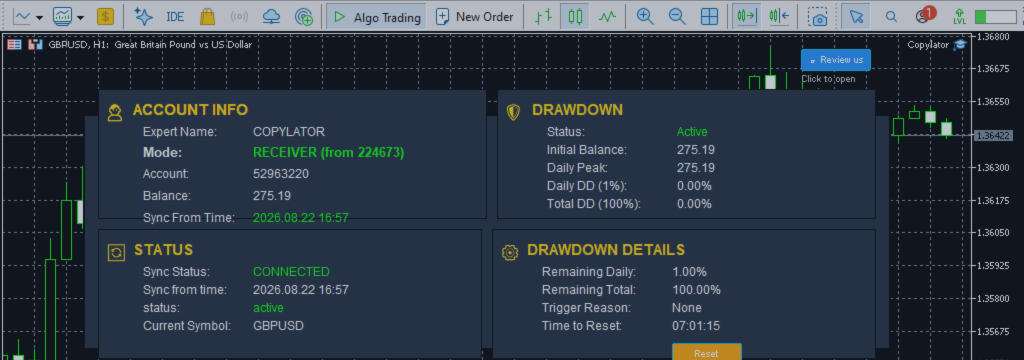
COPYLATOR – MT5 Trade Copier: The Daily Peak and Why Your Drawdown Triggered Earlier Than Expected

Product link:
https://www.mql5.com/en/ market/product/191385
A trader sets a 5% daily drawdown limit. The account is up 2% for the day. A position moves against the account, losing 4% from the current level. The trader expects no trigger because the account is still slightly positive overall.
The protection triggers anyway. If the daily peak was 2% above the starting balance and the current equity is now 2% below the starting point, the drawdown from the peak is approximately 3.9% when calculated relative to that peak—not 2%. Depending on the configured limit and calculation method, the protection may trigger earlier than the trader expects.
This scenario illustrates an important concept in drawdown protection: the daily peak.
WHAT THE DAILY PEAK ACTUALLY IS
The daily peak is the highest equity or balance value reached during the current daily cycle, depending on the protection's calculation method. It is not necessarily the starting balance or the previous day's close. It represents the highest recorded value since the last daily reset.
If the account starts the day at $10,000, rises to $10,200 on floating profit, and then falls to $9,800, the daily peak is $10,200 if the protection tracks equity. The drop from peak to current equity is $400, which is approximately 3.92% of the peak.
The trader watching the account fall from $10,200 to $9,800 sees a $400 decline. The protection calculates the drawdown from the recorded peak. These are related measurements, but they use different reference points.
WHY THE PEAK MAY BE UPDATED CONTINUOUSLY
In a peak-based drawdown system, the daily peak is not necessarily a fixed value established at the start of the day. If the protection tracks equity, a new high in equity may update the peak. The exact behavior depends on the implementation and selected settings.
This approach measures losses from the highest account value reached during the cycle rather than solely from the starting value. If the account rises by 2% and then falls below its starting level, the decline from the peak includes both the surrendered gain and the subsequent loss.
This can create a difference between the trader's expectations and the protection's calculation. A trader may judge performance relative to the starting balance, while peak-based protection measures the decline from the highest recorded value.
THE UNREALIZED PROFIT PROBLEM
A specific complication can arise when the daily peak is set by unrealized profit. A position that briefly shows a large floating gain may raise the equity peak, even if the position is later closed at a smaller profit or at a loss.
If a trade reaches $500 in floating profit and then retraces to close at $100 profit, the account has given back $400 of the peak profit. If the protection tracks equity, that temporary high may remain relevant to the drawdown calculation for the rest of the daily cycle.
The trader may focus on the $100 realized gain, while the protection measures the decline from the higher equity peak. Both figures describe different aspects of the account's performance.
WHY EQUITY-BASED PEAKS CAN BE MORE VOLATILE
When protection is equity-based, floating profit and loss can affect the measured account value while positions remain open. Consequently, the recorded peak may change as market prices fluctuate.
Balance-based measurements generally change when transactions are realized and reflected in the account balance. A temporary floating profit does not directly increase the balance while the position remains open.
The choice depends on the protection mechanism and the trader's objectives. Equity-based protection can account for unrealized losses sooner, while balance-based protection may not reflect the full risk of open positions. Neither method is universally better; each measures a different aspect of account performance.
THE IMPACT OF A SINGLE EARLY SPIKE
Consider the following example.
The day starts at $10,000. A position opens and moves 3% in profit, pushing equity to $10,300. The position is held, the market reverses, and the position closes at break-even. Equity returns to $10,000, assuming no other account changes.
If the protection retains the $10,300 equity peak, subsequent losses may be measured from that value. A 5% drawdown from $10,300 corresponds to $9,785.
In this example, the account has returned to its starting value without retaining the temporary floating gain. The distance from the peak is therefore greater than the loss measured from the starting balance alone.
WHY THE PEAK MAY NOT RESET WHEN PROFITS ARE GIVEN BACK
In a conventional peak-based drawdown calculation, the recorded peak remains unchanged when equity falls. It is updated when a new high is reached or cleared when the relevant reset occurs, according to the protection's implementation.
This design measures how far the account has declined from its previous high. If the reference peak automatically fell whenever equity declined, the calculation would no longer measure the full decline from that high.
For this reason, traders should understand how their particular drawdown protection records and resets its peak. The exact behavior should be verified in the product's settings and documentation.
THE MORNING SPIKE AND THE AFTERNOON TRIGGER
Consider an account that starts the day at $10,000. An early trade pushes equity to $10,150, establishing a peak if the protection tracks equity.
The position closes at a small profit, and equity settles at $10,050. Later, the account declines to $9,700.
The difference between the $10,150 peak and the current equity of $9,700 is $450, or approximately 4.43% of the peak. The account is 3% below its starting balance.
If the daily limit is 4% and the protection uses this peak-based calculation, the drawdown may trigger even though the loss measured from the starting balance is smaller. The difference arises from the reference point used for the calculation.
HOW TO DIAGNOSE THIS PROBLEM
If the daily drawdown protection triggers earlier than expected, the first step is to check the daily peak and current drawdown values displayed on the dashboard, if available.
Compare the peak with the starting reference value. If the peak is significantly higher, determine whether the difference resulted from floating profit, realized profit, or another account change.
Then compare the current value with the peak and confirm which reference point the configured drawdown limit uses. This helps establish whether the apparent discrepancy comes from the calculation method, the selected settings, or another factor.
WHEN TO ACCEPT THE EARLY TRIGGER
An early trigger may be consistent with the configured protection. If the account has declined from its recorded peak by the amount specified in the limit, the protection may be operating as intended.
The trader's expectation may be based on the starting balance, while the protection uses the peak. These methods measure different types of drawdown, so the trigger should be assessed against the selected calculation method.
A trader who prefers to measure losses from the starting balance should verify whether the product supports that type of calculation. Adjusting a peak-based limit to compensate for typical peak deviations is another possible approach, but it should be based on observed data rather than an assumed average.
WHEN TO ADJUST THE CONFIGURATION
If the protection repeatedly triggers at levels that differ from the trader's intended risk threshold, review the configuration and the recorded drawdown data.
The first consideration is whether the daily limit matches the intended measurement. If the trader wants to allow a particular decline from the starting balance, a peak-based limit may need to be configured differently to account for the reference point.
The second consideration is whether equity-based or balance-based protection is appropriate. If temporary floating gains frequently establish peaks, compare how each supported calculation method behaves. Remember that balance-based protection may not reflect substantial unrealized losses on open positions.
The third consideration is position sizing. If individual trades create large changes in account equity, review whether the lot sizes are appropriate for the account and its risk objectives.
THE PEAK AND THE TOTAL DRAWDOWN
The daily peak and total drawdown baseline are separate concepts. In a configuration where daily drawdown is measured from the daily peak and total drawdown is measured from a fixed baseline, the two calculations can produce different readings.
A trader may therefore see a daily drawdown trigger while the total drawdown remains within its configured limit. This does not automatically indicate a malfunction: the two protections may be measuring different periods or reference values.
Check the configured calculation method for each limit and assess them independently.
THE PEAK AND THE RESET
A daily reset may establish a new daily reference point, depending on the product's reset behavior. The peak then develops according to the account values recorded during the new daily cycle.
A manual reset may also establish a new total drawdown baseline. Whether it clears the daily peak at the same time depends on the implementation and settings.
Before resetting, verify which reference values will be changed. A reset can change how future drawdown is calculated, so it should be performed deliberately rather than solely to remove an active warning or trigger.
TRACKING THE PEAK OVER TIME
Traders who want to understand their strategy's peak behavior can record the daily starting value, highest recorded value, and lowest relevant value for each trading day.
Over time, these observations can show how often the account reaches new highs and how far the peak typically moves above the starting reference. The results may vary across strategies and market conditions.
This information can help inform the daily limit. Historical observations are useful for calibration, but they do not guarantee that future peaks or drawdowns will remain within the same range.
A PRACTICAL RULE OF THUMB
There is no reliable universal rule that daily peaks will exceed the starting balance by a fixed percentage. The difference depends on the strategy, position sizing, market conditions, and whether the protection tracks equity or balance.
Rather than automatically adding 1% or 2% to the daily limit, record the account's actual peak behavior and compare it with the intended maximum loss. Choose a limit that reflects the strategy's observed behavior while remaining consistent with the amount of risk the trader is prepared to accept.
If the strategy is volatile or positions experience substantial floating profit and loss, review the peak data carefully before finalizing the configuration.
SUMMARY
The daily peak is the highest equity or balance value recorded during the current daily cycle, depending on the protection's calculation method. In a peak-based system, the reference value may rise as the account reaches new highs and remain unchanged when the account subsequently declines, until the applicable reset.
This can explain why a daily drawdown trigger occurs earlier than expected. The trader may be measuring the decline from the starting balance, while the protection measures it from a higher peak.
Diagnose the discrepancy by checking the recorded peak, current drawdown, and configured calculation method. Review the daily limit using actual observations, and consider whether equity-based or balance-based protection better matches the intended risk controls.
The peak is not necessarily a malfunction. It may be a deliberate part of the drawdown calculation. Understanding the reference point helps explain why a trigger occurred and whether the configuration needs adjustment.
Product link:
https://www.mql5.com/en/ market/product/191385


![[EURUSD]: Weekly Liquidity Activation Points (LAP), October 12-16, 2026](https://c.mql5.com/6/1035/splash-preview-777305.png "[EURUSD]: Weekly Liquidity Activation Points (LAP), October 12-16, 2026")
![[Nasdaq]: Weekly Liquidity Activation Points (LAP), October 12-16, 2026](https://c.mql5.com/6/1035/splash-preview-777311.png "[Nasdaq]: Weekly Liquidity Activation Points (LAP), October 12-16, 2026")
![[XAGUSD]: Weekly Liquidity Activation Points (LAP), October 12-16, 2026](https://c.mql5.com/6/1035/splash-preview-777308.png "[XAGUSD]: Weekly Liquidity Activation Points (LAP), October 12-16, 2026")