
In algorithmic trading, we often spend enormous amounts of time deciding what should trigger an entry.
Much less attention is given to when that signal is still valid.
That distinction matters more than it seems.
A strategy may identify a valid condition at the close of a candle, but if the Expert Advisor is started much later, the market may already be in a completely different state. The original signal may technically still exist in historical data, yet the opportunity that created it may already be gone.
This creates a subtle but important problem.
Imagine a strategy operating on H12.
The previous H12 candle closed and generated a valid signal.
But the EA is started ten hours later.
Should the system still enter?
Technically, it could.
Methodologically, I do not think it should.
The market has already had ten hours to move.
The relationship that justified the original signal may have changed.
The entry is no longer synchronized with the event that generated the decision.
That means the strategy is no longer trading the signal itself.
It is trading a delayed interpretation of the signal.
A Signal Has a Temporal Context
Every trading signal exists inside a time structure.
A breakout on M15 is not the same thing fifteen minutes later.
A volatility expansion on H1 may lose relevance after half the candle has already passed.
A regime transition detected on H12 may be even more sensitive to delayed execution.
This is why I began treating signal timing as part of the strategy itself, not merely as an execution detail.
If a strategy was designed around information available at the close of a candle, then its decision should belong to the opening of the next candle.
Not three hours later.
Not ten hours later.
Not simply whenever the Expert Advisor happens to be restarted.
The Problem With Stale Signals
A stale signal can look perfectly valid in code.
The previous candle still exists.
The indicator values are still there.
The model still recognizes the historical pattern.
But the market has already moved forward.
This creates a mismatch between research assumptions and live execution.
The backtest may have assumed:
Signal detected → next candle begins → entry
But live operation could accidentally become:
Signal detected → hours pass → EA restarts → entry
Those are not the same strategy.
That difference can quietly distort real-world performance.
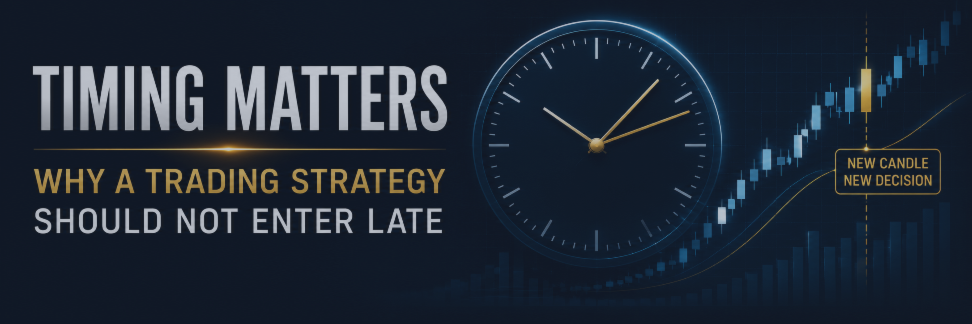
The New-Candle Principle
For that reason, I adopted a simple rule in the latest QuantMatrix architecture:
A newly activated specialist must wait for the next candle of its own timeframe before opening a new position.
If an H12 specialist becomes active in the middle of an H12 candle, it waits for the next H12 candle.
If an H2 specialist becomes active, it waits for the next H2 candle.
The important point is that each specialist respects the temporal structure in which its strategy was discovered and validated.
This keeps live execution closer to the assumptions used during research.
Different Specialists, Different Clocks
A multi-timeframe architecture makes this especially important.
Suppose an H12 specialist has just closed a position.
Another H12 model should not immediately act on a signal that belongs to a candle already mostly completed.
But an H2 specialist may soon reach the opening of a fresh H2 candle and become eligible to act.
The system therefore does not wait globally.
Each specialist follows its own clock.
That allows the architecture to remain flexible without accepting late entries.
Entry Timing and Position Management Are Different Problems
This rule applies to new entries.
It does not mean the EA becomes inactive between candles.
Open positions still require management.
Stops may need to be respected.
Trailing logic may need to respond.
Risk controls may need to act.
A strategy can deteriorate.
A position can be invalidated.
The system continues monitoring the market.
The only difference is that a new trade must begin from a fresh decision point.
This distinction is important.
Waiting for a new candle does not mean waiting to manage risk.
Why This Matters for Research Integrity
One of the principles behind QuantMatrix is that live execution should resemble the conditions under which the strategy was validated as closely as possible.
If research assumes entry at a specific temporal boundary, then delayed live execution introduces a variable that was never properly tested.
That can create false conclusions.
If the trade loses, was the strategy bad?
Or was the strategy entered too late?
If the trade wins, did the model work?
Or did the delayed entry accidentally improve the price?
Once timing becomes inconsistent, it becomes harder to evaluate the strategy honestly.
Synchronizing entries with new candles reduces that ambiguity.
A Small Operational Rule With a Large Effect
This may sound like a minor technical change.
It is not.
Quantitative systems are often improved not by adding another indicator, but by making the relationship between research and execution more faithful.
A strategy should not only know what market condition it wants.
It should also know when that condition is still actionable.
That is the principle behind this adjustment:
A valid historical signal is not automatically a valid current entry.
Time is part of the evidence.
And if the system arrives late, sometimes the correct decision is simply to wait.
Rafael Haddad
Creator of QuantMatrix FX+Gold
#QuantTrading #AlgorithmicTrading #MetaTrader5 #ExpertAdvisor #MultiTimeframe #TradingSystems #QuantMatrix