Not All Order Blocks Deserve a Trade: Validating SMC Zones with Session Volume Profile in MT5

Anyone who has traded order blocks for a while has noticed the same thing: some zones react to the pip, while others get run straight through as if they were never there. Market structure alone does not tell you which is which. Price shows you where something happened. Volume shows you how much actually happened there. This post explains how I combine the two in MetaTrader 5.
What a volume profile actually measures
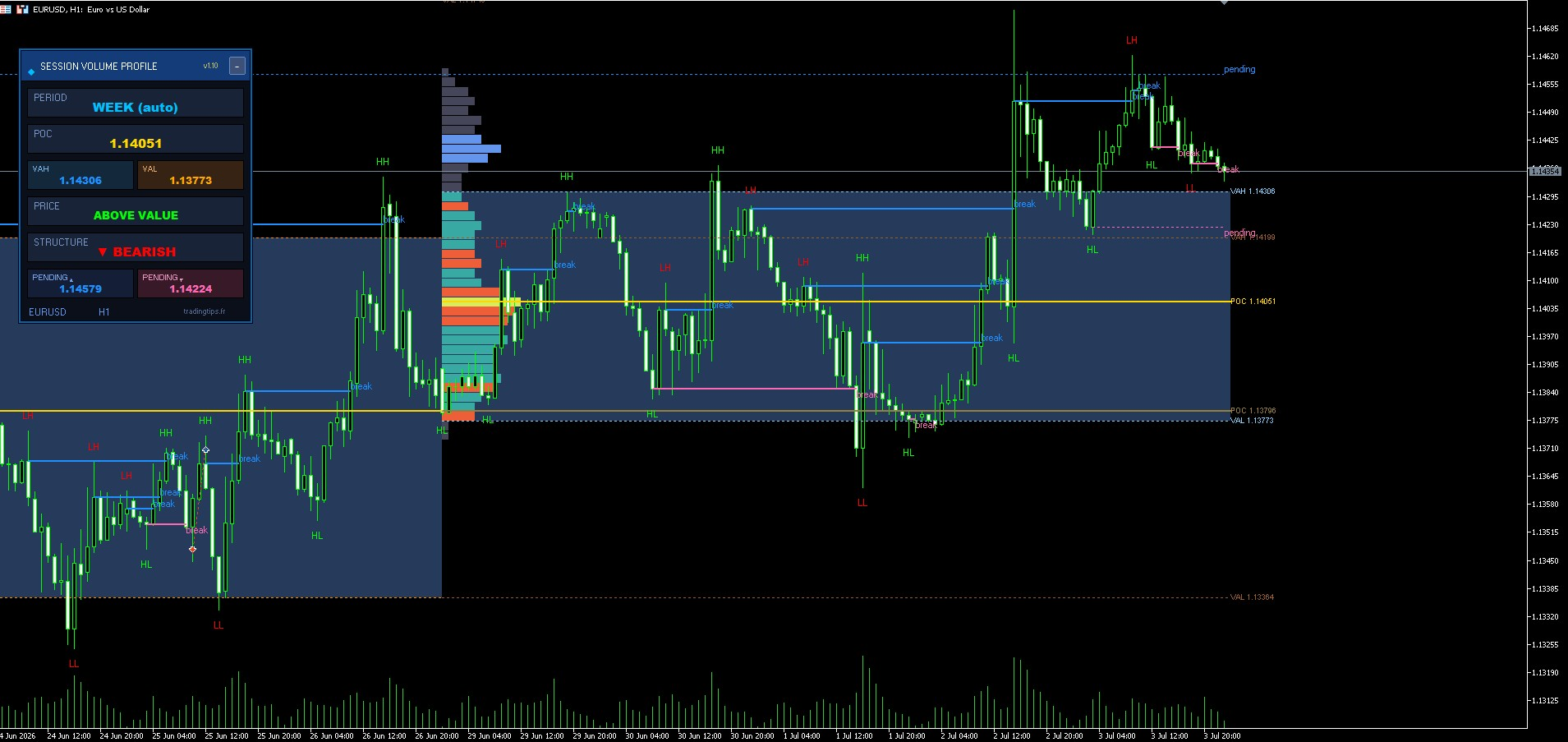
A volume profile is a horizontal histogram: instead of showing volume per candle (per unit of time), it shows volume per price level. Three elements matter for this workflow:
- POC (Point of Control) - the single price level where the most volume traded. This is where buyers and sellers agreed the most.
- Value Area (VAH / VAL) - the price range containing roughly 70% of the traded volume. Inside it, the market considered price "fair".
- LVN (Low Volume Node) - a level where very little traded. Price was rejected there or travelled through it quickly.
Why session profiles, not just daily ones
Asia, London and New York are effectively three different auctions, with different participants and different liquidity. A level that acted as the POC of the London session can be completely irrelevant to the Asian range. Building one profile per session, instead of one profile per day, keeps each auction separate and makes the levels far easier to read on intraday timeframes.
The validation rule for order blocks
Here is the practical filter. When you mark an order block after a break of structure, check where it sits on the session profile:
- An order block that overlaps the session POC or a value area edge is backed by real transacted volume. Participants actually built positions there, which is exactly the logic an order block is supposed to represent.
- An order block that sits inside a low volume node is fragile. Very little business was done at that price, and in my charting these zones get traded through far more often than they hold.
The same map also helps with targets: an untested POC from a previous session ("naked POC") is a natural magnet for price, and the opposite value area edge gives you an objective end-of-move reference instead of a guess.
A concrete MT5 workflow
- Mark structure first: BOS / ChoCH and the order blocks they create.
- Add a session-based volume profile (Asia / London / New York) to the same chart.
- Delete or ignore every order block that does not overlap a POC or a value area edge. Most of the cleaning happens in this step.
- Wait for price to return to a validated zone and look for a lower-timeframe confirmation before entering.
- Use naked POCs and the opposite value area edge as target references.
Automating the mapping
Drawing session profiles by hand every day is not realistic, so I automated both sides of this workflow. Session Volume Profile SMC builds the per-session profiles automatically in MT5 (POC, VAH, VAL, developing VWAP), and Market Structure Order Block Dashboard handles the structure side: BOS, ChoCH and order block detection. Both have a free demo you can run in the MT5 Strategy Tester to check the logic on your own pairs before deciding anything.
One honest note to finish: no tool and no confluence removes risk. Volume context filters out weak zones - it does not turn trading into a certainty. Test it on your own charts, keep your risk fixed, and judge the filter on a sample, not on one trade.