Automated Harmonic Pattern Detection: How the Butterfly Harmonic Dashboard Scans 20 Symbols Across All Timeframes

1. Introduction
You are staring at EURUSD on the hourly chart, trying to piece together five swing points into a Butterfly harmonic pattern. You think you have found X at a swing low, A at the subsequent high, and B at a pullback low -- but does B sit at precisely 78.6% of the XA leg? You grab the Fibonacci retracement tool, measure, and get 77.1%. Close enough? Maybe. Now you need to find C, verify it retraces between 38.2% and 88.6% of AB, then locate D and check two more ratios: the BCD extension between 161.8% and 261.8% of BC, and the critical XAD extension between 127% and 161.8% of XA. But here is the part that makes the Butterfly uniquely difficult to spot: D does not stay within the XA leg like a Bat or Gartley pattern. D extends beyond X. In a bullish Butterfly, D drops below X. In a bearish Butterfly, D rises above X. By the time you have processed that counterintuitive geometry, measured all four Fibonacci relationships, and confirmed the extension, the D-point entry window has closed.
Now multiply that by twenty symbols across nine timeframes. The Butterfly harmonic pattern is one of the most visually deceptive structures in harmonic trading -- it looks like a pattern that has failed and broken the starting level, when in reality that extension beyond X is precisely what defines it. Each potential Butterfly requires identifying five confirmed swing points in the correct alternating sequence, then measuring and validating four separate Fibonacci ratios against acceptable ranges, including an extension ratio greater than 1.0. Manual scanning for Butterfly patterns across a full watchlist is not just slow; it is operationally unfeasible.
The fundamental problem is not understanding the pattern. Most traders who study harmonic analysis can describe the Butterfly structure and its Fibonacci requirements from memory. The problem is that no human can scan 180 chart combinations in real time, identify every valid five-point XABCD formation where D extends past X, validate four ratio conditions simultaneously, and act on them before the entry window at point D closes. You need a system that performs the geometric analysis for you -- continuously, automatically, and across your entire watchlist.
I built the Butterfly Harmonic Dashboard to solve this exact problem. It scans up to 20 symbols across nine timeframes, identifies confirmed swing pivots, constructs potential Butterfly XABCD extension patterns, validates them against four Fibonacci ratio ranges with configurable tolerance, and presents every valid pattern in a compact six-column dashboard with real-time alerts. No manual measuring. No missed patterns. One glance tells you which symbols have active Butterfly harmonic setups right now.
The indicator is available on the MQL5 Market for both platforms:
- MetaTrader 5: Butterfly Harmonic Dashboard MT5
- MetaTrader 4: Butterfly Harmonic Dashboard MT4
2. What Is Harmonic Pattern Trading?
Harmonic pattern trading is a methodology based on the idea that price movements form geometric structures defined by specific Fibonacci ratios between their legs. When those ratios align within acceptable tolerances, they identify high-probability reversal zones where price is statistically likely to change direction.
The concept traces back to H.M. Gartley's 1935 book Profits in the Stock Market, where he described a specific five-point price pattern that offered favorable risk-to-reward entries. Larry Pesavento later refined the Gartley pattern with strict Fibonacci measurements. Scott Carney then systematized harmonic trading further, publishing a series of books beginning in the late 1990s that defined a complete family of harmonic patterns with precise ratio requirements.
The Butterfly pattern has a distinctive lineage within this history. Bryce Gilmore and Larry Pesavento first identified the Butterfly structure as a recurring price formation with specific geometric properties. Scott Carney later formalized it with precise Fibonacci ratios in his harmonic trading framework, giving the pattern the strict validation rules that distinguish it from subjective chart reading. What makes the Butterfly unique within the harmonic family is its classification as an extension pattern -- unlike the Gartley and Bat, where the D point stays within the XA leg, the Butterfly's D point extends beyond X. This places it in the same family as the Crab, but with different ratio requirements that create a distinct completion zone.
What makes harmonic patterns different from standard chart patterns like head and shoulders or double tops is their mathematical precision. A head and shoulders pattern is identified visually -- there is no universally agreed-upon ratio defining how deep the neckline should be relative to the head. Harmonic patterns, in contrast, require specific Fibonacci relationships between each leg. A pattern either meets the ratio criteria or it does not. This binary validation removes much of the subjectivity from pattern identification.
Why do these geometric structures repeat? The Fibonacci sequence and its derived ratios (0.382, 0.50, 0.618, 0.786, 0.886, 1.272, 1.618, 2.618) appear throughout natural systems. In financial markets, these ratios manifest in the way crowds of traders react to price swings. Retracements and extensions tend to find support or resistance at Fibonacci levels because large numbers of participants use these same ratios for entries, stops, and targets. The self-reinforcing nature of this behavior is what gives harmonic patterns their predictive power.
The Butterfly pattern occupies a critical position within the harmonic family as the primary extension pattern that most traders encounter. Its defining XAB ratio of 78.6% -- a Fibonacci number that is the square root of 0.618 -- combined with its D-point extension beyond X, makes it one of the most geometrically precise and operationally demanding patterns to identify.
3. The Butterfly Pattern Explained
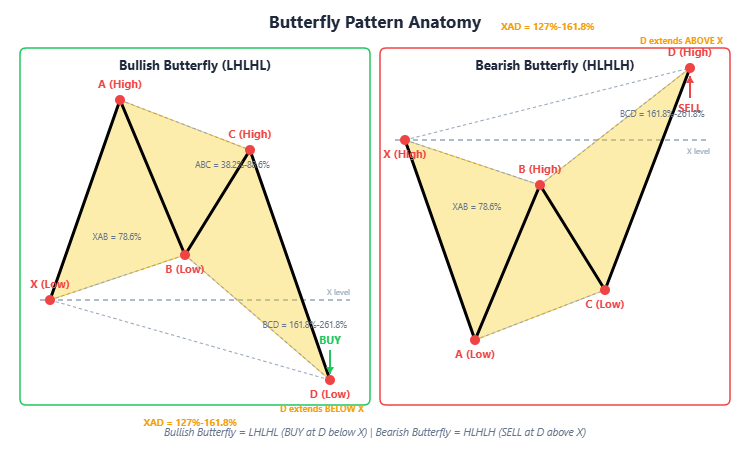
The Butterfly pattern consists of five consecutive swing points -- labeled X, A, B, C, and D -- that form a specific geometric structure with four Fibonacci relationships between its legs. What fundamentally distinguishes the Butterfly from retracement patterns like the Bat and Gartley is its nature as an extension pattern: the D point extends beyond the X point, meaning the pattern "breaks" its starting level before completing.
There are two types of Butterfly patterns:
Bullish Butterfly (LHLHL -- Low, High, Low, High, Low)
In a bullish Butterfly, the five points form this structure:
- X is a swing low -- the starting point of the pattern
- A is a swing high -- price rises from X to A (this is the XA leg)
- B is a swing low -- price retraces downward from A, and B retraces 78.6% of the XA leg
- C is a swing high -- price moves upward from B, but C must be lower than A
- D is a swing low -- price drops from C to D, and D must be below X
The D point is where the pattern completes, and it represents a BUY entry. This is where the Butterfly becomes counterintuitive: price has broken below the X level, which in many other contexts would look like a bearish continuation or a failed pattern. But in Butterfly geometry, this extension beyond X is exactly what the pattern requires. The convergence of four Fibonacci relationships at D -- particularly the XAD extension between 127% and 161.8% of XA -- identifies this level as a high-probability reversal zone. The move below X is a measured overextension, not a breakdown.
Bearish Butterfly (HLHLH -- High, Low, High, Low, High)
In a bearish Butterfly, the structure mirrors the bullish version:
- X is a swing high -- the starting point
- A is a swing low -- price drops from X to A
- B is a swing high -- price retraces upward from A, and B retraces 78.6% of the XA leg
- C is a swing low -- price moves downward from B, but C must be higher than A
- D is a swing high -- price rises from C to D, and D must be above X
The D point completes the pattern and signals a SELL entry. Price has extended above the X level to a Fibonacci-defined resistance zone. The requirement that D exceeds X confirms the extension structure, and the XAD ratio between 127% and 161.8% places D at a zone where the overextension is statistically likely to reverse.
The key structural constraint that defines the Butterfly is the relationship between D and X. In a bullish Butterfly, D must be below X. In a bearish Butterfly, D must be above X. This is the opposite of retracement patterns like the Bat, where D must stay within the XA leg (above X for bullish, below X for bearish). This extension characteristic is what makes the Butterfly visually harder to spot -- it looks like a pattern that has failed when in fact it is completing exactly as intended.
Figure 1. Bullish Butterfly forms as LHLHL with BUY at D (below X); Bearish Butterfly forms as HLHLH with SELL at D (above X). Note how D extends beyond the starting point.
4. Fibonacci Ratios: The Validation Engine
The Fibonacci ratios are what transform a random five-point price swing into a validated Butterfly harmonic pattern. Without ratio validation, you would be trading every zigzag in price, and most of those would be meaningless noise. The Butterfly pattern requires four separate ratio checks, including one fixed ratio and one extension measurement that together create the pattern's signature geometry.
XAB Retracement -- The Defining Ratio (B retraces 78.6% of XA)
The XAB retracement measures how much of the initial XA leg is retraced by the move from A to B:
XAB Retracement = |B - A| / |A - X|
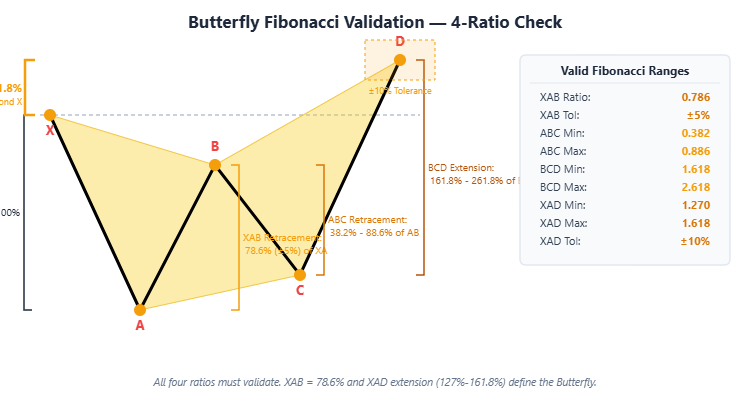
Unlike the Bat pattern, which uses a range of 0.382 to 0.50 for XAB, the Butterfly requires a fixed XAB ratio of 0.786 with a configurable tolerance of plus or minus 5% (default). This means the effective valid range is:
Effective XAB Min = 0.786 x (1 - 0.05) = 0.7467
Effective XAB Max = 0.786 x (1 + 0.05) = 0.8253
The 78.6% level is the square root of 0.618, making it a deeply rooted Fibonacci number. This precise retracement at B is what distinguishes the Butterfly from other harmonic patterns. The Bat uses a shallow 38.2%-50% retracement; the Gartley uses 61.8%. The Butterfly's 78.6% is deeper than both, creating a specific geometric shape where B is relatively close to X. This fixed ratio is one of the strictest requirements in all of harmonic trading.
ABC Retracement (C retraces 38.2%-88.6% of AB)
The ABC retracement measures how much of the AB leg is retraced by the move from B to C:
ABC Retracement = |C - B| / |B - A|
The valid range is 0.382 to 0.886. This is a wide range that accommodates various market conditions. A shallow ABC retracement (near 38.2%) suggests the counter-move at C was modest, while a deep retracement (near 88.6%) indicates a strong corrective move. Both extremes can produce valid Butterfly patterns as long as the remaining ratios also validate.
BCD Extension (D extends 161.8%-261.8% of BC)
The BCD extension measures how far the D leg extends relative to the BC leg:
BCD Extension = |D - C| / |C - B|
The valid range is 1.618 to 2.618. This extension ratio ensures that the move from C to D is proportionally significant -- it is not just a small fluctuation but a genuine measured extension of the BC corrective move. Extensions in this range place D at Fibonacci-defined levels that have historically acted as reversal zones.
XAD Extension -- The Signature Extension (D extends 127%-161.8% of XA)
The XAD extension is the ratio that makes the Butterfly an extension pattern:
For Bullish Butterfly (X=Low, A=High): extensionBeyondX = X - D (D is below X, so this is positive) XAD Extension = (|A - X| + extensionBeyondX) / |A - X| For Bearish Butterfly (X=High, A=Low): extensionBeyondX = D - X (D is above X, so this is positive) XAD Extension = (|X - A| + extensionBeyondX) / |X - A|
The target range is 1.27 to 1.618, with a configurable tolerance of plus or minus 10% (default). This means the effective valid range is:
Effective XAD Min = 1.27 x (1 - 0.10) = 1.143
Effective XAD Max = 1.618 x (1 + 0.10) = 1.7798
Notice that this ratio is greater than 1.0. This is what makes it an extension rather than a retracement. An XAD ratio of 1.27 means D has moved 27% beyond the full XA distance past the X point. An XAD ratio of 1.618 means D has extended 61.8% beyond X. Compare this to the Bat's XAD retracement of 0.886, where D stays within 88.6% of the XA leg and never reaches X. The Butterfly's D goes past X entirely and keeps going.
This extension calculation is what makes the Butterfly visually counterintuitive and computationally demanding to validate manually. You cannot simply measure D's position relative to X and A with a single Fibonacci retracement tool -- you need to calculate the extension beyond the origin point, which requires understanding the directional relationship between all three points.
Figure 2. A valid Butterfly pattern requires four Fibonacci ratios: XAB (0.786 fixed with 5% tolerance), ABC (0.382-0.886), BCD (1.618-2.618), and XAD (1.27-1.618 extension with 10% tolerance).
5. Why Manual Pattern Scanning Fails
Even experienced harmonic traders face three critical operational problems when scanning for Butterfly patterns manually. These problems are amplified for the Butterfly compared to retracement patterns, because the extension geometry at D is visually counterintuitive and requires additional mental processing.
Problem 1: Volume of Chart Combinations
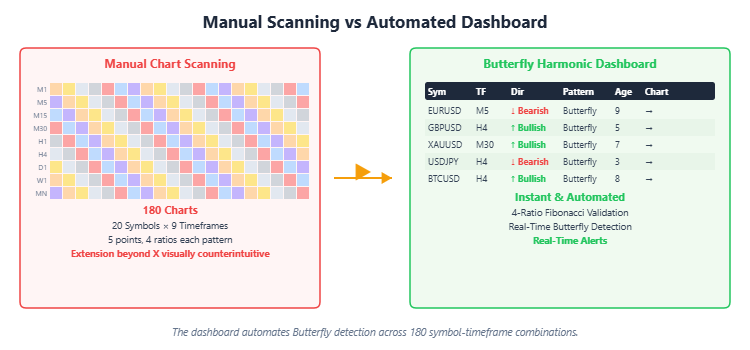
A typical multi-asset trader monitors 20 symbols -- major and minor forex pairs, gold, silver, crypto assets, and indices. With nine available timeframes (M1 through Monthly), that produces 180 possible chart combinations. Scanning each chart for five-point Butterfly patterns requires identifying alternating swing highs and lows, then measuring four separate Fibonacci ratios including the extension calculation at D. At even 50 seconds per chart (longer than simpler patterns because the XAD extension requires more careful measurement), a full scan takes over two and a half hours -- by which time the majority of the setups you were looking for have already played out or disappeared entirely.
Problem 2: Pattern Recognition Fatigue
The Butterfly is one of the most cognitively demanding patterns to identify manually. You are not just looking for five alternating swing points -- you are looking for five points where B sits at precisely 78.6% of XA (not a range, a fixed value), three other ratio conditions are satisfied, and D extends beyond X. The extension aspect creates a specific visual challenge: a bullish Butterfly looks like a downward breakdown below support, and a bearish Butterfly looks like an upward breakout above resistance. Traders who are trained to see breaks of support/resistance as continuation signals have to override that instinct to recognize a Butterfly completion. After thirty minutes of this mental gymnastics across different symbols, accuracy drops dramatically. The human eye starts confusing Butterfly completions with failed patterns, or it filters out valid extensions because they "look wrong."
Problem 3: Real-Time Pattern Completion
Butterfly patterns complete when the D point forms. Because D extends beyond X, the price action at the completion zone can be volatile -- the market is moving through a level where many traders have stops, creating momentum that can quickly carry price away from the ideal entry. The window between pattern completion and optimal entry is narrow. If you are still scanning EURUSD on the M15 chart when a valid bullish Butterfly completes on XAUUSD H1, you miss the entry entirely. And because the stop loss for a Butterfly is placed beyond D (not X, since D is already past X), late entries after the D point significantly degrade your risk-to-reward ratio.
The result is that most harmonic traders either limit themselves to a handful of symbols and timeframes (missing the majority of Butterfly setups) or spend so much time scanning that they cannot act on what they find. The scanning process itself becomes the bottleneck, not the strategy.
Figure 3. The dashboard automates Butterfly pattern detection across 180 symbol-timeframe combinations, eliminating the manual scanning bottleneck.
6. Introducing the Butterfly Harmonic Dashboard
The Butterfly Harmonic Dashboard is a professional multi-symbol, multi-timeframe indicator that automates the entire Butterfly harmonic pattern detection process. Instead of manually scanning 180 charts, identifying five swing points, and measuring four Fibonacci ratios by hand, you get a single dashboard that continuously monitors all your symbols across all enabled timeframes and alerts you the moment a valid Butterfly extension pattern completes.
Core Features:
- Automated Butterfly Detection -- Identifies both Bullish (LHLHL) and Bearish (HLHLH) Butterfly patterns with full four-ratio Fibonacci validation (XAB fixed at 0.786, ABC, BCD, and XAD extension)
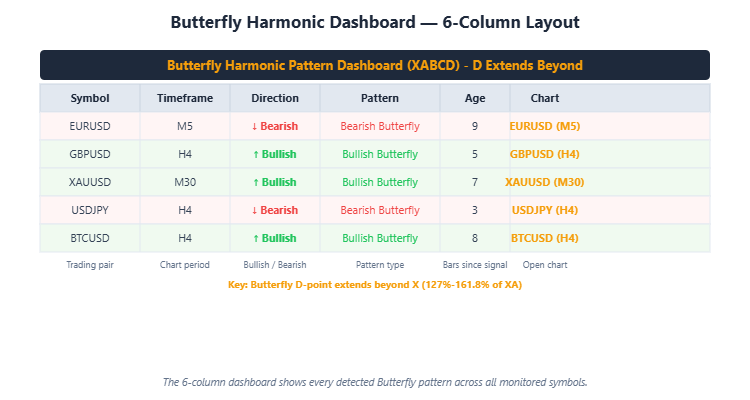
- 6-Column Dashboard -- Symbol, Timeframe, Direction, Pattern, Age, and one-click Chart navigation
- Multi-Symbol Scanning -- Monitor up to 20 instruments simultaneously (forex, metals, crypto, indices)
- Multi-Timeframe Coverage -- Scan M1 through Monthly (9 timeframes, individually toggleable)
- Non-Repainting Signals -- Patterns are based on confirmed swing pivots with right-bar validation
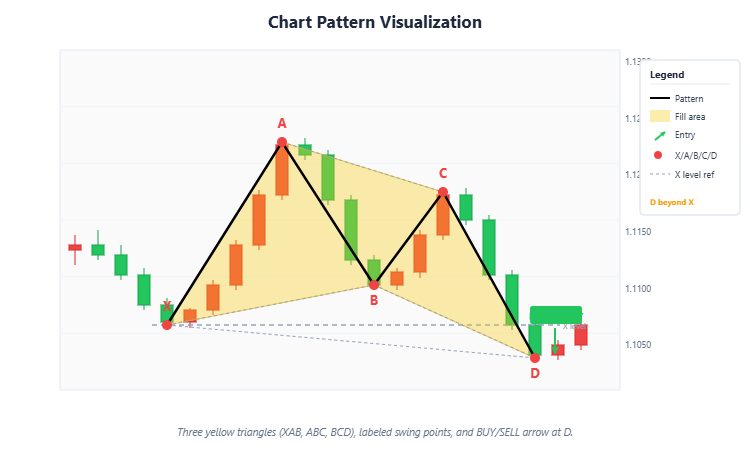
- Yellow Triangle Fill -- Completed patterns are drawn with three filled yellow triangles (XAB, ABC, BCD) and labeled X/A/B/C/D points
- 4-Channel Alerts -- Popup, sound, email, and push notifications with pattern details
- Configurable Fibonacci Ranges -- Adjust XAB tolerance, ABC, BCD ranges and XAD extension tolerance to match your trading style
The indicator handles all the geometric analysis automatically, including the extension calculation at D that makes manual Butterfly identification so demanding. You configure your symbols, preferred timeframes, and Fibonacci tolerance ranges, and the dashboard does the rest -- scanning, measuring, validating, and alerting in real time.
Download the free demo or purchase the full version:
- MetaTrader 5: Butterfly Harmonic Dashboard MT5
- MetaTrader 4: Butterfly Harmonic Dashboard MT4
Figure 4. The 6-column dashboard shows every detected Butterfly pattern across all monitored symbols and timeframes.
7. How the Detection Engine Works
The detection engine operates in three stages on every new bar: pivot identification, pattern construction, and Fibonacci validation.
Stage 1: Pivot Identification
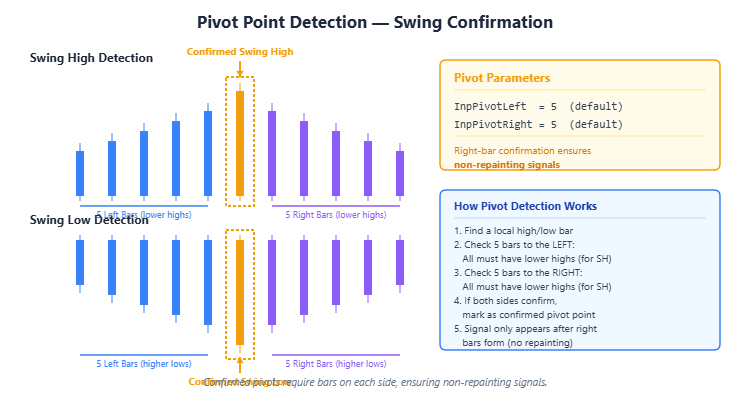
The engine first identifies confirmed swing highs and swing lows across the price history. A swing high is a bar whose high is greater than the highs of a specified number of bars to its left and to its right. Similarly, a swing low is a bar whose low is lower than the lows of bars on both sides.
The key parameters are Pivot Left Bars and Pivot Right Bars , both defaulting to 5. This means a swing high requires 5 bars with lower highs on both the left and right sides before it is confirmed. This right-side confirmation is what makes the signals non-repainting -- a pivot cannot be identified until enough future bars have confirmed it.
Stage 2: Pattern Construction
Once pivots are identified, the engine searches for valid five-point alternating sequences. This is where the Butterfly differs critically from the Bat:
-
For Bullish Butterfly: it looks for a Low (X), then a subsequent High (A), then a Low (B), then a High (C) that is lower than A, then a Low (D) that is below X. This LHLHL sequence with D below X ensures the correct Butterfly extension geometry -- D has extended past the origin point, creating the characteristic overshoot below the starting level.
-
For Bearish Butterfly: it looks for a High (X), then a subsequent Low (A), then a High (B), then a Low (C) that is higher than A, then a High (D) that is above X. This HLHLH sequence with D above X mirrors the bullish structure with D extending past X to the upside.
Note that this D constraint is the opposite of the Bat pattern. In a Bat, D must stay within the XA leg (above X for bullish, below X for bearish). In a Butterfly, D must extend beyond X (below X for bullish, above X for bearish). This single structural difference is what separates extension patterns from retracement patterns in the harmonic family.
The engine scans up to 500 bars of history (configurable via Max History Bars ) to find the most recent valid pattern for each symbol-timeframe combination.
Stage 3: Four-Ratio Fibonacci Validation
Every candidate pattern is validated against all four Fibonacci ratio criteria:
- Calculate XAB retracement: |B - A| / |A - X| -- must equal 0.786 within plus or minus 5% tolerance (effective range: 0.7467 to 0.8253)
- Calculate ABC retracement: |C - B| / |B - A| -- must fall within [0.382, 0.886]
- Calculate BCD extension: |D - C| / |C - B| -- must fall within [1.618, 2.618]
- Calculate XAD extension: (|A - X| + extensionBeyondX) / |A - X| -- must fall within [1.27, 1.618] with plus or minus 10% tolerance (effective range: 1.143 to 1.7798)
Only patterns that pass all four ratio checks are displayed on the dashboard. This rigorous four-gate validation ensures that every signal represents a geometrically valid Butterfly harmonic structure -- not just any random five-point zigzag where price happened to break a prior swing level.
Non-Repainting Guarantee
The indicator evaluates only confirmed pivots -- pivots where the required number of right-side bars have already formed. Because the D point must be a confirmed pivot (with Pivot Right Bars bars to its right), the signal cannot appear until the pattern is fully confirmed. Once displayed, it never changes or disappears.
8. The 6-Column Dashboard
The dashboard presents all detected Butterfly patterns in a compact, scrollable table with six columns:
| Column | Content | Description |
|---|---|---|
| Symbol | e.g., EURUSD | The instrument where the pattern was detected |
| Timeframe | e.g., H1, M15 | The chart timeframe of the pattern |
| Direction | Bullish / Bearish | Green for Bullish (BUY at D), Red for Bearish (SELL at D) |
| Pattern | Butterfly | The pattern type |
| Age | e.g., 3 | Number of bars since the pattern completed |
| Chart | Click to navigate | Opens the corresponding chart for visual confirmation |
The dashboard displays in a separate indicator window below your main chart. It supports scrolling when there are more signals than visible rows (configurable, default 12 rows). Each row is color-coded by direction -- green background tint for Bullish, red for Bearish -- making it easy to scan for the type of setup you want.
Clicking the Chart column on any row switches your main chart to that symbol and timeframe, where the full Butterfly pattern is drawn with three yellow triangle fills (XAB, ABC, and BCD), X/A/B/C/D labels, dashed lines connecting X-B, A-C, B-D, and X-D (showing the extension), and a BUY ENTRY or SELL ENTRY arrow at the D point. The three triangles visually decompose the five-point structure into its component parts, while the X-D dashed line makes the extension beyond X visually explicit.
The Age column tells you how fresh each signal is. An age of 1 means the pattern just completed on the most recent confirmed bar. Higher ages indicate older patterns that may still be valid if price has not moved significantly from the D point.
Figure 5. The indicator draws three yellow-filled triangles (XAB, ABC, BCD), labels each swing point, and places BUY/SELL arrows at point D. Dashed lines show the X-B, A-C, B-D, and X-D connections.
9. 4-Channel Alert System
The Butterfly Harmonic Dashboard supports four independent alert channels, any combination of which can be enabled simultaneously:
| Channel | Parameter | Default | Description |
|---|---|---|---|
| Popup | Enable Popup Alerts | ON | Standard MetaTrader popup dialog |
| Sound | Enable Sound Alerts | ON | Plays a WAV file (default: alert2.wav) |
| Enable Email Alerts | OFF | Sends to the email configured in MT4/MT5 settings | |
| Push | Enable Push Notifications | ON | Sends to MetaTrader mobile app |
Alert Message Format:
When a new Butterfly pattern is detected, the alert message includes the essential details:
Butterfly Harmonic Dashboard: EURUSD BULLISH BUTTERFLY (BUY) pattern on H1
The message tells you the symbol, pattern direction (Bullish or Bearish), the trading action (BUY or SELL), and the timeframe. This gives you enough information to immediately pull up the chart and evaluate the setup.
Alerts fire only once per pattern per symbol-timeframe combination to prevent duplicate notifications. The alert title is configurable via the Alert Title parameter, which defaults to "Butterfly Harmonic Dashboard".
For email and push notifications to work, you need to configure the respective settings in your MetaTrader terminal options (Tools > Options > Notifications for push, Tools > Options > Email for email).
10. Practical Trading Workflow
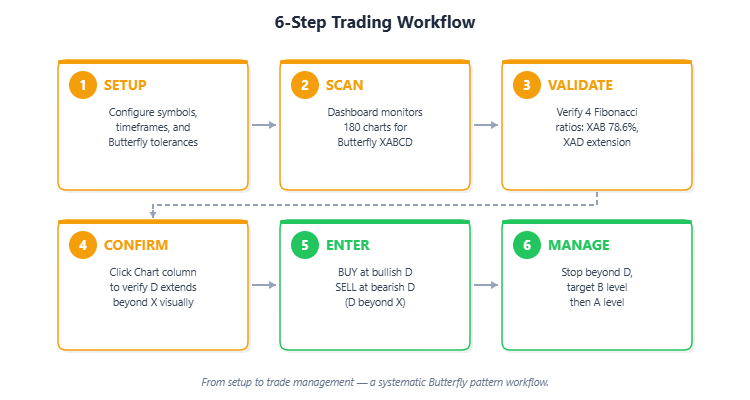
Here is a systematic six-step workflow for trading with the Butterfly Harmonic Dashboard:
Step 1: Setup
Configure the indicator with your preferred symbols (up to 20) and enable the timeframes you trade. Set your Fibonacci ranges based on how strict you want pattern validation to be. Pay particular attention to the XAB tolerance -- the default 5% works well for most instruments, keeping B close to the defining 78.6% level. Also consider the XAD extension tolerance -- the default 10% accommodates the wider variability inherent in extension measurements, but you may want to tighten it to 5% for higher-quality signals.
Step 2: Scan
Let the dashboard run. It continuously monitors all symbol-timeframe combinations and populates the table with every valid Butterfly pattern it detects. Fresh patterns appear with low Age values. The four-ratio validation ensures that every pattern in the table is a geometrically valid Butterfly extension pattern, not just a five-point zigzag that happened to break a prior swing level.
Step 3: Validate the Fibonacci Ratios
When a new pattern appears (Age = 1 or 2), note the direction. Bullish Butterfly patterns indicate a BUY opportunity at the D point. Bearish Butterfly patterns indicate a SELL opportunity. The dashboard has already validated all four Fibonacci ratios (XAB at 0.786, ABC, BCD, and XAD extension), but you can click through to the chart to visually confirm the structure and verify that D has genuinely extended beyond X.
Step 4: Confirm on Chart
Click the Chart column to open the corresponding chart. Verify that the three yellow triangles and five labeled points (X, A, B, C, D) form a clean Butterfly structure. Confirm visually that D has extended past X -- below X for bullish, above X for bearish. Look for additional confluence -- does the D point align with a support/resistance level, a round number, a moving average, or a higher-timeframe structure? The extension beyond X often coincides with stop-hunting zones, making confluence with other levels particularly powerful.
Step 5: Enter the Trade
If the pattern passes your visual confirmation:
- For a Bullish Butterfly (BUY): Enter long near the D point. Place your stop loss below D by a buffer (e.g., 1x ATR below D). Note that the stop goes beyond D, not X -- since D is already below X in a bullish Butterfly, placing the stop below X would leave too much room. Set take profit at the B level initially, with an extended target at the A level.
- For a Bearish Butterfly (SELL): Enter short near the D point. Place your stop loss above D by a buffer. Set take profit at the B level or the A level, depending on your risk-reward preference.
Step 6: Manage the Position
Monitor the trade. Butterfly patterns, because of the extension beyond X, often produce sharp snap-back reversals from the D point as the overextension corrects. Consider moving your stop to breakeven once price has moved in your favor by 1R (one times your initial risk). The natural targets at B and A provide logical levels for scaling out of the position.
Figure 6. From setup to trade management -- a systematic workflow using the Butterfly Harmonic Dashboard.
11. Real Trade Examples
The following examples are taken from live charts with the Butterfly Harmonic Dashboard active. Each screenshot shows the completed pattern with three yellow triangle fills, X/A/B/C/D labels, and the dashboard running in the indicator window.
EURUSD M5 -- Bearish Butterfly
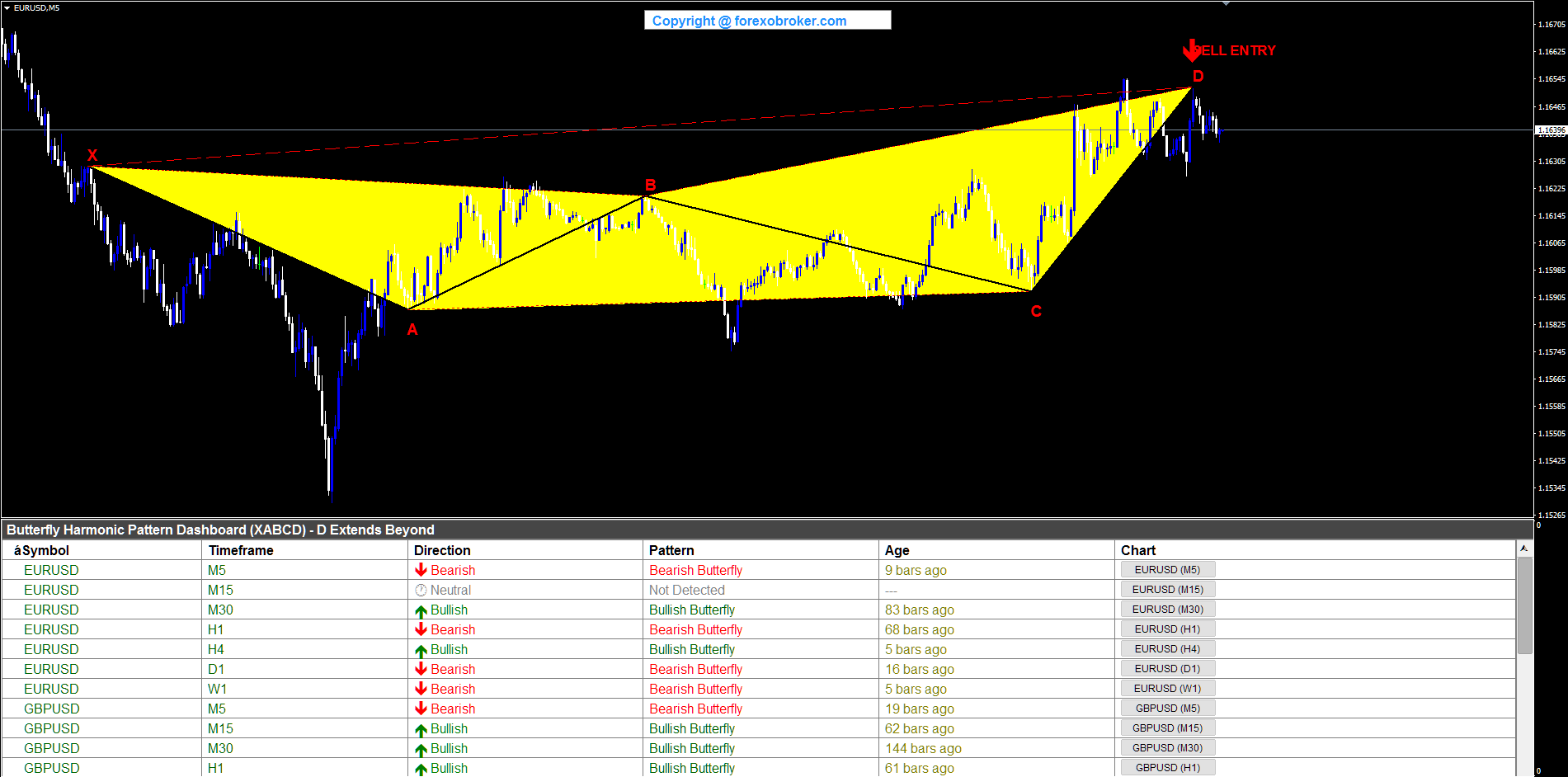
EURUSD on the M5 timeframe produced a bearish Butterfly signaling a fast-timeframe reversal opportunity. The X point formed at a swing high near 1.1630, with A dropping to a swing low around 1.1590. B retraced upward to approximately 1.1622, sitting close to the 78.6% XAB retracement level. C pulled back to about 1.1590, and D completed at a swing high near 1.1650 -- critically, D was above X, confirming the Butterfly extension structure. The SELL ENTRY arrow appeared at D, and the three yellow triangles (XAB, ABC, BCD) clearly outlined the five-point Butterfly geometry. The dashed X-D line showed the extension beyond the starting level, and the dashboard row displayed EURUSD on M5 with Bearish direction in red.
GBPUSD H4 -- Bullish Butterfly
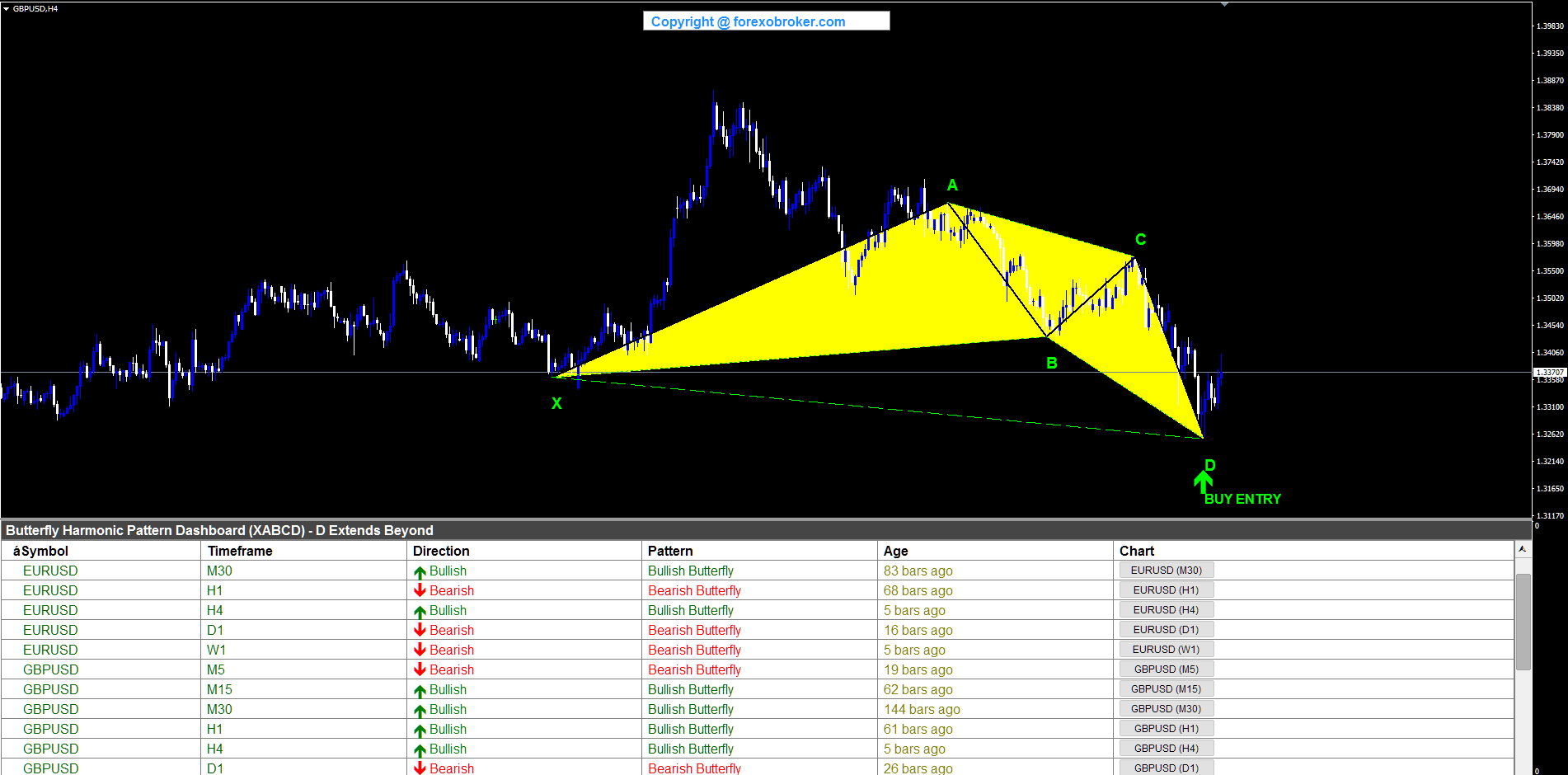
Cable on the H4 chart displayed a large-scale bullish Butterfly suitable for swing trading. X formed at a swing low near 1.3310, A reached a swing high around 1.3650. B retraced to approximately 1.3410, sitting at the 78.6% XAB level of the substantial XA leg. C rose to about 1.3600, and D completed at a swing low near 1.3210 -- below X, confirming the bullish Butterfly extension. The BUY ENTRY at D offered a long entry at a Fibonacci-validated support zone that had extended past the original starting level. The three yellow triangles covered a wide price range, and the pattern demonstrated how the Butterfly's D point breaks below the initial swing low before reversing.
USDJPY H4 -- Bearish Butterfly
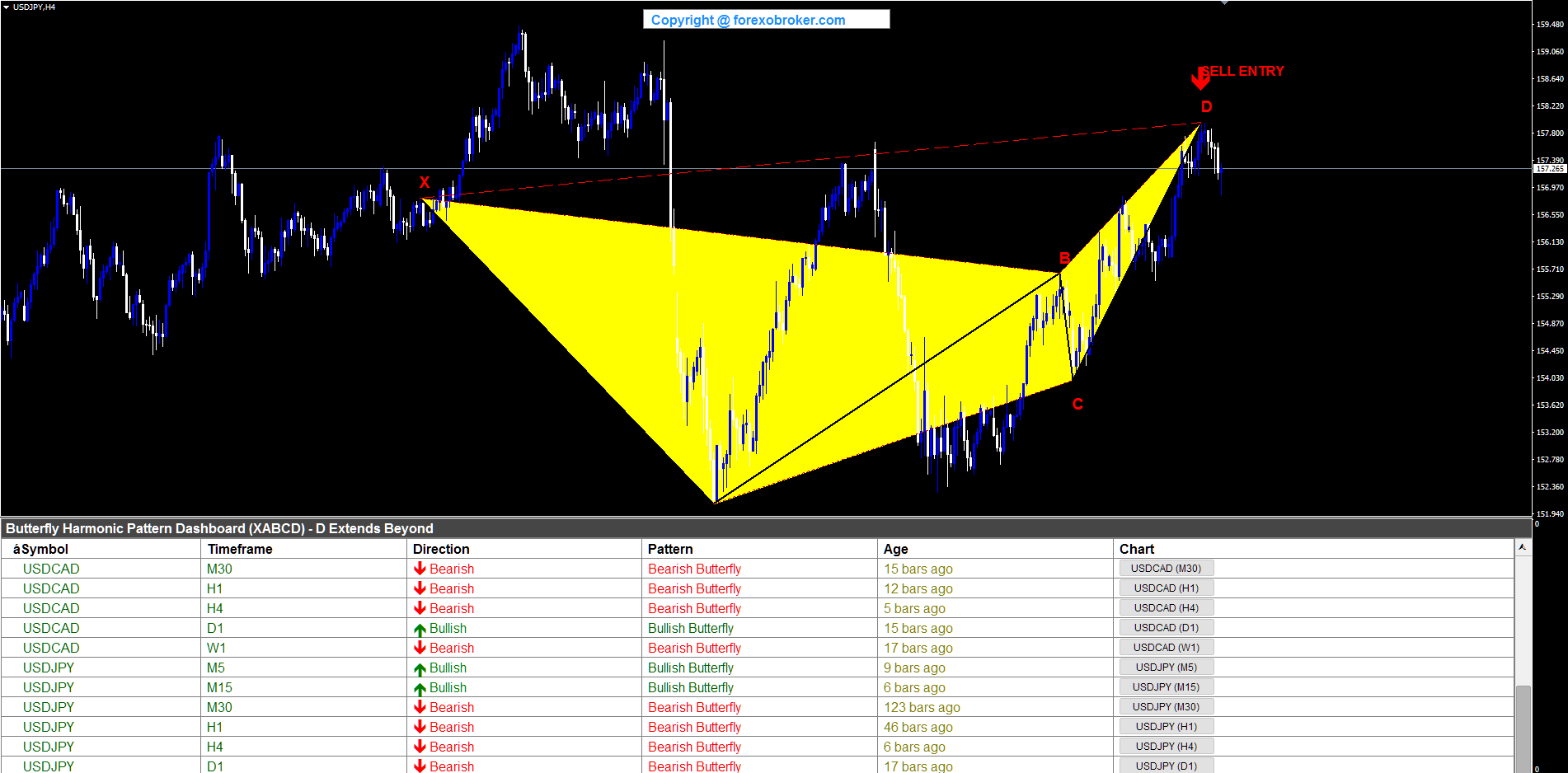
The yen pair on the H4 chart produced a bearish Butterfly spanning a significant price range. X formed at a swing high near 157.20, A dropped to a swing low around 153.40. B retraced upward to approximately 155.60, and C pulled back to about 153.40. D completed at a swing high near 158.20 -- above X, confirming the bearish extension. The SELL ENTRY at D represented a swing reversal opportunity at a level where the XAD extension placed price in the 127%-161.8% zone of the XA leg. The three yellow triangles spanned a wide area of the chart due to the large pip range, and the dashboard captured this H4 setup alongside other timeframe detections.
USDCAD H1 -- Bearish Butterfly
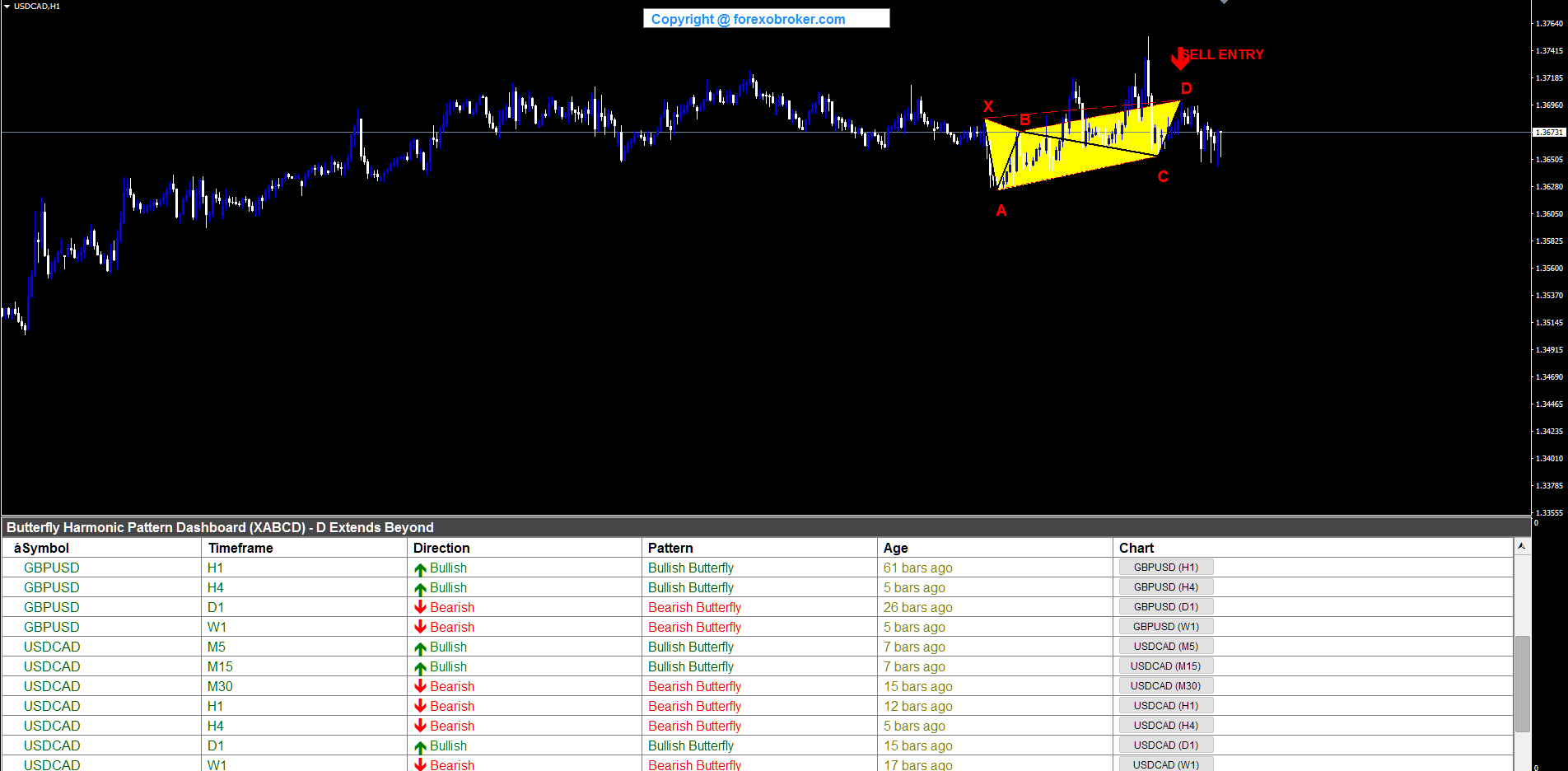
USDCAD on the hourly chart formed a bearish Butterfly suitable for intraday swing trading. X was identified at a swing high near 1.3690, A at a swing low around 1.3610. B retraced to approximately 1.3660, close to the 78.6% XAB level. C dropped to about 1.3630, and D completed at a swing high near 1.3710 -- above X, confirming the bearish Butterfly extension. The SELL ENTRY at D offered a reversal trade at a Fibonacci-defined resistance zone where price had overextended past the original swing high. The dashboard showed USDCAD alongside other symbols, demonstrating the multi-symbol scanning capability.
XAUUSD M30 -- Bullish Butterfly
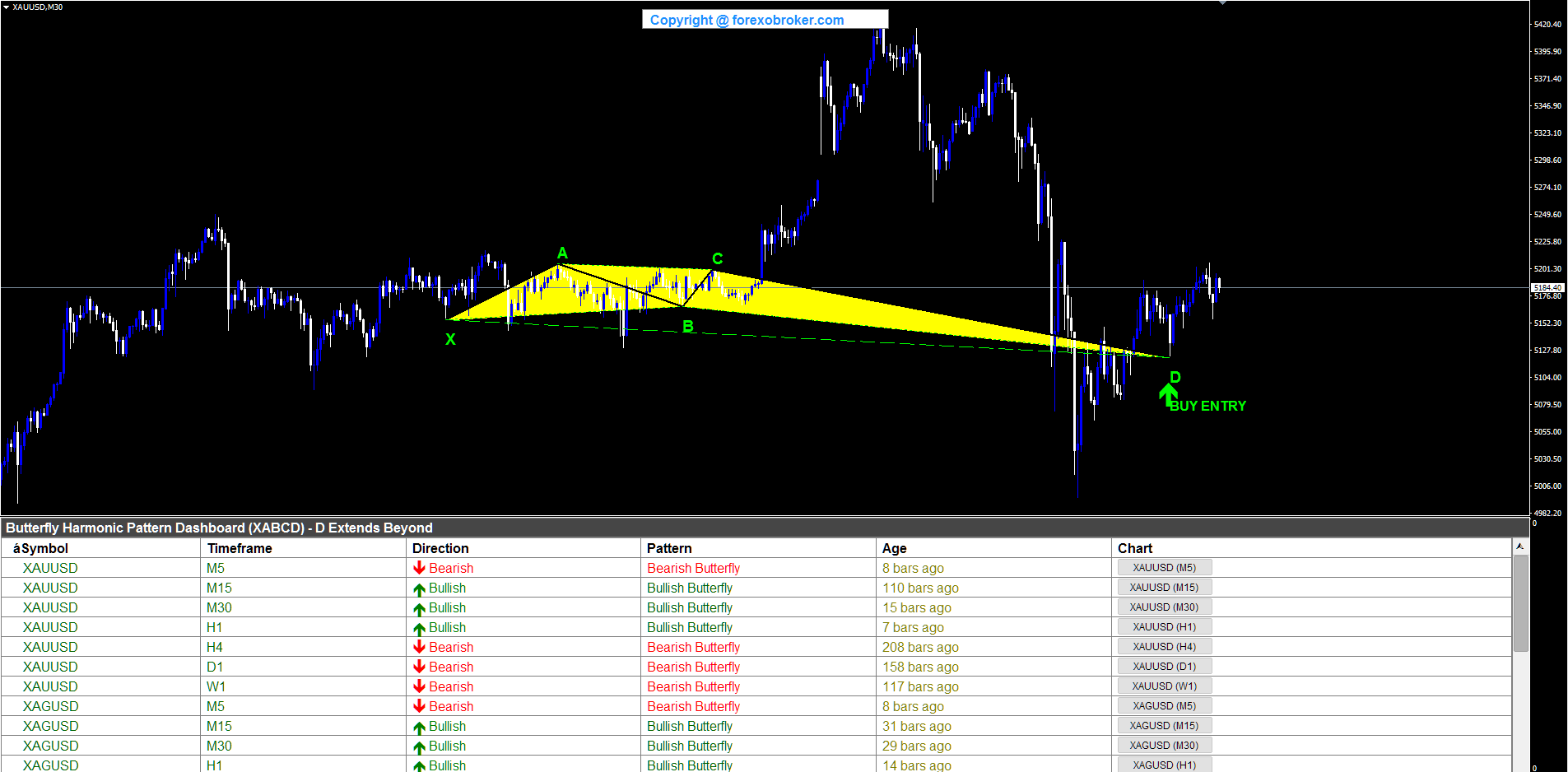
Gold on the M30 chart displayed a bullish Butterfly with clearly defined extension geometry. X established at a swing low near 5165, A surged to a swing high around 5215. B retraced to approximately 5160, C rose to about 5200, and D completed at a swing low near 5100 -- well below X, confirming the bullish Butterfly extension. The BUY ENTRY at D coincided with a significant extension beyond the X level, reflecting the XAD ratio in the 127%-161.8% range. The three yellow triangles were prominently visible on the gold chart, and the pattern offered a long entry at a zone where the measured extension suggested price was due for a reversal back toward B and A levels.
XAGUSD M5 -- Bearish Butterfly
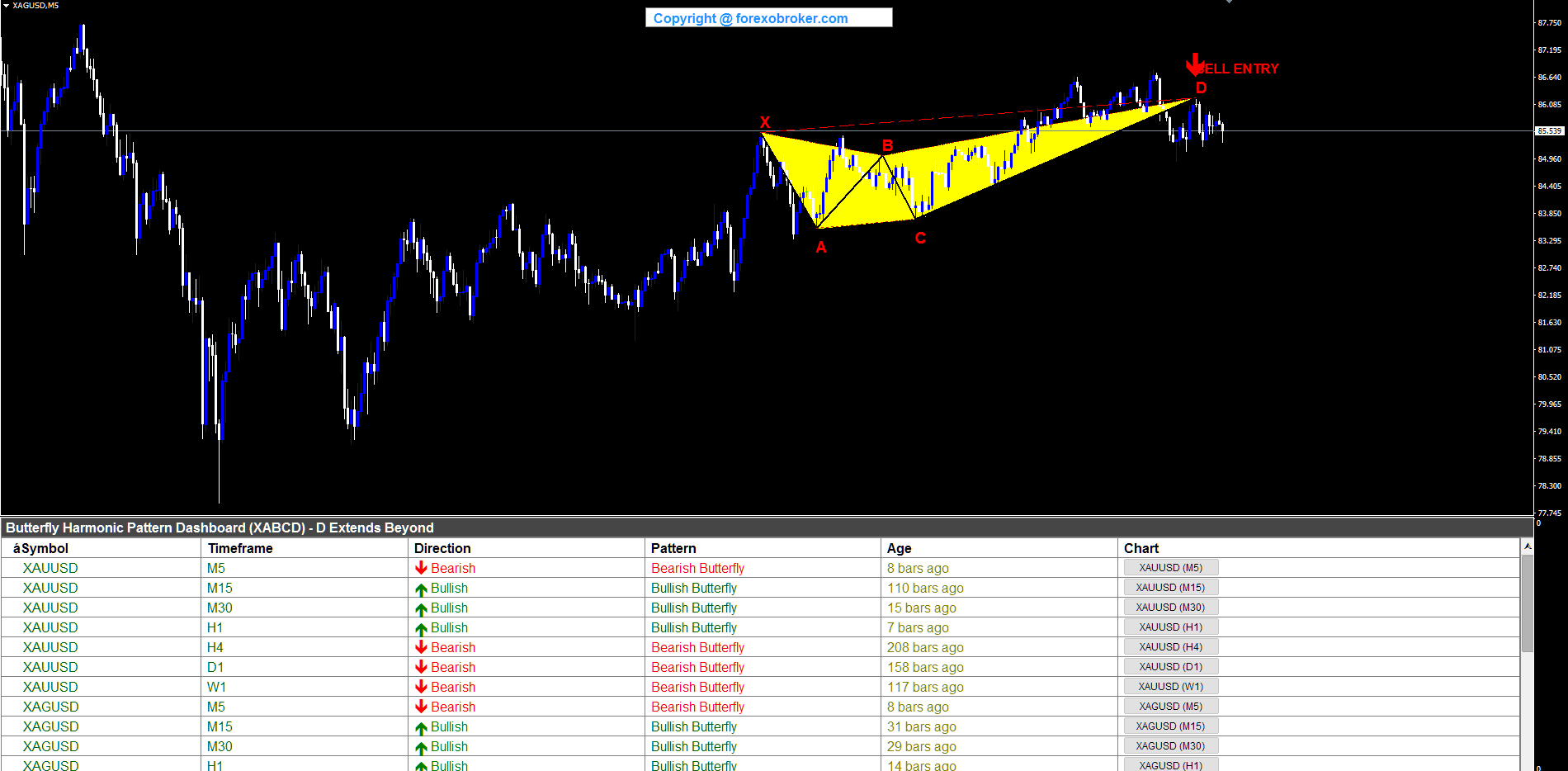
Silver on the M5 timeframe formed a bearish Butterfly signaling a short-term sell opportunity. X was identified at a swing high near 85.50, A dropped to a swing low around 83.40. B retraced to approximately 84.50 at the 78.6% XAB level, C pulled back to about 83.40, and D completed at a swing high near 86.60 -- above X, confirming the extension. The SELL ENTRY at D marked the pattern completion where the XAD extension placed price beyond the original swing high. The dashed X-D line clearly showed how D had overextended past X, and the dashboard displayed the XAGUSD M5 row with Bearish direction.
US500 M30 -- Bullish Butterfly
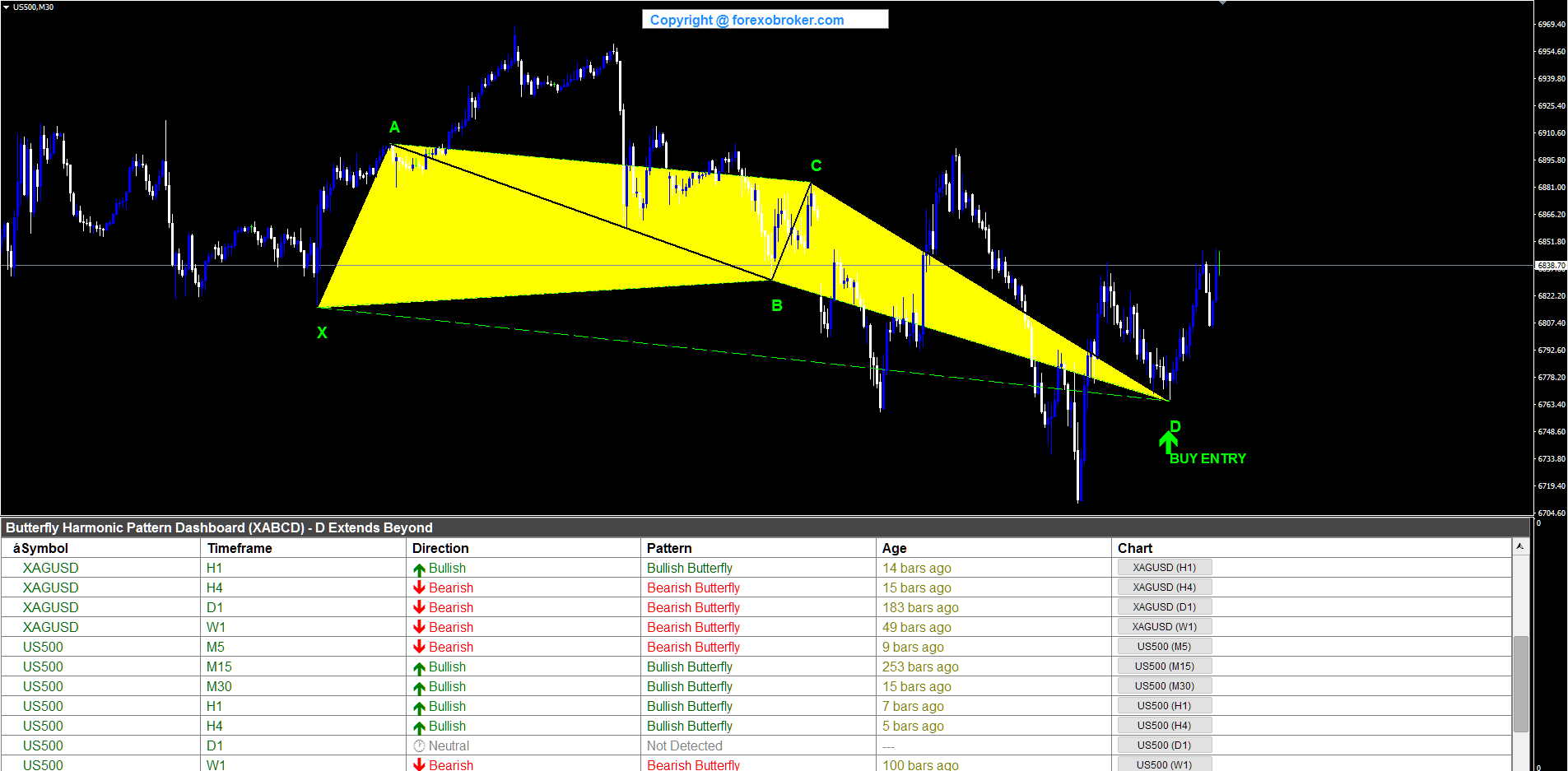
The S&P 500 index on the M30 chart produced a bullish Butterfly demonstrating that extension patterns occur across asset classes. X formed at a swing low near 6835, A at a swing high around 6920. B retraced to approximately 6835, C rose to about 6880, and D completed at a swing low near 6750 -- significantly below X, confirming the bullish Butterfly extension. The BUY ENTRY at D signaled a long entry on the index at a Fibonacci-defined support level where the overextension below X created a high-probability reversal zone. The dashboard showed the US500 row alongside forex and metals patterns.
BTCUSD H4 -- Bullish Butterfly
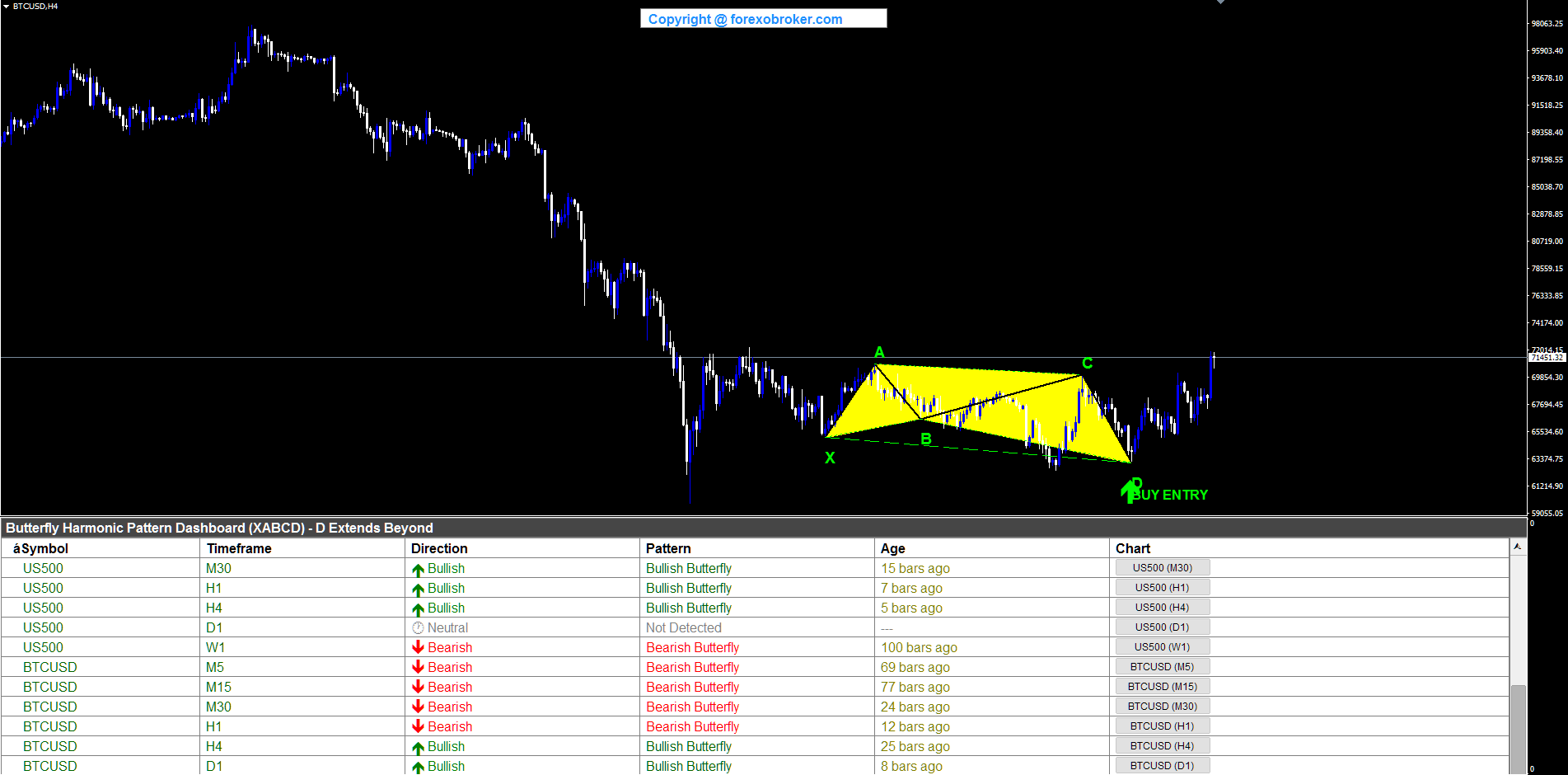
Bitcoin on the H4 chart formed a large bullish Butterfly spanning thousands of points in price. X was established at a swing low near 64,500, A surged to a swing high around 71,000. B retraced to approximately 65,500, C rose back to about 70,500, and D completed at a swing low near 61,500 -- well below X, confirming the extension structure. The massive price range between X and A produced three prominent yellow triangles that dominated the chart. The BUY ENTRY at D represented a higher-timeframe long opportunity on Bitcoin at the XAD extension zone, where the overextension past X by thousands of dollars created a significant reversal zone. The dashboard captured this H4 setup, demonstrating the indicator's ability to detect Butterfly extension patterns across crypto assets on swing trading timeframes.
12. Pivot & Fibonacci Tuning Guide
The Butterfly Harmonic Dashboard provides several parameters for fine-tuning pattern detection to match your trading style and the instruments you trade.
Pivot Sensitivity
| Parameter | Default | Effect of Increase | Effect of Decrease |
|---|---|---|---|
| Pivot Left Bars | 5 | Requires more bars before the pivot, finds major swings only | Finds minor swings, more patterns but lower quality |
| Pivot Right Bars | 5 | More confirmation bars needed, fewer but more reliable patterns | Faster pattern detection, more patterns but higher false-positive risk |
For scalping on M1-M5, consider reducing pivot bars to 3-4 for faster pattern detection. For swing trading on H4-D1, the default 5 or even 7-8 gives higher-quality patterns based on significant swing points.
Butterfly-Specific Fibonacci Range Tuning
| Trading Style | XAB Tolerance | ABC Range | BCD Range | XAD Tolerance | Patterns |
|---|---|---|---|---|---|
| Strict (fewer, higher-quality) | 3% | 0.50 - 0.786 | 1.80 - 2.40 | 5% | Few, high quality |
| Default (balanced) | 5% | 0.382 - 0.886 | 1.618 - 2.618 | 10% | Balanced |
| Relaxed (more patterns) | 8% | 0.30 - 0.90 | 1.50 - 3.0 | 15% | Many, wider net |
Strict settings tighten the XAB tolerance to just 3% (effective range 0.7624-0.8096) and the XAD tolerance to 5%. This filters for near-textbook Butterfly patterns where B sits almost exactly at 78.6% and D's extension falls squarely within the 127%-161.8% zone. You will see fewer signals, but each one is a high-confidence harmonic structure. Use this approach for major forex pairs on higher timeframes where price behavior tends to be more geometrically precise.
Default settings cover the standard harmonic trading ranges and work well across most instruments and timeframes. The 5% XAB tolerance (effective range 0.7467 to 0.8253) allows reasonable variation around the defining 78.6% level, while the 10% XAD tolerance (effective range 1.143 to 1.7798) accommodates the wider variability inherent in extension measurements. This is recommended for most traders starting out with the indicator.
Relaxed settings cast a wider net. The 8% XAB tolerance (effective range 0.7231 to 0.8489) accepts B-point retracements that are further from the ideal 78.6%, and the 15% XAD tolerance allows D-point extensions with more variation. You will see more patterns, but some will be at the edges of what would be considered valid Butterfly geometry. Use this when scanning instruments with irregular price behavior (crypto assets, exotic currency pairs) where patterns tend to be less geometrically precise.
Max History Bars
The Max History Bars parameter (default: 500) controls how far back the indicator looks for pivots. Reducing this value speeds up calculation but may miss larger patterns that span many bars. Increasing it to 1000 or more allows detection of major extension patterns on higher timeframes but increases computation time. For most trading scenarios, 500 bars provides sufficient lookback depth to capture Butterfly patterns across all enabled timeframes.
Figure 7. Pivot points require confirmation bars on each side, ensuring patterns are based on confirmed swings rather than noise.
13. Parameter Reference
Dashboard Settings
| Parameter | Default | Description |
|---|---|---|
| Symbols | EURUSD,GBPUSD,USDCAD,USDJPY | Comma-separated list of symbols to monitor (up to 20) |
| Symbol Prefix | (empty) | Broker prefix, e.g., "x" for xEURUSD |
| Symbol Suffix | (empty) | Broker suffix, e.g., ".pro" for EURUSD.pro |
| Enable M1 | false | Toggle M1 timeframe scanning |
| Enable M5 | true | Toggle M5 timeframe scanning |
| Enable M15 | true | Toggle M15 timeframe scanning |
| Enable M30 | true | Toggle M30 timeframe scanning |
| Enable H1 | true | Toggle H1 timeframe scanning |
| Enable H4 | true | Toggle H4 timeframe scanning |
| Enable D1 | true | Toggle D1 timeframe scanning |
| Enable W1 | true | Toggle W1 timeframe scanning |
| Enable MN | false | Toggle Monthly timeframe scanning |
| Visible Rows | 12 | Number of rows displayed in the dashboard |
Butterfly Pattern Settings
| Parameter | Default | Description |
|---|---|---|
| Pivot Left Bars | 5 | Number of bars to the left for swing detection |
| Pivot Right Bars | 5 | Number of bars to the right for confirmation |
| XAB Ratio | 0.786 | Target XAB retracement (78.6% of XA) |
| XAB Tolerance | 0.05 | Tolerance for XAB (±5%) |
| ABC Min Retracement | 0.382 | Minimum ABC retracement ratio (C retraces at least 38.2% of AB) |
| ABC Max Retracement | 0.886 | Maximum ABC retracement ratio (C retraces at most 88.6% of AB) |
| BCD Min Extension | 1.618 | Minimum BCD extension ratio (D extends at least 161.8% of BC) |
| BCD Max Extension | 2.618 | Maximum BCD extension ratio (D extends at most 261.8% of BC) |
| XAD Min Extension | 1.27 | Minimum XAD extension ratio (D extends at least 127% of XA) |
| XAD Max Extension | 1.618 | Maximum XAD extension ratio (D extends at most 161.8% of XA) |
| XAD Tolerance | 0.10 | Tolerance for XAD range (±10%) |
| Max History Bars | 500 | Number of historical bars to scan per symbol-timeframe |
Chart Display Settings
| Parameter | Default | Description |
|---|---|---|
| Show Butterfly Pattern | true | Draw the pattern overlay on chart |
| Show BUY/SELL Arrows | true | Display entry arrows at point D |
| Show Pattern Labels | true | Display X, A, B, C, D text labels |
| Bullish Pattern Color | Lime | Color for bullish (BUY) patterns |
| Bearish Pattern Color | Red | Color for bearish (SELL) patterns |
| Pattern Fill Color | Yellow | Color for the triangle fills |
| Pattern Line Color | Black | Color for the X-A-B-C-D connecting lines |
| Arrow Size | 4 | Size of entry arrows (1-5) |
| Arrow Gap (ATR mult.) | 0.8 | Distance of arrow from price (ATR multiplier) |
Alert Settings
| Parameter | Default | Description |
|---|---|---|
| Alert Title | "Butterfly Harmonic Dashboard" | Title for alert messages |
| Enable Popup Alerts | true | Show MetaTrader popup dialog |
| Enable Sound Alerts | true | Play alert sound |
| Sound File | alert2.wav | WAV file for sound alerts |
| Enable Email Alerts | false | Send email notification |
| Enable Push Notifications | true | Send mobile push notification |
14. Conclusion
The Butterfly harmonic pattern is one of the most geometrically precise extension structures in technical analysis. Its effectiveness comes from the convergence of four Fibonacci ratio relationships -- XAB at 78.6%, ABC, BCD, and the defining XAD extension between 127% and 161.8% -- that together identify high-probability reversal zones where price has overextended beyond its starting level. The fixed 78.6% XAB level, the square root of 0.618, anchors the B point with exceptional precision. The XAD extension ratio greater than 1.0 places the D-point completion zone beyond X, creating entries at levels where the market has exhausted its momentum in a measured, Fibonacci-defined overextension.
The challenge has always been operational. The Butterfly's extension geometry makes it visually counterintuitive -- D extending past X looks like a breakdown or breakout, not a pattern completion. Identifying five-point XABCD patterns that simultaneously satisfy four Fibonacci conditions, including a fixed-ratio check at B and an extension calculation at D, across a full watchlist of 20 symbols and nine timeframes requires continuous measurement and validation that exceeds what any manual scanning process can deliver. The cognitive load of verifying the 78.6% XAB, calculating the XAD extension, and distinguishing genuine Butterfly completions from failed patterns across 180 chart combinations makes comprehensive Butterfly pattern scanning humanly impossible to do consistently.
The Butterfly Harmonic Dashboard automates this entire process. It identifies confirmed swing pivots, constructs five-point Butterfly pattern candidates in both bullish (LHLHL) and bearish (HLHLH) orientations, validates them against four configurable Fibonacci ranges with tolerance adjustment -- including the extension calculation that makes manual detection so demanding -- and presents every valid pattern in a clean six-column dashboard with real-time alerts across four channels. The non-repainting design ensures that every signal is based on confirmed price structure, and the three yellow triangle fills make pattern identification immediate and intuitive.
Whether you trade forex, metals, crypto, or indices -- and whether you scalp on M5 or swing trade on the Daily -- the dashboard adapts to your watchlist and timeframe preferences. Configure it once, and let it scan continuously while you focus on evaluating setups and managing trades.
Try the free demo or get the full version on the MQL5 Market:
- MetaTrader 5: Butterfly Harmonic Dashboard MT5
- MetaTrader 4: Butterfly Harmonic Dashboard MT4