AI in Trading: The $100,000 Mistake of Using a "Crystal Ball" Instead of a "Radar"

AI in Trading: The $100,000 Mistake of Using a "Crystal Ball" Instead of a "Radar"
Do me a favor. Open the MQL5 Market right now in another tab. Search for "AI". What do you see?
You see thousands of flashy Expert Advisors. They promise neural network-powered profits, machine learning precision, and deep learning algorithms that can supposedly "see" the market's next move before it happens.
Now, close that tab and ask yourself a painful, honest question: If all these thousands of "AI" robots actually worked as advertised, why is the 95% failure rate in retail trading exactly the same today as it was ten years ago?
Why are prop firms still failing 90% of their applicants if "AI" is readily available for $99?
The answer lies in a fundamental, catastrophic misunderstanding of what Artificial Intelligence is actually good at when applied to chaotic financial markets. The retail crowd is using the most powerful technology in human history to do the absolute wrong job.
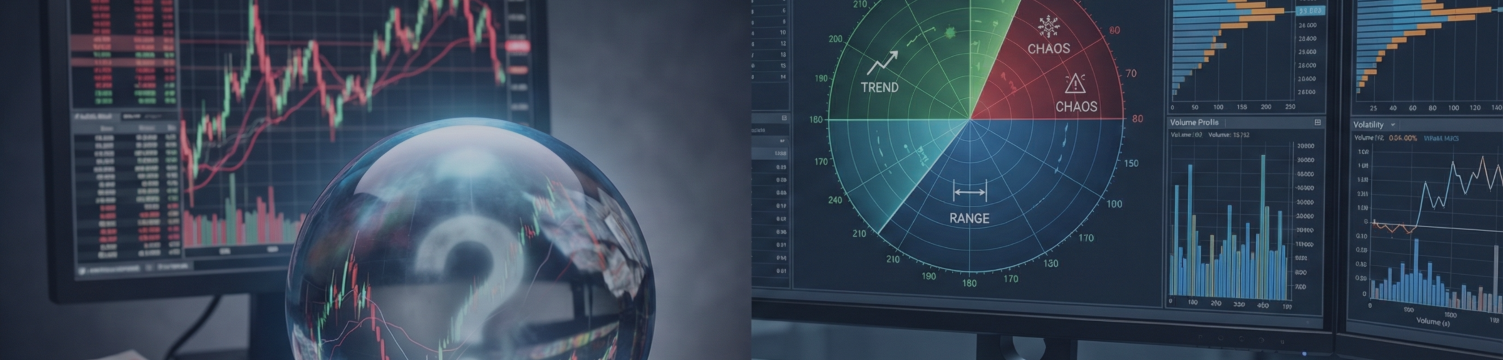
They are desperately trying to build a Crystal Ball to predict the future.
Professionals, quant funds, and smart algorithmic traders are building a Radar to understand the present.
The "Crystal Ball" Delusion: Why Predictive AI Fails
The average retail developer, excited by the hype of ChatGPT and Midjourney, approaches financial AI with a simple, linear mindset: "I will feed this neural network 10 years of historical price data (EURUSD H1 candles). The AI will learn the patterns, and then it will predict if the next candle will close bullish or bearish."
This sounds incredibly logical on the surface. It’s also financial suicide.
The Rearview Mirror Problem
Here is the Captain Obvious truth about markets that most amateur data scientists ignore: Financial data is non-stationary and incredibly noisy.
Trying to predict the exact closing price of tomorrow's candle based solely on yesterday's patterns is like trying to drive a car down a winding mountain road while looking exclusively in your rearview mirror. You can see where you've been perfectly, but that information is useless—even dangerous—when you hit the next sharp curve.
Markets change regimes. What worked in the low-volatility environment of 2019 got crushed in the COVID volatility of 2020, and that got crushed again in the inflationary trend of 2022. An AI trained to predict prices in one environment will fail catastrophically when the environment shifts.
The Overfitting Trap
When you train an AI to "guess future price," you aren't building intelligence. You are building an expensive curve-fitting machine. The AI doesn't learn the underlying logic of the market (because often there isn't one); it just memorizes the noise of the past 10 years to achieve a high backtest score.
If your EA's logic looks anything like IF AI_Predicts_Up_Next_Candle THEN Buy , you are gambling on a statistically flawed guess. That is not an edge; that is high-tech roulette.
The Paradigm Shift: AI as a Context "Radar"
If AI cannot reliably predict the future price action, what good is it? Why do major hedge funds spend millions on it?
Because while AI is terrible at prediction in chaotic systems, it is superhuman at fast classification.
Think of a modern military fighter jet. The pilot does not have a "crystal ball" in the cockpit telling him exactly what the enemy pilot will do next Tuesday at 3 PM. That's impossible. What he has is an incredibly sophisticated Radar system.
The radar processes thousands of incoming signals in milliseconds—heat, speed, trajectory, altitude—to cut through the noise and tell the pilot exactly what is happening RIGHT NOW:
- "DETECTION: There is an object at your 2 o'clock position."
- "VELOCITY: It is moving at Mach 2 towards you." (Trend)
- "CLASSIFICATION: Its heat signature confirms it is hostile." (Market Regime)
This is exactly how professional quantitative firms use AI. They don't ask the AI: "Where will price go?" They ask the AI a much more valuable question: "What is the exact mathematical structure of the market environment at this very second?"
The Technical Mechanism: Classifying Market Regimes
Instead of training a model to output a binary "Buy" or "Sell" signal, professionals train models to output Market Regimes. This acts as the ultimate Context Filter for your trading ecosystem.
A robust trading AI engine should analyze volatility metrics (like ATR and Standard Deviation), momentum (like ADX and RSI), and volume profiles instantly to classify the market into actionable states. For example:
- Regime A: Clean Trend (The Green Zone). The market shows high directional momentum (e.g., ADX > 30) and stable, aligned volatility. Action: Deploy Trend-Following Engines and Breakout EAs.
- Regime B: Mean Reversion (The Yellow Zone). The market has low momentum and is bouncing between clear average prices. Action: Deploy Grid or Oscillator-based Engines.
- Regime C: Chaos & Shock (The Red Zone). News events, central bank speeches, or liquidity vacuums cause erratic volatility spikes that defy technical analysis. Action: ENGAGE CIRCUIT BREAKER. STOP ALL TRADING.
The holy grail of trading is not a bot that wins every trade. The holy grail is a system intelligent enough to know when NOT to trade.
A Conceptual MQL5 Example: The Difference in Code
To make this concrete, let's look at pseudo-code. This is how the amateur codes an "AI" EA:
// Amateur Logic: The Crystal Ball Guess // The trader trusts a black-box prediction blindly. double Prediction = AI_NeuralNet_PredictNextClose(); if(Prediction > CurrentPrice) { // "The AI said it would go up, so I buy." // No regard for current volatility or news shocks. OrderSend(Symbol(), OP_BUY...); } // RESULT: Blows up during NFP because the AI predicted "up" based on yesterday's data, ignoring today's chaos.
Now, look at how the professional codes an Ecosystem where entry logic is secondary to the AI Context Radar:
// Professional Logic: The AI Radar Check // The trader uses AI to validate the environment first. int CurrentRegime = AI_Context_Engine.GetState(Symbol()); // STEP 1: SAFETY CHECK (The Radar) if(CurrentRegime == REGIME_CHAOS_SHOCK) { Print("AI Radar detects high-risk chaos. Disengaging all engines."); return; // THE MOST PROFITABLE DECISION: DO NOTHING AND PRESERVE CAPITAL. } // STEP 2: DEPLOY THE CORRECT TOOL if(CurrentRegime == REGIME_CLEAN_TREND) { // The environment is safe for trend strategies. // Only NOW do we check our specific entry setup. if(Trend_Engine.SignalTriggered()) { OrderSend(Symbol(), OP_BUY...); } } // RESULT: Survives NFP by sitting on the sidelines. Trades aggressively when the dust settles and a clear trend emerges.
Do you see the massive difference? The professional system uses AI to determine if it should even play the game today, before it ever decides how to play the game.
Social Proof: The Radar in Action
This isn't just abstract theory. We see the difference between "prediction bettors" and "context engineers" every day in our user base. When traders stop trying to guess the future and start accurately classifying the present using AI, their anxiety drops, and their consistency improves dramatically.
"I used to run three different commercially available trend EAs. They made money for a month and then gave it all back in a single choppy week during central bank announcements. Since switching to the Ratio X toolbox approach, I realized my bots weren't necessarily 'broken'; they were just blind. The AI quantum radar kept me entirely out of the EURUSD chop last Thursday during the CPI release. It didn't make money that day, but it saved me a 4% drawdown. In this game, saving 4% is a massive win."
— Marcus D., Prop Firm Trader (Currently Funded Phase)
"The concept of AI for 'Regime Detection' instead of price prediction changed everything for me. I stopped looking for the 'perfect setup' and started focusing on the environment. The AI acts like a strict filter; if the market condition isn't mathematically right for my strategy, the AI simply locks the door. It’s like having a senior mentor sitting next to you slapping your hand away from the mouse when you try to do something stupid out of boredom."
— Priya K., Algorithmic Developer
The Solution: The Ecosystem Decision Engine
Real automation is not about having a simple bot that places buy and sell orders based on a moving average cross. Real automation is about automating the high-level decisions of a portfolio manager.
If the market turns chaotic, a human manager knows to reduce risk or go flat. Your automated system must have the intelligence to do the same, instantly and without emotion.
At Ratio X, we don't sell "crystal balls." We spent years engineering an Ecosystem managed by a central AI "Radar." Our flagship engine, MLAI 2.0, acts as the central nervous system for your trading. It aggregates technical data, volume profiles, and volatility metrics in real-time to validate the market context.
It decides which specialized tool in your arsenal to deploy. Is it time for the Trend Engine? Is it time for the Breakout Engine? Or is it time to engage the Circuit Breakers and sit on the sidelines because the radar shows incoming hostile volatility?
This ecosystem approach—using AI for context filtering rather than price prediction—is exactly how we engineer longevity and how our users pass rigorous prop firm challenges. We don't try to beat the market's uncertainty; we manage our exposure to it with military-grade detection.
Stop Guessing. Start Detecting.
Upgrade Your Trading to a Professional AI Radar System.
Stop trying to force static, blind robots to understand a dynamic market with brute-force prediction. Professional algorithmic trading requires an arsenal of specialized tools managed by a sophisticated context engine.
The official price for lifetime access to the complete Ratio X Trader's Toolbox—which includes the Prop-Firm verified MLAI 2.0 "Radar" Engine, AI Quantum, specialized EAs for different regimes, and our comprehensive risk management framework—is $247.
However, I maintain a personal quota of exactly 10 coupons per month specifically for my blog readers. If you are ready to stop gambling with a crystal ball and upgrade to a professional radar, use the code below to secure an immediate discount.
✓ BONUS INCLUDED: Your access includes the exact "Prop-firm Challenger Presets" that utilize this specific AI filtering logic to pass live verification.
The "Radar" Guarantee: Don't take our word for it. Test the AI Context Filter during the next major news release (NFP or CPI) on a Demo account. Watch how it identifies chaos and refuses to trade when others blow up. If it doesn't act as a protective filter exactly as described, use our 7-Day Unconditional Guarantee for a full refund.