How Ideas from ChatGPT Could Herald a New Era of Trading Systems

How Ideas from ChatGPT Could Herald a New Era of Trading Systems
Topic: Trading Philosophy, Machine Learning, The Future of Algorithmic Trading.
Greetings, community!
Today, I want to step away from dissecting a specific indicator or expert advisor. Let's talk about the future. About where algorithmic trading could evolve when classical approaches—moving averages, Fibonacci levels, Price Action patterns—begin to resemble navigating by a star chart in the age of GPS.
For the past year, I, like many of you, have been haunted by the thought: "What if we applied the principles of these large language models (LLMs), like ChatGPT, to the market?" Does it sound like marketing hype? Possibly. But let's dig deeper, discard the buzz, and get to the essence.
From Words to Candles: A Provocative Analogy
Imagine that every price level on a chart is a word. The level of $1.1000 in EURUSD is one "word," $1.1005 is another. The entire history of quotes is a gigantic, multi-volume novel written by the sum of all market participants.
The more often price "utters" this "word" (tests it, bounces off it, consolidates at it), the more statistics it accumulates. This "word" bursts into the market "text"—sometimes as part of a powerful trending "sentence," sometimes as a stutter in a ranging phase.
What does ChatGPT do when you give it a prompt?
- It breaks down your text into entities (tokens).
- It analyzes the ENTIRE context of the dialogue, determining which words are key.
- Based on statistics from billions of texts, it calculates which word (token) should come next to form a coherent, grammatically correct continuation.
It does not "understand" the meaning. It calculates a probability distribution. It plays a game of guessing the most plausible continuation.
Now let's transfer this to a chart.
What if our trading system did the same?
- Tokenizes the market: Transforms the current price situation (the last N candles, their shape, volume, values of key indicators) into a unique "context vector"—a digital fingerprint of the moment.
- Searches memory for "similar moments": Instead of a brute-force search through history for 3-candle patterns, it finds situations where the contextual fingerprint was maximally similar. And this is not just price! It's the aggregate state: "an uptrend, but RSI is near overbought, volume is rising, price is hitting a key monthly level."
- Looks at what happened "after": And here is where the magic is born. The system does not give a single "BUY" or "SELL" signal. It says: "In 127 historical moments similar to the current one, in 42% of cases the price was here after 5 candles, in 28% it was here, and in 15% there was a sharp false breakout to here."
This is not prediction. This is scenario analysis based on statistical similarity.
The Death of the "Single Answer" and the Birth of the "Probability Tree"
A traditional expert advisor is a dictator. "IF (condition) THEN (order)". It gives a binary signal. A new system built on LLM principles is a wise advisor. It draws for us a tree of possible scenarios with an assessment of their probability.
Its report would look like this:
- Base Scenario (Probability ~40%): Correction to level 1.1050 followed by consolidation.
- Alternative Scenario (Probability ~30%): Breakout of the current high and an impulse to 1.1120.
- "Black Swan" Scenario (Probability ~10%): A sharp pullback on false news to 1.0950.
- Recommended zone for orders: Between 1.1020 and 1.1035, with lot distribution in a 70/30 ratio in favor of the base scenario.
This changes EVERYTHING. Money management ceases to be a "bet on red." It becomes a weighted allocation of resources across probability branches.
Technical Challenges: Why Isn't This in Every Expert Advisor?
- Computing power. Training such a model requires GPUs and terabytes of tick data. This is not a 10 MB expert advisor.
- Overfitting - enemy #1. The market is not a language. English grammar is stable. The "grammar" of the market changes every few years. Finding true patterns, not random noise, is a Herculean task.
- Continuum of data. Price is continuous. Choosing the "granularity" of tokens (price step) is an art. Too fine - noise; too coarse - loss of essence.
- Context encoding. How to translate not only price but also, for example, news about an FOMC decision or geopolitical tension into a digital vector? This is the most difficult, yet most promising frontier.
A View to the Future: Not Replacement, But Evolution
I do not believe such a system would replace a trader. It would enhance them. Like a navigator in a pilot's cockpit. It would answer not the question "Buy or sell?" but questions like:
- "What risk zones are most likely in the next 24 hours?"
- "If I open a trade here, what are the most realistic targets and where to place a stop so it doesn't get taken out by noise?"
- "What does the current market most resemble - August 2019 or March 2020?"
Imagine that you are launching not just an advisor, but an entire simulator of probabilistic outcomes, which constantly learns from new data.
Conclusion. An Idea for the Bold.
I am writing this post not just for philosophical discussion. I see in this direction the next logical step for complex trading systems that already operate at the intersection of algorithms and discretionary analysis.
For example, my GOLD QUEEN system incorporates complex logic for working with levels and impulses (but it is not an LLM/AI). In future versions, given sufficient interest from the community and the development of technology, the principle of LLM-like scenario analysis could become that very qualitative leap—from a tactical tool to a strategic advisor.
But it all begins with discussion. With brainstorming. With the question "what if?"
That's why I am addressing you, colleagues. What do you think? A crazy fantasy or an inevitable future? Are our hardware and our minds ready to stop guessing and start calculating the spectrum of probabilities?
Write in the comments. Let's build this future together.
Trade consciously.
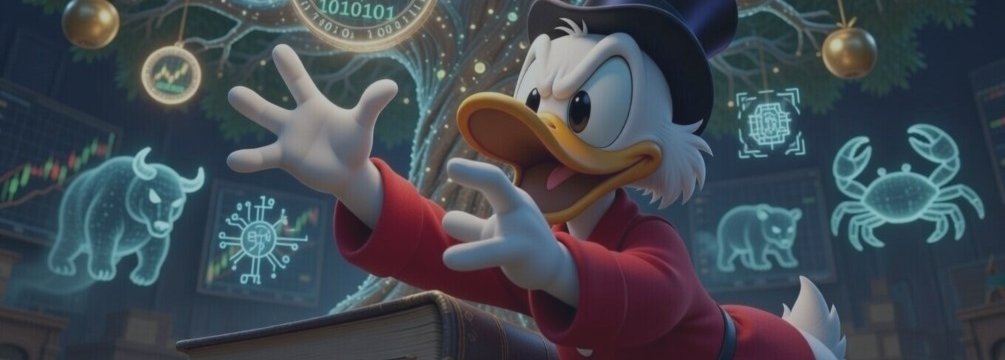
***The Scrooge McDuck character is the intellectual property of The Walt Disney Company. The use of this image in this article is for analytical and allegorical purposes.