From Trading Idea to Robust EA – Why the Best Backtest Is Not the Best System

From an Idea to a Trading System – How TH Systems ATR Breakout Was Developed
The development of an Expert Advisor does not always begin with a completely new trading idea.
In my case, it started with a trading strategy I saw in a video some time ago. I liked the basic concept: a strong momentum move followed by a period of market indecision before a potential continuation of the move.
I found the idea interesting and wanted to see whether it could be transformed into a fully rule-based and automated trading system.
That was the starting point for the development of TH Systems ATR Breakout EA.
The Basic Idea
The EA operates on the M1 timeframe and is currently designed for index trading.
The main trigger consists of two candles:
1. Momentum Candle
A strong price movement that must meet defined momentum and volatility requirements.
2. Indecision Candle
This is followed by a candle representing short-term market indecision.
Based on this combination, the EA looks for potential continuation opportunities in the direction of the preceding momentum.
ATR-based conditions are used to incorporate current market volatility into the setup.
Turning an Idea Into My Own System
The original concept, however, was only the starting point.
During development, I added my own rules, filters and functionality. These include trading sessions, different momentum and volatility conditions, risk and position management, as well as rules controlling when and how long positions may remain open.
The EA uses a defined Stop Loss and Take Profit.
There is no Grid, no Martingale and no Recovery logic.
Another important objective was not to generate as many trades as possible. Although the EA operates on M1, there can be days without a single valid setup. On other days, several signals may occur.
A trade should only be taken when the defined conditions are met.
The Biggest Lesson Came From Optimization
One of the most interesting parts of developing the system was optimization.
At first, it is tempting to assume:
The better a parameter set performs in a backtest, the better the strategy.
My testing showed me quite clearly why this assumption can be dangerous.
During development, I found many parameter combinations that produced significantly better In-Sample results than the settings I use today.
Some of the differences were substantial.
If I had selected settings purely based on profit, Profit Factor or the most attractive equity curve, I probably would have chosen some of those configurations.
Then came the Out-of-Sample test.
In-Sample Performance Wasn't the Real Objective
The strongest In-Sample configurations were often not the configurations that performed best outside the optimization period.
Some parameter sets with excellent In-Sample results failed completely during Out-of-Sample testing.
That became one of the most important lessons from the development process.
An impressive backtest can simply mean that the parameters fit the specific historical data on which they were optimized extremely well.
Because of this, my approach changed.
Instead of asking:
“Which settings generate the highest profit?”
I started asking:
“Which settings can still perform on data they were never optimized on?”
This sometimes meant deliberately choosing settings with weaker In-Sample results.
For me, a less impressive In-Sample result combined with reasonable Out-of-Sample behaviour is far more interesting than an almost perfect historical backtest that collapses on unseen data.
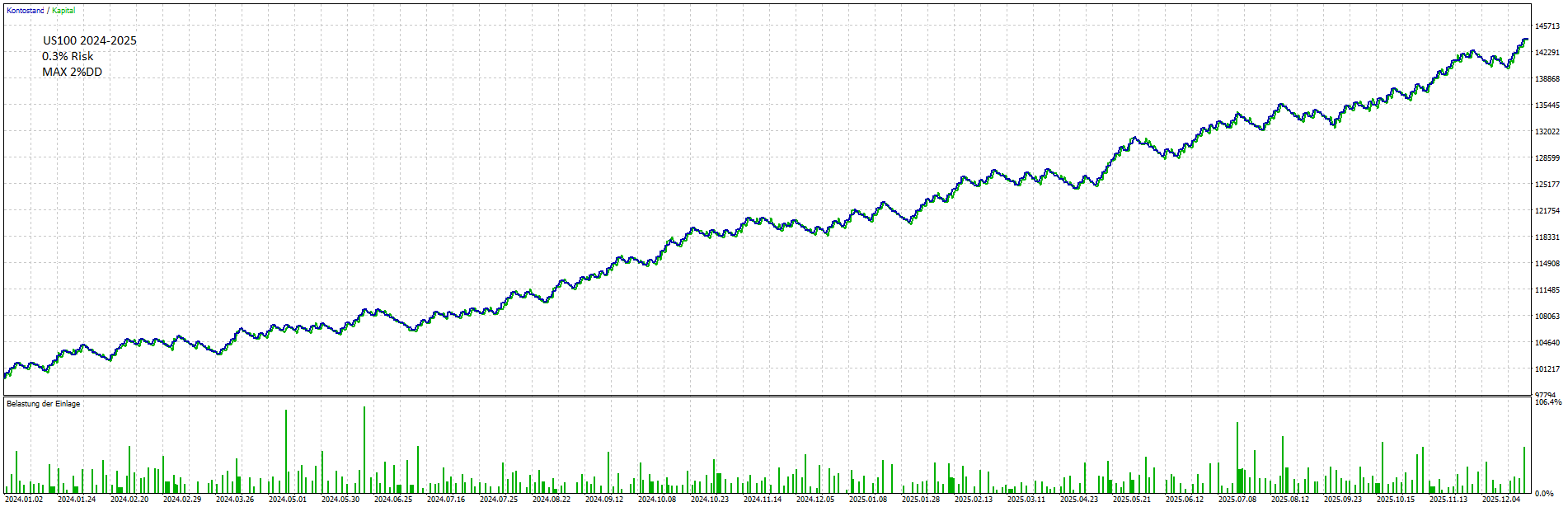
Bild 1 – US100 Out-of-Sample
US100 – In-Sample test used during the development and optimization process.
Bild 2 – US100 In-Sample
US100 – Out-of-Sample test using the same parameter set on unseen data.
The US100 example above illustrates this approach. The objective is not to achieve identical results in both periods. What matters to me is whether the underlying strategy remains viable when the same parameters are applied to data that was not used during optimization.
Robustness Instead of a Perfect Equity Curve
Of course, even a successful Out-of-Sample test does not prove that a trading system will be profitable in the future.
Market conditions change, and every automated trading strategy can experience losing periods and drawdowns.
That is exactly why my objective with TH Systems is not to create the most impressive historical equity curve.
I want to find rules that depend as little as possible on the future behaving exactly like a specific period in the past.
Over time, this philosophy has become an even more important part of ATR Breakout development than the original trading idea itself.
Current Status
TH Systems ATR Breakout is currently designed for:
DAX · US100 · US500 · US30
The recommended timeframe is M1.
Current settings for RoboForex and FTMO are also available.
The EA will continue to be tested and developed. In future posts, I also want to document not only what works, but what does not work.
Because failed tests are also an important part of developing a systematic trading approach.
TH Systems
Discipline · System · Edge