A familiar situation. In the morning you marked up the chart: here is the zone (POI) where price should react, and here is the level beyond which the idea breaks. Now all you have to do is wait.
What usually happens next is one of three things:
1. Price reached the POI while you were away from the screen. It reacted, moved off, and you are looking at a nice move without your entry.
2. You could not wait and placed a limit order right at the zone. Price sliced through it, the stop was hit, and the reversal came later, without you.
3. You waited for confirmation but spent too long on the lot size. By the time you typed the prices into the order window, price had already moved half a stop away.
None of these mistakes is about analysis. They are about execution.
What does an entry actually need?
Let's go step by step:
• Price reaches the zone (POI). A touch on its own means nothing yet.
• A confirmation appears on a lower timeframe. For example, a break of structure (BOS) in your direction, an inverted FVG or a clear candle pattern. Confirmation filters out the cases where the zone simply breaks.
• The stop goes beyond the invalidation level, not "by eye". If price gets there, the idea has failed and there is no reason to stay in the trade.
• The lot comes from the risk. Every trade costs the same share of the account.
These are strict rules. And anything that comes down to rules can be handed to a program, leaving you the main part: reading the chart, where the zone (POI) is and which way to trade.
There are two ways to make life easier:
1. If you sit at the screen and enter yourself, you no longer need a calculator: set the stop and take as lines on the chart, and the lot is calculated from your risk. All you do is check the summary. The entry takes seconds, and getting the lot or the button wrong in a hurry becomes almost impossible.

Easy Entry: stop and take are lines on the chart, the lot is calculated from your risk in percent.
2. If you do not want to sit at the screen, hand the waiting to an Expert Advisor. You draw two lines: the reaction zone and the invalidation level. It then waits for price to reach the zone, waits for confirmation on a lower timeframe and enters with the stop behind the nearest structure swing. If price touches the invalidation level first, the idea is dropped. If there is no confirmation, there is no trade.
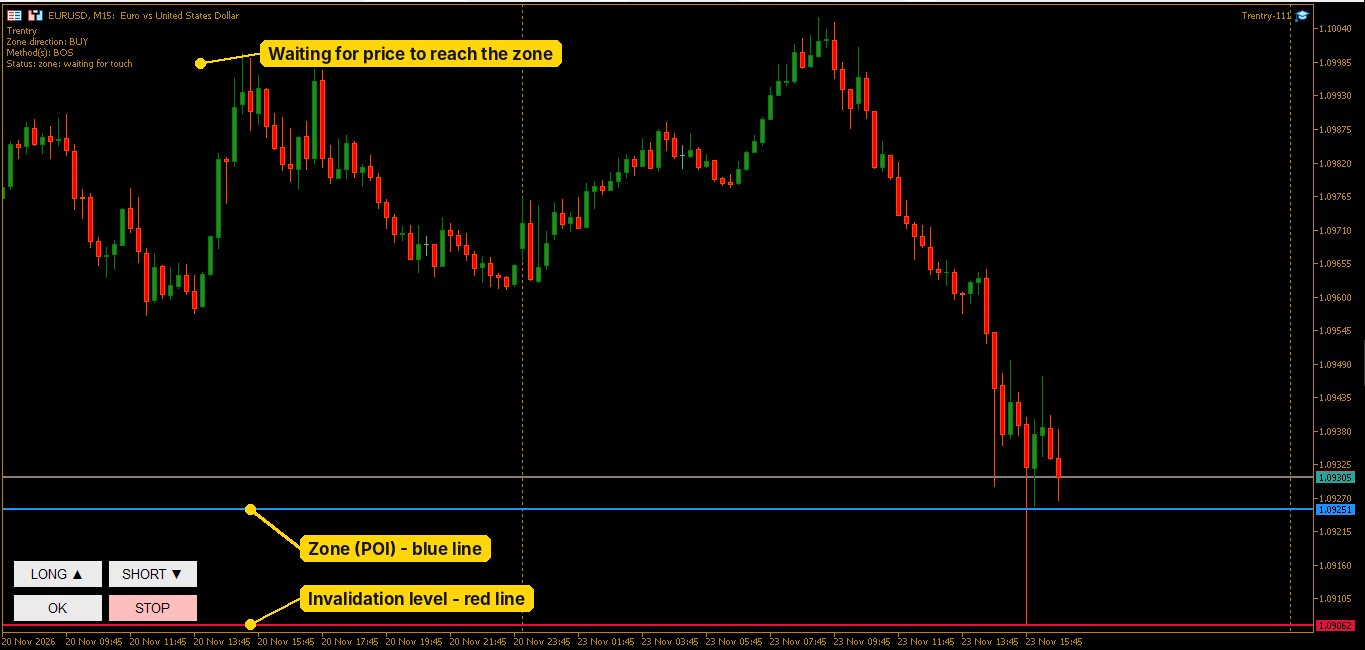
Trentry: the blue line is the zone (POI), the red line is the invalidation level. The EA waits for price to reach the zone.

Price touched the zone. Now Trentry waits for a break of structure on a lower timeframe - no break, no trade.
What this does not solve
To be honest: automating the entry will not turn a bad zone into a good one. If the analysis is wrong, the EA will enter a losing trade neatly and with discipline. What you do get is that good ideas stop being lost on execution, and after a month the trade journal shows where the mistake is: in the zones or in the entries.
Tools from this post
I built both for my own trading, and both are on the Market:
• Trentry: entry from your zone after confirmation (break of structure, IFVG or candle pattern), on a bounce or a breakout, with a decision journal. A free demo version for the Strategy Tester is available.
Questions and suggestions are welcome in the comments, I will answer.