Golconda
- Experts
-
Alex Amuyunzu Raymond
 I’m an experienced MQL5 developer and software engineer specializing in building robust, high-performance algorithmic trading systems for MetaTrader 5. My work goes beyond standard EA development — I design intelligent, scalable solutions that combine market logic, automation, and external
 - Versão: 1.0
- Ativações: 5
Golconda — Where Gold Finds Discipline.
Golconda is a professional multi-directional grid and hedge management system built specifically for traders who want structured, rule-based exposure to volatile gold-style instruments instead of blind martingale gambling. Named after the legendary fortress city once synonymous with limitless wealth, Golconda is engineered to pursue that same idea in modern markets — but with layers of protection, filtering, and monetary control wrapped around every decision the system makes.
At its core, Golconda separates trading into two fully independent baskets — BUY and SELL — each with its own initial entry logic, its own martingale progression, its own profit target, its own trailing protection, and its own drawdown safeguards. This means the system can run both directions at once without one side interfering with the other, or it can be locked to a single direction for traders who prefer a purely trend-following or purely counter-trend approach.
Every new sequence begins with a single Initial Trade, sized exactly as configured by the trader, generated from a multi-timeframe signal engine. Multiple timeframes can be required to agree before an entry is even considered, giving the trader control over how selective the system is before it commits capital. Before that initial trade is allowed to fire, Golconda checks two independent, stateful lock systems — an RSI hysteresis filter and a Bollinger Band hysteresis filter. Both function the way an experienced discretionary trader would think about overbought and oversold extremes: once a side is locked out because the market moved too far in one direction, it stays locked until the market has genuinely recovered past a resume threshold, rather than flickering on and off around a single number. Trading days and trading hours can also be restricted independently, so new entries only occur during the sessions a trader actually trusts, while any position already open continues to be professionally managed around the clock regardless of the entry-hour restriction.
Once a basket is open and price moves against it, Golconda's martingale engine takes over — but not blindly. Distances between each additional position are defined directly in account-currency terms rather than confusing broker points, so a trader working with an instrument like gold can configure exactly how many dollars of adverse movement are required before the next position is added. Multiple distance-and-multiplier sets can be layered so that early-stage additions behave differently from deep, late-stage additions, giving full control over how the grid's shape evolves as it grows. Every martingale addition respects a hard maximum lot size and a hard maximum trade count, so the sequence can never run away from the account size the trader has configured.
Before any martingale position is allowed to open, it must pass through a filtering stack that can be toggled on or off piece by piece. An ATR-based spike filter detects abnormal volatility and pauses new additions during it while leaving existing positions under full management. A Market Safe module cross-references volume behavior, trend strength, Bollinger expansion, momentum, on-balance volume, and Ichimoku cloud structure to judge whether current conditions are stable enough to add exposure. On top of that sits an indicator confirmation voting system spanning eight distinct tools — RSI, MACD, Bollinger Bands, ADX, Stochastic, OBV, Ichimoku, and CCI — where the trader defines the minimum number of confirmations required before a martingale trade is permitted to fire.
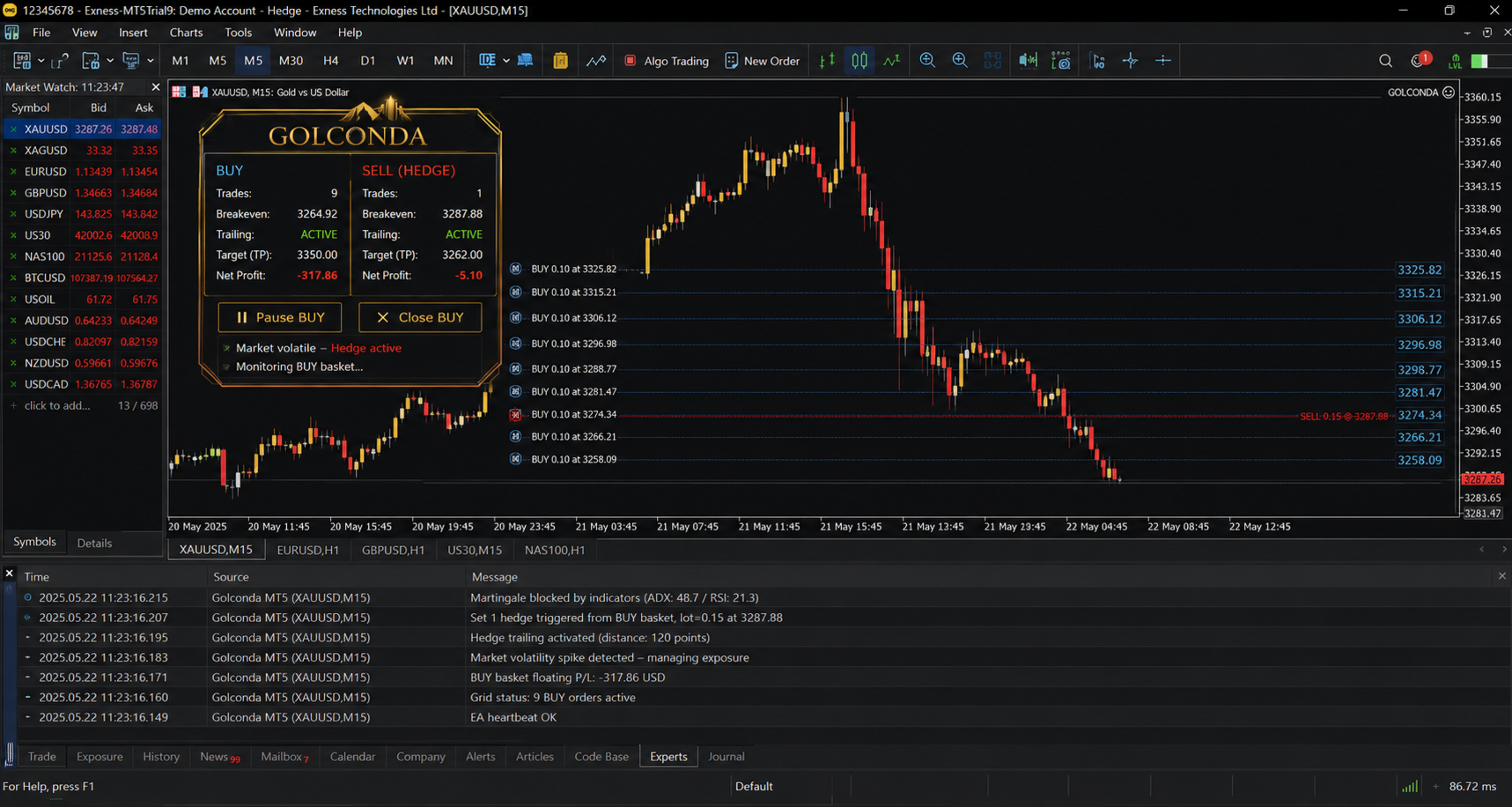
When the very first martingale step is blocked by these filters rather than allowed to open, Golconda does not simply do nothing. It triggers a hedge position sized to match what that blocked martingale trade would have used, opened in the opposite direction. Crucially, this hedge is explicitly linked back to the basket that created it in the system's internal bookkeeping, so a hedge generated by a BUY basket can never be mistakenly folded into an unrelated, independently existing SELL basket. This solves a subtle but serious accounting problem that plagues many grid systems, where mixed-origin positions distort profit targets, trailing calculations, and closing decisions without the trader ever realizing it.
Profit and risk throughout Golconda are expressed the way a trader actually thinks about their account — in dollars and cents, not points. Each basket has a configurable profit target per participating trade, so a basket's overall take-profit scales automatically with how many positions are currently open. A virtual trailing mechanism protects unrealized basket profit once it reaches a configurable activation level, allowing the basket to continue running toward its full target while locking in gains along the way. Both calculations account for swap and commission, not just raw floating profit, and the system computes a cost-adjusted breakeven price for each basket rather than a naive average of entry prices. Manual trades can optionally be included in this profit accounting as well, letting a discretionary trader add a manually opened position that contributes toward closing the managed basket sooner, without that manual position ever being allowed to interfere with the martingale sequence's internal numbering or lot progression.
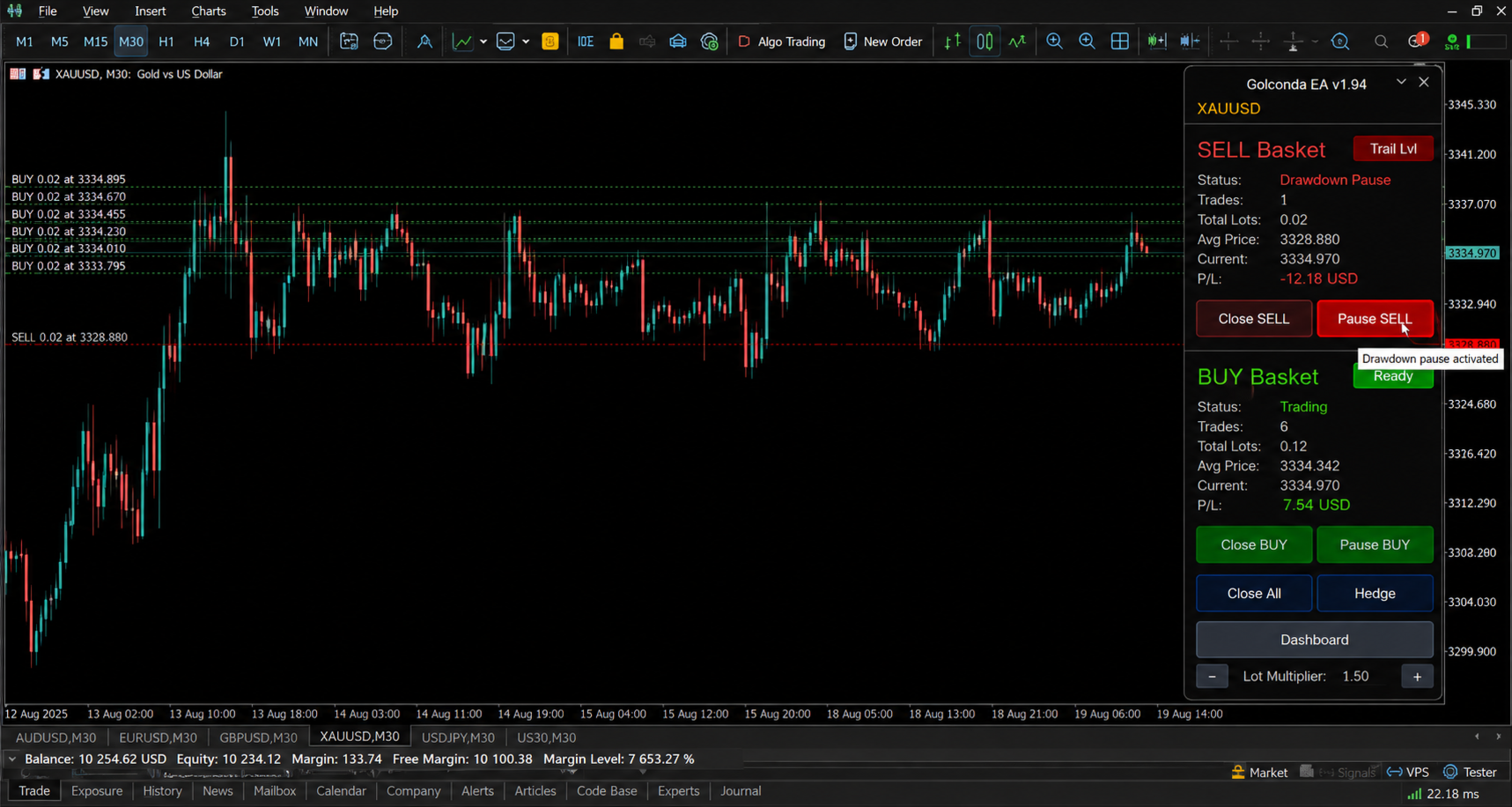
Risk control operates on two distinct levels. A drawdown pause threshold temporarily halts new martingale additions once losses reach a configured level, while leaving existing positions under active management — and resumption is governed by a configurable recovery percentage, so the system does not flicker martingale trading on and off around a single number. A separate, harder cut-loss threshold exists above that, which closes the entire basket outright if losses reach a level the trader has defined as unacceptable. A daily profit target sits above both of these, halting new trade generation for the day once reached, while still allowing the trader to raise that target intraday and resume trading automatically if the new target has not yet been met.
For traders who want an additional way to reduce basket exposure without waiting for the full target, Golconda includes a martingale pair-closing strategy. It continually looks for a newer, profitable position in the sequence capable of offsetting an older, losing position by a configured margin, closes both together when the condition is met, and dynamically renumbers the remaining sequence so the same logic can repeat as the basket grows again. This gives the system a second, faster route toward reducing risk and locking in partial gains between full basket closures.
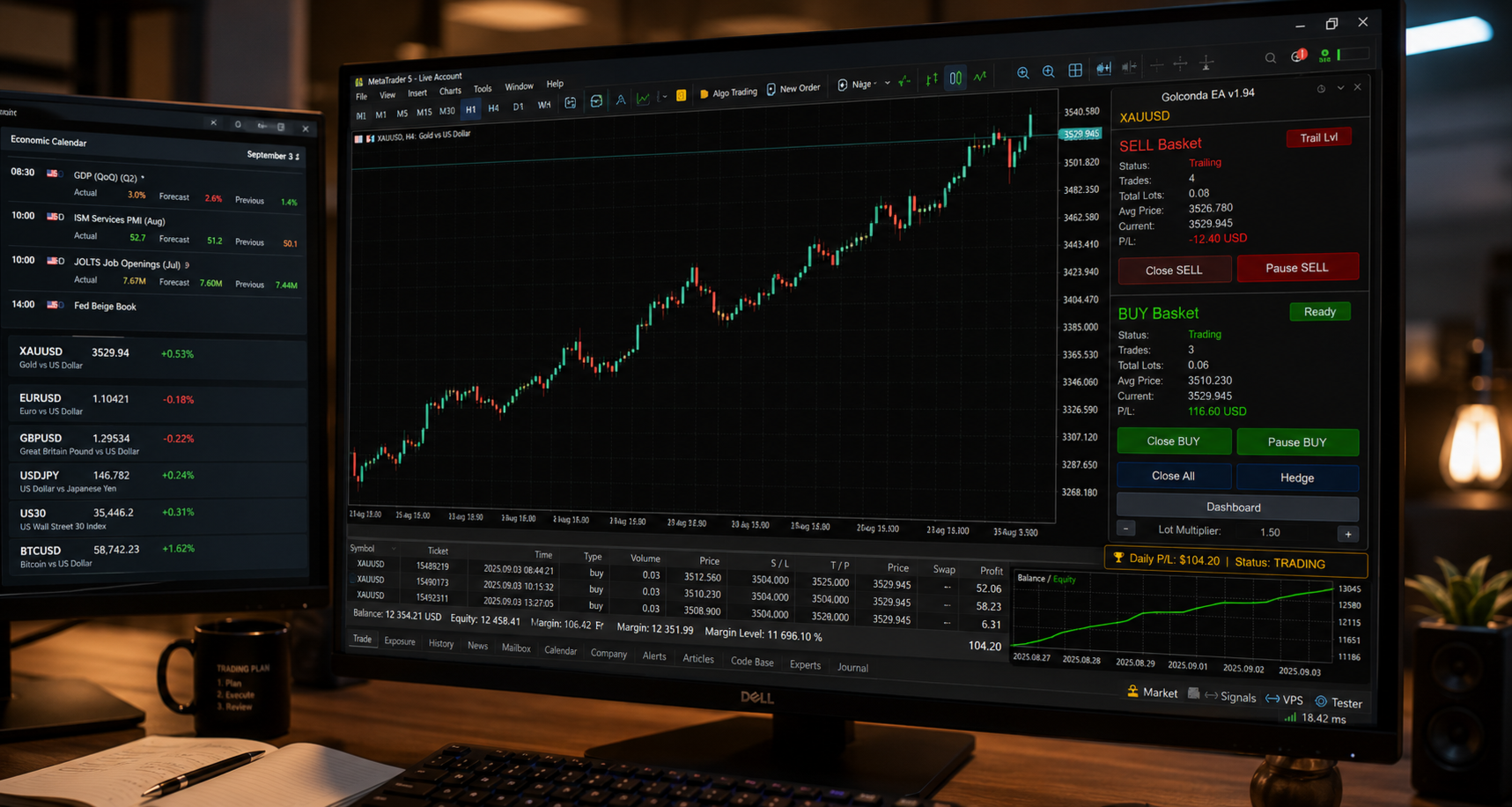
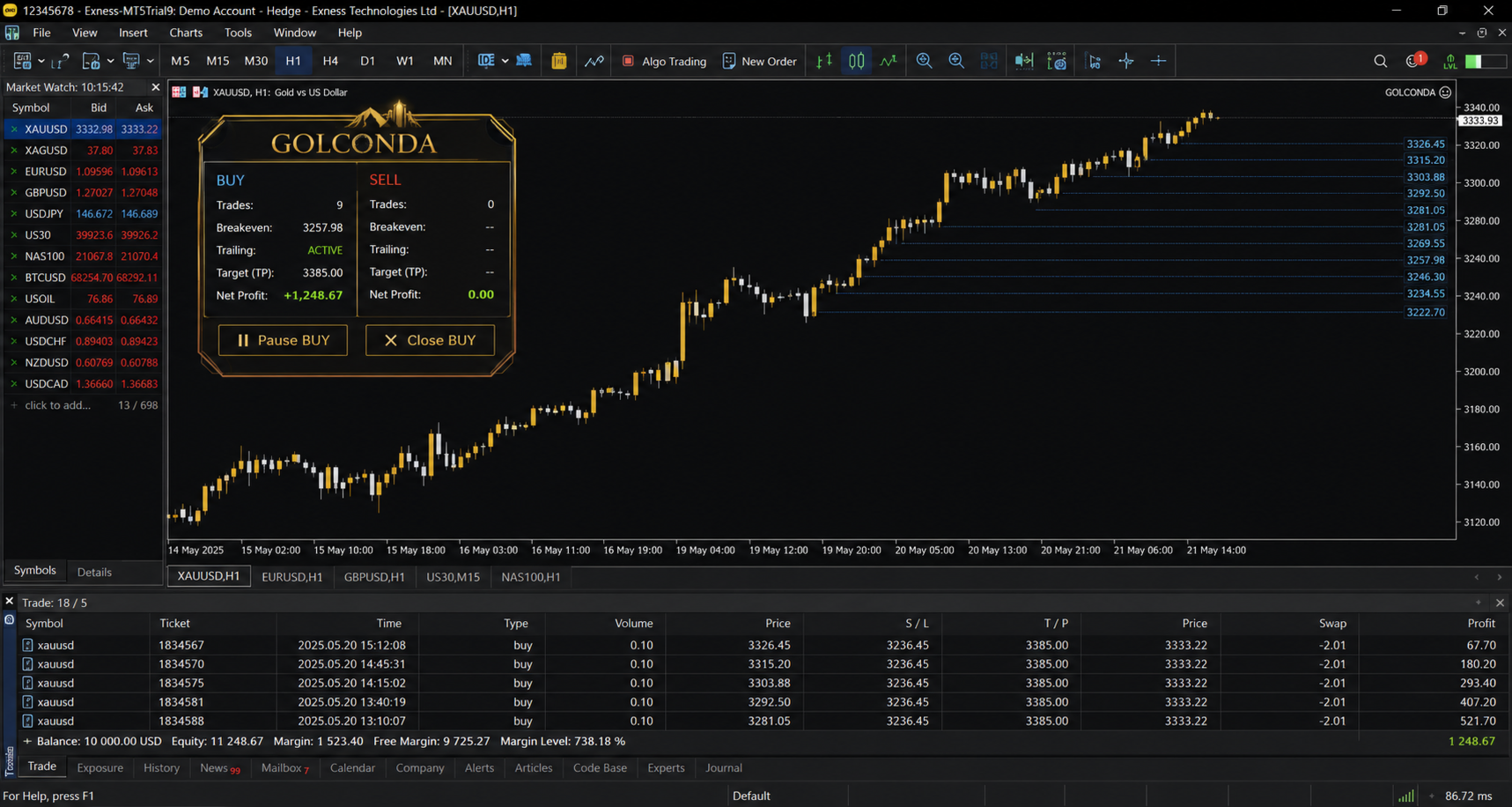
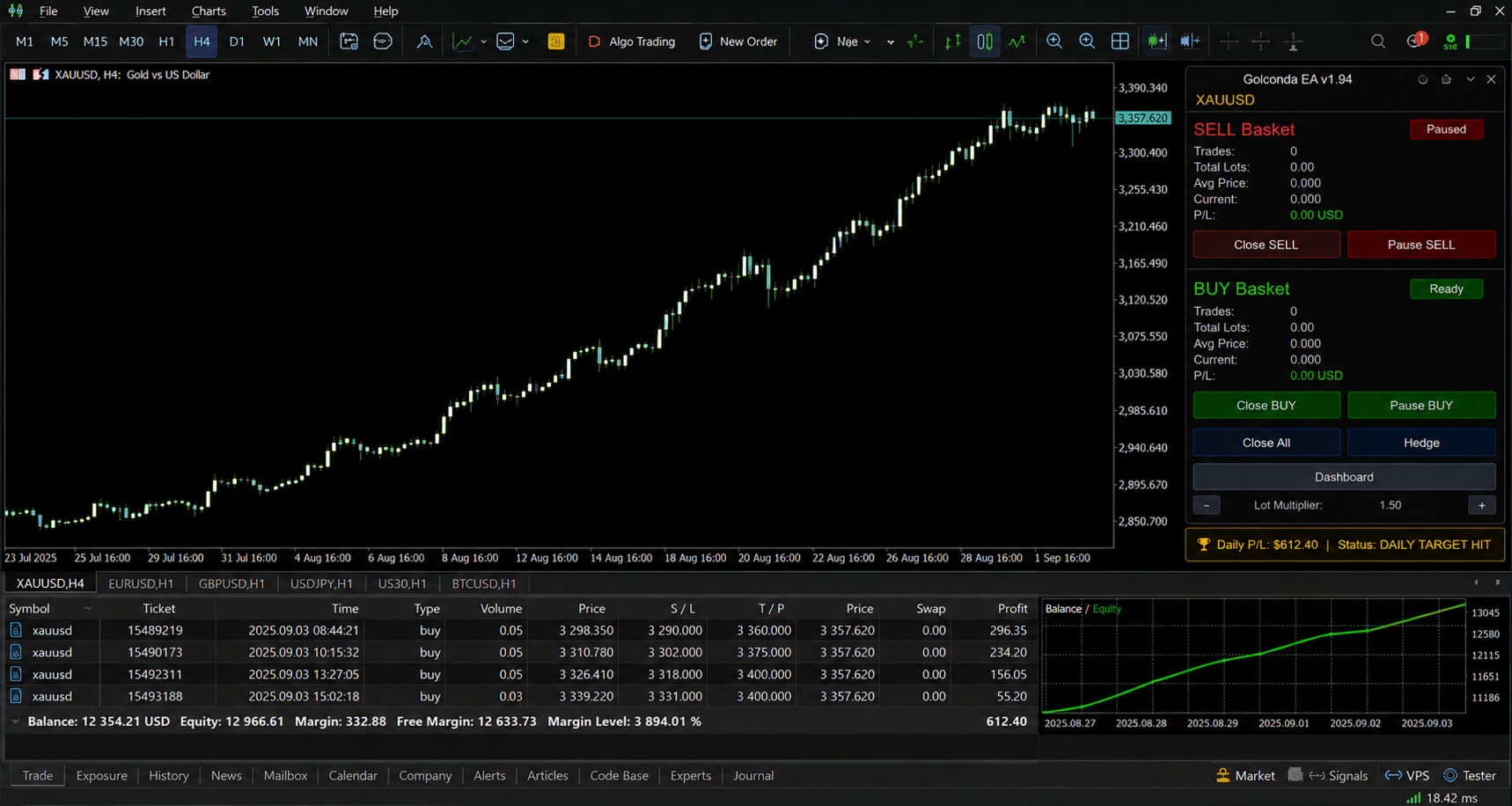
Everything is presented through an on-chart control panel designed to look and function like professional trading software rather than a debug overlay. Separate BUY and SELL sections display live trade counts, cost-adjusted breakeven price, current trailing level and activation state, target take-profit, and net profit in real time, each color-coded for instant readability. Independent Pause and Close buttons for each side let the trader intervene instantly without touching the EA's inputs or removing it from the chart, and a status line reports daily profit progress at a glance. Optional diagnostic logging reports exactly why the system did or did not act at every decision point — an initial entry locked by RSI, a martingale blocked by insufficient confirmations, a hedge triggered, a trailing stop activated, a cut-loss executed — turning strategy testing and live monitoring from guesswork into a transparent, auditable process.
Golconda is built for traders who understand that grid and martingale-style systems carry real risk, and who want a tool that manages that risk with layered, configurable, and transparent controls rather than hiding it behind a simple lot multiplier. It is not a promise of guaranteed profit — no such tool exists — but it is a serious attempt to bring structure, filtering, and monetary discipline to a trading style that is too often deployed carelessly.