MSI Dual Mode
- Experts
- Versão: 5.0
- Atualizado: 6 julho 2026
- Ativações: 5

MSI-Dual-Mode EA v5
Professional Multi-Timeframe Trading System with Higher TimeFrame (HTF) filtering, Adaptive Position Transition Engine (Z-Mode™) and Enhanced EMA Directional Validation
A Trading System, Not a Traditional EA
Most Expert Advisors behave as rule-based scripts: they open trades, apply indicators, and wait for fixed conditions to close positions.
MSI-Dual-Mode is designed differently.
It is a multi-layer trading system that continuously:
-
Interprets higher-timeframe market structure in real time
-
Generates directional signals from dual independent engines
-
Validates entries through adaptive EMA-based directional filters
-
Manages transitions between market states dynamically
-
Consolidates and rebalances exposure during reversals
Instead of executing isolated trades, MSI-Dual-Mode manages continuous position flow across changing market conditions.
Core System Architecture
MSI-Dual-Mode is built around five interacting layers:
1. Market Interpretation Layer (HTF Engine)
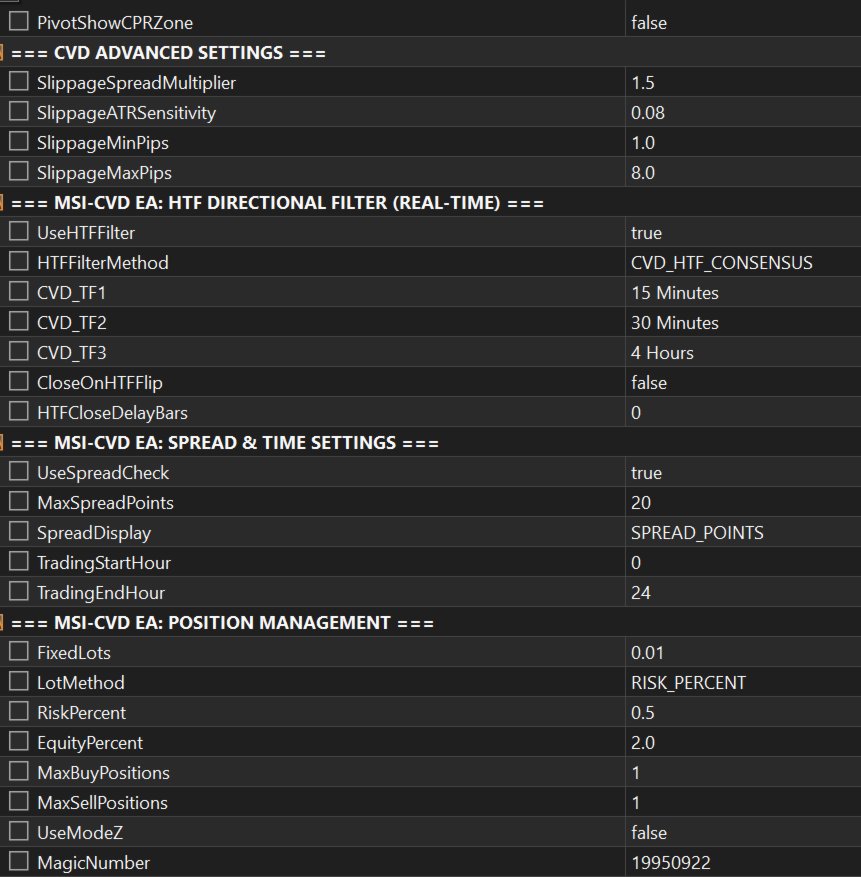
The system evaluates higher-timeframe conditions on every tick.
-
Tick-by-tick HTF evaluation (not bar-close dependent)
-
Uses completed higher-timeframe bars for stable regime detection
-
Configurable stability controls to filter out market noise
-
Continuous regime detection (bullish / bearish / neutral shifts)
-
Trading decisions are based on live market state with noise filtration
2. Signal Generation Layer (Dual-Engine System)
The system generates trade signals using two independent models:
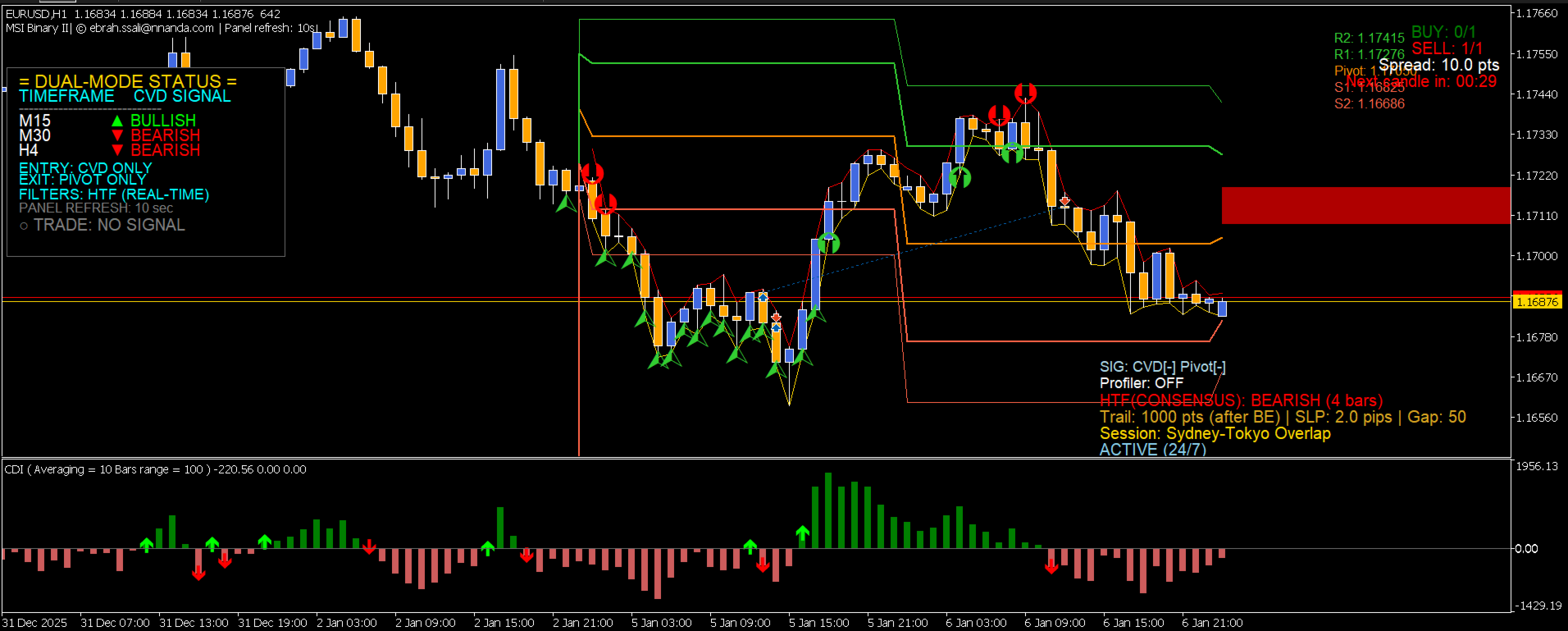
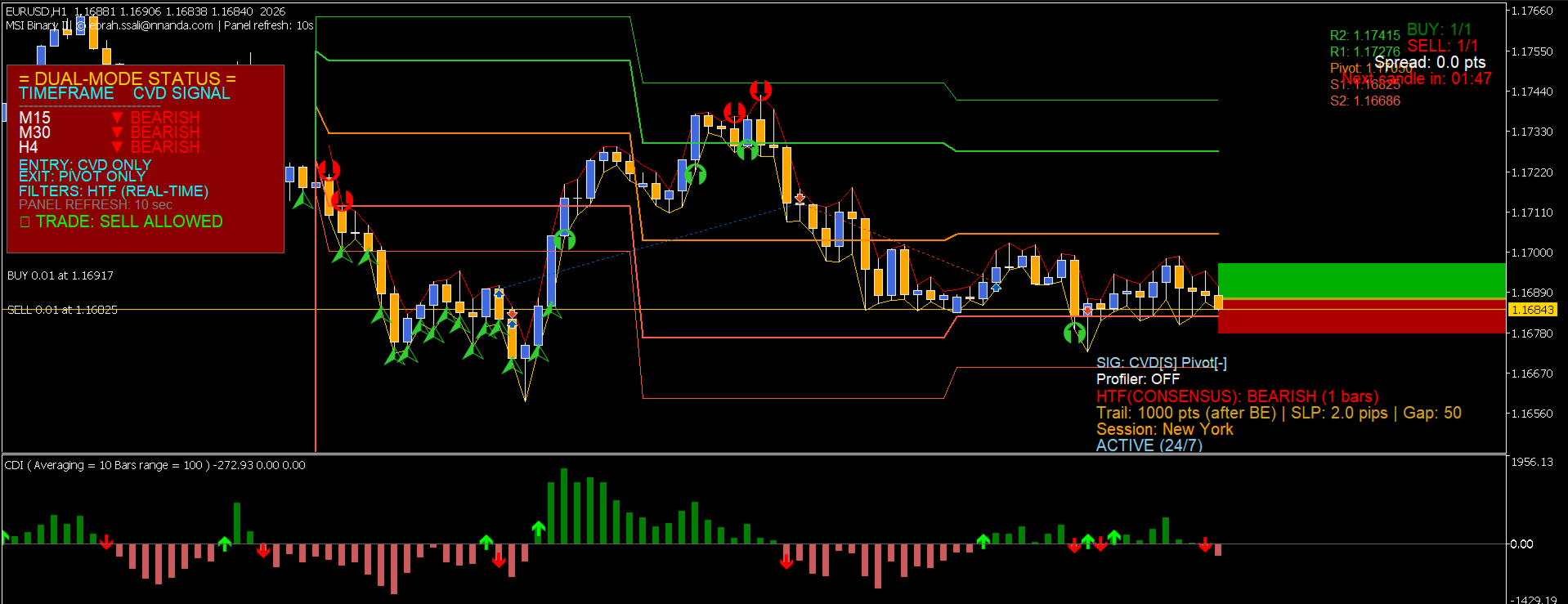
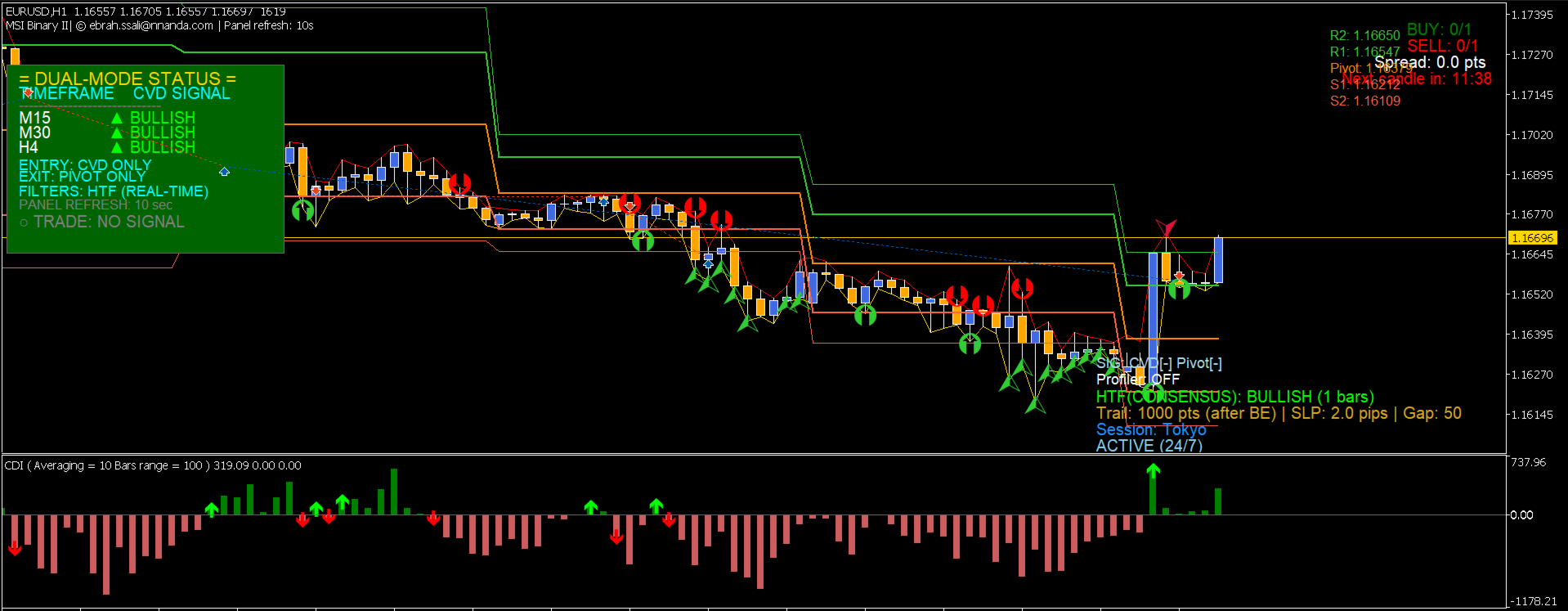
CVD Engine (Momentum Pressure Model)
-
Measures cumulative buying vs selling pressure
-
Detects shifts in market momentum
-
Identifies early directional changes before price expansion
Pivot Engine (Structural Price Model)
-
Uses support and resistance zones (R1/S1/R2/S2) to identify trades based on key structural price levels
-
Identifies reaction and breakout levels (R1/S1 for entry signals / R2/S2 for exit signals)
-
Provides structural trade anchors
-
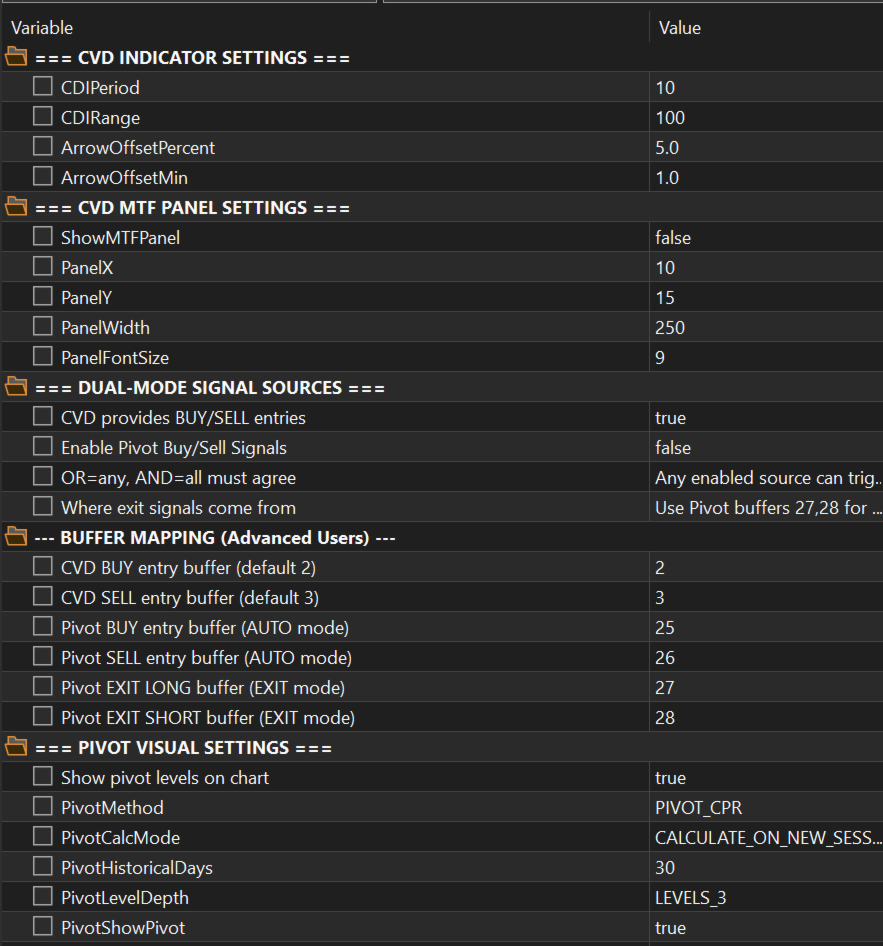
Six pivot calculation methods: Classic, Woodie, Fibonacci, Camarilla, DeMark and CPR
RSI Momentum Filter
To improve signal quality, the pivot engine can incorporate RSI confirmation. When enabled:
-
BUY signals require RSI to be above the oversold threshold (default 30)
-
SELL signals require RSI to be below the overbought threshold (default 70)
This prevents entries during momentum exhaustion.
3. Directional Validation Layer (Enhanced EMA Filter) – NEW in v5
Before any signal is executed, the system applies an adaptive EMA-based directional filter that ensures entries align with the prevailing market bias. Unlike simple price-above/below checks, this layer offers four configurable validation modes:
Position Validation Modes:
| Mode | BUY Requirement | SELL Requirement | Best Use Case |
|---|---|---|---|
| ABOVE_ONLY | Price ABOVE EMA | Price BELOW EMA | Trend following (default) |
| BELOW_ONLY | Price BELOW EMA | Price ABOVE EMA | Counter-trend / mean reversion |
| EITHER | No position restriction | No position restriction | Distance or cross only |
Slope Validation Modes:
| Mode | Requirement | Application |
|---|---|---|
| DISABLED | No slope check | Simple position-based filtering |
| UP_ONLY | EMA must be rising | Strong bullish trend confirmation |
| DOWN_ONLY | EMA must be falling | Strong bearish trend confirmation |
| ALIGN | Slope matches trade direction | Dynamic alignment with entry bias |
Additional Controls:
-
Minimum Distance: Requires price to be a specified number of points from the EMA (ensures sufficient momentum)
-
Cross Confirmation: Requires a recent EMA cross within a configurable lookback period (validates trend change)
-
Minimum Slope Threshold: Prevents entries when EMA is flat (configurable in pips per bar)
This multi-dimensional validation transforms the EMA from a rigid "must be above" rule into a versatile tool that adapts to different trading styles:
-
Trend Followers → Use ABOVE_ONLY + UP_ONLY
-
Counter-Trend Traders → Use BELOW_ONLY + DOWN_ONLY
-
Pullback Traders → Use EITHER + Cross Required
-
Momentum Traders → Use ANY position + Minimum Distance
The filter provides detailed block reasons for every rejection, making optimisation transparent and systematic.
4. Decision Layer (Adaptive Strategy Control)
This layer determines how the system reacts to market changes.
Z-Mode™ Intelligent Position Reversal
Z-Mode™ allows the system to actively respond to structural shifts in market direction.
When a valid reversal signal is detected, the system can:
-
Close existing positions even at a loss (optional behaviour depending on configuration)
-
Immediately transition into a new directional position
-
Re-align exposure with the updated market regime
This transforms trading from static position holding into adaptive directional switching.
Batch Position Consolidation Engine
When multiple positions exist in the same direction, the system can consolidate exposure during reversals:
-
Closes multiple open positions simultaneously
-
Opens a single unified position in the opposite direction
-
Reduces fragmented exposure across price levels
-
Simplifies downstream trade management (trailing, breakeven, reporting)
This ensures that transitions between market states remain structured rather than fragmented.
5. Execution Layer (Broker-Adaptive Engine)
The execution layer ensures the system adapts to real-world broker conditions.
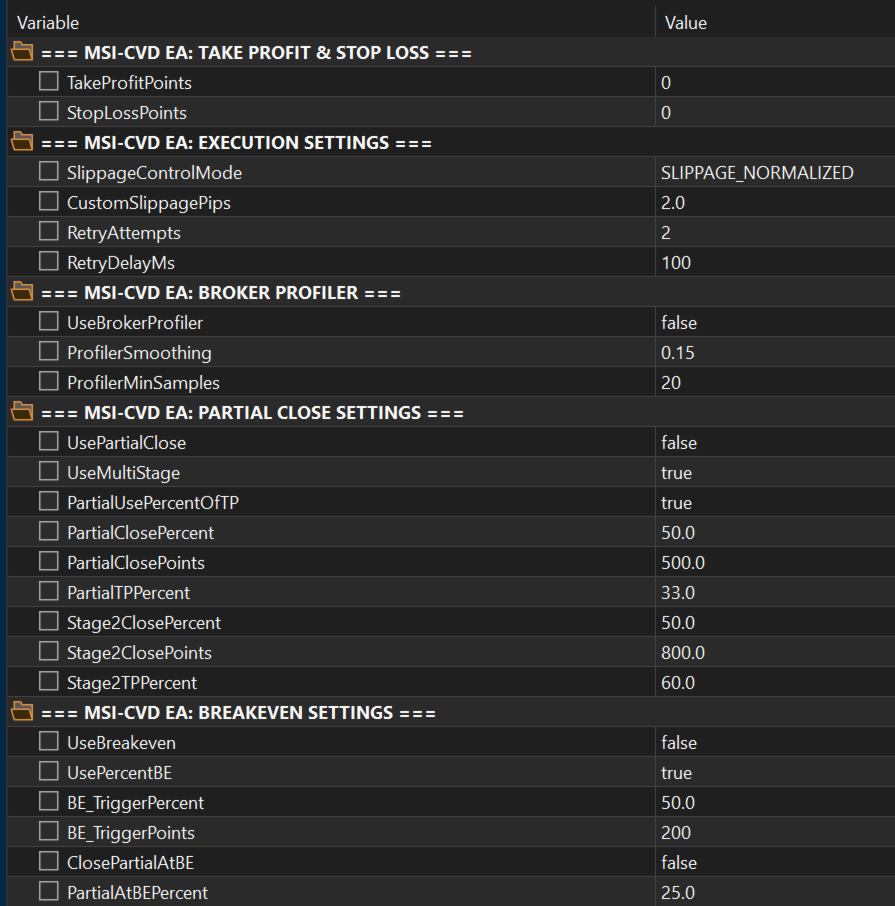
Broker Profiler
-
Monitors slippage patterns, execution speed, and fill behaviour
-
Adjusts execution strategy based on observed broker performance
-
Optimises order handling for ECN, STP, and Market Maker environments
Adaptive Execution Controls
-
Dynamic slippage management (adaptive / low / high / custom modes)
-
Intelligent order retry system
-
Spread monitoring and trade blocking during adverse conditions
System-wide Risk and Trade Management
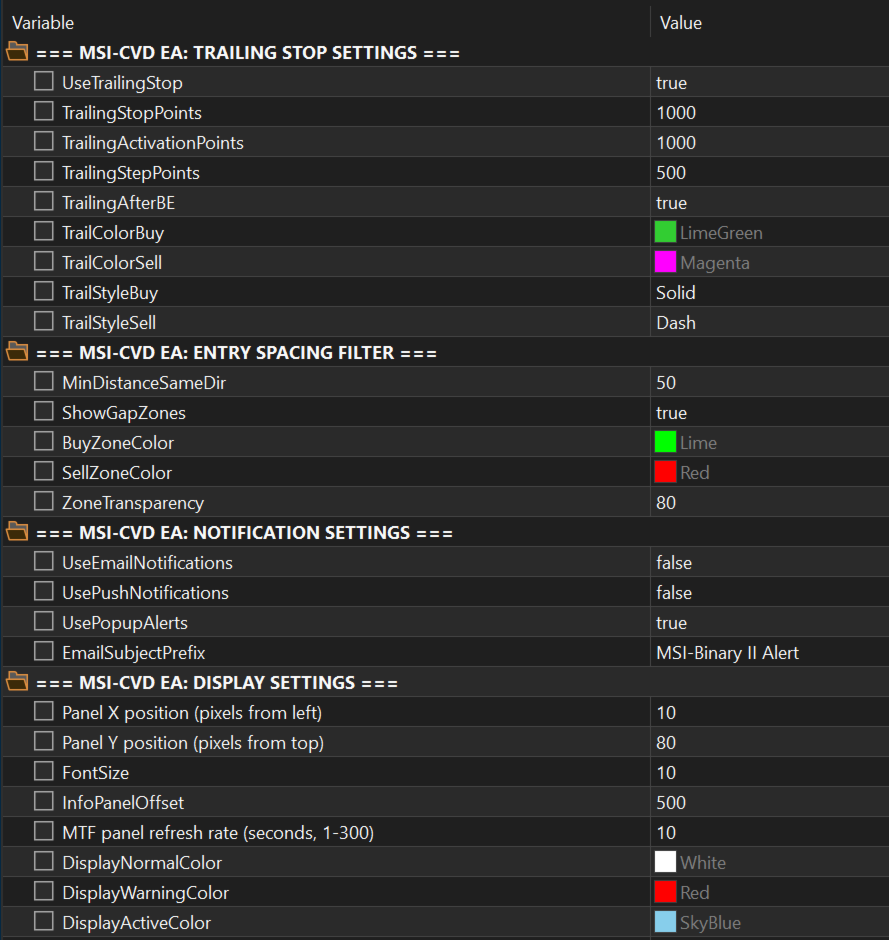
Risk is managed continuously across the entire system:
-
Trailing Stop (adaptive to market structure)
-
Automatic Breakeven protection
-
Multi-stage partial profit-taking
-
Position spacing control (prevents clustering of entries)
-
Trading session filters (liquidity-aware execution windows)
-
Trading hour constraints
-
Fixed, risk-based, or equity-scaled position sizing
Rather than managing risk per trade, MSI-Dual-Mode manages risk at the system exposure level.
Market Awareness Engine
The system continuously evaluates external conditions before execution:
-
Higher-timeframe consensus state
-
Spread environment analysis
-
Session detection (Sydney, Tokyo, London, New York)
-
Liquidity overlap identification
-
Entry spacing constraints
-
EMA alignment and slope validation
This ensures trades are only executed when market conditions align with system parameters.
Example System Behaviour
Scenario: Trend Expansion → Reversal → Transition
-
System detects bullish HTF alignment
-
CVD confirms buying pressure
-
EMA confirms price above EMA with rising slope (ABOVE_ONLY + UP_ONLY mode)
-
Multiple BUY positions are opened during trend expansion
Later:
-
HTF regime begins to shift
-
CVD momentum weakens
-
Pivot resistance is approached
-
Opposite signal is confirmed
-
EMA slope flattens or reverses
System response:
-
Z-Mode™ triggers reversal logic
-
Batch Consolidation closes all BUY positions
-
A single SELL position is opened
-
System re-aligns with new market regime
Result: A structured transition from one market state to another, without fragmented exposure.
Why This Is Different
| Traditional EA | MSI-Dual-Mode System |
|---|---|
| Isolated trade entries | Continuous position flow management |
| Static exit rules | Adaptive regime-based transitions |
| Independent trades | System-level exposure control |
| Manual consolidation needed | Automated batch transition engine |
| Indicator-based signals only | Multi-layer decision architecture |
| Fixed EMA rules | Adaptive EMA validation with 4 modes |
| No slope awareness | Slope detection & alignment |
System Summary
MSI-Dual-Mode operates as an integrated trading system composed of:
-
Market Interpretation Engine (HTF tick system)
-
Dual Signal Generation System (CVD + Pivot)
-
Directional Validation Layer (Enhanced EMA Filter with Position + Slope Modes) – NEW
-
Adaptive Decision Layer (Z-Mode™ + Batch Transition Engine)
-
Broker-Adaptive Execution Layer (Profiler + Slippage Control)
-
System-Level Risk Management Framework
New in v5 – Enhanced EMA Filter
The EMA filter has been completely re-engineered from a simple "price above/below" check into a comprehensive directional validation system:
| Feature | Description |
|---|---|
| 3 Position Modes | ABOVE_ONLY (trend), BELOW_ONLY (counter-trend), EITHER (flexible) |
| 4 Slope Modes | DISABLED, UP_ONLY, DOWN_ONLY, ALIGN (matches trade direction) |
| Minimum Distance | Configurable point threshold from EMA |
| Cross Confirmation | Requires recent EMA cross within lookback period |
| Slope Threshold | Minimum slope in pips per bar (prevents flat EMA entries) |
| Detailed Block Reasons | Transparent rejection logging for optimisation |
Quick Configuration Guide:
-
Trend Following: ABOVE_ONLY + UP_ONLY + Cross optional
-
Counter-Trend: BELOW_ONLY + DOWN_ONLY + Cross optional
-
Pullback Entries: EITHER + Cross Required
-
Momentum Confirmation: Any position + Minimum Distance
MSI-Dual-Mode EA v5 is not designed as a traditional Expert Advisor.
It is a multi-timeframe trading system with adaptive position transition logic and intelligent HTF & EMA-based directional validation, built as options to continuously interpret market structure, manage exposure dynamically, and transition between market regimes in real time.