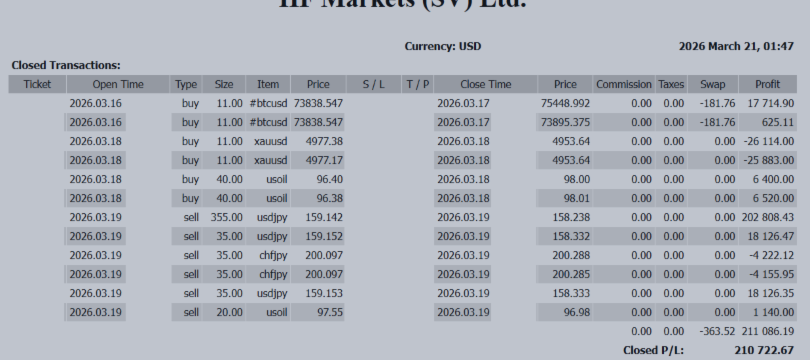
📊 +210,722 USD | USD/JPY Short Breakout Geopolitics × Central Banks → A “Volatility Capture” Market

📊 +210,722 USD | USD/JPY Short Breakout
Geopolitics × Central Banks → A “Volatility Capture” Market
📊 Weekly Total: +210,722 USD
📉 Trade Summary
This week’s profit structure was extremely clear:
- Core profit: Shorting the short-term correction in USD/JPY
- Oil & USD trends: Remained intact
- Key edge: Capturing volatility (amplitude), not direction
The most important takeaway:
👉 Don’t fight the trend — extract inefficiencies within the trend
🔎 Market Structure (This Week)
This market can be broken into three layers:
① Oil (Origin)
- Uptrend driven by Middle East tensions
➡ The foundation of all markets
② USD (Core)
- Supported by geopolitical risk + inflation concerns
➡ Structural bullish bias
③ USD/JPY (Outcome)
- Uptrend remains intact
- But short-term corrections created opportunities
④ Gold
- Heavy on the upside
➡ Sell-the-rally dominance
➡ Lost its role as the primary driver
🎯 Current Strategy
The strategy is now simplified:
- Focus on oil & commodity-related assets
- Trade USD/JPY with trend + pullback logic only
- Avoid currencies with unclear structure
- Lower priority for GOLD
👉 We are now in a phase of:
“Only trade markets with clear themes.”
Cutting unnecessary trades = maximizing efficiency
🌍 Weekly Review (March 16–20)
■ Overview
This week was driven by:
👉 Geopolitical risk × Central bank events
Resulting in extreme volatility
Key characteristics:
- Oil: sharp spikes and pullbacks
- USD/JPY: battle near 160
- Central banks: repeated short-term reversals
👉 This was not a trend market, but a:
“Volatility (amplitude) market”
■ USD/JPY
- Broke below 158 → recovered to high 159s
- Dropped to 157 after BOJ
Drivers:
- Middle East risk → USD buying
- FOMC → Hawkish interpretation
- BOJ → Trigger for JPY buying
👉 Uptrend + crash risk coexisting
■ EUR/USD
- Range: 1.14–1.15
- Dollar strength capped upside
👉 Structure remains:
Sell the rally
■ GBP
- Strong vs JPY
- Weak vs USD
Background:
- Inflation concerns
- Growth slowdown
👉 Mixed signals → No clear trend
🔮 Key Themes (Week of March 23)
① Middle East × Oil
- Hormuz issue unresolved
- Continued volatility in oil
👉 Oil remains the #1 driver
② Post-FOMC USD
- Hawkish bias remains
- Dollar likely to be bought on dips
👉 USD is structurally hard to weaken
③ USD/JPY 160 Level (Critical)
- Psychological turning point
- Intervention risk zone
👉 Asymmetrical structure:
- Upside capped
- Downside moves can accelerate
💱 Currency Overview (Simple)
| Currency | Status |
|---|---|
| USD | Strongest (geopolitics + rates) |
| JPY | Weak, but can spike stronger suddenly |
| EUR | Weak (energy risk) |
| GBP | Unstable |
| CAD | Oil-driven |
| AUD | Relatively strong |
🗓 Key Events
- Japan CPI
- Global PMIs
- Australia CPI
- UK CPI
- Germany IFO
- SARB
- U.S. employment & sentiment
👉 Interpretation matters more than the data itself
🎯 Trading Strategy (Most Important)
👉 The essence of next week:
“This is NOT a direction-based market.”
✔ Effective Strategies
- USD/JPY: Buy dips + short near highs
- EUR/USD: Sell rallies
- AUD: Buy pullbacks
- Oil: Core position
⚠️ Caution
- 160 zone = hard-to-trade area
- Headlines can move price 2–3 yen instantly
🧠 Conclusion
The true nature of next week is NOT:
❌ Trend × Events × Geopolitics
But:
👉 “A market where you extract distortions within trends”
Key truths:
- USD is strong
- JPY is weak but volatile
- Oil drives everything
👉 To win:
Understand structure, not just direction
This is a market where:
👉 Adaptability > Prediction
📜 Afterword | Relationships Are Part of Trading
Thank you for reading this week’s report.
Recent studies suggest that prolonged exposure to high-stress individuals (“stressors”) may accelerate biological aging.
And the impact goes beyond mood:
- Increased stress
- Reduced focus
- Higher anxiety and mental fatigue
👉 This directly affects performance.
🧠 The Real Reason Traders Lose
Most traders think:
- “My entries are bad”
- “My analysis is weak”
But often the real issue is:
- Negative social influence
- Fear-driven information (SNS)
- Stress from relationships
👉 These external noises distort decision-making
📊 Environment Creates “Silent Edge”
Top traders don’t just analyze charts.
They choose:
👉 Who they engage with
- Cut unnecessary information
- Distance from negativity
- Build a calm decision-making environment
This is not a technique.
👉 It’s the foundation of consistency
⚖️ Focus on What You Can Control
You cannot control everything.
But you CAN:
- Adjust distance from people
- Reduce exposure time
- Control your own reactions
Studies show:
👉 Stress impact = Environment × Interpretation
🌱 Final Thought
Successful traders don’t just manage capital.
👉 They manage energy
- Focus
- Decision-making
- Mental clarity
All depend on environment.
Next week, take a moment to reflect:
- What information are you consuming?
- Who are you interacting with?
Even small adjustments can dramatically improve performance.
Markets will always provide opportunities.
So first:
👉 Protect your environment
Stay calm.
Stay consistent.
Keep building.
See you next week. 📈