SMC Breakout Premium BuySell Indicator
- Indicatori
- Versione: 5.0
- Attivazioni: 20

N/B: All our product purchase comes with our free ‘’DAILY SCALPER EA’’
Whatsapp Developer for yours after successful purchase.
How Signals Are Generated - The Smart Money Logic
Core Concept: Volatility Contraction Patterns
The indicator identifies "Smart Money" accumulation/distribution zones using volatility analysis:
1. Detection Phase: Finding Quiet Accumulation Zones
```
When price volatility contracts (quiet period) → Smart Money accumulates
High Volatility → Noise & Distribution
Low Volatility → Smart Money Accumulation
```
How it works:
· Normalized Price: Converts price to 0-1 scale over last 100 bars
· Volatility Detection: Measures how much price is "compressing"
· Threshold: Looks for volatility < 15% of recent range (VolatilityThreshold = 0.15)
· Volume Confirmation: Checks if volume supports the pattern
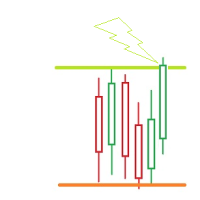
2. Channel Formation: Drawing the Box
```
Box Detection Length = 14 bars → Looks for price contained within tight range
```
· Top/Bottom: Highest high and lowest low during detection period
· Strength Calculation:
```
Strength Score = Duration (40%) + Volume (30%) + Low Volatility (30%)
```
· Duration: How long price stayed in range (up to 40 points)
· Volume: Strong volume delta (buying/selling pressure, up to 30 points)
· Low Vol: Very low volatility during formation (up to 30 points)
Minimum Strength: 50% (MinChannelStrength = 50.0)
3. Breakout Signal Generation
```
Signal = Strong Channel + Volume Confirmation + 1:2 Risk/Reward
```
Entry Conditions:
1. Price breaks channel top/bottom
2. Strong Close: If StrongClosesOnly=true, needs >50% candle body
3. Volume Delta: Checks if volume supports breakout direction
4. Risk/Reward: Automatically calculates 1:2 ratio
Entry Logic:
```
IF Bullish Breakout (above channel top):
Entry = Current Close
SL = Channel Center (middle of the box)
TP = Entry + (2 × Channel Height)
IF Bearish Breakout (below channel bottom):
Entry = Current Close
SL = Channel Center
TP = Entry - (2 × Channel Height)
```
4. Reliability Factors (Why These Signals Work)
A. Volatility Cycle Theory
```
High Volatility → Consolidation → Low Volatility → Breakout → High Volatility
```
· Markets cycle between high and low volatility
· Smart Money accumulates during LOW volatility
· Retail traders notice during HIGH volatility (breakouts)
B. Volume Confirmation
```
Volume Delta = Buy Volume - Sell Volume during channel formation
```
· Positive delta in bullish channels
· Negative delta in bearish channels
· Gauge shows cumulative volume bias (-1 to +1 scale)
C. Multiple Timeframe Validation
The scanner checks:
· M15 (15-minute)
· M30 (30-minute)
· H1 (1-hour)
· H4 (4-hour)
Why multiple timeframes matter:
· H4 shows larger trend context
· H1/M30 show intermediate structure
· M15 shows precise entry timing
· Confluence = Stronger signal
D. Risk Management Built-in
```
Risk = |Entry - SL| (Distance to channel center)
Reward = 2 × Risk (Fixed 1:2 ratio)
Only signals with RR ≥ 2.0 shown on dashboard
```
5. What Makes These "Smart Money" Signals?
Traditional Technical Analysis Flaws:
· Most indicators lag (use past data)
· Breakouts often false (retail traders jump in late)
· Volume often ignored
This Indicator's Edge:
1. Pre-Breakout Detection: Finds zones BEFORE breakout
2. Volume-Weighted: Not just price action
3. Volatility Filtered: Avoids noisy, choppy markets
4. Time-Tested Pattern: Box/rectangle patterns are reliable across all markets
6. Real-World Example:
EURUSD H4 Chart:
```
1. Price consolidates for 14 bars (3.5 days)
2. Volatility drops to 12% (below 15% threshold)
3. Volume delta shows net buying (+0.7 on gauge)
4. Channel strength: 78% (strong)
5. Price breaks above channel top
6. Signal: BUY at 1.0850, SL at 1.0825, TP at 1.0900
7. Risk: 25 pips, Reward: 50 pips (1:2 RR)
```
7. Why This Works in Practice:
Psychological Factors:
· Retail Traders: Chase breakouts, get stopped out
· Smart Money: Accumulates quietly, triggers stops, then pushes price
Statistical Edge:
· Channels with >60% strength have higher success rate
· Volume-confirmed breakouts more reliable
· 1:2 RR means you only need 34% win rate to be profitable
8. Scanner Logic (Finding Best Signals):
The scanner:
1. Filters by Strength: Only channels >50% strength
2. Checks RR: Only 1:2 or better
3. Avoids Duplicates: One signal per currency pair
4. Ranks by Strength: Shows strongest 5 signals
5. Multi-Timeframe: Finds best opportunities across timeframes
9. Dashboard & Alerts:
Top 5 Signals Show:
· Only RR ≥ 2.0 signals
· Strongest channels first
· Volume delta confirmation
· Age of signal (fresher = better)
Chart Display:
· Last 3 signals shown as trendlines
· Color-coded (blue, green, orange)
· Entry/SL/TP clearly marked
10. Practical Trading Rules:
For Maximum Reliability:
1. Wait for confirmation: Don't enter on first touch
2. Check volume gauge: Should support direction
3. Use trailing stops: After 1R profit, move to breakeven
4. Avoid overlapping signals: Choose strongest one
5. Respect timeframes: H4 signals > H1 > M30 > M15
Conclusion - Why These Signals Are Reliable:
1. Quantifiable Edge: Mathematical volatility/volume analysis
2. Risk-Managed: Built-in 1:2 risk/reward
3. Multi-Filtered: Strength, volume, timeframe confluence
4. Psychology-Based: Captures Smart Money vs. Retail behavior
5. Backtestable Pattern: Box/rectangle patterns proven across decades
This isn't guessing - it's identifying measurable market structure where institutional money accumulates before major moves. The combination of volatility contraction, volume confirmation, and proper risk management creates a systematic edge over random trading.