Nomad Grid
- Experts
- Version: 9.62
- Mise à jour: 12 septembre 2026
- Activations: 5

Nomad Grid — Volatility Adaptive Mean-Reversion Grid
Version 9.62 · MetaTrader 5 · AUDCAD · NZDCAD · AUDNZD · M15
A bar closes outside the Bollinger envelope and Nomad Grid takes the other side. If price keeps going, it does not cut — it extends a ladder, spaced by the market's own 30-day daily range, and the whole basket shares one exit. One reversal closes the lot.
That is a grid, and this page is not going to pretend otherwise. What 9.62 changed is everything around it.
What is new in 9.62
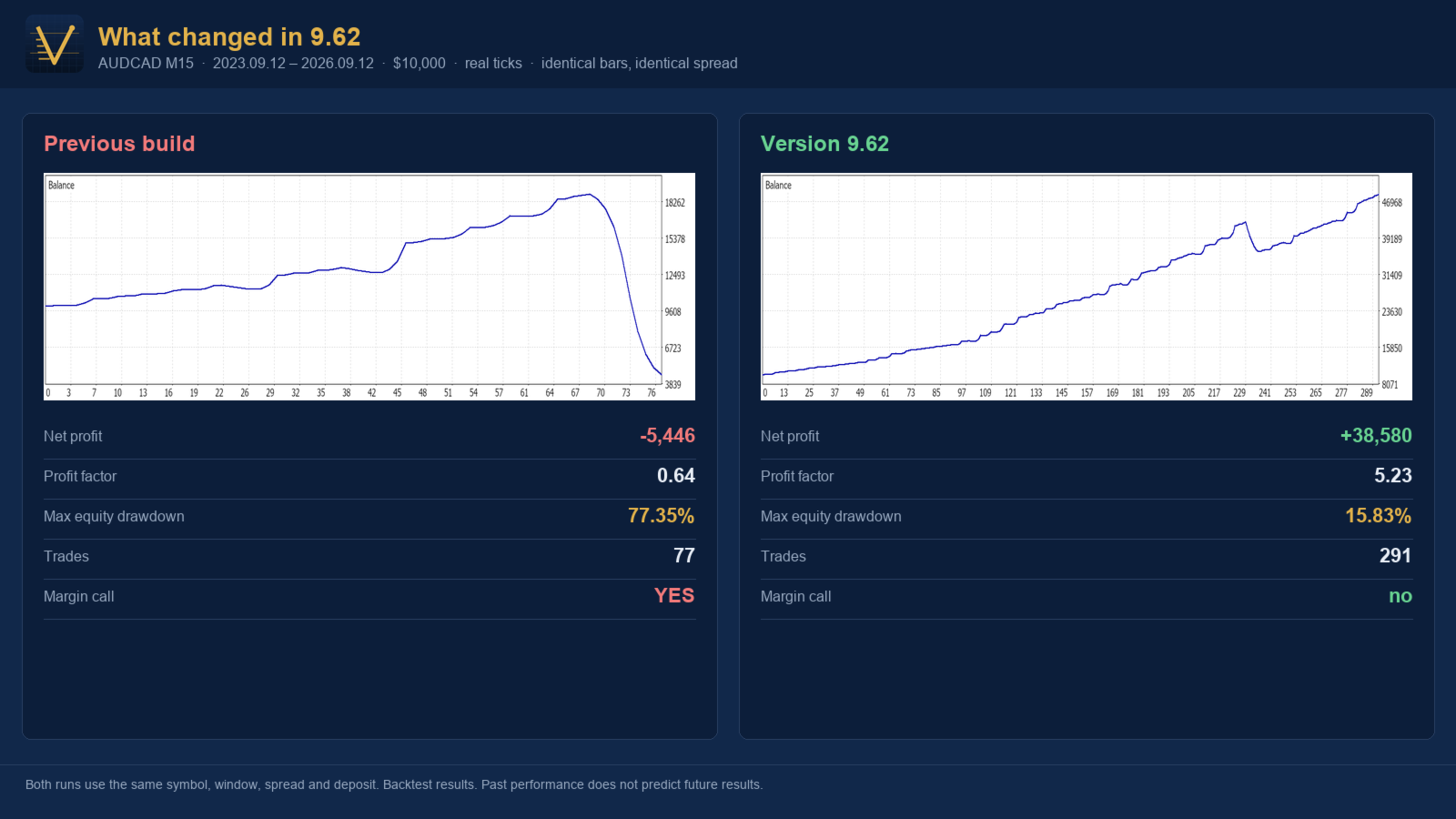
The basket exits at its own breakeven, not at the last order's. Earlier builds measured the shared take profit from the newest entry, so the older, further-away positions in a deep basket were closed at a loss — a basket could close negative at its own target. 9.62 measures the target from the volume-weighted average entry of the whole basket.
The ladder has an end. MaxGridLevels (default 6) stops it. Before, it did not stop.
Every level is funded before it is opened. Free margin is checked, the broker's volume step and limits are respected, and the order's return code is read — a rejected level no longer drags the rest of the basket deeper.
The Auto-Risk Cutoff is a percentage and it binds. Default 15% of balance. In three years of tick-level testing, measured drawdown came out at 15.8% — the cutoff doing exactly what it says.
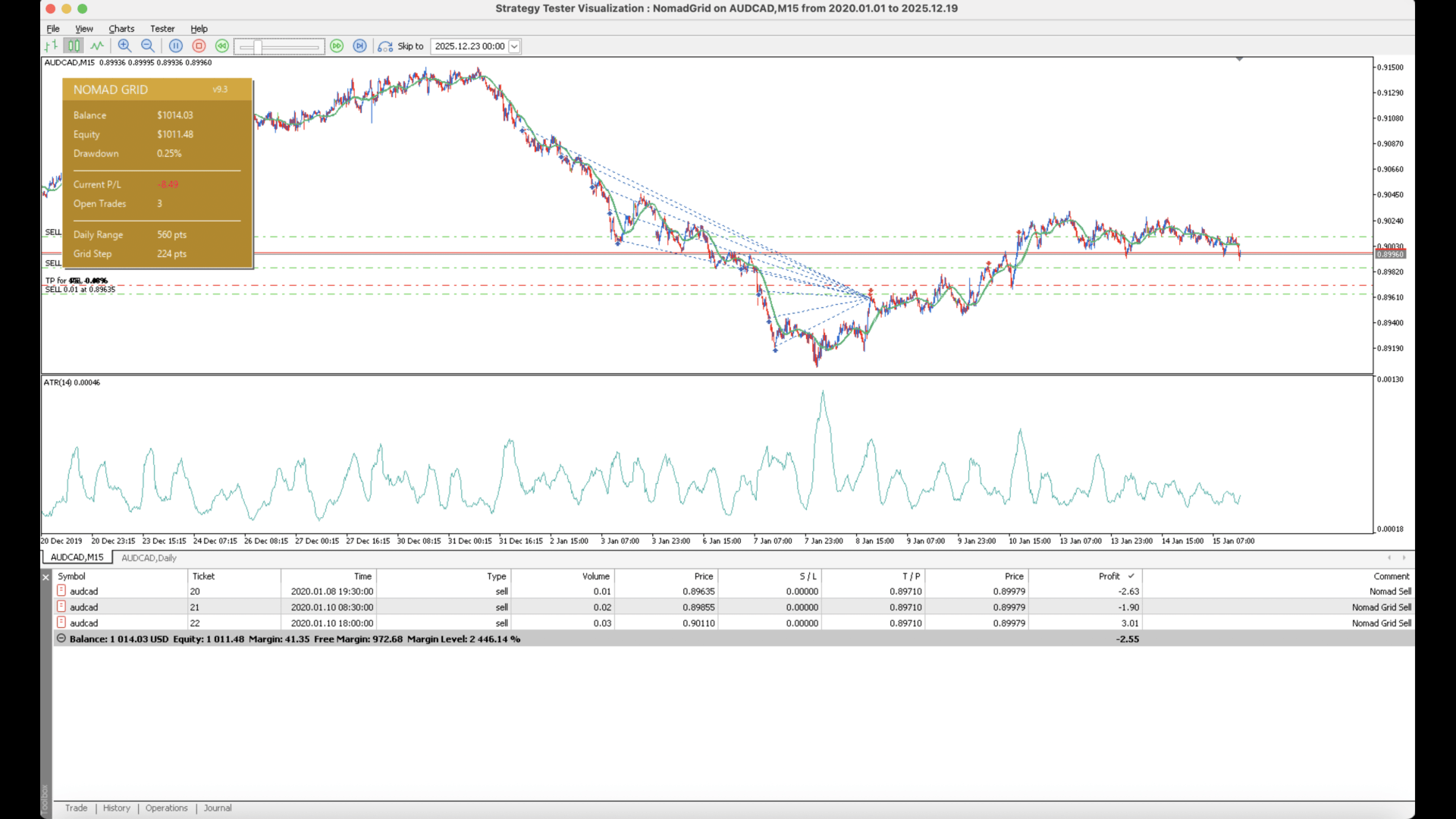
Golden Panel. A goldenrod-on-navy dashboard: balance, equity, drawdown against its limit with a meter that fills as the allowance is spent, floating P/L, the daily range the volatility memory is reading, the current grid step, basket depth and volume, average entry, and where the next level sits and how large it will be.
One chart, one basket. Positions are matched by symbol as well as magic number, so running all three recommended pairs at once works properly.
Netting accounts are handled properly. Where the broker merges grid levels into a single position, the EA tracks the ladder itself, so the multiplier still applies to the last level rather than to the whole basket.
Tested — three years, real ticks
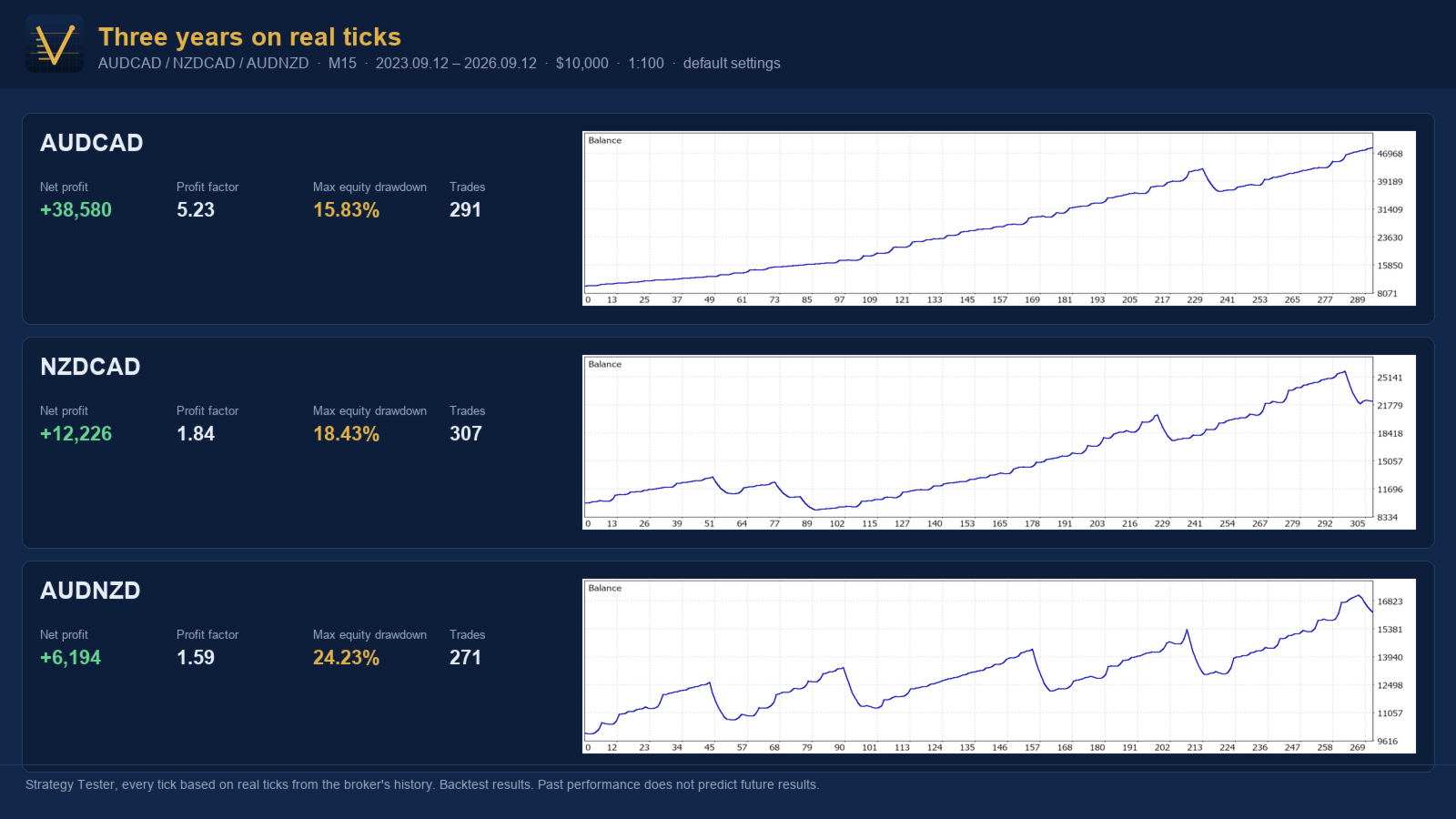
Broker tick history, 2023.09.12 – 2026.09.12, M15, $10,000, 1:100, default settings, 76,099,414 real ticks on AUDCAD.
| Symbol | Net profit | Profit factor | Max equity drawdown | Trades |
|---|---|---|---|---|
| AUDCAD | +38,580 | 5.23 | 15.83% | 291 |
| NZDCAD | +12,226 | 1.84 | 18.43% | 307 |
| AUDNZD | +6,194 | 1.59 | 24.23% | 271 |
The same parameters were tuned on 2023–2025 and then checked on 2025.06 – 2026.09, a window the optimiser never saw: +5,077 at profit factor 3.09, drawdown 15.85%. In-sample drawdown was 16.06%. A cutoff that actually binds looks like that.
Modelling matters less than it usually does here: the same test on 1-minute OHLC gives +37,278 versus +38,580 on real ticks, with the identical 291 trades.
Settings
- Symbols: AUDCAD (best of the three by a clear margin), NZDCAD, AUDNZD. Timeframe: M15.
- The defaults are the tested values. Attach it and load nothing, and you get the configuration the table above was measured on.
- Minimum deposit $500 at 0.01 lots. More capital does not lower the percentage drawdown — it buys depth before the broker's margin rules interfere.
- LotPer1000 scales the first lot with the account. Note that below roughly a $10,000 balance, any setting under 0.01 reaches the broker's minimum volume and stops scaling.
- VPS recommended. A basket left unmanaged by a disconnected terminal is the one thing this EA cannot protect you from.
Risk — please read
This is a martingale. Volume multiplies by 1.5 at every level. The depth cap and the drawdown cutoff bound the loss; they do not remove it. The shape of the strategy is a long run of small wins interrupted by one loss larger than any of them, and the backtests above contain exactly that.
The parameters are fitted to quiet, range-bound commodity crosses. On EURUSD, over the same three years, the same settings lose money (−1,987, profit factor 0.92). Do not point this at an arbitrary symbol.
Backtests are not predictions. Three years, one broker, perfect fills, and the historical spread. Live results will be worse.
Check your prop-firm rules before using this on a funded or challenge account. Most funded programmes prohibit grid and martingale strategies outright.