Haim Bodek, former CEO of Trading Machines, a Prominent High Frequency Trading firm based in Connecticut, joins Merlin
for a look into what has been happening in the HFT world. Haim takes a
look at some of the significant changes which may ultimately change the
landscape of the financial markets just like litigation did back in
1996! The duo also talk about Haim’s new class on HFT and system
trading.
if actual > forecast = good for currency (for AUD in our case)
[AUD - PPI] = Change in the price of finished goods and services sold by producers. It's a leading indicator of consumer inflation - when producers charge
more for goods and services the higher costs are usually passed on to
the consumer.
Final demand producer prices climbed 2.3 percent on year in the
second quarter of 2014, the Australian Bureau of Statistics said on
Friday - slowing from the 2.5 percent increase in the previous three
months.
On a quarterly sequential basis, final demand producer
prices dipped 0.1 percent after climbing 0.9 percent in the first
quarter.
Trading the News: U.S. Non-Farm Payrolls (NFP)(based on dailyfx article)
U.S. Non-Farm Payrolls (NFP) to Increase 200+K for Sixth Straight Month.
Would Mark Longest String of 200+K Prints Since 1997
U.S. Non-Farm Payrolls (NFP) are anticipated to increase another 231K in
July, and a positive employment print may produce a further decline in
the EUR/USD as it puts increased pressure on the Federal Reserve to
normalize monetary policy sooner rather than later.
What’s Expected:
Why Is This Event Important:
The deviation in the policy outlook favors a bearish outlook for the
EUR/USD as the European Central Bank (ECB) stands ready to implement
more non-standard measures, and the NFP print may generate fresh 2014
lows in the euro-dollar should the release boost the interest rate
outlook for the U.S.
The resilience in private consumption along with the marked rebound in
economic activity may encourage firms to further expand their labor
force, and a better-than-expected NFP print should produce a bullish
reaction in the U.S. dollar as puts increased pressure on the Federal
Open Market Committee (FOMC) to move away from its zero-interest rate
policy (ZIRP).
However, the downturn in business confidence along with the rise in
planned job cuts may produce further headwinds for the U.S. labor
market, and a dismal employment report may undermine the bullish
sentiment surrounding the reserve currency as it raises the Fed’s scope
to retain the highly accommodative policy stance for an extended period
of time.
How To Trade This Event Risk Bullish USD Trade: NFPs Rises 231K+; Unemployment Holds at 6.1%
Need red, five-minute candle following the release to consider a short trade on EUR/USD
If market reaction favors a long dollar trade, sell EUR/USD with two separate position
Set stop at the near-by swing high/reasonable distance from entry; look for at least 1:1 risk-to-reward
Move stop to entry on remaining position once initial target is hit; set reasonable limit
Bearish USD Trade: Employment Print Falls Short of Market Forecast
Need green, five-minute candle to favor a long EUR/USD trade
Implement same setup as the bullish dollar trade, just in the opposite direction
Potential Price Targets For The Release EUR/USD Daily
Remains at Risk for Further Decline as Long as RSI Holds Below 30
Interim Resistance: 1.3580 (23.6% expansion) to 1.3600 Pivot
Interim Support: 1.3300 Pivot to 1.3310 (78.6% expansion)
Impact that the U.S. Non-Farm Payrolls report has had on EUR/USD during the previous month
Period
Data Released
Estimate
Actual
Pips Change
(1 Hour post event )
Pips Change
(End of Day post event)
JUN 2014
7/03/2014 12:30 GMT
215K
288K
-34
-34
June 2014 U.S. Non-Farm Payrolls
EURUSD M5 : 48 pips price movement by USD - Non-Farm Employment Change news event
AUDUSD M5 : 40 pips price movement by USD - Non-Farm Employment Change news event
The U.S. economy added another 288K jobs in June following a revised
224K advance the month prior, while the jobless rate unexpectedly
narrowed to an annualized 6.1% from 6.3% in May. The
better-than-expected NFP print propped up the greenback, with the
EUR/USD slipping below the 1.3625 region, and the reserve currency
retained the bullish reaction going into the end of the week as the pair
closed at 1.3608.
Forex Weekly Outlook August 4-8
The US dollar was the star during most of the week, although it lost
some of its shine towards the end. Rate decisions in Australia, the
UK, Japan and the Eurozone, Employment data, in Australia, Canada and
US trade data are some of the highlight events on Forex calendar. Here
is an outlook on the main market movers for this week.
The US dollar was on a roll in the past week: the excellent GDP report
that showed 4% Q2 growth (annualized) and speculation about an upcoming
rate hike (despite a not-too hawkish Fed) boosted the greenback. The
below expectations Non-Farm Payrolls report took out some of the shine
of the greenback, but the US economy continues doing well. In the
euro-zone, inflation fell deeper, to 0.4%, and cast a dark cloud on
not-too-shabby employment and consumption data. The pound continued
falling on more weak data in what looks like a u-turn rather than a
correction. Weak data in Japan helped USD/JPY move higher and weak
Australian data finally sent the Aussie below 0.93. The kiwi and the
loonie were not spared, but also managed to stage a recovery in an
exciting week.
Australian rate decision: Tuesday,
4:30. The Reserve Bank of Australia maintained rates at 2.5% on its
last meeting in July, despite rumors of a possible rate cut. RBA
Governor Glenn Stevens declared the currency was “overvalued” but kept
monetary policy unchanged. Stevens noted the growth signs and the
pickup in demand saying accommodative policy would continue to boost
economic activity. It is unlikely that the RBA would step in again with
further stimulus measures. No change in rates is expected this time.
US ISM Non-Manufacturing PMI:
Tuesday, 14:00. Service sector activity expanded slower than expected
in June, reaching 56 after posting 56.3 in May, amid bleak economic
outlook. Economists expected a smaller drop to 56.2. New Orders Index
increased by 0.7 points to 61.2. Employment Index increased 2.0 points
to 54.4. Overall, the non-Manufacturing sector reported growth in June. A
rise to 56.6 is expected now.
New Zealand employment data:
Tuesday, 22:45. Unemployment in New Zealand remained unchanged at 6%
in the first quarter, with an increase in labor force and the highest
participation rate in New Zealand’s history. Economists expected the
unemployment rate to fall to 5.8%. However, the participation rate edged
up 0.4% to 69.3%, reaching a record high for New Zealand. Wages
increased an annualized 1.6% (including overtime) in the March quarter,
unchanged from the previous quarter. New Zealand job market is expected
to rise by 0.7%, while the unemployment rate is predicted to tick down
to 5.8%.
US Trade Balance: Wednesday, 12:30.
The U.S. trade deficit narrowed to $44.4 billion in May as U.S. exports
expanded to an all-time high of $195.5 billion, while, imports
declined slightly. The trade deficit narrowed 5.6% in May after hitting
a two-year high of $47 billion in the prior month. The low trade
deficit ensures better growth rate. The U.S. trade deficit is expected
to shrink further to 44.2B this time.
Australian employment data:
Thursday, 1:30. Australia’s jobless rate increased to 6.0% in June
following 5.9 registered in the previous month. However the labor force
increased by 15,900, beating forecast for a 13,200 job addition. The
number of full-time jobs declined by 3,800, and part-time employment
edged up by 19,700. Australia’s participation rate climbed to 64.7% in
June from 64.6% in May. Australia is expected to add 13,500 jobs, while
the unemployment rate is expected to remain at 6%.
UK rate decision: Thursday,
11:00. The Bank of England maintained its benchmark interest rates at a
record low of 0.5% in July. However economic activity has greatly
improved, bouncing back from a long period of stagnation, raising calls
for a rate hike at the end of this year or in early 2015. BoE’s
Quarterly Inflation Report will be released this month and may act as a
catalyst for the more hawkish members of the committee to contemplate
voting for a tightening. The BOE is not expected to change its monetary
policy this time.
Eurozone rate decision:
Thursday, 11:45. The ECB kept rates on hold in July’s meeting after
cutting them to boost economic growth. Mr. Draghi said interest rates
will remain put for an “extended period of time in view of the current
outlook for inflation“. Inflation remained at the “danger zone” below
1% in June, reaching 0.5%. However Markit’s survey shows a pickup in
new orders suggesting economic activity will grow in the second half of
the year. No change in rates is forecasted.
US Unemployment Claims:
Thursday, 12:20. The number of people seeking U.S. unemployment
benefits edged up by 23,000 last week reaching 302,000. The reading was
broadly in line with market forecast while remaining at pre-recession
levels. The four-week average, a less volatile measure, fell 3,500 to
297,250, posing the lowest average since April 2006. Fewer layoffs and
strong confidence in the US economic outlook strengthens the US labor
market. The number of jobless claims is expected to rise to 305,000.
Japan rate decision: Friday.
The Bank of Japan decided to continue increasing monetary base at an
annual pace of ¥60 trillion to ¥70 trillion and lowered its growth
forecast for the fiscal year of 2014 to 1%. The pace of recovery was in
line with forecasts, despite a decline in domestic demand following
the consumption tax hike. The BOE forecasts economic growth will
increase in the coming months. Rates are expected to remain unchanged.
Canadian employment data:
Friday, 12:30. Canadian workforce narrowed by 9,400 jobs in June after
a 25,800 addition registered in the previous month. The unemployment
rate increased to 7.1% following 7.0% in May. On a yearly base,
Canada’s labor market increased 0.4%, the lowest growth rate since
February 2010. Canada added 33,500 full-time jobs, while part-time jobs
and positions held by youths aged 15-24 dropped 43,000. Youth
unemployment remains a major problem. Canadian workforce is expected a
job gain of 25,400, while the unemployment rate is expected to reach 7%.
Trading Video: Dollar, Euro and Equities Top Market Movers Next Week
Volatility is the primary concern this week as the market decides: another pullback or true trend change
The Dollar's run at risk of stalling without a further speculative collapse or recharged rate forecasts
An ECB rate decision anchors a stormy fundamental week for a troubled Euro
The durability of two burgeoning fundamental themes will draw FX
traders' attention this week: the permanence of the most recent swoon in
risk trends and the dollar's charge on rate expectations. Following
incredible momentum on both fronts this past week, tell-tale hesitation
began to arise before terminal velocity was met. For the greenback, the
NFPs and employment data may have knocked the currency off pace; and the
lack of heavy event risk ahead may create trouble for bulls.
Market-wide speculative positioning presents a much more comprehensive
threat / opportunity. The transition from a backdrop of quiet congestion
to one of trend development rests with on a particular bearing in
sentiment. Will volatility hold out long enough to mark that evolution?
We discuss these and other major trading themes in the Weekend trading
video.
Fundamental Forecast for Australian Dollar: Neutral
Australian Dollar May Rebound as Markets Retool Fed Policy Outlook
Jobs Report May Overshadow RBA Rate Decision as Aussie Catalyst
The Australian Dollar faced heavy selling pressure last week, with
prices dropping through the bottom of a range that contained price
action since the beginning of June. The force behind the move lower
came from external factors: an impressively strong second-quarter US
GDP figure and an easing of the FOMC’s concern about persistently low
inflation hinted Janet Yellen and company may move swiftly to raise
rates after the QE3 asset purchase program is wound down in October.
The recovery may prove short-lived however as domestic factors return
to the spotlight. The RBA monetary policy announcement seemingly ought
to take top billing, but officials are unlikely to offer up anything
unheard of in recent months. Another restatement of the commitment to
hold rates unchanged for the foreseeable future may force a pause in
the Aussie’s recovery, but the likelihood of another strong push lower
will probably hinge on July’s employment figures. A net jobs gain of
13,200 is expected, marking a slowdown from the previous month’s 15,900
increase. Furthermore, Australian economic data has increasingly
underperformed relative to consensus forecasts since mid-April, opening
the door for a downside surprise. Such a result is likely to extend
the perceived length of the standstill on the monetary policy front,
undermining yield-based support for the Aussie and forcing prices lower
in earnest.
• Opposable thumbs, upright posture, big brains, sophisticated language:
What most effectively sets humans apart from other species? Our
addiction to stories (Edge)
• .@HiddenCash Revealed: Making Generosity Go Viral (TechCrunch)
• SCOTUS: The Anti-Court Court (New York Review of Books)
• What Do Chinese Dumplings Have to Do With Global Warming? (NY Times)
• We All Got Trolled (Medium)
• Windhorst: LeBron’s mighty memory (ESPN) see also Playground basketball is dying (ESPN)
• The Miraculous Face Transplant of Richard Norris (GQ)
• Washington’s Economic Boom, Financed by You (NY Times)
• This is a spider’s brain on drugs (Priceonomics)
• Our 25 Favorite Unlocked New Yorker Articles (Longform)
Weekly Price & Time: Critical Test Coming Up For Gold
Gold prices are lower for a third consecutive week with the precious
metal off by 0.90% to trade at $1295 ahead of the New York close on
Friday. The losses mark a 2.47% decline for the month of July and come
amid renewed strength in the greenback with the Dow Jones FXCM Dollar
Index breaking through trendline resistance dating back to the 2013
high on the back of a stellar 2Q GDP print and a more upbeat assessment
of the economy from the Federal Reserve. However with a miss on the
July employment report and a massive sell-off in broader equity
markets, the gold bulls may not be ready to give up just yet.
The release of the second quarter GDP figures on Wednesday fueled a
massive rally in the US Dollar after the print showed an annualized
growth rate of 4% q/q, far surpassing expectations of a 3% read. The
release also saw an upward revision to the 1Q print from -2.9% to -2.1%
with personal consumption and also topping market estimates. The FOMC
interest rate decision released later that day further exacerbated the
dollar’s move with the policy statement citing a more cautiously
optimistic assessment of the labor markets and inflation while
explicitly noting the reasons for the sole descent from Mr Charles
Plosser, “who objected to the guidance indicating that it likely will be
appropriate to maintain the current target range for the federal funds
rate for "a considerable time after the asset purchase program ends,"
because such language is time dependent and does not reflect the
considerable economic progress that has been made toward the Committee's
goals.” The developments saw interest expectations bought in with the
greenback mounting an offensive that took to the dollar index to highs
not seen since April as US Treasury yields moved higher.
The July NFP report came in short of market expectations with a print
of 209K missing calls for a read of 230K with the headline unemployment
rate ticking higher to 6.2% from 6.1%. Despite the uptick however,
it’s important to note that the move was accompanied by a broadening of
the labor force with the participation rate moving up to 62.9% from
62.8% and an upward revision to last month’s blowout print NFP print
from 288K to 298K. With the dollar seemingly well supported here,
topside advances in gold are likely to remain limited with the biggest
variable for gold traders being the recent sell-off in risk assets.
Looking ahead to next week, traders will be closely eying the slew of
central bank rate decision on tap with the RBA, BoJ, ECB and BoE on
tap. Look for broader market sentiment to steer gold prices with a more
significant sell-off in stocks likely to help support the battered
metal in the near-term.
From a technical standpoint, the July calendar month proved to be a
textbook opening range play with the break of the initial monthly lows
on the 14th shifting the bias to the short side mid-month. The end
result saw gold close July AT THE LOWS before rebounding off near-term
support on the back of Friday’s NFP miss. Support now stands at the
61.8% retracement of the June advance at $1280 and this level will now
serve as our initial range low as we open up August trade. Key support
and our bullish invalidation threshold rests just lower in the
zone between $1260-$1270- a region which is defined by key longer-term
Fibonacci ratios and has served as a major pivot in gold dating back to
June of 2013. Resistance stands at last week’s high at $1312 and is
backed by our bearish invalidation level at $1320/21. Friday’s rally
has now pared the entire Thursday decline and with the USDOLLAR index
looking to post an outside reversal candle at fresh three-month highs,
the risk for a near-term continued push higher in Gold (lower in USD)
to open the month remains. As such, while our broader outlook remains
weighted to the downside we’ll maintain a more neutral tone heading into
the start of the month pending a break of the initial July opening
ranged. Bottom line: looking for an early-mid month rally to sell.
The gold markets as you can see fell during the course of the week, but
overall found enough support just below the $1300 level to bounce and
form something along the lines of a hammer. This hammer of course isn’t
perfect, but it does tell us that the market still has a bit of a fight
in it as far as keeping somewhat afloat. Ultimately, we believe that the
market has back towards the $1350 level, and as a result we have no
interest in selling. We think it could be choppy, but ultimately this
market is fairly bullish.
HFT with Haim Bodek
Haim Bodek, former CEO of Trading Machines, a Prominent High Frequency Trading firm based in Connecticut, joins Merlin for a look into what has been happening in the HFT world. Haim takes a look at some of the significant changes which may ultimately change the landscape of the financial markets just like litigation did back in 1996! The duo also talk about Haim’s new class on HFT and system trading.
2014-08-01 01:30 GMT (or 03:30 MQ MT5 time) | [AUD - PPI]
if actual > forecast = good for currency (for AUD in our case)
[AUD - PPI] = Change in the price of finished goods and services sold by producers. It's a leading indicator of consumer inflation - when producers charge more for goods and services the higher costs are usually passed on to the consumer.
==========
Australia PPI Gains 2.3% On Year In Q2
Final demand producer prices climbed 2.3 percent on year in the second quarter of 2014, the Australian Bureau of Statistics said on Friday - slowing from the 2.5 percent increase in the previous three months.
On a quarterly sequential basis, final demand producer prices dipped 0.1 percent after climbing 0.9 percent in the first quarter.
Trading the News: U.S. Non-Farm Payrolls (NFP) (based on dailyfx article)
U.S. Non-Farm Payrolls (NFP) are anticipated to increase another 231K in July, and a positive employment print may produce a further decline in the EUR/USD as it puts increased pressure on the Federal Reserve to normalize monetary policy sooner rather than later.
What’s Expected:
Why Is This Event Important:
The deviation in the policy outlook favors a bearish outlook for the EUR/USD as the European Central Bank (ECB) stands ready to implement more non-standard measures, and the NFP print may generate fresh 2014 lows in the euro-dollar should the release boost the interest rate outlook for the U.S.
The resilience in private consumption along with the marked rebound in economic activity may encourage firms to further expand their labor force, and a better-than-expected NFP print should produce a bullish reaction in the U.S. dollar as puts increased pressure on the Federal Open Market Committee (FOMC) to move away from its zero-interest rate policy (ZIRP).
However, the downturn in business confidence along with the rise in planned job cuts may produce further headwinds for the U.S. labor market, and a dismal employment report may undermine the bullish sentiment surrounding the reserve currency as it raises the Fed’s scope to retain the highly accommodative policy stance for an extended period of time.
How To Trade This Event Risk
Bullish USD Trade: NFPs Rises 231K+; Unemployment Holds at 6.1%
- Need red, five-minute candle following the release to consider a short trade on EUR/USD
- If market reaction favors a long dollar trade, sell EUR/USD with two separate position
- Set stop at the near-by swing high/reasonable distance from entry; look for at least 1:1 risk-to-reward
- Move stop to entry on remaining position once initial target is hit; set reasonable limit
Bearish USD Trade: Employment Print Falls Short of Market Forecast- Need green, five-minute candle to favor a long EUR/USD trade
- Implement same setup as the bullish dollar trade, just in the opposite direction
Potential Price Targets For The ReleaseEUR/USD Daily
- Remains at Risk for Further Decline as Long as RSI Holds Below 30
- Interim Resistance: 1.3580 (23.6% expansion) to 1.3600 Pivot
- Interim Support: 1.3300 Pivot to 1.3310 (78.6% expansion)
Impact that the U.S. Non-Farm Payrolls report has had on EUR/USD during the previous month(1 Hour post event )
(End of Day post event)
June 2014 U.S. Non-Farm Payrolls
EURUSD M5 : 48 pips price movement by USD - Non-Farm Employment Change news event
AUDUSD M5 : 40 pips price movement by USD - Non-Farm Employment Change news event
The U.S. economy added another 288K jobs in June following a revised 224K advance the month prior, while the jobless rate unexpectedly narrowed to an annualized 6.1% from 6.3% in May. The better-than-expected NFP print propped up the greenback, with the EUR/USD slipping below the 1.3625 region, and the reserve currency retained the bullish reaction going into the end of the week as the pair closed at 1.3608.
The US dollar was the star during most of the week, although it lost some of its shine towards the end. Rate decisions in Australia, the UK, Japan and the Eurozone, Employment data, in Australia, Canada and US trade data are some of the highlight events on Forex calendar. Here is an outlook on the main market movers for this week.
The US dollar was on a roll in the past week: the excellent GDP report that showed 4% Q2 growth (annualized) and speculation about an upcoming rate hike (despite a not-too hawkish Fed) boosted the greenback. The below expectations Non-Farm Payrolls report took out some of the shine of the greenback, but the US economy continues doing well. In the euro-zone, inflation fell deeper, to 0.4%, and cast a dark cloud on not-too-shabby employment and consumption data. The pound continued falling on more weak data in what looks like a u-turn rather than a correction. Weak data in Japan helped USD/JPY move higher and weak Australian data finally sent the Aussie below 0.93. The kiwi and the loonie were not spared, but also managed to stage a recovery in an exciting week.
Forum on trading, automated trading systems and testing trading strategies
Something Interesting in Financial Video August 2014
newdigital, 2014.08.02 12:08
Trading Video: Dollar, Euro and Equities Top Market Movers Next Week
The durability of two burgeoning fundamental themes will draw FX traders' attention this week: the permanence of the most recent swoon in risk trends and the dollar's charge on rate expectations. Following incredible momentum on both fronts this past week, tell-tale hesitation began to arise before terminal velocity was met. For the greenback, the NFPs and employment data may have knocked the currency off pace; and the lack of heavy event risk ahead may create trouble for bulls. Market-wide speculative positioning presents a much more comprehensive threat / opportunity. The transition from a backdrop of quiet congestion to one of trend development rests with on a particular bearing in sentiment. Will volatility hold out long enough to mark that evolution? We discuss these and other major trading themes in the Weekend trading video.
AUDUSD Fundamentals (based on dailyfx article)
Fundamental Forecast for Australian Dollar: NeutralThe Australian Dollar faced heavy selling pressure last week, with prices dropping through the bottom of a range that contained price action since the beginning of June. The force behind the move lower came from external factors: an impressively strong second-quarter US GDP figure and an easing of the FOMC’s concern about persistently low inflation hinted Janet Yellen and company may move swiftly to raise rates after the QE3 asset purchase program is wound down in October.
The recovery may prove short-lived however as domestic factors return to the spotlight. The RBA monetary policy announcement seemingly ought to take top billing, but officials are unlikely to offer up anything unheard of in recent months. Another restatement of the commitment to hold rates unchanged for the foreseeable future may force a pause in the Aussie’s recovery, but the likelihood of another strong push lower will probably hinge on July’s employment figures. A net jobs gain of 13,200 is expected, marking a slowdown from the previous month’s 15,900 increase. Furthermore, Australian economic data has increasingly underperformed relative to consensus forecasts since mid-April, opening the door for a downside surprise. Such a result is likely to extend the perceived length of the standstill on the monetary policy front, undermining yield-based support for the Aussie and forcing prices lower in earnest.
10 Weekend Reads
• Opposable thumbs, upright posture, big brains, sophisticated language: What most effectively sets humans apart from other species? Our addiction to stories (Edge)
• .@HiddenCash Revealed: Making Generosity Go Viral (TechCrunch)
• SCOTUS: The Anti-Court Court (New York Review of Books)
• What Do Chinese Dumplings Have to Do With Global Warming? (NY Times)
• We All Got Trolled (Medium)
• Windhorst: LeBron’s mighty memory (ESPN) see also Playground basketball is dying (ESPN)
• The Miraculous Face Transplant of Richard Norris (GQ)
• Washington’s Economic Boom, Financed by You (NY Times)
• This is a spider’s brain on drugs (Priceonomics)
• Our 25 Favorite Unlocked New Yorker Articles (Longform)
XAUUSD Fundamentals (based on dailyfx article)
Fundamental Forecast for Gold: NeutralGold prices are lower for a third consecutive week with the precious metal off by 0.90% to trade at $1295 ahead of the New York close on Friday. The losses mark a 2.47% decline for the month of July and come amid renewed strength in the greenback with the Dow Jones FXCM Dollar Index breaking through trendline resistance dating back to the 2013 high on the back of a stellar 2Q GDP print and a more upbeat assessment of the economy from the Federal Reserve. However with a miss on the July employment report and a massive sell-off in broader equity markets, the gold bulls may not be ready to give up just yet.
The release of the second quarter GDP figures on Wednesday fueled a massive rally in the US Dollar after the print showed an annualized growth rate of 4% q/q, far surpassing expectations of a 3% read. The release also saw an upward revision to the 1Q print from -2.9% to -2.1% with personal consumption and also topping market estimates. The FOMC interest rate decision released later that day further exacerbated the dollar’s move with the policy statement citing a more cautiously optimistic assessment of the labor markets and inflation while explicitly noting the reasons for the sole descent from Mr Charles Plosser, “who objected to the guidance indicating that it likely will be appropriate to maintain the current target range for the federal funds rate for "a considerable time after the asset purchase program ends," because such language is time dependent and does not reflect the considerable economic progress that has been made toward the Committee's goals.” The developments saw interest expectations bought in with the greenback mounting an offensive that took to the dollar index to highs not seen since April as US Treasury yields moved higher.
The July NFP report came in short of market expectations with a print of 209K missing calls for a read of 230K with the headline unemployment rate ticking higher to 6.2% from 6.1%. Despite the uptick however, it’s important to note that the move was accompanied by a broadening of the labor force with the participation rate moving up to 62.9% from 62.8% and an upward revision to last month’s blowout print NFP print from 288K to 298K. With the dollar seemingly well supported here, topside advances in gold are likely to remain limited with the biggest variable for gold traders being the recent sell-off in risk assets. Looking ahead to next week, traders will be closely eying the slew of central bank rate decision on tap with the RBA, BoJ, ECB and BoE on tap. Look for broader market sentiment to steer gold prices with a more significant sell-off in stocks likely to help support the battered metal in the near-term.
From a technical standpoint, the July calendar month proved to be a textbook opening range play with the break of the initial monthly lows on the 14th shifting the bias to the short side mid-month. The end result saw gold close July AT THE LOWS before rebounding off near-term support on the back of Friday’s NFP miss. Support now stands at the 61.8% retracement of the June advance at $1280 and this level will now serve as our initial range low as we open up August trade. Key support and our bullish invalidation threshold rests just lower in the zone between $1260-$1270- a region which is defined by key longer-term Fibonacci ratios and has served as a major pivot in gold dating back to June of 2013. Resistance stands at last week’s high at $1312 and is backed by our bearish invalidation level at $1320/21. Friday’s rally has now pared the entire Thursday decline and with the USDOLLAR index looking to post an outside reversal candle at fresh three-month highs, the risk for a near-term continued push higher in Gold (lower in USD) to open the month remains. As such, while our broader outlook remains weighted to the downside we’ll maintain a more neutral tone heading into the start of the month pending a break of the initial July opening ranged. Bottom line: looking for an early-mid month rally to sell.
Gold (XAUUSD) Technical Analysis for the week of August 4, 2014
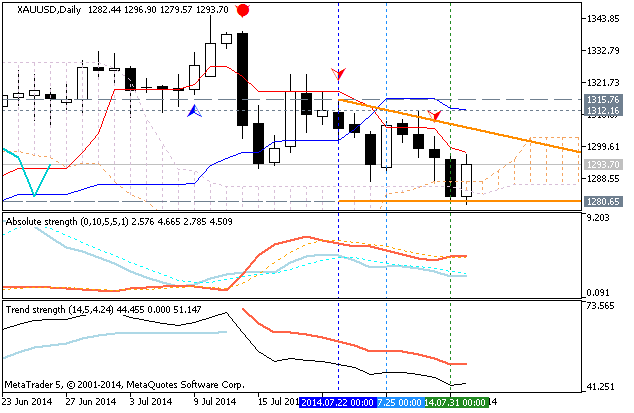
The gold markets as you can see fell during the course of the week, but overall found enough support just below the $1300 level to bounce and form something along the lines of a hammer. This hammer of course isn’t perfect, but it does tell us that the market still has a bit of a fight in it as far as keeping somewhat afloat. Ultimately, we believe that the market has back towards the $1350 level, and as a result we have no interest in selling. We think it could be choppy, but ultimately this market is fairly bullish.