What Drawdown Minimizer does not do: same equity, less load, and the price you pay

Out of drawdown #5 – the last parts explained where the money comes from (the savings book) and what it is spent on (the oldest loser, slice by slice). Before anyone switches off dry run, one part has to be clear: what this tool does not do. It is easy to read past it on a product page, so here it is in one place.
It does not make the loss smaller
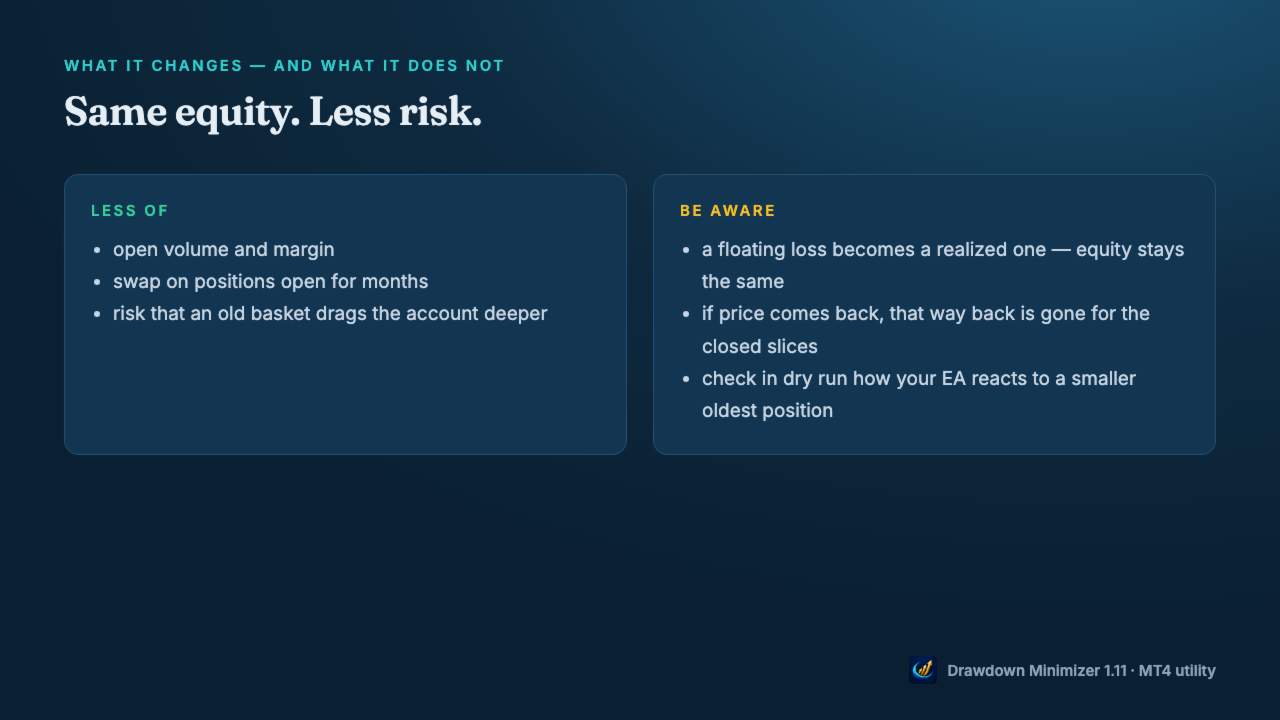
When Drawdown Minimizer closes a slice of an old losing position, the loss of that slice is not reduced. It is booked. A floating loss becomes a realized one.
That is why your equity stays the same when a slice is closed, apart from slippage. Equity already contains the floating loss. Closing the position only moves that number from "open" to "closed". The balance goes down by the same amount, and it grows more slowly than it would without the tool, because part of the new profit is used to pay for old losers.
A short illustration (example numbers, not a result): equity 10,000, one old position with an open loss of −300. The tool closes it with saved profit. Afterwards the balance is 300 lower, the open loss is gone, and equity is still about 10,000.
So the tool does not turn a loss into a profit, and it does not predict the market. Both product pages say it in the same words: it pays old losses off with money the account has already earned.
It does not create money
The savings book from part 3 is a counter, not a separate account. Saved, Spent and Available are calculated from the deal history. The money stays on your balance and stays at risk. Nothing is put aside where a bad week cannot reach it.
If the book drops below what was already spent – for example because the account had losing trades – the tool spends nothing until money has been earned again. Deposits, withdrawals, bonus and credit never count. A deposit does not buy you a faster reduction.
It does not touch everything that is red
Only losing positions of the EAs you name are candidates – by magic number, magic range or comment text. Winners are never closed. Positions of other EAs and your manual trades are never closed. And the tool never opens a trade.
It also does not steer your grid EA. The grid EA keeps running as before. That is exactly why its reaction matters: some grid EAs calculate the next level from the open volume, and on MT4 the rest of a partly closed position gets a new ticket. Both product pages ask you to check this in dry run before any real close.
What does change: the load
If equity stays the same, why do it at all? Because equity is only one number. What changes is what the account carries:
| Before a close | After a close |
|---|---|
| Open volume of the old position | Less open volume |
| Margin for that volume | Less margin used |
| Swap every night on that volume | No more swap on the closed volume |
| The old basket can drag the account deeper | Smaller chance that it does |
Part 2 showed why this matters: a stuck basket costs swap every night and blocks margin for weeks or months. That cost does not show up in a single equity snapshot, but it adds up.
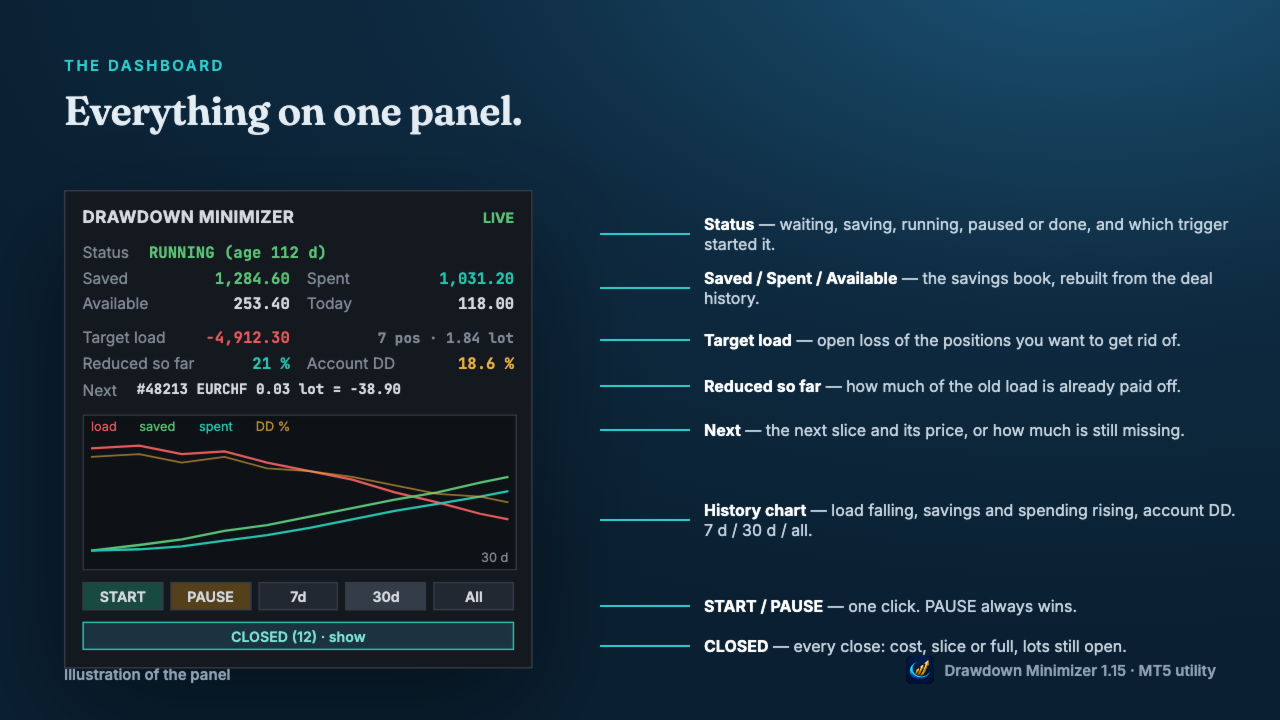
On the panel you see this as Target load – the open loss of the positions you want to get rid of – and Reduced so far. In the history chart the red load line should fall over time while saved and spent rise. Account DD is shown next to it, so you can see that the reduction does not jump your equity up. It only means less is left to go wrong.
The price: the way back is gone
This is the honest part. If the market would have come back, that way back is gone for the closed slices. A position that is closed cannot recover. If you had held the old basket and price returned to its entry, the loss would have disappeared without spending anything. With the tool, that part was paid with real profit.
Nobody knows in advance which of the two happens. Drawdown Minimizer does not try to guess. It is a decision you make in the settings:
- Which positions: only the EAs you list, and with Min position age (days) only positions that are old enough.
- When: a trigger by age of the oldest position, by account drawdown, or the START button. PAUSE always wins.
- How fast: Max spend per day, Min seconds between closes, and Close mode Slices or Whole.
If you believe the old basket will come back soon, do not start the reduction. If it has been sitting there for months and paying swap every night, the trade-off may look different.
Start in dry run
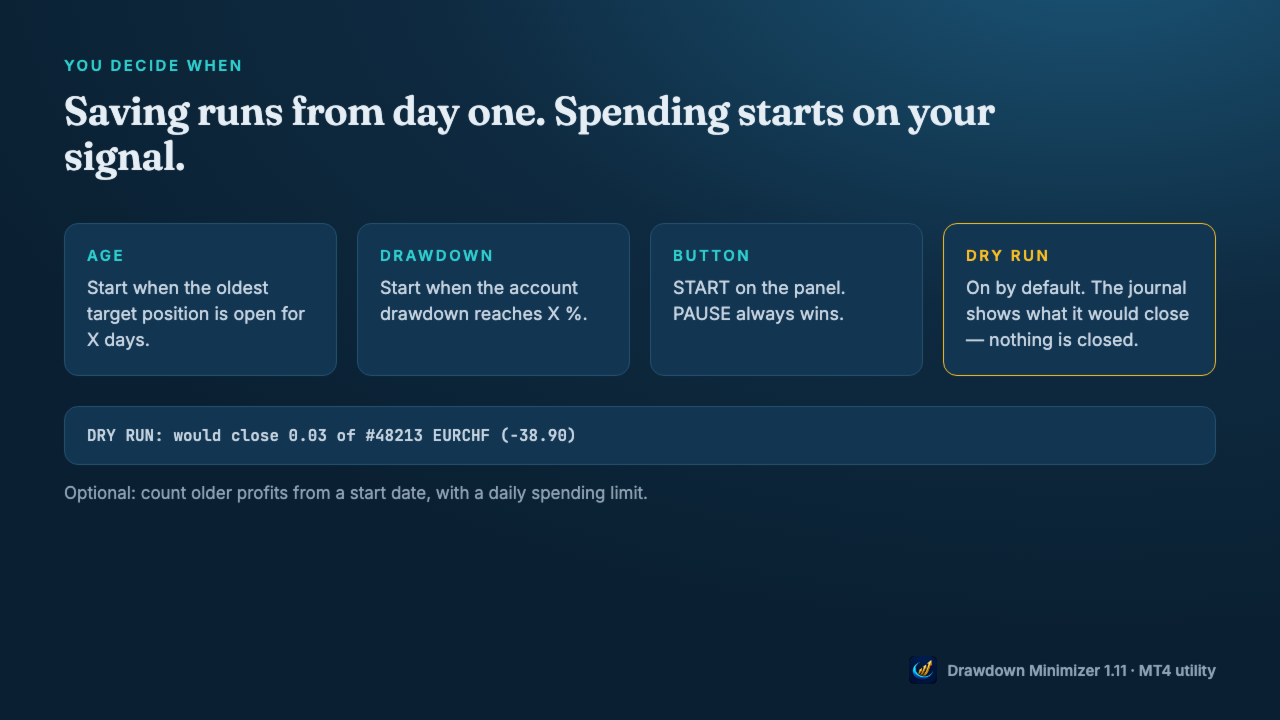
Dry run is on by default. The journal only shows what would be closed, for example "DRY RUN: would close 0.03 of #48213 EURCHF (-38.90)". Nothing is closed. Watch it for one or two weeks, check which positions it would pick and how your grid EA behaves, and only then set Dry run to false.
Part 6 shows the setup in four steps, with the video.
Complete guide: https://www.mql5.com/en/blogs/post/778023
Drawdown Minimizer MT5: https://www.mql5.com/en/market/product/201728