The Recovery Trap: Why Traders Increase Size After a Drawdown Trigger — COPYLATOR – MT5 Trade Copier

Product link:
https://www.mql5.com/en/ market/product/191385
A drawdown trigger can create a powerful emotional reaction. Copying is blocked, positions may have been closed, and the account balance is smaller than it was before. The trader is left looking at a loss and thinking about one thing: recovering it as quickly as possible.
The mechanism many traders reach for is position size. If the account has lost 15%, increasing the lot size may appear to offer a faster route back to the previous balance.
The arithmetic behind that idea is not entirely wrong. Larger positions can produce larger gains. But they also produce larger losses, and increasing exposure immediately after a drawdown can turn a manageable setback into a much more serious problem.
This is the recovery trap: responding to a period of losses by increasing the very risk that made the account vulnerable in the first place.
The Arithmetic That Feels Right
Consider an account that starts with $10,000 and loses 15%.
- Starting balance: $10,000
- Loss: $1,500
- Remaining balance: $8,500
- Amount required to return to $10,000: $1,500
A trader may reason that increasing the position size by 50% will make recovery faster. If the strategy produces gains, the larger positions can indeed generate larger dollar profits.
But the same increase applies to losses. If the strategy continues to experience unfavorable trades, a 50% larger position size can make the next losing sequence significantly more damaging.
There is another important detail: recovering a percentage loss requires a larger percentage gain than the original loss. An account that falls from $10,000 to $8,500 needs a gain of approximately 17.65% on its remaining balance to return to $10,000.
Increasing position size does not remove that mathematical challenge. It simply increases the account's exposure while attempting to overcome it.
The Buffer That Gets Smaller
After a drawdown, the account has less capital available to absorb additional losses.
For example, consider a hypothetical 15% additional loss measured against the account's current balance:
- At $10,000, a 15% loss equals $1,500.
- At $8,500, a 15% loss equals $1,275.
The percentage is identical, but the amount of money available to absorb the loss is smaller.
Now consider what happens if the trader also increases position size. A market movement that previously produced a 5% account loss could produce a larger percentage loss under the new sizing, assuming comparable exposure and execution conditions.
The account therefore faces two disadvantages at once: a smaller capital base and potentially greater exposure relative to that capital.
This is why recovery calculations should never consider only the potential speed of making money. They must also account for the possibility of another losing sequence.
Why the Next Drawdown Can Arrive Faster
Imagine that a strategy has entered a losing phase. Its drawdown protection reaches the configured threshold and blocks further copying.
The trader resets the protection, increases the lot multiplier, and resumes trading without first determining why the drawdown occurred.
If the losing conditions continue, the larger positions can consume the remaining risk budget more quickly. The next drawdown trigger may arrive after fewer unfavorable trades than it would have under the original sizing.
The exact outcome depends on the strategy, trade sequence, position sizes, account equity, and execution conditions. There is no universal timetable for a second trigger. But the underlying risk is clear: increasing exposure after a loss reduces the account's ability to withstand another adverse period.
How the Recovery Spiral Develops
The recovery trap often develops through a repeating sequence:
- The account reaches its drawdown threshold.
- The trader resets the protection and resumes copying.
- The trader increases the lot multiplier to accelerate recovery.
- The strategy experiences another losing sequence.
- The larger positions produce a greater loss than they would have at the original size.
- The trader responds to the new loss by increasing exposure again.
Each decision is made with the intention of recovering faster. But the combined effect can be the opposite: less capital, greater exposure, and a smaller margin for error.
The strategy itself may not have changed. The trader's response to its drawdown has changed the account's risk profile.
Why Drawdown Protection Cannot Prevent the Recovery Trap by Itself
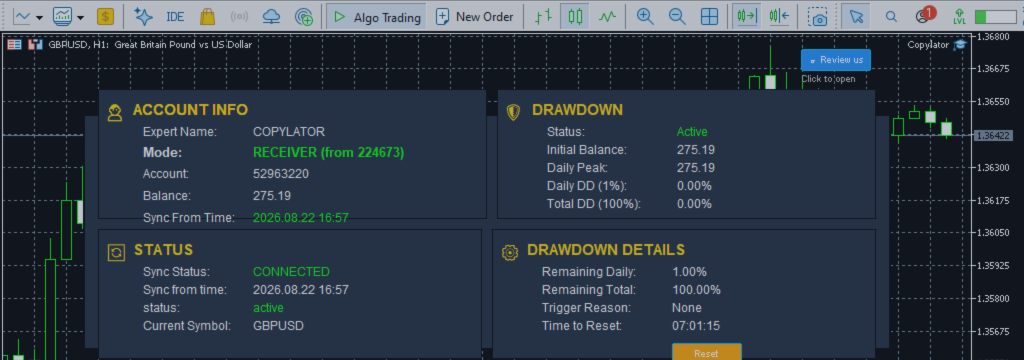
Drawdown protection is designed to respond to account-level risk conditions. Depending on its configuration, COPYLATOR can block further copying when a configured drawdown threshold is reached. It can also be configured to close open positions and delete pending orders.
However, drawdown protection does not decide what the trader should do after the trigger. It cannot independently prevent someone from resetting the protection, increasing the lot multiplier, and resuming with greater exposure.
This distinction is essential:
- Drawdown protection responds to configured account-risk thresholds.
- Lot management determines how copied positions are sized.
- Trading discipline determines whether the trader changes those settings responsibly after a loss.
A protection feature can work exactly as configured while the trader makes a separate decision that exposes the account to more risk.
It is also important to remember that a drawdown threshold is not a guaranteed maximum realized loss. Slippage, gaps, execution delays, and market conditions can cause the final result to exceed the configured level.
A Cooldown: Creating Space Before Resuming
One practical way to reduce impulsive decisions is to establish a mandatory waiting period after a significant drawdown trigger.
For example, a trader might decide not to increase position size or resume live copying immediately after a total drawdown event. Instead, the trader waits for a predefined period, reviews the trading history, and checks whether the original strategy and configuration remain suitable.
A waiting period of several days may help reduce the pressure to recover immediately. The appropriate duration depends on the strategy and the trader's circumstances; no single number is suitable for every account.
This should be understood as a trading-discipline procedure, not as a claim that COPYLATOR automatically enforces a built-in cooldown timer. The drawdown trigger, reset process, and any additional waiting rule should be managed according to the features and procedures actually available in the setup.
The purpose is simple: prevent an emotional reaction from becoming an immediate increase in financial exposure.
The Sizing Rule: Let Account Capital Guide Exposure
A more sustainable approach is to avoid increasing position size merely because the account has suffered a loss.
Where balance-ratio lot sizing is used, the receiver's position size can be calculated in relation to the relevant account balances. This can help keep copied exposure aligned with account size rather than relying on a fixed lot amount that may become disproportionately large as capital declines.
For example, if an account's balance falls from $10,000 to $8,500, a proportional sizing arrangement may reduce the corresponding lot size by approximately 15%, depending on the configured ratio and the balances used in the calculation.
This does not guarantee that the percentage risk per trade remains exactly unchanged. Actual risk also depends on stop-loss distance, instrument volatility, contract specifications, leverage, simultaneous positions, and execution conditions.
The important principle is that position size should be based on a defined risk model, not on the amount of money the trader wants to recover.
The Multiplier Rule: Do Not Increase It Under Pressure
Some traders adopt a simple discipline: the lot multiplier is not increased immediately after a drawdown.
Under this approach, the multiplier is selected during an initial calibration period and is reduced when necessary to reflect a more conservative risk plan. Any later increase requires a documented review rather than an emotional reaction to losses.
A trader might also require the account to recover to a previous equity high, demonstrate stable behavior over a meaningful sample of trades, and complete a predefined waiting period before considering an increase.
These conditions are examples of a personal risk-management policy, not universal rules. The key is to define the conditions in advance, when the trader is not under pressure to recover.
The False Recovery
One of the most dangerous versions of the recovery trap occurs when a larger position size initially appears to work.
Consider an account that falls from $10,000 to $8,500. The trader resets the drawdown protection and increases the lot multiplier by 30%.
The next several trades are profitable, and the account rises to $9,100. The trader concludes that the larger size was the correct decision because it accelerated the recovery.
But a short winning sequence does not establish that the new position size is sustainable. If the strategy returns to an unfavorable period, the larger exposure can produce a deeper loss than the original configuration would have produced.
This is a common reasoning error: judging a risk decision by its immediate result rather than by whether the decision was appropriate before the result was known.
A sound sizing policy must be evaluated across both favorable and unfavorable market conditions.
When Returning to the Original Size May Be Reasonable
There are situations in which restoring a previously used position size can be justified.
For example, suppose a temporary configuration error, incorrect symbol mapping, or broker-related issue caused an unusual loss. The problem is identified and corrected, and the trader has verified that the original strategy and risk assumptions remain valid.
In that case, returning to the previously tested position size may be reasonable after reviewing the account's current capital and exposure.
But restoring the original size is different from increasing beyond it simply to recover faster. The decision should be based on the corrected configuration and current account conditions, not on the emotional impact of the loss.
Keep a Record of Every Position-Size Change
The recovery trap can be difficult to recognize when each decision is viewed separately. A simple record makes the pattern easier to identify.
For every change in lot size or multiplier, record:
- The date of the change.
- The account balance and equity at the time.
- The previous and new lot multiplier.
- The reason for the adjustment.
- Whether the change followed a drawdown trigger.
- The results of the subsequent review period.
If increases repeatedly occur immediately after drawdown events, the trader may be responding to recovery pressure rather than to evidence about the strategy.
Recording the reason for each adjustment creates accountability and makes it easier to distinguish planned risk management from emotional decision-making.
Summary
The recovery trap begins when a trader responds to a drawdown by increasing position size in an attempt to recover faster.
Larger positions can produce larger gains, but they also increase losses. After a drawdown, the account already has less capital available to absorb unfavorable trades. Increasing exposure at that point can make the next trigger arrive sooner and make the resulting loss more damaging.
Drawdown protection can block copying and, when configured, close positions and delete pending orders. But it cannot prevent a trader from resetting the protection and increasing the lot multiplier afterward.
The practical defenses are disciplined reset procedures, a waiting period before resuming after a major loss, balance-aware lot sizing, careful control of multiplier changes, and a written record of every adjustment.
The objective after a drawdown should not be to recover as quickly as possible. It should be to preserve enough capital to allow a properly evaluated strategy to continue operating.
A drawdown trigger is a warning to review risk, not a signal to increase it.
Product link:
https://www.mql5.com/en/ market/product/191385