An arrow that does not lie: how I built a non-repainting signal and checked it on 20,458 bars

Most arrow indicators look great on history and poor in real time, for one reason: the arrow is drawn on a bar that has not closed. Price touches a level, an arrow appears, the bar closes back, and the arrow is gone. History keeps only the arrows that "guessed right".
In the update of my free indicators Swing Structure ATR 2.40 and Gold Session Cost Panel 1.11 I added a simple BUY / SELL / WAIT verdict. My condition: the arrow must be honest, and a test has to prove it. Along the way I hit a rarely discussed trap: for a few weeks a year, the broker's clock, New York and London disagree by an hour.
Why an arrow must wait for the bar close
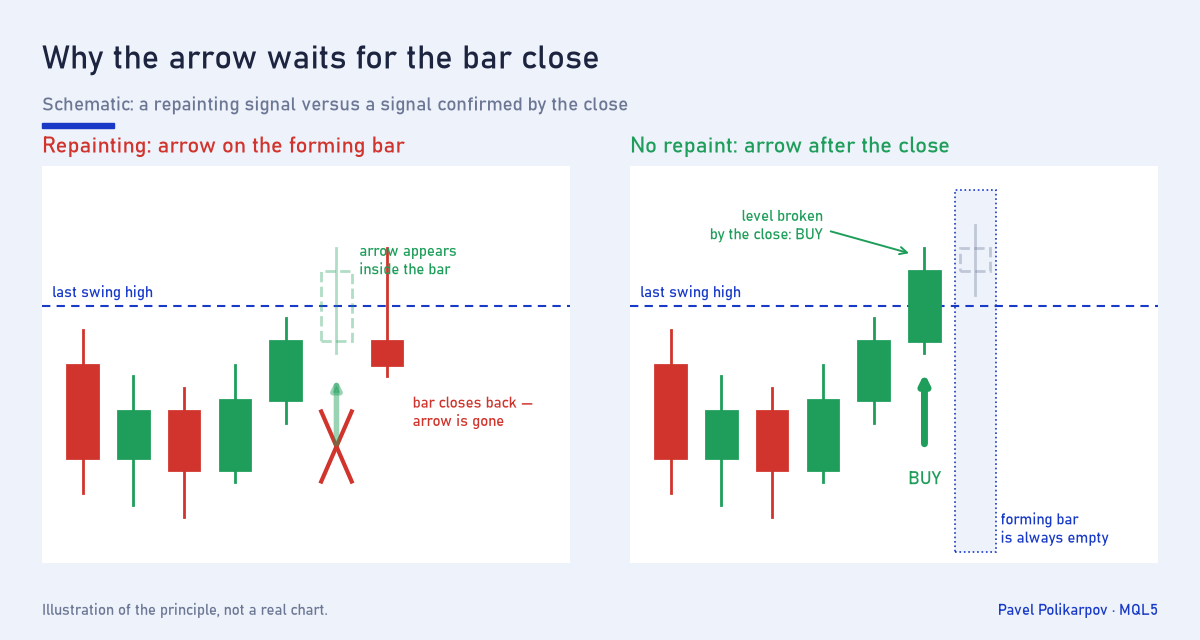
While a bar is forming, its high, low and close are unknown. A signal calculated from the current price changes its mind on every tick. Typical symptoms:
- the arrow blinks inside the bar;
- after the close the arrow disappears or jumps to the next bar;
- the tester shows a beautiful history, and the live chart looks different.
Swing Structure ATR 2.40 follows a strict rule:
- Swings and structure are calculated from closed bars only.
- A BUY arrow is placed on the bar whose close confirmed a bullish change of character (CHoCH). A SELL arrow goes on the bar that confirmed a bearish one.
- The forming bar is always empty.
- Once placed, an arrow is never moved or removed.
- Trend continuation (BOS) gets a small mark, not a new arrow, to keep the chart quiet.
The price of honesty is simple: the arrow appears after the close, not at the exact extreme. In return, what you see on history is what you would have seen live.
How I tested it: 20,458 bars, 0 mismatches
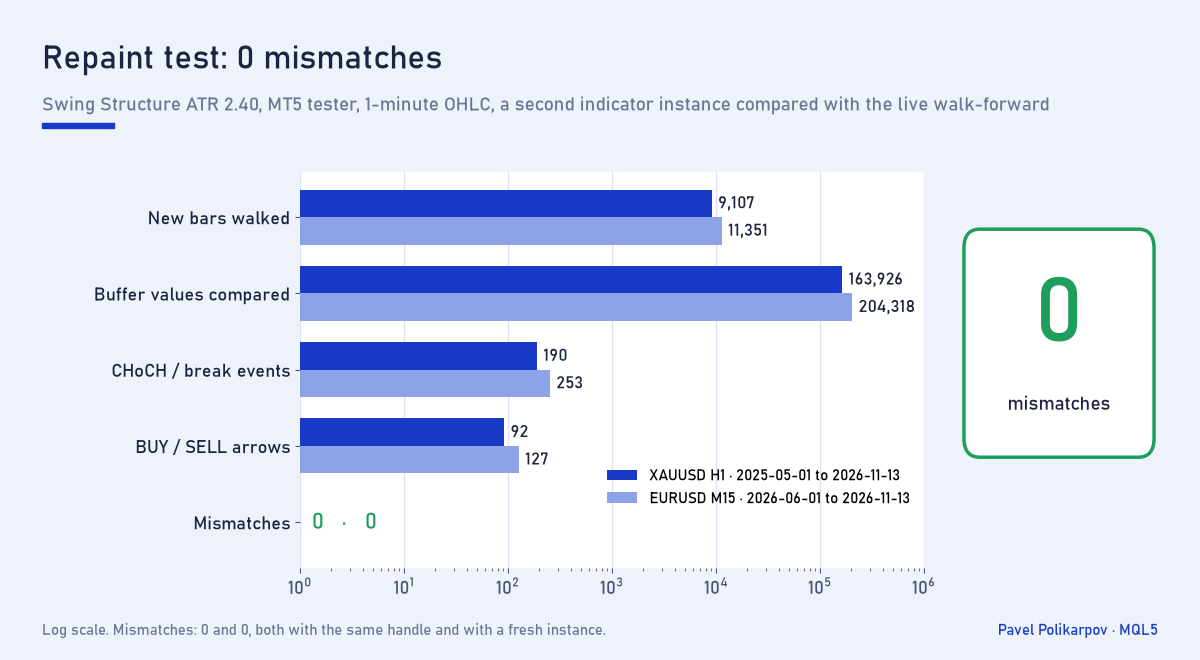
Almost every description says "no repaint", so I tested it. The MT5 tester walked bar by bar in 1-minute OHLC mode. On every new bar a script checked that the forming bar was empty. At the end, a fresh instance of the indicator calculated the whole history at once, and its values were compared with what the indicator had shown during the live walk.
| Test | Bars | Values compared | Arrows | Mismatches |
|---|---|---|---|---|
| XAUUSD H1, 2025-05-01 to 2026-11-13 | 9,107 | 163,926 | 92 | 0 |
| EURUSD M15, 2026-06-01 to 2026-11-13 | 11,351 | 204,318 | 127 | 0 |
The forming bar never had a value, and there were no mismatches with either instance. 92 arrows in eighteen months of gold H1 is roughly one a week. The indicator does not spray signals, because an arrow needs a change of structure.

What else was fixed in 2.40:
- Double break. If one bar broke both the last swing high and the last swing low, the old version kept only the second break. Now the structure goes neutral: admitting uncertainty is more honest than inventing a direction.
- An equal swing is no longer labelled LH or LL.
- Objects no longer pile up. Labels older than the bar limit are removed.
- Higher timeframe. If the chart is already on it, the panel now says so instead of silently dropping the levels.
Time: the trap everyone forgets
Now the bug I found while checking all my products.
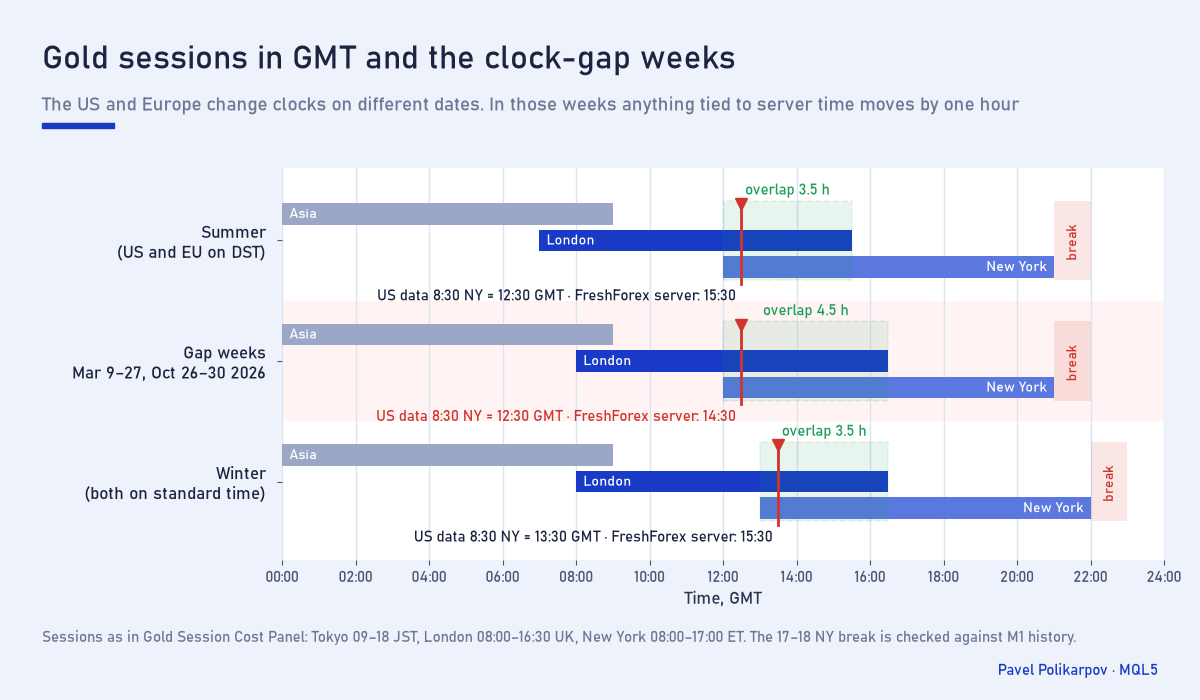
The US and Europe change clocks on different dates. The US moves to summer time on the second Sunday of March, Europe on the last one. In autumn Europe goes back on the last Sunday of October, the US on the first Sunday of November. In 2026 those gap weeks were March 9–27 and October 26–30.
My broker FreshForex runs its server on the European rule: UTC+3 in summer, UTC+2 in winter. In a normal week, US data at 8:30 New York time comes out at 15:30 server time. In a gap week it comes out at 14:30. If you are used to waiting for NFP at 15:30 on your terminal clock, you are an hour late.
You can see it directly in the broker's gold M1 history. The daily market break (17:00–18:00 New York) looks like this in server time:
| Week | Trading hours, server time |
|---|---|
| October 19–23, 2026 | 01:00 – 23:59 |
| October 26–30, 2026 (gap week) | 00:00 – 22:59 |
| November 2–6, 2026 | 01:00 – 23:59 |
Anything tied to server time shifts by an hour in those weeks: news windows, the Friday close, session countdowns.
What I fixed:
- Gold Session Cost Panel. London and New York summer time is computed in GMT, not from the broker's clock. The weekend status used to be fixed at 22:00 GMT and was an hour off on Fridays in summer and on Sundays in winter. Now it follows real gold market hours: Friday 17:00 to Sunday 18:00 New York time. That fix shipped in 1.11.
- Swing Structure ATR does not use clock time: structure is built from bars. It was fine.
- The Golden Sniper XAU expert advisor. The same bug shifted everything news-related by an hour in exactly those weeks. Version 3.1 reads server time with the European rule. The next gap week, March 15–26, 2027, includes the Fed meeting of March 16–17.
A tip: if your indicator or EA takes session times from TimeCurrent() and adds a constant, test it on a gap week. The error shows up right away.
What the spread really costs
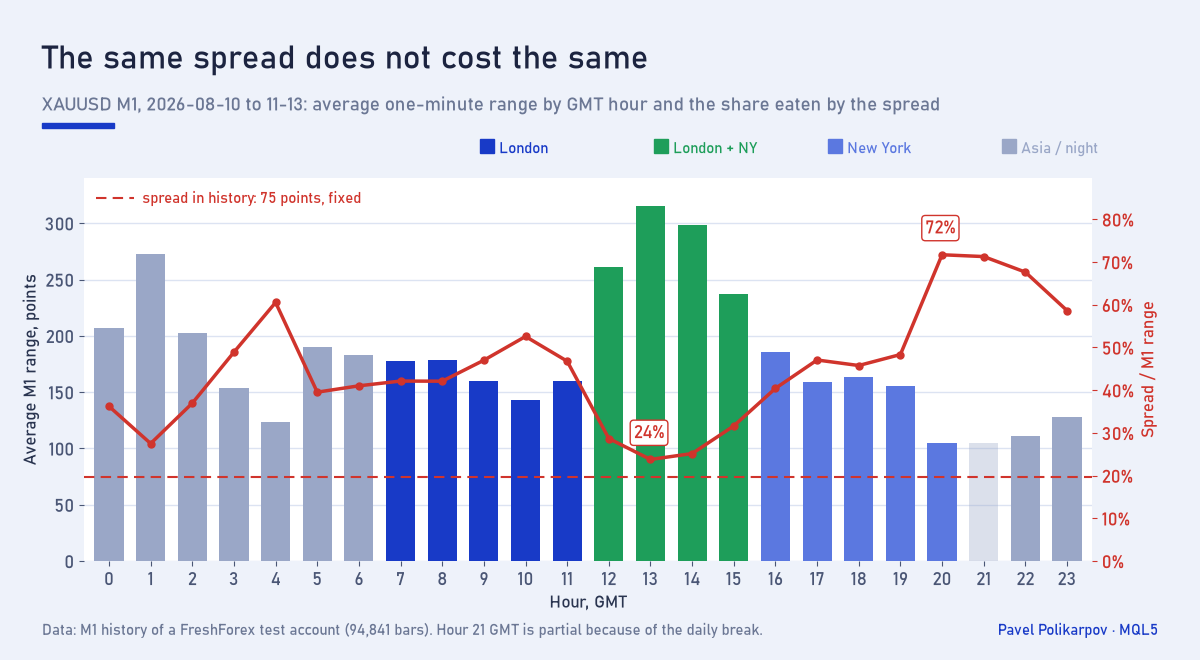
The other half of Gold Session Cost Panel is about cost. On my FreshForex test account the gold spread in M1 history is fixed at 75 points at every hour. So entry time should not matter? The chart says otherwise.
I measured the average one-minute XAUUSD range by GMT hour from 2026-08-10 to 11-13 (94,841 bars). In the London/New York overlap, around 13:00 GMT, a one-minute bar travels 315 points on average and the spread eats 24% of it. At 20:00 GMT, before the daily break, the bar travels 105 points and the same spread eats 72%. The spread is the same on paper, yet relative to the move it is three times more expensive.
On floating-spread accounts the gap is usually even wider. That is why the panel shows:
- the live spread tagged cheap / normal / expensive against its 24-hour average;
- the spread cost in your account currency for your lot size, not only for 1.00;
- long and short swaps and the triple-swap day;
- today's range against the 20-day average daily range (ADR). When the day has already covered most of its average range, chasing the move is risky;
- the next three high-impact news events with a countdown.
The panel's verdict uses an open rule. BUY when at least three of M15, H1, H4 and D1 point up on a closed bar against EMA(50), none points down, and the spread is not expensive. SELL in the mirror case. WAIT if the picture is mixed, the spread is expensive, or high-impact news is less than 30 minutes away. The trend tiles also use the closed bar, so they no longer flicker inside the forming candle.

Why my EA does not trade these arrows
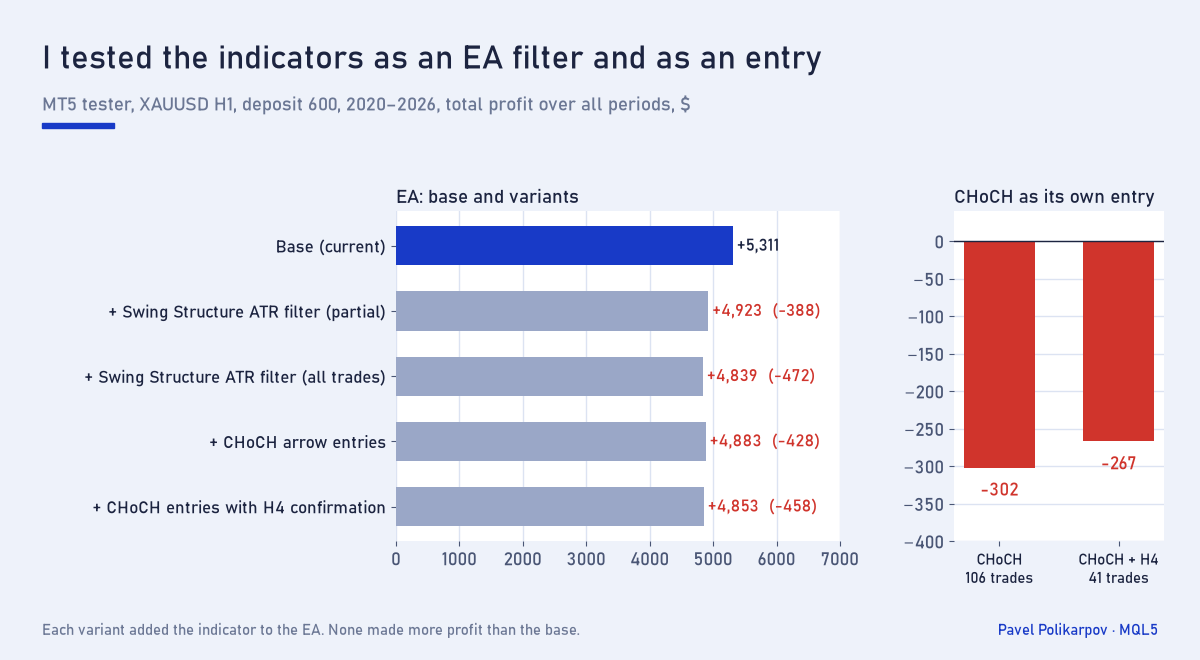
A fair question: if the indicators are that good, why does my Golden Sniper XAU EA not trade them? I did not answer "by design". I ran it through the tester instead: XAUUSD H1, deposit 600, 2020–2026, 28 runs.
Gold Session Cost Panel as a filter. Of the EA's 341 trades (244 in 2024–25 and 97 in 2026), none was opened against the panel's higher-timeframe verdict. Requiring full agreement, however, would remove 123 of the 341 trades and about $1,296 of profit. Most of the profit comes while the panel shows WAIT. That makes sense: some of the EA's trades enter on pullbacks, before the higher timeframes line up.
Swing Structure ATR as an entry filter. PF rises from 3.21 to 3.40, which looks great. But total profit over all periods falls by $389–473, and the 2024–25 relative drawdown rises from 19.4% to 23.8%. The filter throws away good trades along with bad ones.
The CHoCH arrow as a standalone automated entry. Over 2020–2026: 106 trades, −$302. With H4 confirmation: 41 trades, −$267. A close-confirmed structure break comes too late for automated entries on gold H1: by the time the hourly bar closes, part of the move is already gone.
The takeaway: an indicator that is honest and useful for reading the chart is not automatically an edge for a robot. I tested it before adding it to the EA, and I did not add it. The arrow stays what it was built to be: context for a manual decision.
Summary
- Swing Structure ATR 2.40: BUY/SELL arrows on closed bars only, 0 mismatches on 20,458 bars of two symbols.
- Gold Session Cost Panel 1.11: BUY / SELL / WAIT verdict, correct time in the gap weeks, spread cost for your lot size.
- Both indicators are free, in English and Russian, with no DLLs and no web requests.
Ideas for the next version are welcome in the comments.
Trading involves risk. Charts and screenshots show historical data, not trading results.
The gold EA mentioned in this article: Golden Sniper XAU