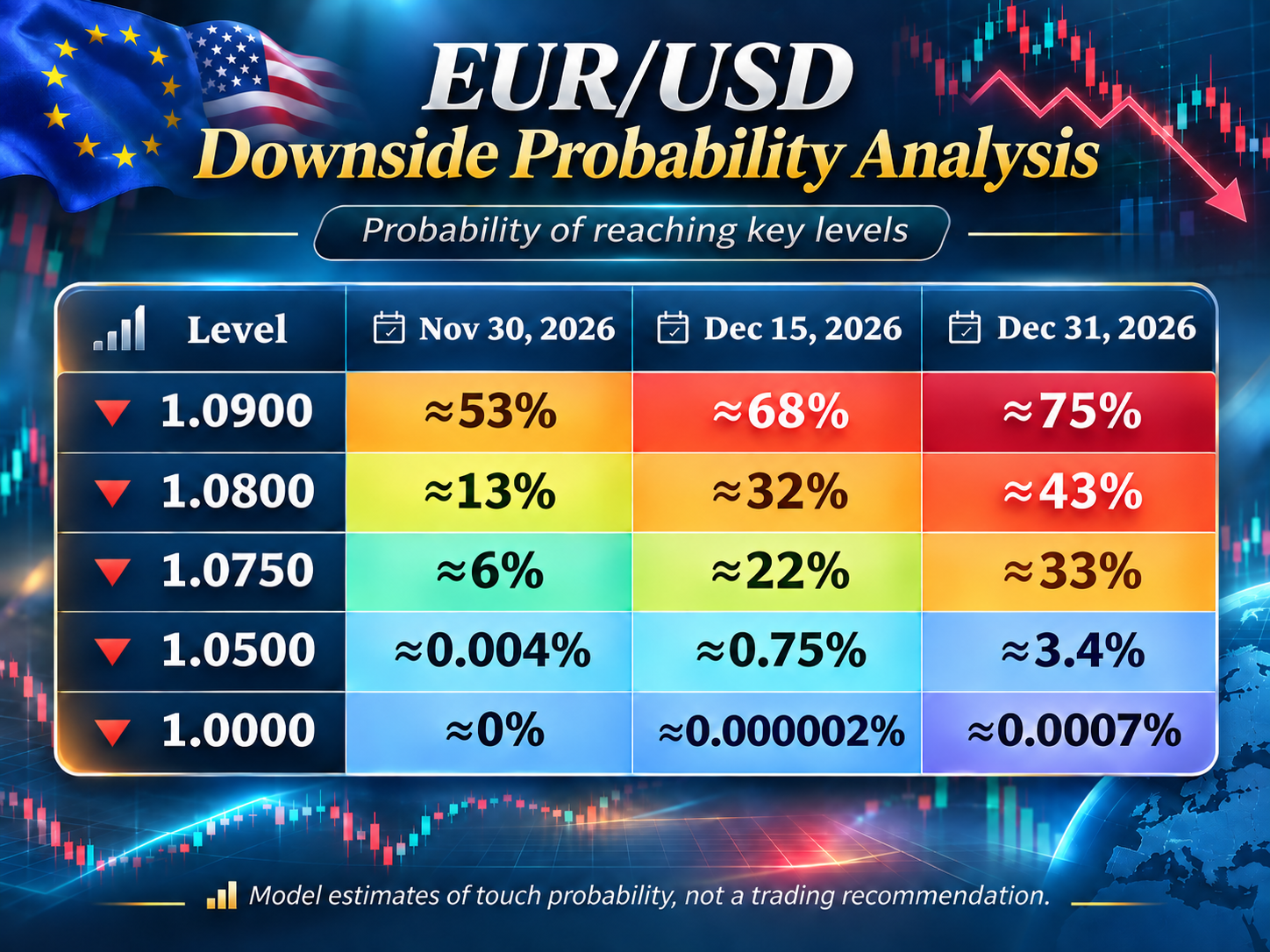
Mathematical modelling can help estimate the probability of EUR/USD reaching key price levels over different time horizons, taking into account the current exchange rate and market volatility.
📊 Probability of Reaching Key Levels:
🔹 1.0900: 30 November – 53%, 15 December – 68%, 31 December – 75%.
🔹 1.0800: 30 November – 13%, 15 December – 32%, 31 December – 43%.
🔹 1.0750: 30 November – 6%, 15 December – 22%, 31 December – 33%.
🔹 1.0500: 30 November – 0.004%, 15 December – 0.75%, 31 December – 3.4%.
🔹 1.0000: 30 November – ≈0%, 15 December – ≈0.000002%, 31 December – ≈0.0007%.
📌 Key Findings
🔹 1.0900 and 1.0800. These are the most likely downside targets, with probabilities of reaching them by the end of December estimated at 75% and 43%, respectively.
🔹 1.0750. The probability of reaching this level by year-end is approximately 33%. Whether this scenario materialises will largely depend on the continuation of the downward trend in December.
🔹 1.0500. The probability of reaching this level by 31 December is just 3.4%, or roughly one chance in thirty. Such a decline would most likely require a significant acceleration in downward momentum and an increase in volatility.
🔹 1.0000 (parity). Under the model's current assumptions, the probability of falling to this level before year-end is practically zero.
📈 Conclusion
The mathematical model indicates a substantial difference between the probability of moderate euro weakness and a sharp decline in EUR/USD. The 1.0900–1.0800 levels remain realistically attainable, while the probability of falling to 1.0500, let alone parity, is extremely low.
It should also be noted that the model may underestimate the probability of extreme market movements. Taking real-world market characteristics into account, the probability of reaching 1.0500 by the end of December could be closer to 4–6%, rather than 3.4%.
⚠️ The figures represent model-based estimates of the probability of touching the specified levels at least once by the respective dates. They are neither forecasts of the exchange rate on particular dates nor trading recommendations.